Typed outputs are the reason to choose Pydantic AI
Pydantic AI v2.46.0 makes the most sense when an agent has to return data that the rest of a Python application can trust. An output type can be a Pydantic model, and function annotations become the schema used for tool arguments. Dependencies travel through a typed run context. That keeps validation beside ordinary application code instead of burying it in prompt instructions. If your team already treats Pydantic models as contracts at API boundaries, the agent layer feels familiar.
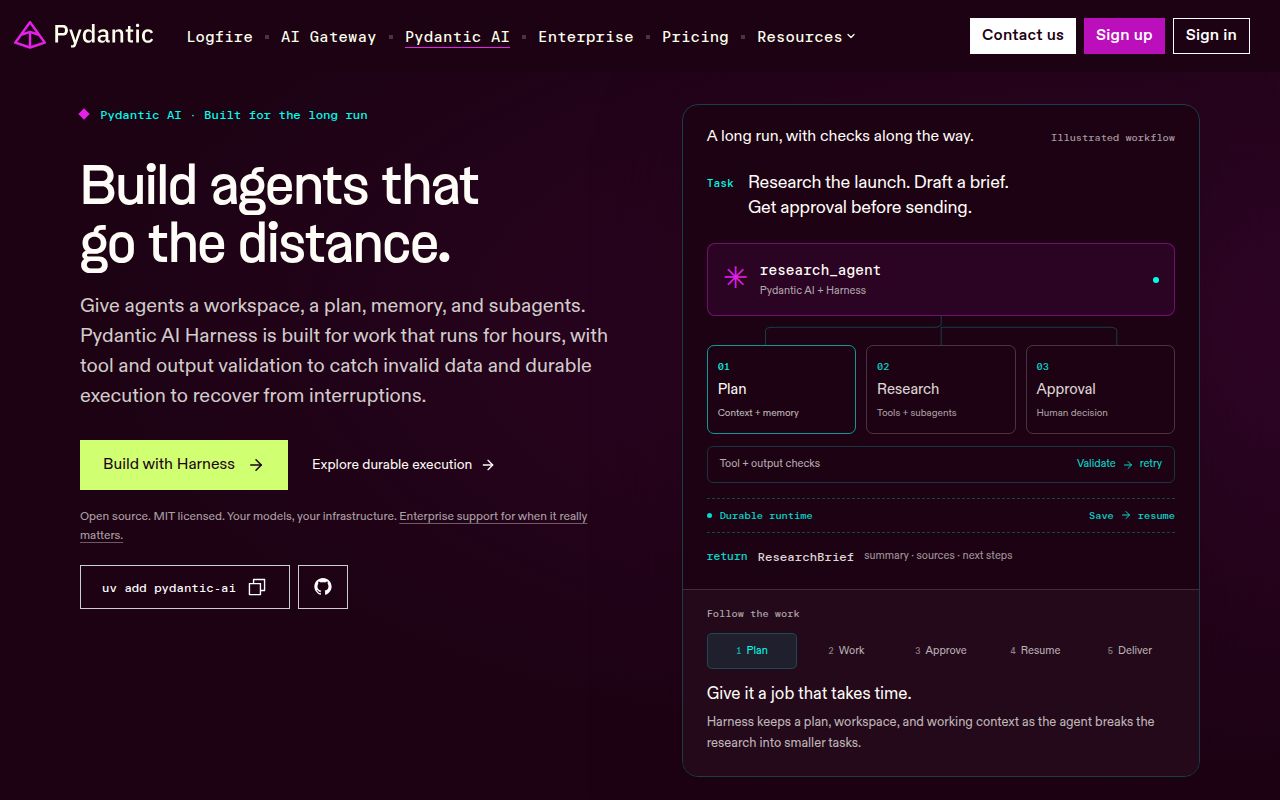
The library now covers much more than a typed chat loop. The README describes CLI and web interfaces, realtime voice, image generation, embeddings, MCP, OpenTelemetry instrumentation, and durable execution through 7 engines. Pydantic Graph and Pydantic Evals are separate packages for control flow and behavioral tests. That breadth is useful when one agent must move between an HTTP request and a background queue. It also means adopting the whole stack is a larger decision than adding one model SDK.
Seventeen provider families share one agent interface
The current provider guide lists 17 named families, including OpenAI, Anthropic, Gemini, Bedrock, Mistral, Ollama through an OpenAI-compatible path, and several others. A string such as openai:gpt-5.2 selects a model class, provider, and profile. The profile records differences such as tool support and accepted JSON Schema features. Swapping that string is convenient, but applications should still test the exact provider and model combination they plan to ship.
That warning has a concrete example. Open issue #8525 reports that Pydantic AI 2.42.0 could produce a mixed thinking history that DeepSeek rejected through a generic OpenAI-compatible endpoint. The report includes a workaround and a proposed fix. Release v2.46.0 also fixed Bedrock tool-choice handling and gateway IDs misclassified as OpenAI o-series models. A shared interface reduces rewriting; it cannot erase differences in vendor request formats.
What happened when we ran it
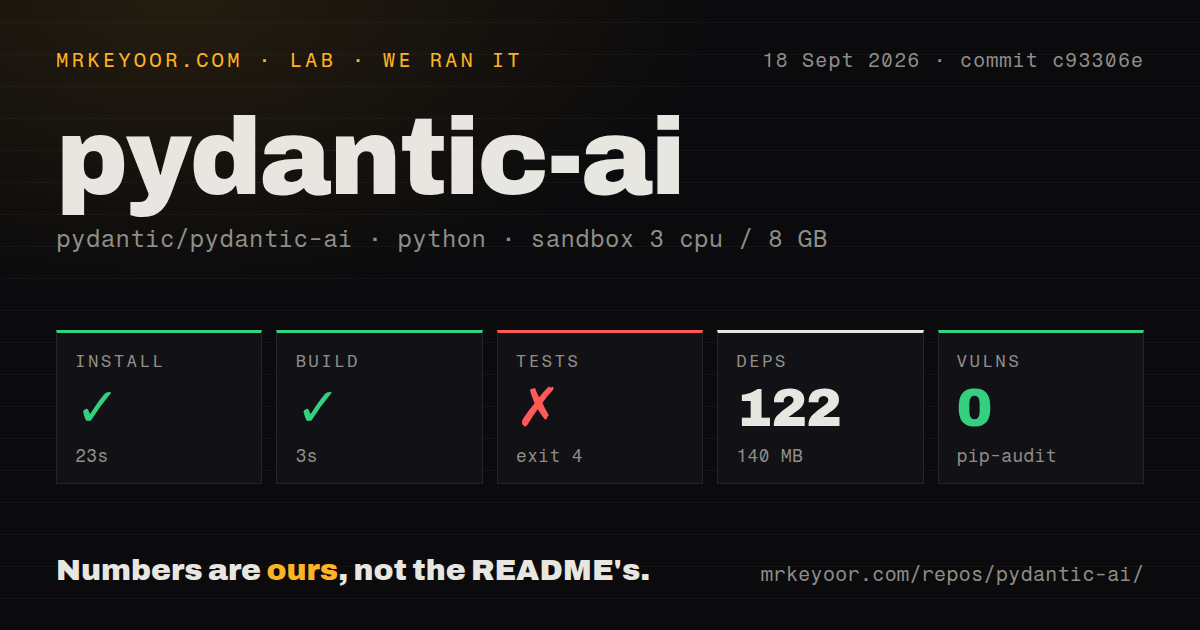
Our run at commit c93306e installed 122 packages in 23 seconds and occupied 140 MB. The build completed in 3 seconds. Pip-audit reported 0 known vulnerabilities in the installed environment. Our measurement setup was an unprivileged Debian container with 3 CPUs, 8 GB of RAM, Python 3.12, and no secrets, so these results cover repository setup rather than a paid model call.
The test command failed with exit code 4 after 2 seconds, before collecting the suite. The final log says tests/conftest.py imported MockerFixture, then Python raised ModuleNotFoundError: No module named 'pytest_mock'. That log establishes the missing module and nothing more. It does not show whether the checkout metadata, the install command, or another setup choice should have supplied it, so we would not call the repository tests passing on this setup.
The source checkout itself was substantial: 2,807 files, roughly 529,708 lines of source, and 264.9 MB. We found 33 CI workflow files and a tests directory, but no Dockerfile. Those numbers explain why the 3-second build is only part of the contributor experience. They also make the missing test dependency worth fixing or documenting, since a new contributor can reach the test command quickly and still stop before one test runs.
The slim package is the sensible production default
The regular pydantic-ai install includes libraries for 3 major hosted providers plus the CLI, MCP, evals, web UI, and Logfire integrations. That convenience produced 122 installed packages on our box. Teams that know their provider should start with pydantic-ai-slim and add only the matching extras. It gives up the everything-ready default in exchange for a dependency set that better matches the service being deployed.
Container work needs one detail that is easy to miss. Pydantic AI requires Python 3.10 or newer, and its own HTTP requests use the operating system trust store. A minimal image may need the ca-certificates system package, while a corporate proxy may require its private root certificate. Since the repository has no Dockerfile, your team owns that base image, certificate setup, provider credentials, and any local model process.
Two local model doubles make agent code testable
The testing guide provides 2 local stand-ins: TestModel generates schema-valid data and calls registered tools, while FunctionModel lets a test decide the response and tool arguments. Agent.override can replace the production model, and ALLOW_MODEL_REQUESTS=False blocks accidental calls to non-test models. These are good seams for checking application control flow without spending tokens or accepting network variability in every unit test.
Neither stand-in reproduces a provider. The guide says TestModel uses procedural Python and cannot emulate provider-executed native tools. A sensible suite therefore has two levels: fast local tests for tool routing and output validation, then a smaller set against the exact hosted or local model used in production. The failed repository test run is separate from that application-testing advice; it concerns developing this checkout at commit c93306e.
Same-day releases show activity and adapter churn
GitHub showed 20,035 stars and 918 open issues and pull requests when fetched on September 19, 2026. The last push was that same day, and release v2.46.0 was published on September 19. Recent issue and pull request updates were also arriving within hours. This is plainly maintained software with a large user and contributor queue, not a quiet package that changes twice a year.
Fast maintenance is necessary for this job. Open issue #8535 records a latest-dependency canary failure after AG-UI changed a type and OpenAI added model names that the known-name list lacked. The report says the v2.46.0 release itself was unaffected. That distinction matters: the maintainers are catching upstream drift, while buyers still need version pins and provider-level regression tests. Pydantic AI is a strong fit for typed Python agent systems, provided your team treats its adapters as active dependencies rather than invisible plumbing.