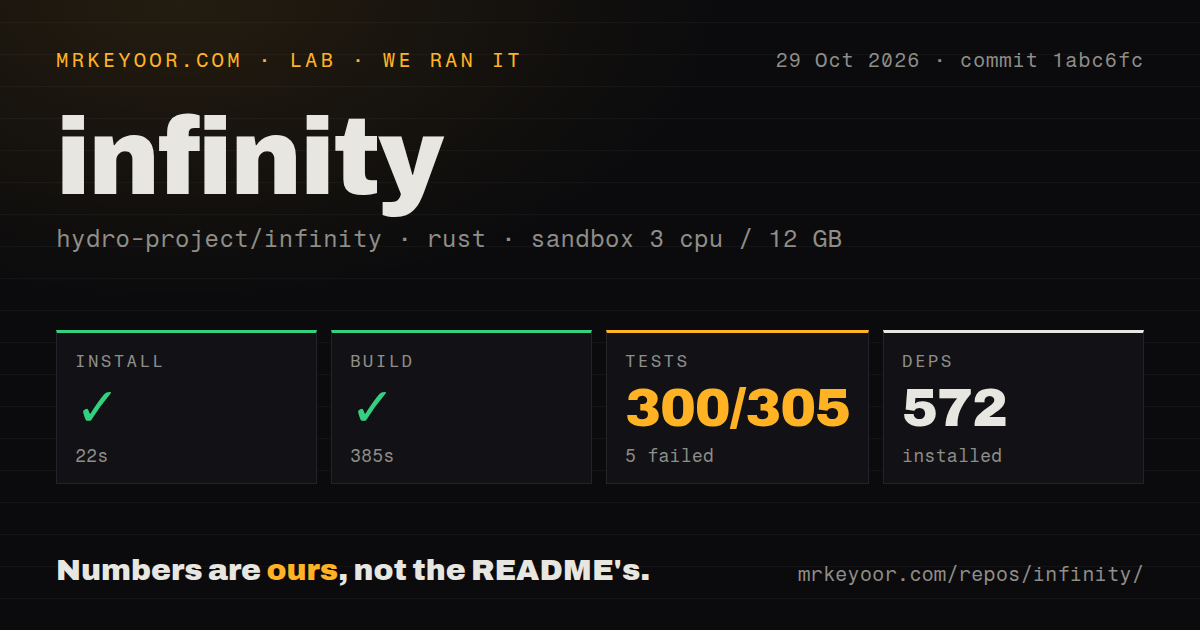
Hydro Project Infinity built successfully in our sandbox, but five tests failed. For a Rust team evaluating agents that wait on external tools, that leaves two questions: does the runtime's message-based design fit the application, and does the intended workflow work at the chosen revision?
Why the waiting model matters
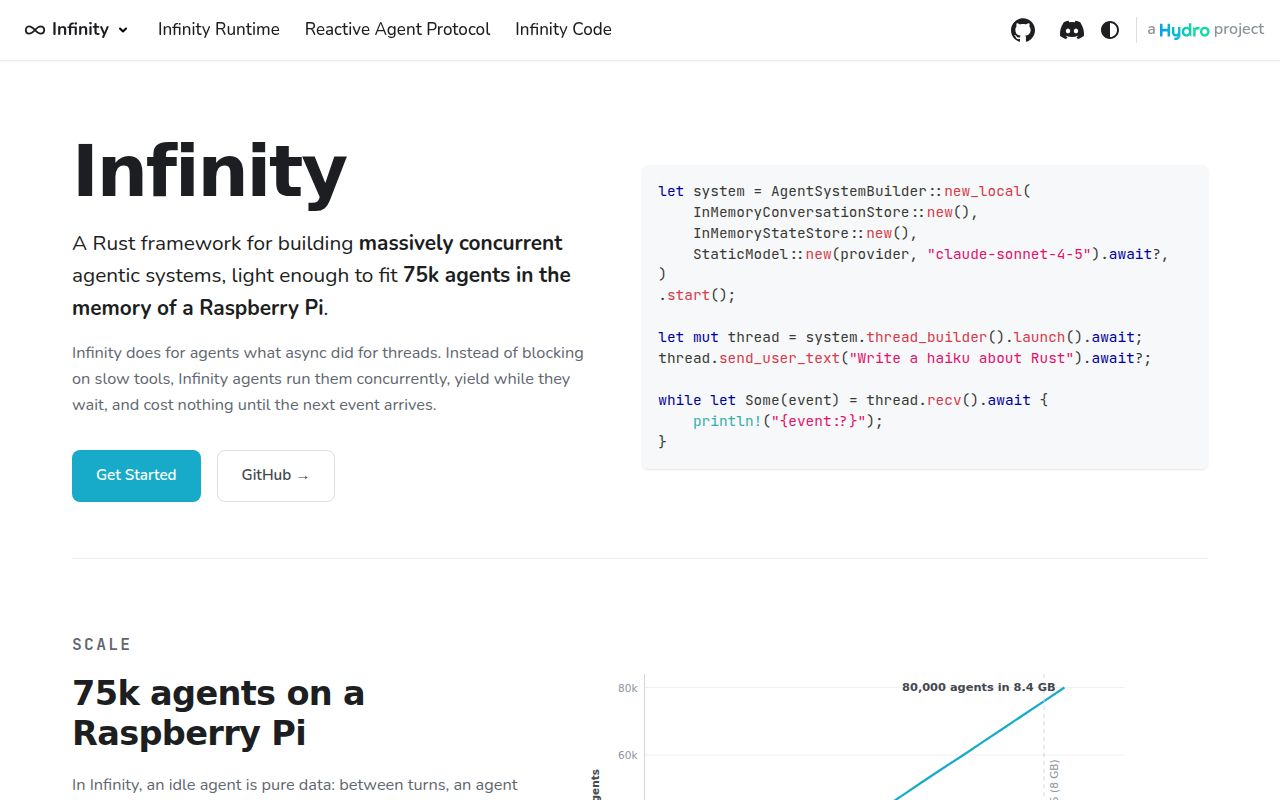
The README describes agents that yield while tools run and resume on the next message. Between turns, it describes conversation data without a running task, stack or open connection. These are upstream design claims; our run did not measure waiting-agent memory or concurrent capacity.
The architecture guide explains how messages connect that lifecycle. A slice loads conversation history and processed-message IDs from storage, prepares incoming messages, requests a model completion and dispatches work. RAP tool results return as later messages. Synchronous tools can execute within the slice, so yielding is not the path for every tool call.
For an application developer, the useful consequence is that storage and message delivery are part of the execution model. A successful source build alone does not verify those paths with your provider and tools.
What happened when we ran it
Our October 29, 2026 run used commit 1abc6fc. Installation succeeded in 22 seconds, and the build succeeded in 385 seconds. The record lists 572 dependencies. Tests exited 101 after 580 seconds, with 300 passed and 5 failed out of 305.
The supplied log tail identifies the sandbox-local test target bookmark_moved_externally and gives the rerun arguments -p sandbox-local --test bookmark_moved_externally. It does not include the failing assertions or underlying error messages. The cause remains unknown; the target name does not establish an operating-system problem, a missing dependency or a product defect.
The recorded configuration was 3 CPUs, 12 GB RAM and image lab-rust:1. The checkout contained 563 files, approximately 68,180 source lines and 7.5 MB of source. Those figures do not measure installed disk usage or agent memory. The scan found four CI workflow files and reported no Dockerfile or tests directory. The absence of that directory did not mean there were no executable tests.
This run did not establish model quality, authenticated provider access, MCP compatibility, AWS deployment or a completed coding task.
Evaluate the runtime and coding workflow separately
The README distinguishes Infinity Runtime, Reactive Agent Protocol and Infinity Code. It describes Infinity Code as running builds and tests in the background, editing through parallel threads with stacked sandboxes, and returning diffs for review. We did not reproduce that coding workflow.
The sandbox-local failures deserve investigation before adopting a tool built around sandboxes. They do not establish that every runtime operation fails. Use a disposable repository for the first coding trial and inspect the resulting diff.
The README says existing MCP servers run through a compatibility layer. Treat that as a compatibility claim to verify with the server you intend to use, including its authentication and error handling. The introductory provider-and-in-memory-store example is documentation only here; it was not executed as an agent conversation in our run. The linked AWS Lambda route likewise remains unverified by this evaluation.
Check provider access before the first conversation
The supplied issues listing includes an October 27, 2026 report that accounts without the hardcoded default model cannot complete a first run. That report is a reason to check model availability for the chosen provider account. It does not explain our sandbox-local test failures, and the supplied listing does not establish a fix.
The supplied release lookup resolved to sandbox-remote-v0.2.0, dated October 22, 2026. That is a component-specific release, not evidence that the whole framework passed our tests. The tested checkout remains commit 1abc6fc.
Choose the first trial by the requirement
Rig describes a Rust library for building LLM applications, alongside a terminal coding agent. Its library is another starting point when model integration is the immediate requirement. LangGraph describes a framework for long-running, stateful agents, making it another option to examine for orchestration. These are scope comparisons from their READMEs, not performance or reliability rankings.
For Infinity, first verify a complete conversation with the chosen provider and a representative external tool. Then investigate the failing sandbox-local target before relying on Infinity Code. Evaluate AWS deployment separately if the application needs it.