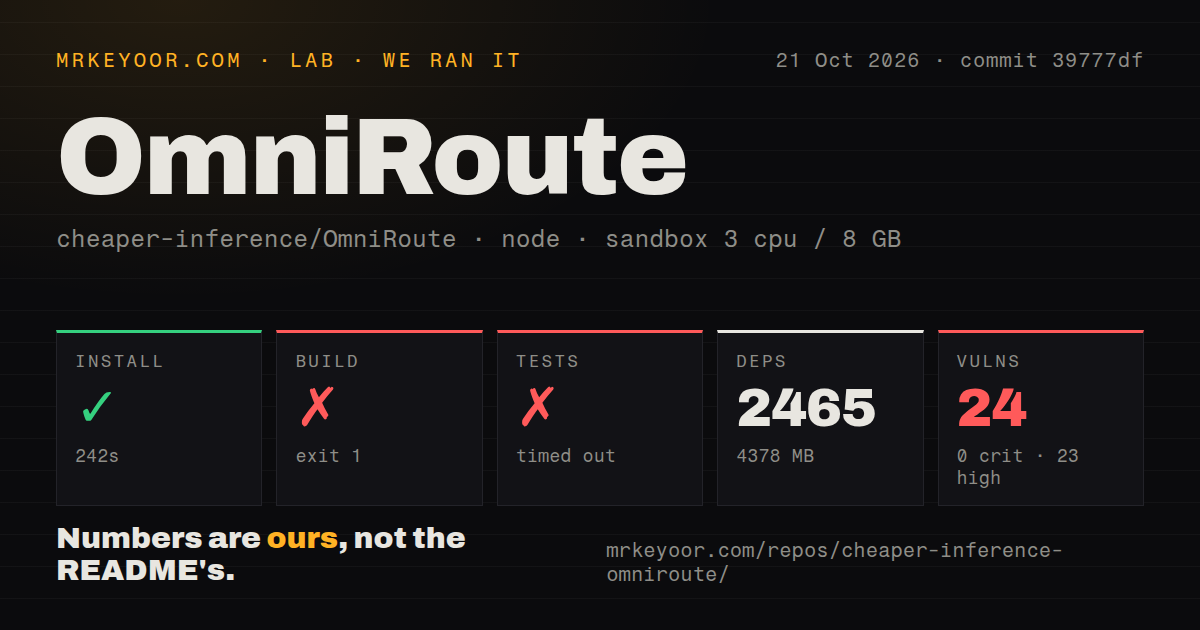
OmniRoute pulled 4,378 MB of dependencies into our sandbox, then its build failed in 5 seconds. That's a substantial developer checkout to take on for an AI gateway. The reason to consider it is the control it promises over provider selection and fallback, especially when several coding tools need to share the same connections.
You still supply the provider accounts. The README explicitly says its free-tier headline is an estimate across separately eligible third-party accounts, rather than a token grant from OmniRoute. Treat the gateway as a way to manage access you actually have. It cannot make a provider's quota or eligibility conditions disappear.
What happened when we ran it
Our OmniRoute installation succeeded in 242 seconds, the build failed with exit 1 after 5 seconds, and tests timed out after 900 seconds. We ran commit 39777df on October 21, 2026. The npm record lists 2,465 dependencies and 4,378 MB on disk.
The build tail contains MODULE_NOT_FOUND entries in the SWC require stack and an ERR_SWC_NATIVE_CACHE error. The latter says the cache root /work/home/.cache has a parent writable by another user without trusted sticky protection. That is the specific native-addon obstacle the log exposes. It doesn't establish that application routing is defective, nor does it justify disabling the protection to obtain a passing build.
The final test lines show a chat-completions request, an API-key policy rejection and a SQLite WAL checkpoint. They don't explain why the command remained running until the timeout. We can't turn that tail into a passing-test count or diagnose a hanging component. Policy rejection in a test log also isn't evidence that a real customer's valid request was rejected.
The npm audit reported 24 known vulnerabilities: 23 high and 1 moderate, with none critical or low. The supplied record doesn't identify the affected packages or establish exploitability in a deployed gateway. That leaves a concrete dependency-review task before production use, rather than grounds for declaring the application compromised.
Our sandbox configuration specified 3 CPUs, 8 GB RAM and image label lab-node:22. The label doesn't establish the actual runtime version. The checkout scan recorded 25,979 files, about 2,583,315 source lines and 812.3 MB, with monorepo workspaces. It found 33 CI workflow files, a Dockerfile, a Compose file and a tests directory. Those files show available project structure, not that their checks or deployments passed.
Provider fallback needs a policy you can explain
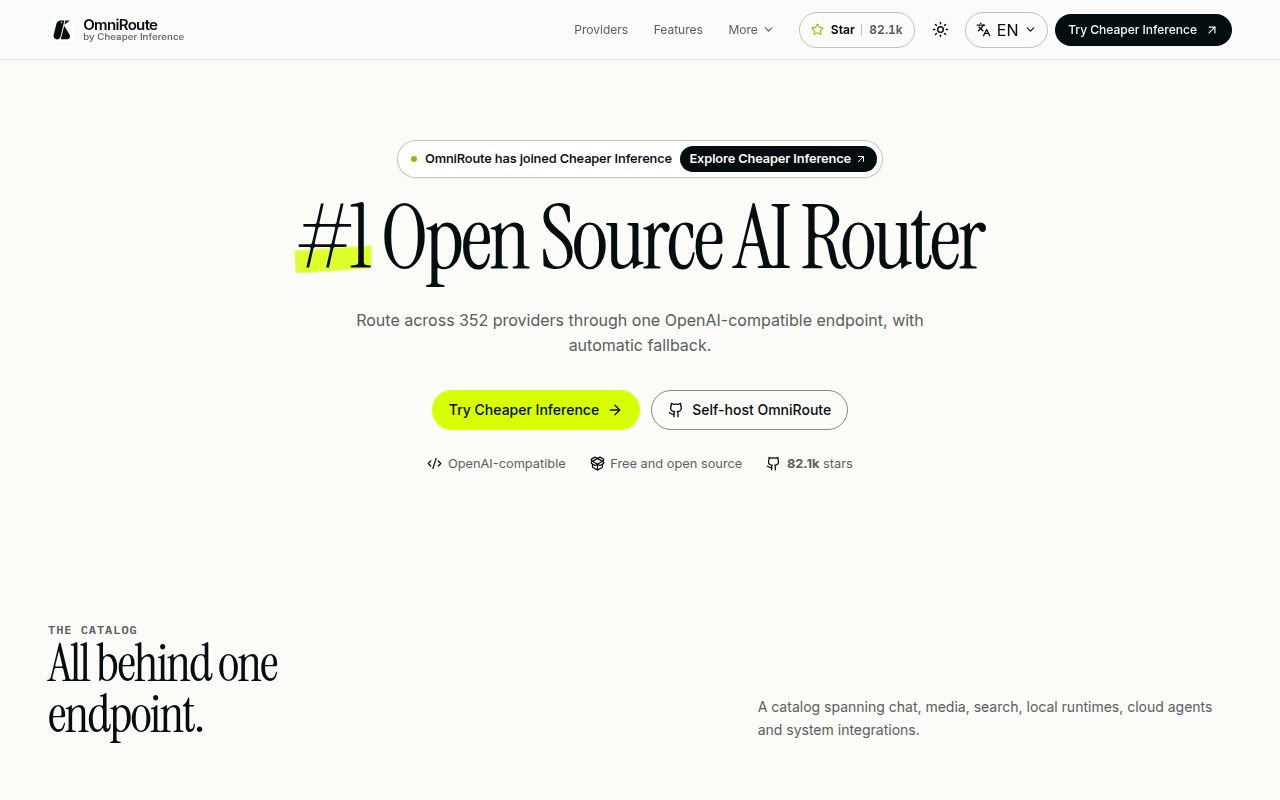
The README documents routing strategies including ordered priority, round-robin and quota-aware selection. Its client instructions use an OpenAI-compatible endpoint and either automatic routing or an explicit provider/model choice. This is useful when you want to change available connections centrally instead of editing each coding tool's settings.
Automatic routing also creates an acceptance question: which provider may receive a particular request? Before enabling fallback, list the allowed destinations and choose a strategy whose behavior you can inspect. Then exercise an unavailable provider and observe the destination selected for the next attempt. We didn't run that workload, so this is an evaluation requirement, not a measured reliability claim.
Start with one provider and one client. Confirm a normal request and a streaming response before adding alternative destinations. That gives you a baseline for separating gateway behavior from an upstream account restriction. The README's large catalog doesn't establish that every connection works with your account or supports every client feature.
MCP access can change the gateway itself
OmniRoute's README documents MCP interfaces over stdio and HTTP, alongside a remote CLI. It describes agents controlling routing, providers and other gateway settings. That is a reason to consider it for an operator who wants automation around the gateway, beyond sending model requests through it.
It is also a reason to be selective about agent access. The README labels MCP scope enforcement as opt-in. Check the installed release's authorization settings before handing an agent those controls, and verify that its allowed operations match what you intended. We haven't tested enforcement or performed a security review of the management interfaces.
Claude Code appears in the documented integration examples, but our run did not establish a working Claude Code session. Keep client compatibility as a separate trial. A successful models-list request alone wouldn't establish that a long coding conversation, tool calls and fallback preserve the behavior your workflow needs.
Choose a distribution before repeating our source attempt
The current README offers npm, container and source routes, and documents headless operation. Our measured dependency footprint belongs to the recorded repository run. It isn't a measurement of a published container, a global npm installation or the memory needed to serve requests.
You'll need the gateway's configuration and eligible provider credentials, plus persistent storage for its state. Follow the selected distribution's instructions and check its native-runtime preparation requirements. The SWC cache error makes environment preparation worth investigating, but the supplied tail doesn't prove a particular package reinstall or cache-path change will resolve it.
LiteLLM and Portkey deserve a workload comparison
LiteLLM offers a Python SDK as well as a proxy server. Evaluate it when direct Python integration or a shared model gateway matches your application. We haven't measured its setup footprint or compared its routing behavior with OmniRoute.
Portkey AI Gateway documents retries, fallback and conditional routing. Evaluate it when those controls are your central requirement, and check which release and deployment you are comparing. Its published performance claims are not results from our lab.
I'd keep OmniRoute in a local evaluation until the chosen distribution starts cleanly, its dependency findings have been reviewed, and one real client request survives the fallback policy you intend to use. Keep that policy small enough to explain which upstream receives the prompt. Adding more providers can wait until the first route is understood.