It is a current discovery board, not a complete course
Tech OA & Interview Questions tackles a real prep problem: reports of online assessments are scattered, age quickly, and often lack consistent labels. The repository turns those reports into a company-searchable board with practice links on FastPrep. Its README presents material for the 2026 and 2027 hiring seasons across coding, SQL, system design, low-level design or OOD, and AI coding. It is a maintained catalog, not a textbook or coding library.
The scale is the attraction. The README claims 1,600+ questions and names 214+ companies. Format links show 1,772 coding entries, 158 system design entries, 29 low-level design entries, 20 AI coding entries, and only 2 SQL entries. Those figures reveal both breadth and imbalance: coding candidates get a deep index, while SQL-focused candidates should look elsewhere.
The workflow is clear: search for a company, open a row, and follow its Practice link for an editor and test cases. Rows expose company, title, format, practice destination, and updated date. Examples include Maven Securities and TikTok questions dated Aug 26, 2026, while symbols mark additions from the last 2 weeks or 45 days. That is useful metadata for deciding what to review first.
Our run installed and built, but proved no behavior
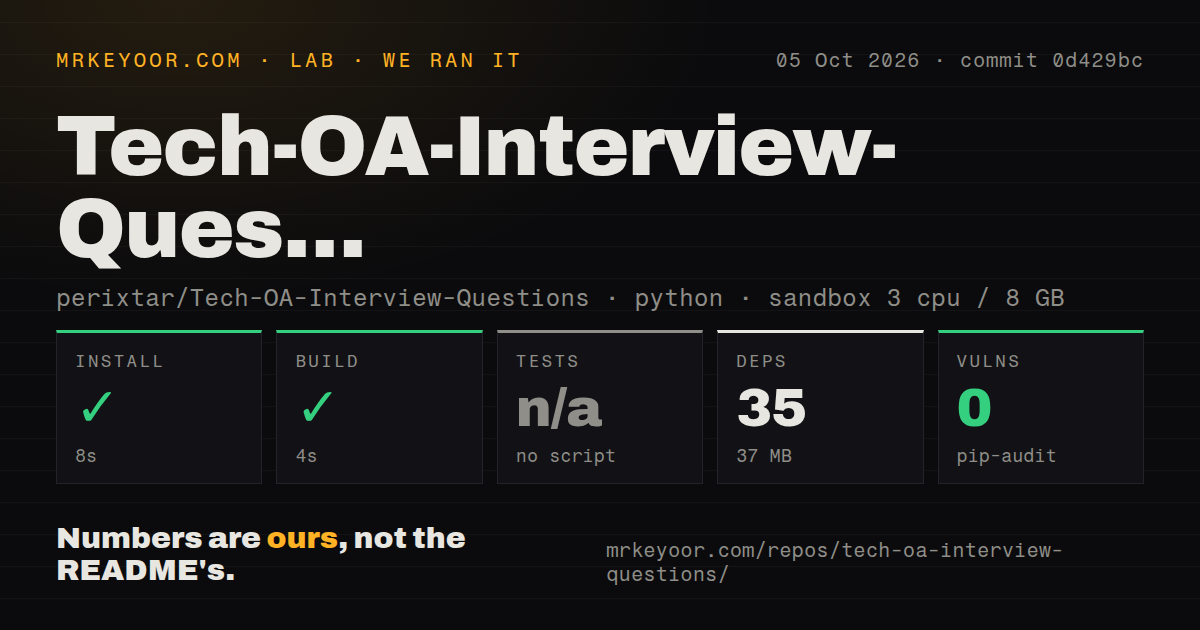
We cloned commit 3c98ad5 into a fresh, unprivileged Debian sandbox with Python 3.12, 3 CPUs, 8 GB of RAM, and no secrets. Our run installed successfully in 12 seconds: 35 packages consumed 37 MB. The build then succeeded in 4 seconds. Those are encouraging setup results and make basic inspection inexpensive.
The checkout contained 18 files, roughly 1,015 source lines, and occupied 0.9 MB. pip-audit reported 0 known vulnerabilities. We found 1 CI workflow, which is better than having no automated project check. There was no Dockerfile, so users wanting an identical containerized workflow must define their own environment.
The main qualification is testing. There was no tests script or target and no tests directory, so tests were skipped. That is not a passing suite, and a successful 4-second build cannot show whether links, synchronization, dates, or generated format pages are correct. For a catalog whose value depends on accuracy and freshness, automated content validation would improve confidence.
Specific coverage and clear labels are its strongest assets
A July 2026 snapshot lists Amazon at 369 tracked items, Google at 99, IBM at 83, TikTok at 74, and Microsoft at 65. Candidates can quickly see whether a target has meaningful representation. The README says system design, low-level design, and AI coding rows synchronize hourly from public, candidate-safe FastPrep catalogs.
Its labeling shows editorial care. Updated means either the latest reported sighting or the first public synchronization date, while Unattributed means no source-backed employer was reported. Contribution guidance requests a short summary, company, and date while rejecting confidential screenshots and full proprietary statements. That boundary matters for a collection built from candidate reports, although it cannot turn those reports into official company material.
Separate format pages make the long table easier to scan, and every row puts practice access beside the title. An issue template and Discord channel accept fresh submissions. With 4,636 stars, the project has enough visibility to attract contributors, though stars measure attention rather than question quality.
The unknown license and hosted links limit reuse
The most serious rough edge is the unknown license. Readers can browse a public repository, but organizations should not assume they may copy, redistribute, or embed its catalog. A stated license and clearer content provenance policy would make reuse decisions much easier, particularly for a collection claiming 1,600+ questions.
The experience also depends heavily on FastPrep. The README is a useful index, but Practice actions lead to the hosted site for the editor and test cases. If you need offline access or an auditable answer corpus, the 0.9 MB checkout is not presented as a complete substitute. The fastprep sync --season 2026 console block looks like a product demonstration, but the excerpt does not document a general local installation workflow for that command.
Coverage is not verification. Titles are rebuilt from candidate reports, and dates may use a first public sync when no later sighting exists. Candidates should treat attribution and recency as signals, not promises about a future assessment. Visible wording such as "for mle also :)" also suggests the 2026 catalog could use more normalization.
Active maintenance offsets the lack of releases, not tests
Project health looks positive in the evidence available. The latest push was Aug 28, 2026, the day of our review, and only 5 issues were open. There is no listed release, but that is not abandonment for a content repository updating its main branch and catalogs. The push date and low issue count together support calling it active.
No releases still means consumers lack obvious stable checkpoints, changelogs, or compatibility promises. The 1 CI workflow may guard a maintenance path, but our evidence includes no test target. GitHub issues and Discord provide community routes, yet the supplied community item only records a GitHub Trending star, not response times or maintainer resolutions. We would infer visible activity and adoption, no more.
It belongs beside a curriculum and primary practice tools
Use this repository as a discovery layer. Start with its company and date labels, then practice the underlying skills through a structured curriculum and established coding or system design material. Its 5 formats can form a checklist, but uneven counts demand outside sources, especially for SQL. Keep your own notes instead of depending on hosted links remaining unchanged.
For maintainers, it is better treated as a monitored dataset than a Python dependency. Pin commit 3c98ad5 when reproducibility matters, validate outgoing links, review attribution manually, and do not redistribute content until license terms are clear. For candidates, the advice is simpler: bookmark it for fresh leads, use FastPrep links when convenient, and verify fundamentals elsewhere. That focused role is genuinely useful.