Read the hosted handbook before cloning it
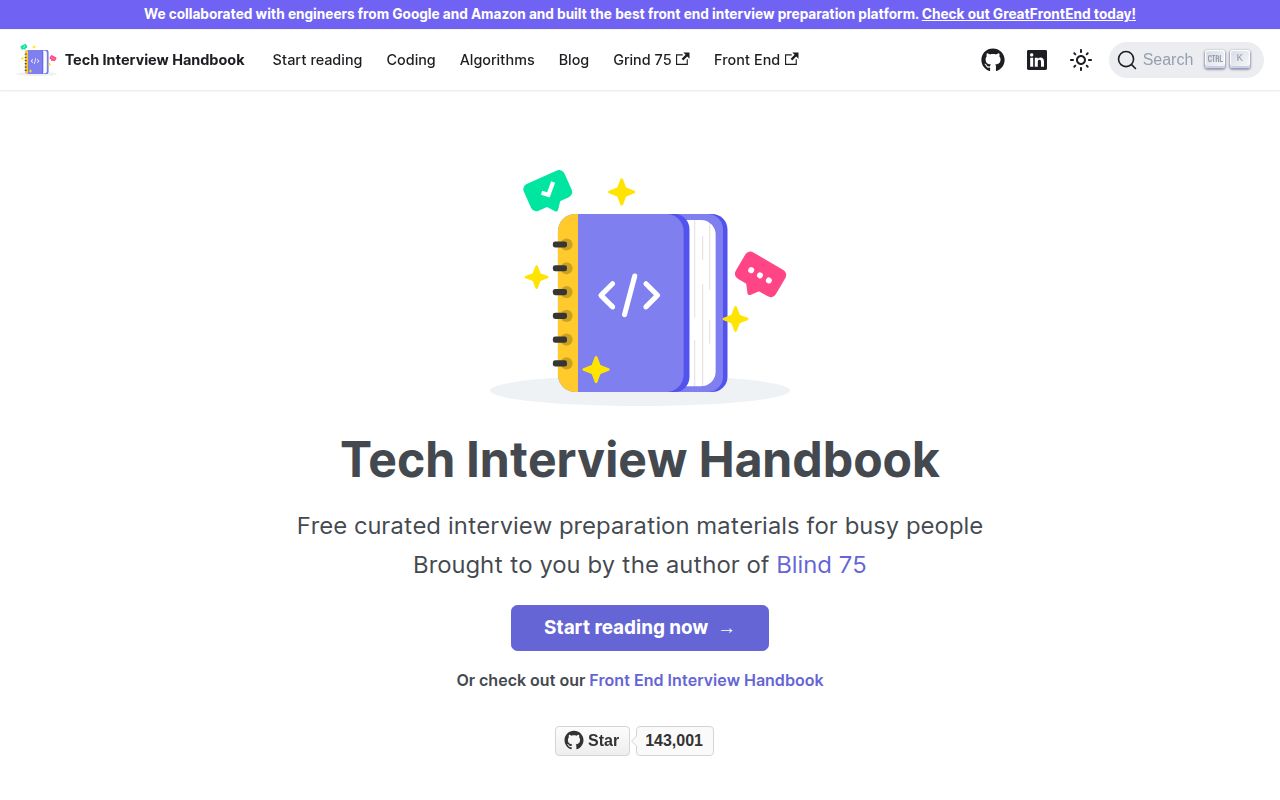
Opening the hosted Tech Interview Handbook avoids the 850 MB local environment we measured. The README directs readers to a free website with algorithm preparation and guidance on the rest of the hiring process. Cloning makes sense when you want to change that publication. It adds work that a candidate reading the same material doesn't need to take on.
The study plan tells you what to practice first
The coding interview study plan ranks topics by priority and connects them to exercises. Arrays and strings appear early, while dynamic programming receives lower priority. Grind 75 lets readers adjust a question plan to their available time and filter by topic or difficulty. That's useful for an engineer returning to interviews: you can choose a starting point instead of assembling another resource list.
The 603 files in our checkout belong to a publication with more than coding questions. The README also links to a resume guide and behavioral questions, and the behavioral preparation page explains how to organize stories around your own project experience. I would use those pages alongside algorithm practice. A correct solution won't answer an interviewer asking how you handled a disagreement, and remembering a project isn't the same as explaining your contribution clearly.
The handbook's preparation guide also calls out communication, problem solving, technical competency, and checking your answers. Those criteria give practice a purpose beyond finishing a problem. Explain the approach aloud, consider corner cases, and examine where your explanation becomes vague. These recommendations aren't measured improvements in interview results. The repository's popularity cannot tell you whether a particular candidate will get an offer.
Front-end preparation lives elsewhere, and system design needs supplements
Our checkout contained roughly 37,357 lines of source, but that size doesn't make the handbook a complete curriculum for every role. The README explicitly sends front-end candidates to a separate Front End Interview Handbook. Its system-design wording says work is ongoing, although the checked source already has a guide distinguishing distributed systems, API design, object-oriented design, and front-end architecture. That page supplies example prompts and links to further resources.
For a senior backend interview, I would add worked system-design exercises immediately. The handbook names problems such as a URL shortener and a chat service, then directs readers toward other material. That helps you identify the interview format, but it leaves the detailed design practice elsewhere. Likewise, someone preparing for browser and UI questions should follow the separate front-end resource rather than assume general algorithm preparation covers the role.
What happened when we ran it
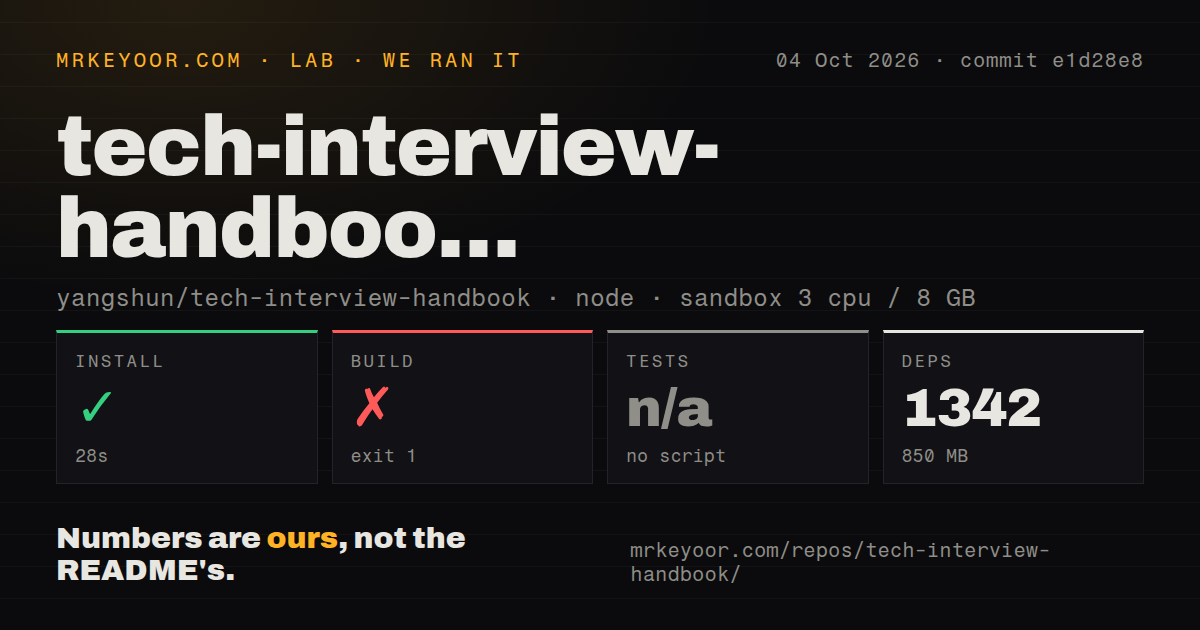
Our run installed 1,342 pnpm packages in 28 seconds and occupied 850 MB on disk. We cloned commit e1d28e8 on October 4, 2026 into a fresh unprivileged Debian container with 3 CPUs, 8 GB of RAM, and no secrets. The checkout itself was 21.2 MB. Installation succeeded, so the first observed failure came after dependency installation, when the build command started.
The build failed with exit code 1 after 1 second. Its command was vp run --cache -r build, and the log points into vite-plus 0.1.13. It imported styleText from node:util. Node rejected the import because the module did not provide that named export. This is a concrete local-build failure at the measured commit, before the log shows any successful website compilation.
The image was labelled lab-node:22, while the failing process reported Node.js v18.20.8. The log shows which runtime encountered the missing export, but doesn't explain why that runtime ran inside the labelled image. It also doesn't establish that changing Node would make the entire build pass. A corrected environment needs a fresh build before anyone can claim success.
The lab skipped tests because it found no test script or target. Its scan recorded 2 CI workflow files, monorepo workspaces, no Dockerfile, and no tests directory. Those signals don't supply a passing test result or explain the runtime mismatch. Our measurements cover repository setup and its failed build, without measuring the handbook's effect on interview performance or the behavior of the hosted website.
Promotional banners have a reported reading defect
Issue 776 reports that rotating promotional cards change height and move the article text while someone is reading. The report specifically names the coding-interview preparation page, so it concerns this handbook's reading experience. We haven't reproduced that behavior in the sandbox. The README itself contains affiliate course links and discount promotions. Readers who want an uninterrupted, promotion-free reference have a concrete reason to choose another resource.
An August push and September issues show recent activity
The last push was August 7, 2026. GitHub returned 143,001 stars and 37 open issues and PRs, while the latest-release endpoint returned no published latest release. July issue closures included wording corrections, and September brought a report about English terminology. Those dates show recent maintenance and reader activity, alongside unresolved feedback. They don't justify calling the project abandoned, or treating its audience size as proof that every page stays accurate.
Choose a different handbook when your preparation gap is specific
Coding Interview University supplies a longer computer-science study checklist for someone who needs foundations. System Design Primer includes architecture discussions, diagrams, and sample solutions for design practice. Front End Interview Handbook focuses on browser technologies and front-end interview formats. Each solves a different preparation gap. I would choose among them by the round I'm preparing for, rather than collect all their reading lists and postpone writing code.
For contributors, the 28-second install is only the beginning: our build stopped at a Node.js import, and the contributing guide asks you to discuss substantial changes in an issue first. For candidates, use the hosted study plan to pick a topic you need to revisit. Work through its linked exercises, then explain a solution without reading the answer. That gives you a specific weakness to address before the interview.