Background and Context
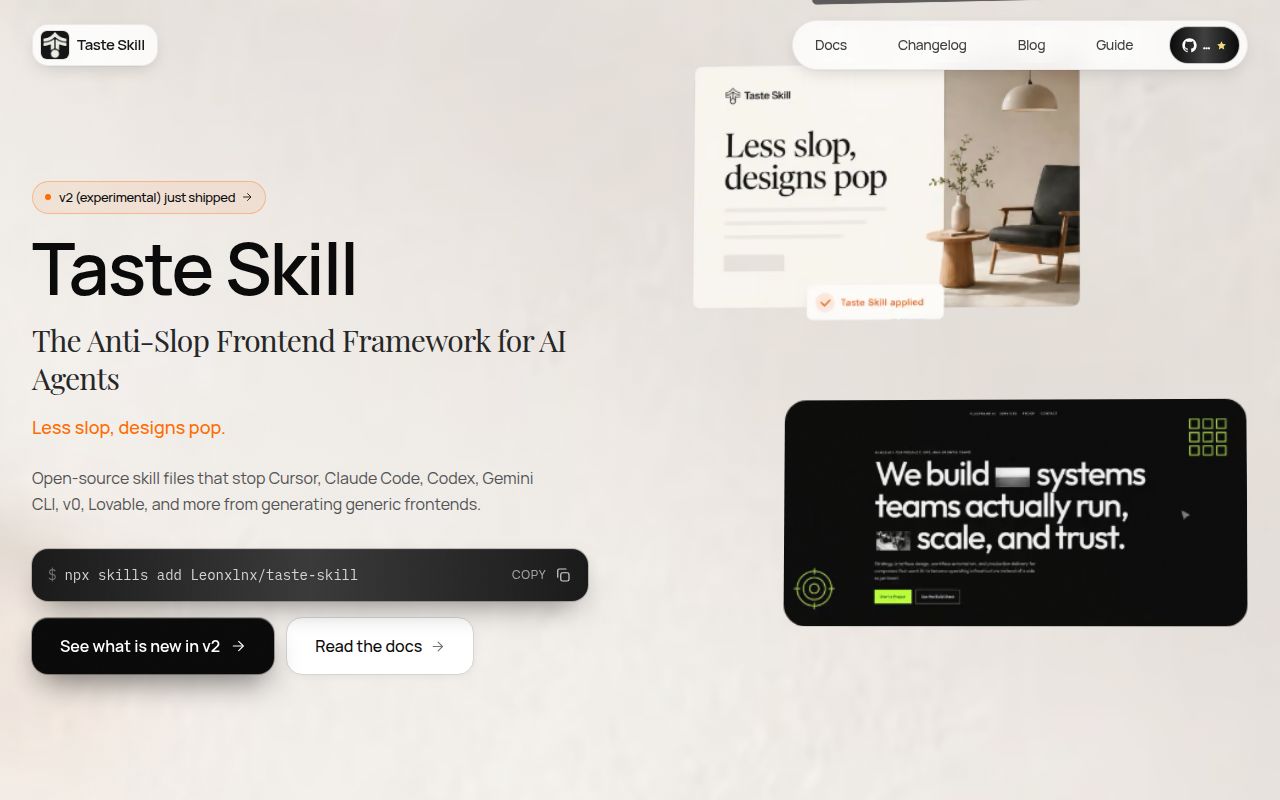
The rise of AI code assistants like GitHub Copilot, ChatGPT, and Claude has been a seismic shift for developers. We can now generate entire components, functions, and even full applications from a simple text prompt. The problem? The output is often functional but aesthetically... bland. AI-generated frontends frequently have a generic, "boilerplate" feel, lacking the nuance of a thoughtful design system. They are often riddled with what the creators of Taste Skill call "slop", inconsistent spacing, weak typography, and uninspired layouts. This is the exact problem Taste Skill aims to solve. It’s not another component library or JavaScript framework; it’s a set of instructions, or "skills," that you give to your AI agent to imbue it with a sense of design taste.
How It Works: Skills, Not Code
Taste Skill's core concept is brilliantly simple. Instead of being a library you import into your codebase, it's a collection of structured prompts that you "install" for your AI agent to use. The installation itself is a one-liner via npx: npx skills add https://github.com/Leonxlnx/taste-skill. This command uses a CLI from Vercel Labs' agent-skills project, which scans the repository and makes the skills available to your AI workflow.
Once installed, you can invoke specific skills when prompting your AI. The project is highly modular, offering a menu of skills tailored to different needs. The main skill, design-taste-frontend, is the default and is currently an experimental v2 rewrite. It's designed to read your brief, infer the appropriate design language, and then apply it by tuning three conceptual "dials": VARIANCE, MOTION, and DENSITY. This is a powerful abstraction that gives you high-level control over the final look and feel.
Beyond the default, the repository includes a suite of specialized skills. If you need the vibe of a modern, minimalist SaaS app, you can use minimalist-ui to get "Notion/Linear vibes." If you're building something edgy and raw, industrial-brutalist-ui provides a "hard mechanical language" with "Swiss type" and "sharp contrast." There are also workflow-specific skills, like redesign-existing-projects which first audits an existing UI before suggesting fixes, and image-to-code, which facilitates an image-first pipeline. This modularity is a massive strength, allowing you to mix and match instructions based on the project at hand.
The Good: A Design Director for Your AI
The most compelling aspect of Taste Skill is that it solves a real, painful problem for developers using AI. It bridges the gap between functional code generation and high-quality user interface design. By providing the AI with opinionated, expert-level guidance, it helps produce frontends that look intentional and polished, not randomly assembled. The project's own description, "stronger layout, typography, motion, and spacing", is exactly what’s often missing from raw AI output.
The project is also refreshingly opinionated. The v2 skill includes a "hard em-dash ban," provides "canonical GSAP code skeletons," and runs a "strict pre-flight check." These aren't vague suggestions; they are specific rules that enforce a certain level of quality and consistency. This is what makes it so much more effective than simply adding "make it look good" to your prompt. It's like giving your AI assistant a senior designer to peer-review its work.
Another major plus is the ecosystem and community validation. With nearly 70,000 stars on GitHub, Taste Skill has clearly struck a chord with the developer community. More importantly, it boasts an impressive list of sponsors, including Vercel, IMG.LY, and Novamira. This kind of backing from established companies in the developer and design tool space is a strong signal of the project's quality and relevance.
The Rough Edges: Living on the Bleeding Edge
Taste Skill's biggest strength, its innovative approach, is also tied to its biggest weakness: maturity. The primary v2 skill is explicitly labeled "experimental" and is being "actively" iterated on. The repository doesn't list any formal, tagged releases. This means users are on the main branch, subject to breaking changes as the project evolves. This is fine for experimentation and prototyping, but it's a significant risk for anyone considering using it in a long-term, stable production environment. You're an early adopter here, with all the excitement and instability that entails.
Furthermore, the project's effectiveness is entirely at the mercy of the LLM you're using. Taste Skill provides the recipe, but the AI is the chef. A less capable model might ignore the instructions, or a future update to a model like GPT-4 could change how it interprets the skills, leading to inconsistent results. It's a layer of abstraction that, while powerful, adds another variable to an already unpredictable process.
Finally, while the low number of open issues (53) on a project with 70k stars seems positive, it could also be a sign that community interaction is happening elsewhere (like DMs or email, as suggested in the README). This can make it difficult for a potential user to gauge the common pitfalls and real-world problems others are facing. A public, active issue tracker is often a healthier sign for a project of this scale.
The Verdict
Taste Skill is a brilliant and timely tool that feels like a glimpse into the future of software development. It elegantly solves the "AI slop" problem by packaging design expertise into a format that LLMs can understand and act upon. For solo developers, startups, and anyone prototyping frontends with AI, it’s a real step up, capable of dramatically elevating the quality of your generated code with minimal effort.
You should absolutely use Taste Skill if you are building UIs with AI and are frustrated by the generic results. It’s the perfect tool to speed up your workflow while maintaining a high aesthetic bar. However, you should be prepared for its experimental nature. This isn't a stable, versioned library you can depend on for years to come, at least not yet. It’s a cutting-edge tool for developers working on the cutting edge.