Short answer
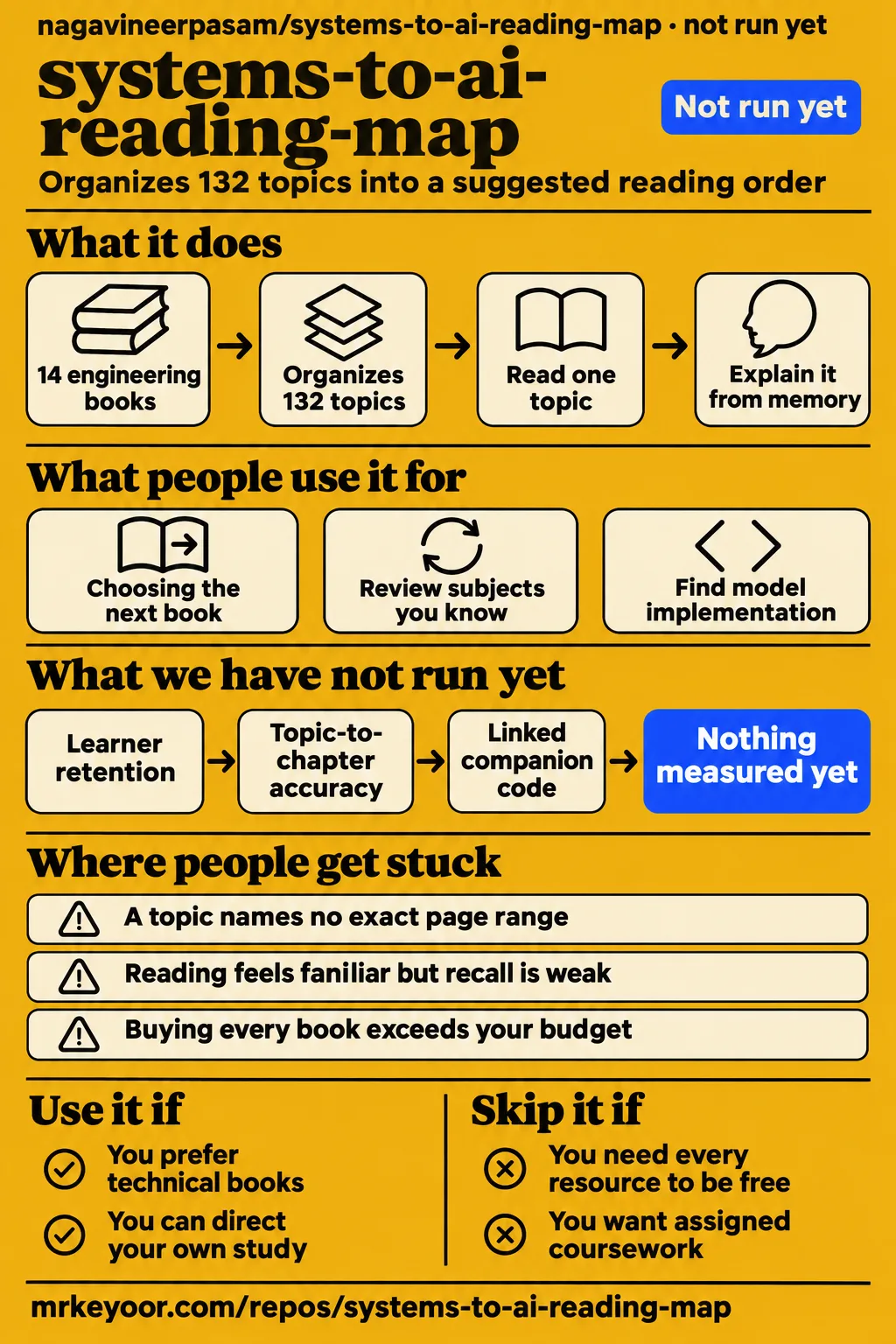
Systems to AI organizes 132 topics from 14 books into a suggested reading sequence, according to its README. Use it if you enjoy learning from technical books and want help choosing what comes next. Choose another format if you need every resource to be free or want assigned coursework and external assessment. The author tells you to buy or borrow some books and makes explaining a topic from memory the central study exercise.
The decision is about study format. This repository gives you book titles, editions, numbered topics and an order. OSSU gives you a course curriculum, while the linked LLMs-from-scratch repository gives you implementation material. A practical way to use Systems to AI is as a personal reading checklist, keeping your explanations beside it. That follows the author's exercise without treating each numbered topic as an equal amount of work or turning the sequence into a deadline.
The sequence connects computer systems to AI application work
The README places computer systems first, followed by operating systems, networking, data systems and later AI subjects in its fourteen-stage sequence. Before reaching tokenization or attention, a reader following the order encounters processes, memory, network protocols, storage, services, containers and reliability. The route therefore asks readers to spend time on infrastructure before reaching its model-building and foundation-model application stages.
The data-systems stage lists replication, sharding, transactions and consistency. Later, the ML-systems stage lists data leakage, offline evaluation, prediction, distribution shifts and monitoring. Reading those stages together gives you a way to organize questions about data and model operation. For a developer choosing reading to address gaps in backend knowledge, these named subjects provide concrete starting points. Each stage points to a book rather than collecting disconnected articles.
The allocation also shows why topic numbers need interpretation. Services & APIs has three entries, including communication styles and microservice security. LLMs from Scratch occupies topics 104 through 118, moving from tokenization to instruction finetuning. These subjects call for different reading sessions. The numbered order lets you locate material and see the author's allocation of topics; the chapter you select still depends on the engineering question you want to answer.
What people use systems-to-ai-reading-map for
The author's documented method is to read one topic and explain it without looking, either aloud or in writing, as the study instructions describe. One practical use is choosing the next book. Each stage identifies a resource and the subjects to find inside it. Someone finishing operating systems can see networking next, while someone approaching foundation-model applications can find the final AI Engineering stage.
A second use is organizing a review of subjects you already know. As an adaptation of the author's exercise, pick a listed topic, write your explanation and then return to the chapter. The operating-systems stage, for example, gives you concrete prompts such as processes, paging, locks and file systems. This makes the list usable as a set of questions to revisit as well as a route to follow from the beginning.
A third use is finding the transition from infrastructure reading to model implementation. The LLMs from Scratch stage links directly to Sebastian Raschka's book repository and names attention, GPT implementation, training and finetuning topics. In the project announcement, vineerpasam described the intended span as "From computer fundamentals to advanced AI". The numbered stages give that broad description specific destinations.
What happened when we ran it
Our run at commit ee9391a on November 23, 2026 recorded NOT RUN: no supported ecosystem (language: null); no Dockerfile. The recorded sandbox configuration was 3 CPUs, 8 GB RAM and image n/a. These figures identify the execution attempt. The repository's instructions direct readers to books and a recall exercise, while the automated attempt stopped before application execution.
| Lab item | Recorded outcome | What you should take from it |
|---|---|---|
| Source checkout | ee9391a, November 23, 2026 | Identifies the lab snapshot |
| Execution | NOT RUN: no supported ecosystem, language null, no Dockerfile | The harness recorded no application execution |
| Sandbox configuration | 3 CPUs, 8 GB RAM, image n/a | Identifies the configuration assigned to the attempt |
| Separate Compose safety step | FAILED: no recognized Compose file | Execution stopped at the required-file check |
| Teardown | ok | Cleanup completed |
The separate attempt stopped with "hands-on step safety: FAILED; unsafe repo: none of compose.yaml, compose.yml, docker-compose.yaml, docker-compose.yml exists (rule: a compose file is required)". That error names the harness requirement and the missing filenames. Cleanup then recorded "teardown: ok". The failed prerequisite explains the stop, and the teardown result describes what happened afterward.
The generic run description says "deployed with its own docker compose on our lab server, every port bound to 127.0.0.1". The specific failed safety step and the explicit NOT RUN measurement contradict that deployment wording. This review follows those concrete outcomes. The README remains the reading interface described by the project; the Compose error records the automated execution path attempted in the lab.
Where people get stuck: finding the reading and judging progress
Readers must locate each topic within the named book and judge their progress through the author's recall exercise. The README's usage instructions ask readers to read the chapter and explain it from memory. For example, "Consistency & consensus" appears under Designing Data-Intensive Applications, second edition. The list supplies the subject and edition; the reader opens the book, locates the relevant material and decides how much to read in that session.
"Go in order" is the author's explicit recommendation. A developer who already understands processes and networking can choose a later stage as a personal adaptation. The distinction is between following the proposed sequence and using the same bibliography to answer a current question. Both begin with a named topic and book, while the original instruction favors working through the stages in order, beginning with bits and bytes.
| Friction in the documented route | A practical response | Basis |
|---|---|---|
| A topic names a subject rather than an exact page range | Find it in the contents of the listed edition | The README organizes topics beneath named books |
| Reading feels familiar but recall is weak | Close the chapter and write the explanation the author requests | The one-topic-at-a-time instruction |
| Buying every book exceeds your budget | Begin with the author-identified free books and borrow others | The free-reading and buy-or-borrow instructions |
| You want to build an LLM immediately | Consider the linked LLMs-from-scratch repository | It is the companion named for stage thirteen |
The recall exercise supplies a concrete task after reading. One editorial suggestion is to keep your written explanation, compare it with the chapter and mark the mechanism you could not describe. That gives a later session a specific starting point. For instance, a note about paging can distinguish an explanation of address translation from an explanation of the TLB, both named in the operating-systems stage.
Free access covers some reading, not every book
The author identifies OSTEP, Google's SRE book and Deep Learning as free online reading, then says "Buy or borrow the rest" in the access instructions. A reader choosing by budget can begin with those named resources and compare their subjects with the immediate learning goal. Starting with the free titles is one documented instruction; following every stage in order is another, so selecting a starting point involves both access and sequence.
The list is MIT licensed. The README's license section also says the books belong to their authors and publishers and that the repository only points to them. Reusing the topic list and obtaining a recommended book are therefore separate decisions. The author directs readers to official book pages, and the access instructions distinguish the free online books from those readers should buy or borrow.
The final stages separate model building from application engineering
Stage thirteen covers building a GPT model, while stage fourteen covers applications built on foundation models in the README's final two stages. This distinction helps readers choose between a model's implementation and the system around it. The former includes tokenization, attention and training; the latter includes evaluation, prompting, retrieval, agents and inference. Those topic groups lead to different choices about what to read next.
Stage thirteen begins at topic 104 with tokenization and byte pair encoding and ends at topic 118 with finetuning to follow instructions. Between them are embeddings, attention, the transformer block, coding the GPT model and loading pretrained weights. If your current question concerns how these pieces fit together in code, this stage points to the specialist implementation companion and identifies the subjects to look for there.
Stage fourteen runs from topic 119, foundation models, through topic 132, user feedback. Its entries include prompt injection and defenses, RAG and retrieval optimization, embeddings and vector search, agents, memory and inference optimization. An application developer can use those entries to choose material about building with foundation models. The preceding stage instead starts with the pieces used to construct and train a GPT model.
Stars show repository activity
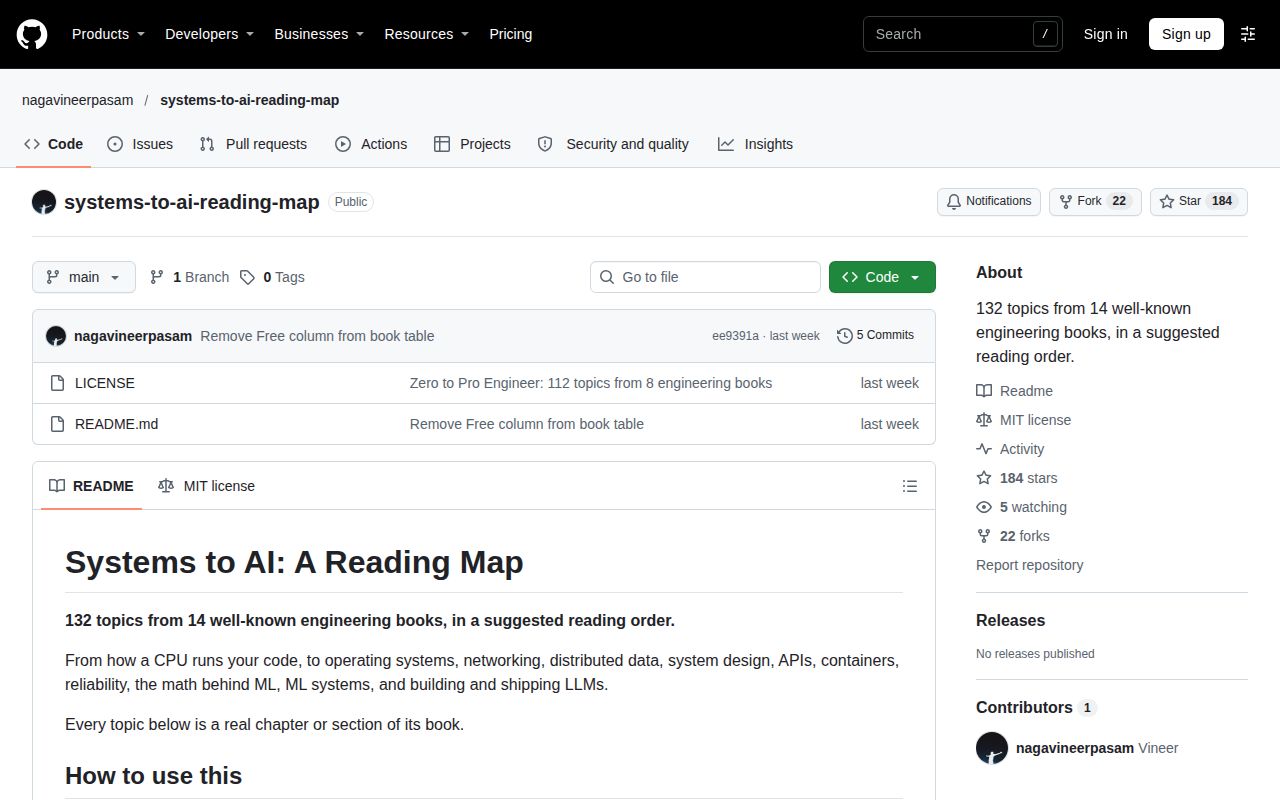
Trendshift records 57 additional stars and 21 additional forks over eight days in its November 16 to November 23, 2026 activity snapshot. The same snapshot reports zero merged pull requests and no appearance in the Trendshift top 25 during that period. The page distinguishes its activity totals from its trending position: the repository gained stars and forks during this window without entering that ranking.
GitHub's repository metadata records a last push of November 17, 2026 and zero open issues and pull requests when checked on November 23. The README's contribution instructions invite readers to open an issue or pull request for a mistake or a missing topic. That is the documented route for proposing a correction to the reading list, including a topic or bibliography entry.
systems-to-ai-reading-map vs OSSU and LLMs-from-scratch
OSSU organizes online computer-science study into courses, while LLMs-from-scratch contains the official book implementation code. Systems to AI organizes selected book topics. Choose among those formats according to the work you want to do next: select a chapter, follow a course or implement part of a model. The map already links to the specialist LLM resource, so these choices can also complement each other.
| Resource | Documented format | Choose it when |
|---|---|---|
| Systems to AI | Suggested reading order across fourteen books | You want a broad book-based route through systems and AI |
| OSSU Computer Science | Introductory, core and advanced study plus a final project | You want course structure for a wider computer-science education |
| LLMs-from-scratch | Official book code for developing, pretraining and finetuning a GPT-like LLM | You want to work directly on model implementation |
OSSU describes its curriculum as a computer-science education using online materials. Its README lists prerequisites, course organization and a final project intended for peer evaluation. It also says some courses may charge for graded assignments, tests or projects. Those details make it an alternative for someone who wants a structured curriculum and is willing to follow course requirements alongside independent study.
LLMs-from-scratch contains code for developing, pretraining and finetuning a GPT-like LLM. Its README identifies a strong foundation in Python programming as the main prerequisite and lists chapter notebooks, exercise solutions and setup guidance. Choose that repository when you want your next session to involve model code. The broader reading map gives you other systems and AI subjects to select when the next question lies outside that implementation sequence.
FAQ
The list is MIT licensed, but the author tells readers to buy or borrow books beyond the named free options in the README. The access question therefore has two parts: permission to reuse the topic list and access to the books themselves. The following first-time-reader questions cover those terms, the author's proposed order and the implementation material linked from stage thirteen.
Is systems-to-ai-reading-map free to use?
The topic list is MIT licensed, and the README names three books that are free to read online. Its access instructions identify OSTEP, the Google SRE book and Deep Learning, along with free LLM book code on GitHub. For the remaining books, the author's instruction is to buy or borrow them. A budget for following the route therefore depends on which books you need to obtain.
How should you follow the reading order?
The author recommends going in order and reading one topic at a time, then explaining it without looking. The usage instructions allow speaking to someone or writing the explanation down. Topic 1 is bits and bytes, and the sequence continues through systems and AI subjects. Jumping to a later stage is a reader's adaptation of that proposed order rather than the author's stated starting method.
Does the list include code for building an LLM?
Stage thirteen links to Sebastian Raschka's official Build a Large Language Model (From Scratch) repository. That companion README describes implementation code and lists chapter notebooks and exercise solutions. The map supplies the topic sequence and destination; the companion supplies the model-building material. Its main prerequisite is a strong foundation in Python programming, which becomes relevant when moving from selecting a topic to following the code.
What we have not tested yet
Learner retention, completion time and engineering outcomes have not been measured for this route. The 132-topic count describes the reading list rather than a workload estimate or evidence that its order suits a beginner. Topic-to-chapter accuracy, every destination link and the linked companion code also remain outside this evaluation. The README supports describing the list's contents and instructions; assessing those educational questions requires work with the books or learners.
The lab produced no installation, build or test results, runtime-version logs or application benchmark. Its configuration describes the attempt rather than reading requirements or compatibility with companion code. Maintenance quality and support response are also unassessed: the eight-day activity snapshot and empty open tracker give no correction history. No direct learner account here establishes completion of this route, and stars or forks do not measure that outcome. Rendered layout, resolved links, related links, recommendation modules and template content were also outside this text-and-evidence review.