A Disciplined, Terminal-Native AI Workforce
SwarmForge, from the repository of Robert C. Martin ("Uncle Bob"), is an AI agent orchestration tool that feels distinctly different from its contemporaries. It eschews web interfaces and complex Python frameworks in favor of the raw power and simplicity of the UNIX philosophy. The project's goal is to turn a swarm of AI agents into a team of reliable software engineers, and it accomplishes this by using tools many developers already master: tmux, git, and shell scripts. It’s a self-hosted, lightweight system for those who want to build and observe an AI development team directly on their local machine.
At its core, SwarmForge is a set of clever scripts and conventions. It solves the primary problem of multi-agent collaboration, agents overwriting each other's work, by isolating them. Each agent is assigned its own tmux session, providing a dedicated terminal environment. For agents that need to work on code, SwarmForge creates separate git worktrees, giving each one a clean checkout of the repository. This structure allows agents to work in parallel on the same project without conflict, a simple yet effective solution.
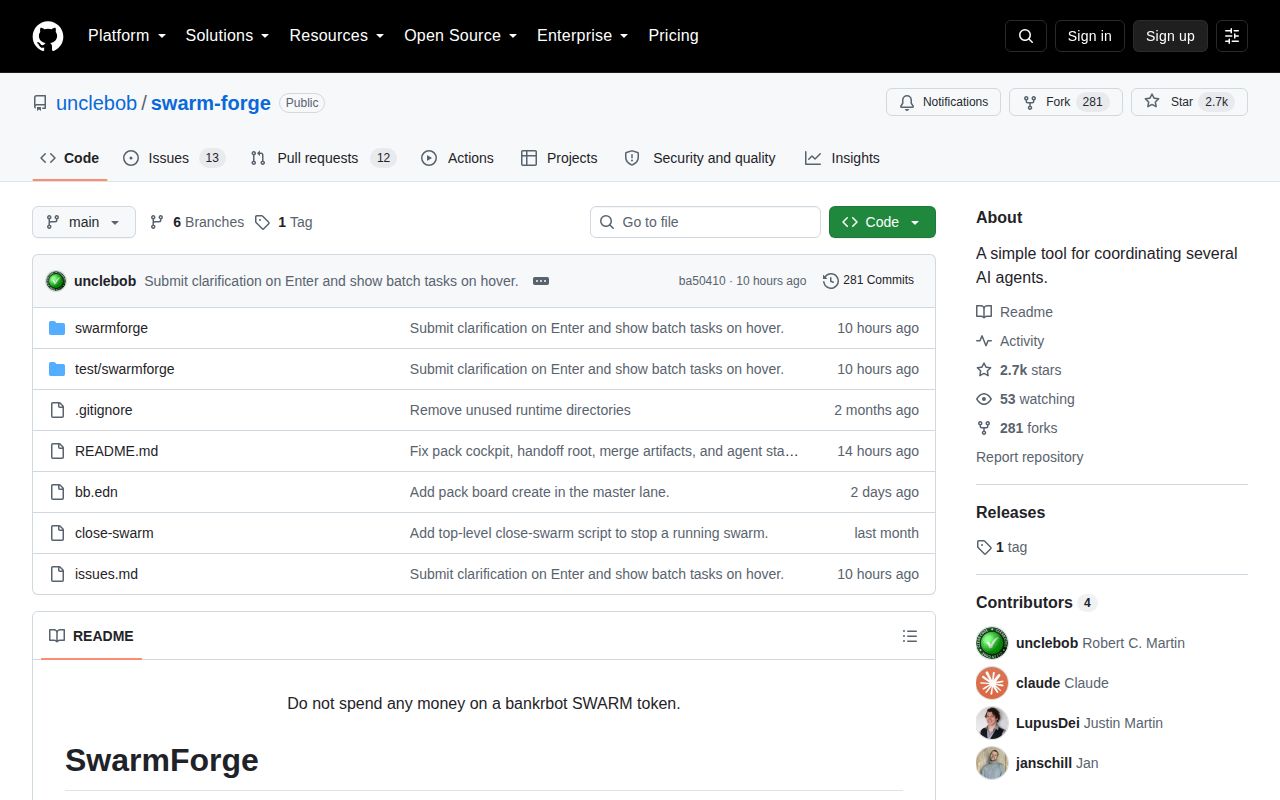
The project's structure is also unique. The main branch serves as a template, holding shared scripts and documentation. The actual, runnable configurations live on separate branches named two-pack, four-pack, and six-pack. This novel approach uses git branches as distribution packages for different workflow complexities, a method that is both unusual and surprisingly practical.
Strengths: Transparency and Control
SwarmForge's greatest asset is its transparency. By running each agent in a dedicated tmux window, you can literally watch your AI team work in real time. This observability is critical for debugging agent behavior, refining prompts, and understanding the flow of work. There are no hidden processes or abstract logs; the entire operation unfolds in your terminal. This is a powerful feedback loop for anyone serious about prompt engineering and agent design.
The system is also deeply configurable and project-local. An entire swarm's behavior is defined by a handful of text files inside a swarmforge/ directory in your project. The swarmforge.conf file defines the agents and their roles, while prompts in swarmforge/roles/ and articles in swarmforge/constitution/ dictate their behavior and guiding principles. This makes workflows easy to version-control, modify, and share. You can specify different AI backends (claude, copilot, grok, etc.) for each role, allowing you to use the best model for each specific task.
The pre-defined workflows (two-pack, four-pack, six-pack) are not arbitrary. They represent well-structured software development processes, reflecting the project's origin. The two-pack offers a tight code-and-refactor loop. The four-pack introduces Gherkin specifications for more formal development. The six-pack provides a full-fledged pipeline with separate roles for specification, coding, cleaning, architecture, hardening, and QA. This built-in discipline provides a fantastic starting point for creating robust, automated development cycles.
Weaknesses: Sharp Edges and Immaturity
While powerful, SwarmForge is not for everyone. Its reliance on tmux and git worktrees means it has a steep learning curve for those not already proficient with these tools. The documentation, while a well-written README, is sparse. There are no external guides, wikis, or tutorials, leaving users to decipher the shell scripts if they run into trouble.
The project is clearly in its early stages. It has no official releases, no specified license, and a small number of open issues. While the recent activity is a positive sign, it lacks the stability and polish of a mature tool. The curl | tar installation method is convenient for experts but bypasses standard package management and can be a security concern for the cautious. The strange, prominent warning at the top of the README about a "bankrbot SWARM token" is also jarring and unprofessional, potentially scaring off users who lack the context to understand it.
Finally, the system is strictly local and single-player. It’s designed to run on one machine, orchestrated by one user. It doesn't offer a path for team collaboration or shared, persistent agent swarms, limiting its use to individual developers and researchers.
The Verdict: A Power Tool for Tinkerers
SwarmForge is a compelling and opinionated take on AI agent orchestration. It is to other agent frameworks what a tiling window manager is to a desktop environment: less accessible, but faster and more powerful in the right hands. It provides an unparalleled level of transparency and local control, making it an ideal sandbox for experimenting with agentic software development workflows. For the command-line power user who wants to build a disciplined AI team without the overhead of cloud services or heavy frameworks, SwarmForge is an exceptional, if unpolished, tool.