Octomind is a coding-agent application for reading and editing repositories and running commands. Its guardrail guide says a malformed policy file leaves no authored rules and lets the session continue. Before using its background workflows, check both whether your rules load and which execution paths they cover.
Where documented policy enforcement stops
The Octomind README describes repository tools exposed through Model Context Protocol, with interactive CLI, stdin, daemon, WebSocket and ACP editor interfaces. These are documented capabilities; our evaluation did not establish a working agent session.
The guardrail guide distinguishes pre-call guards from post-result hooks and end-of-turn validators. Guards can deny matching calls before execution. Hooks and validators deliver feedback that does not undo tool results. A requirement to prevent an action therefore needs more than a feedback script.
Parse errors are treated as no authored rules. The guide says errors go to stderr and the session continues. Matching also depends on resolved capability ownership: tools without an owning capability cannot match a capability target. A policy file's presence does not establish that its rules cover the configured tools.
The guide documents a further exception: the main-session single-call tap action path bypasses ordinary batch checks, call-log recording and result hooks. It explicitly states that guardrails are not a complete process or filesystem sandbox. These are documented boundaries, not runtime findings from our sandbox.
History conditions have another limit. The guide says allowed calls enter the log before execution and remain there if the tool later fails. A recorded test call therefore does not establish a passing test result. Check actual results when success matters.
What happened when we ran it
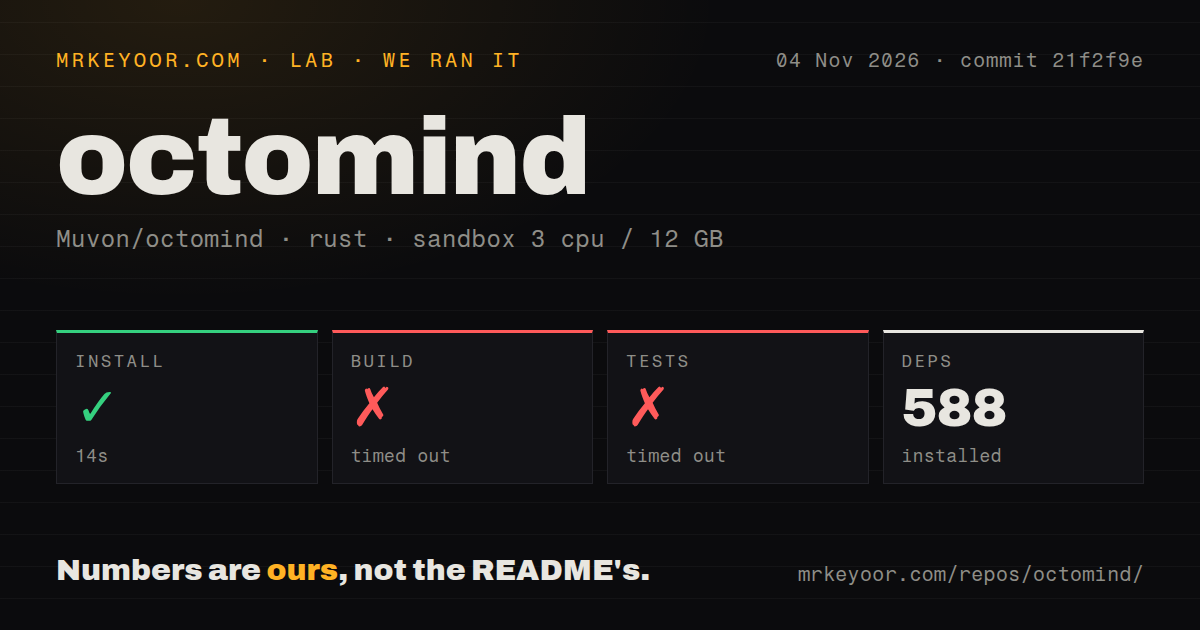
Our November 4, 2026 sandbox run at commit 21f2f9e completed installation in 14 seconds and recorded 588 dependencies. The build timed out at 900 seconds, and the test step also timed out at 900 seconds. Neither step provides a successful completion result. These durations do not measure how quickly an installed agent solves coding tasks.
The test tail contains rust-lld errors for undefined C++ symbols, including a wide-character basic_string replacement symbol. It then reports that octomind could not compile the hindsight_shared_test target and warns that other jobs were still finishing. The recorded timeout and visible compile failure both remain part of the finding. The excerpt does not establish that application-level checks completed.
The sandbox configuration recorded 3 CPUs, 12 GB RAM and image lab-rust:1. Actual runtime and operating-system versions require raw toolchain logs. The supplied excerpt does not identify a confirmed compiler change, package upgrade or other repair. It also does not establish whether distributed binaries encounter the same failure.
The repository scan found 5 CI workflow files, a Dockerfile and a tests directory. Those are investigation entry points, not evidence of passing CI or a successful container run. We have no recorded agent task, policy-denial experiment or model-spend measurement.
Check every model profile
The README offers Octomind Cloud login or your own provider credentials. The main, supervisor and compression profiles default to octohub:auto. Using your own key means updating all three model profiles. Check which provider each role will call before starting a job; a local executable does not establish local model execution.
The README also says specialists may install tools and request credentials on first use. It documents anonymous usage reporting and opt-outs through DO_NOT_TRACK, OCTOMIND_TELEMETRY or the configuration file. These are upstream descriptions, not observations of sandbox traffic. Review provider and tool configuration before granting repository access.
What the ratings cover
Documentation earns 4/5 for detailed task guidance: the supplied README and guardrail guide explain model profiles, enforcement phases, capability matching and execution boundaries. The documentation rubric is 1 for no usable guidance, 2 for fragmentary guidance, 3 for a usable introduction, 4 for detailed task guidance and 5 for independently checked coverage. The documented paths were not independently exercised, so this evaluation does not support the top rating.
Setup ease remains unassessed because the build and test steps timed out without a working agent session in a verified supported environment. Community support and production maturity also remain unassessed: the supplied evidence does not establish maintainer responsiveness or successful sustained unattended work.
Choose a workflow, then investigate its boundaries
Aider offers terminal pair programming with language models. Consider it when interactive work on a codebase is your main requirement. goose documents a native desktop app, CLI and API. Consider it when a desktop interface matters. Neither alternative was tested against Octomind here, so these are interface choices without comparative task-success or cost findings.
For an Octomind trial, begin with a disposable checkout and a narrow task. Establish model access, inspect capability ownership and demonstrate an intended denial against the actual configured tool. Check malformed-policy handling too. One successful denial is only an initial check: it does not establish enforcement across all execution paths. Investigate the documented inline tap-action exception and any separate sandbox controls before deciding whether the configuration meets your requirements for unattended work. These checks remain proposed, not completed.