
Two abstractions split autonomy from control
CrewAI gives Python developers 2 related ways to organize model work. Crews assign roles, goals, tools, and tasks to agents that collaborate with some freedom. Flows are event-driven programs with state, branches, routing, and ordinary Python around model calls. The split is sensible. A research task may benefit from agents dividing work, while payment approval or file deletion belongs in a path whose transitions the application controls. CrewAI lets a Flow call a Crew at the point where that uncertainty is acceptable.
The current scaffold puts agent definitions in JSONC files and crew settings in crew.jsonc; a --classic option retains the older Python and YAML layout. Missing input values are requested when the crew runs. This gives teams a reasonably inspectable layer for prompts and task relationships without forcing all application logic into configuration. It also creates another format to review, version, and migrate, so a small two-call script may be clearer as plain Python.
A useful run still needs at least 1 model connection
The CrewAI README requires Python 3.10 or newer and below 3.14, with uv handling the CLI and project environment. After scaffolding, the user supplies a model provider API key. The bundled research example adds Serper for web search. CrewAI defaults to OpenAI in its example configuration, while its model guide also covers other providers and local services such as Ollama. The framework is open source; the useful inference and search behind many examples may still have a bill or another server to maintain.
CrewAI's feature list covers memory, knowledge, checkpointing, asynchronous execution, structured output, human input, and MCP or A2A connections. That is enough surface for a long-running internal process, but each capability adds failure modes outside the agent prompt. Tool calls need authorization, checkpoints need storage rules, and human review needs a timeout path. The README makes Flows the home for those decisions. Teams should resist turning every ordinary function into an agent merely because the framework can coordinate one.
What happened when we ran it
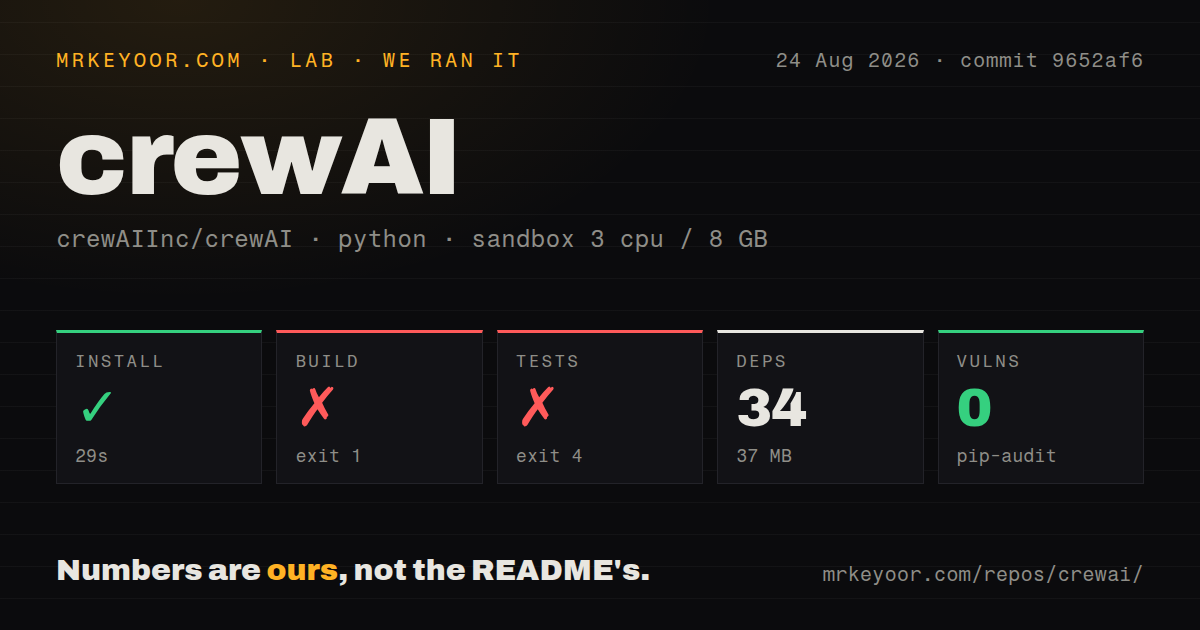
Our run cloned commit 9652af6 into an unprivileged Debian container with 3 CPUs, 8 GB of RAM, and no secrets. The checkout occupied 359.9 MB and contained 27,141 files with about 317,240 lines of source. Installation succeeded in 29 seconds, adding 34 packages and 37 MB. Pip-audit reported 0 known vulnerabilities in that installed environment.
The build failed with exit 1 after 13 seconds. The supplied log tail contains no diagnostic beyond that outcome, so we cannot responsibly assign a cause. Tests then failed with exit 4 after 8 seconds. Pytest stopped while loading the repository's root conftest.py: Python could not import dotenv, reporting ModuleNotFoundError: No module named 'dotenv'. That is a setup failure before test collection, not a failed CrewAI assertion and not evidence about how many tests pass.
Repository signals show 14 CI workflow files, no Dockerfile, and no top-level tests directory. The README's contributor command points pytest at lib/crewai/tests/, so the absence of a root tests folder is consistent with the repository layout. Still, uv sync --all-groups --all-extras did not leave our fresh environment able to import the root test configuration. Contributors should expect to reconcile the documented environment before they get a meaningful local result.
Telemetry needs an explicit 1-line policy
CrewAI says its default anonymous telemetry includes the framework and Python versions, general operating system details, agent and task counts, process type, model name, roles, and available tool names. Setting OTEL_SDK_DISABLED=true disables that collection. A separate share_crew=True option sends detailed task and execution data, including goals, context, and output. Those are materially different modes. Put the chosen setting into deployment configuration instead of leaving it to each developer's shell.
The distinction between the MIT framework and the commercial AMP suite also matters. The repository supplies the programming model. CrewAI markets managed deployment, observability, governance, security controls, and enterprise support through AMP. A team can build its own operating layer, but it should not read the open-source quick start as proof that production access control and incident handling are already solved.
Active releases do not shrink an 806-item work queue
GitHub showed 57,605 stars and 806 open issues and pull requests combined when we fetched the repository. The last push was August 25, 2026, and release 1.15.17 arrived on August 20. Recent activity included fixes and discussions around async model-call hooks, optional fields in task output schemas, and pre-tool-call authorization. That is a busy maintained project, but the combined queue is large enough that adopters should pin a version and test the provider and tool paths they actually use.
CrewAI is easiest to justify when the domain already maps to roles and handoffs, such as research followed by review, and when a Flow can contain the uncertain parts. For a short deterministic pipeline, direct SDK calls will be easier to debug. For a multi-agent product, CrewAI offers a readable vocabulary and a large community, with a contributor setup that our 29-second install did not fully validate.