Low resident memory still requires a large model on disk
kimi-k3-in-c's README specifies a 1.56 TB checkpoint and about 1.7 TB of free storage for the checkpoint and packed trunk. Read that requirement before treating the project's low-memory headline as an invitation to try it on any laptop. The engine streams model data from disk, so reducing resident memory does not remove the files it must read.
That makes this repository most interesting as a model-specific systems project. A C developer can study where the engine keeps data and how it brings weights into computation. Someone looking for a ready application backend has a different decision: the documented scope excludes HTTP serving and tools. Those boundaries matter more than whether a small binary looks appealing.
The README includes upstream memory and generation measurements. We did not reproduce them, and this review makes no claim about token speed or peak inference memory on our sandbox. The available lab record covers repository steps, not a full model run.
What happened when we ran it
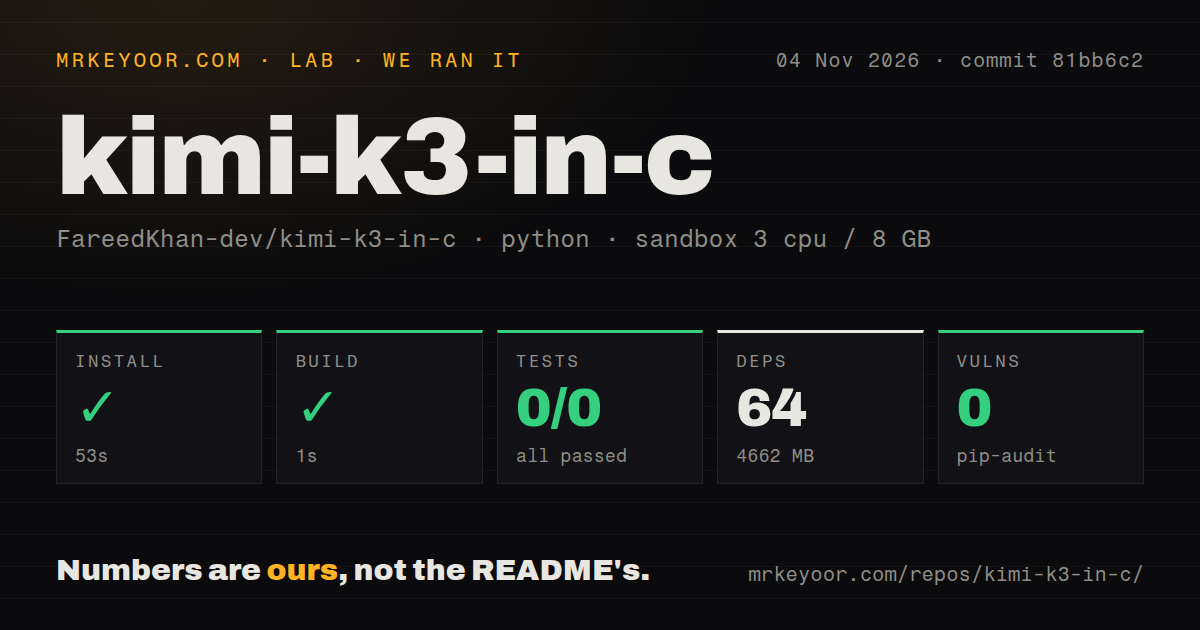
Our November 4, 2026 run at commit 81bb6c2 installed the Python dependencies in 53 seconds, recording 64 dependencies and 4,662 MB on disk. The checkout had 325 files, approximately 24,734 source lines and 45.6 MB. Its small checkout is separate from the model storage requirement.
The build step succeeded in 1 second. Tests exited 5 after 1 second, with pytest reporting 0 passed and 0 failed out of 0. The supplied tail says “no tests ran in 0.03s”. The command therefore supplied no passing test evidence. It also exposed no failed assertion that would establish an engine defect.
The runner classified the ecosystem as Python. GitHub identifies the primary language as C, and the project documents a make-based route. Without the exact build command and full toolchain logs, a successful recorded build does not establish which engine artifact was compiled. Nor does pytest's empty collection establish that the project has no tests.
pip-audit reported 0 known vulnerabilities. That is the reported dependency-audit result, not an assessment of C memory safety or the correctness of generated text. The scan found one CI workflow file and a tests directory, with no Dockerfile. None of those observations substitutes for exercising the intended engine workflow.
The recorded sandbox configuration was 3 CPUs, 8 GB RAM and image ghcr.io/astral-sh/uv:python3.12-bookworm. Actual runtime and operating-system versions require the raw toolchain logs. We cannot use the image name to diagnose the empty pytest result or to claim that full inference fits that sandbox.
The C verification route is a separate next step
The README documents a C compiler and make, with Python used for download, packing and analysis tools. Its quick start names make test as the verification entry point. The Makefile has a test target depending on the CLI and test binaries. That is a route to investigate, not a passing result from our run.
Start there before fetching the checkpoint. A reproduced C verification result would answer a different question from pytest discovering nothing. Keep the selected revision and actual command with the result so a future reader can tell which execution path you checked. This review does not rerun or certify that path.
For full inference, the documented download script requires a Hugging Face token and separate weight acquisition. The repository's Apache license does not grant rights to those weights. Check their own terms before downloading them for your intended use. The source also lists platform and CPU-instruction requirements, which should be checked against the target machine before reserving storage.
Text chat leaves application interfaces for you to solve
The documented scope supports text-only XTML chat while excluding tools, image input, HTTP serving and context compaction. For a person experimenting at a terminal, that may be an acceptable boundary. For an agent backend needing tool calls or a web application's inference endpoint, it is a reason to choose another project or explicitly budget development work.
The README also states that it provides no perplexity or task evaluation. Matching reference execution and getting useful answers for a workload are different checks. Our lab establishes neither. Before accepting this engine for a real task, decide what evidence you need about output correctness and whether the project's stated scope can supply it.
A serving requirement points toward other projects
llama.cpp documents an OpenAI-compatible API server. Ollama documents a REST API for running and managing models. Evaluate those when a callable application interface is the requirement. These comparisons do not establish that either runs this Kimi checkpoint, and we have no comparative setup or performance measurements.
The last push was October 2, 2026. The public feed showed open pull-request activity on November 4, so the push date alone does not justify calling the project abandoned. Proposed changes are also not shipped behavior. We did not assess support responsiveness or maintainer capacity.
Documentation receives 4 on an editorial scale where 1 means an entry description, 3 means actionable instructions with gaps and 5 requires detailed instructions independently checked in use. The concrete prerequisites and explicit scope justify 4. Other dimensions remain unassessed. Before allocating checkpoint storage, reproduce the documented C verification route and decide whether text-only terminal operation actually answers your requirement.