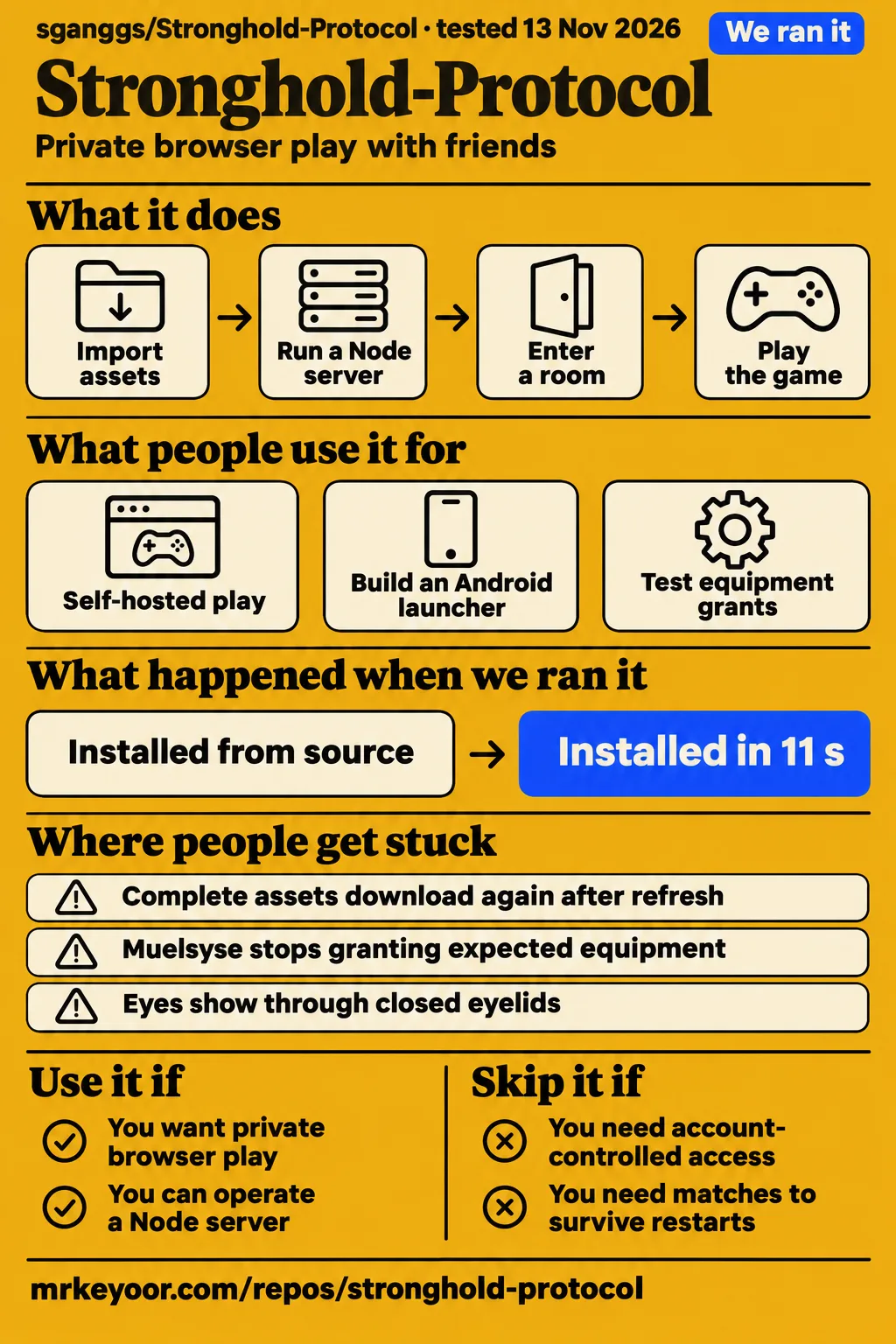
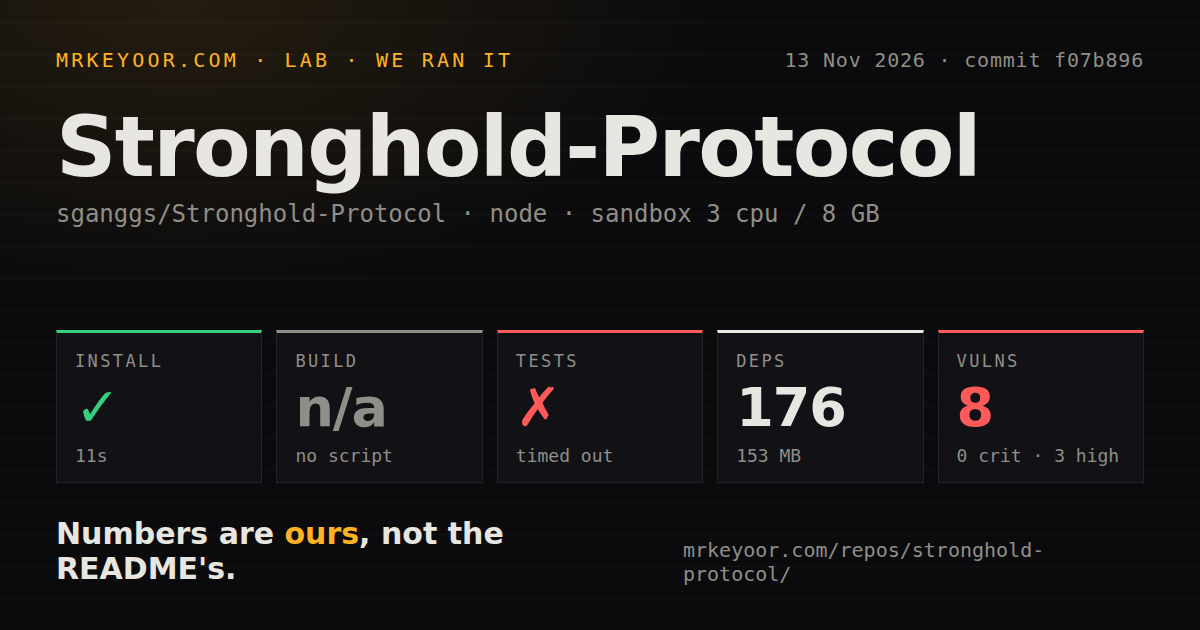
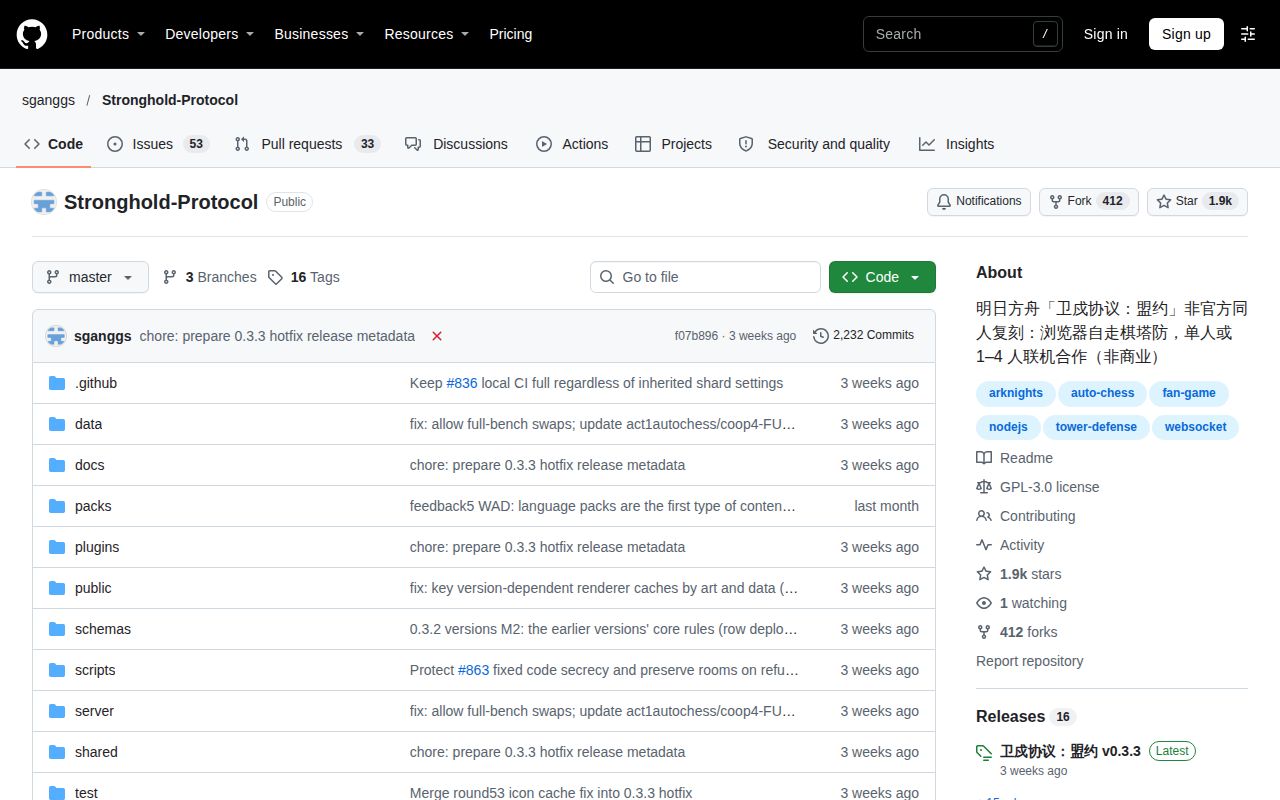
Stronghold-Protocol installed in 11 seconds in our sandbox, but its tests timed out after 900 seconds. It is a candidate for a private Arknights group with someone prepared to operate a Node server and follow release-specific corrections. Its documented access model and non-commercial terms make it a poor fit for an account-controlled public game service or paid offering. This review concerns sganggs/Stronghold-Protocol, the unofficial browser remake of Stronghold Protocol: Alliance.
What people use Stronghold-Protocol for
Users report self-hosted play, an Android import-to-start flow and repeated equipment-grant experiments with friends. These are attributed reports from the supplied issue history. They give a prospective host concrete workflows to compare with their own plans: preparing assets, embedding the game in a launcher, and reporting a reproducible rule discrepancy. Each report below links to the discussion where its participants described the result.
| Who | What they did | Reported outcome |
|---|---|---|
| GitHub user RushFTK | Hosted the game and downloaded the complete asset collection | Downloads recurred after refresh, including after moving to HTTPS. The maintainer later checked a partial download using the development fix on the user's server. Asset-cache report #725 |
| huajixiaobai and their Android launcher team | Wrapped a local Node service in WebView and imported an upstream package | They reported completing ordinary import through game startup, then raised plugin selection, file access and format compatibility concerns. Android integration discussion #454 |
| saltwmc and friends | Repeated Muelsyse equipment-grant scenarios | They reported five consecutive games identifying the equipment-pool limit. The maintainer reported a correction in 0.2.5. Equipment-grant report #488 |
| Stickman618 | Played with AI teammates and acquired Muelsyse under the Investor alliance | Missing items came with an insufficient-stock warning. The maintainer linked this to the fixed-grant regression corrected in 0.2.5. Investor grant report #521 |
The Android authors describe an embedded Node service running an imported upstream package locally. Their follow-up explains why plugin selection affects a launcher differently from a desktop host: the landscape screen has little spare space, WebView already occupies the interface, and Android file access complicates folder-based installation. A fixed server plugin set addresses the selection workflow they requested. Package import and mobile distribution still have their own implementation work.
What happened when we ran it
Our run installed dependencies in 11 seconds at commit f07b896 on November 13, 2026, then reached the 900-second test timeout. The sandbox configuration recorded 3 CPUs, 8 GB RAM and image lab-node:22. The checkout contained 2,370 files, approximately 477,918 source lines and 90.7 MB of repository data. These figures describe the measured checkout and sandbox, rather than a packaged release installation.
| Source-harness check | Our recorded result | What it means for your decision |
|---|---|---|
| Checkout | 2,370 files, approximately 477,918 source lines, 90.7 MB | These are checkout measurements. |
| npm installation | Succeeded in 11 seconds; 176 dependencies recorded; 153 MB on disk | Dependency installation completed in this sandbox. |
| Build | No build script or target; skipped | The harness recorded a skipped build. |
| Tests | Timed out after 900 seconds | The command reached the harness time limit. |
| npm audit | 8 known vulnerabilities: 3 high, 5 moderate, 0 critical, 0 low | These are dependency advisory counts for the checkout. |
| Repository signals | 3 CI workflow files, a Dockerfile and a tests directory | The harness recorded these files and directories. |
The test-log tail records successful combat-time and boss-layout subtests. The combat-time entry concerns conversion from real seconds into game seconds at forced 2× speed, with duration_ms 6.380779. The boss-layout entry concerns the player's boss field, leader weighting and mirrored sides, with duration_ms 106.232872. The command subsequently has a timeout result; the supplied tail gives no cause for it. Subtest identifiers in that tail are not a count of passing tests.
The separate deployment attempt failed its safety step because none of compose.yaml, compose.yml, docker-compose.yaml or docker-compose.yml existed. Its generic run record nevertheless says it deployed using Docker Compose with every port bound to 127.0.0.1. The detailed failure takes precedence in this account. Teardown reported ok. These are our separate hands-on records: safety failure, conflicting run statement and teardown outcome.
The missing Compose file explains the runner's refusal under its own requirement. Upstream documents a direct Node process and deployment with the repository's Dockerfile, so that refusal is not a finding that the application is undeployable. For a host choosing an installation route, the distinction matters: dependency installation completed, while the separate deployment attempt stopped at its safety check. The two records describe different steps.
Where people get stuck: asset storage and release-specific rules
Issue #725 separates ordinary HTTP caching from persistent imported asset storage, while the gameplay reports identify corrections by release. That distinction helps a host choose the relevant troubleshooting path. A repeated download button, an old gameplay complaint and a current recurrence need different evidence. The table preserves the reported symptoms and maintainer responses without treating the issue history as results from our sandbox.
| Symptom | What the source says | Useful response |
|---|---|---|
| Complete assets appear to download again | RushFTK reported renewed traffic after enabling HTTPS. The maintainer described a storage change in development for 0.3.4. | Compare the same asset's transferred bytes, status and cache headers across refreshes; the maintainer offered asset import as a workaround. |
| Muelsyse stops granting expected equipment | The maintainer identified a 0.2.4 regression and reported its correction in 0.2.5. | Follow the final grant-stock explanation in #488. |
| Maps look too dark | In lighting report #549, the maintainer reported a 0.3.0 lighting rework; a reporter said brightness looked similar to the official game. | Include the installed version when reporting a recurrence. |
| Eyes show through closed eyelids | In animation report #177, the maintainer reported eye hiding in 0.2.2 and broader coverage in 0.3.0. | Name the operator and animation. |
| Sleeping enemies consume Blemishine's blocking capacity | In mechanics report #140, the maintainer corrected an earlier explanation and reported a 0.1.4 fix. | Use the corrected rule: sleeping enemies release blocking capacity. |
In #725, the maintainer initially explained that ordinary HTTP cache can serve files without HTTPS and requested transfer details. RushFTK then supplied evidence of renewed traffic on an HTTPS deployment. The development change stores preloaded files in site storage on HTTPS or localhost, alongside imported assets. The maintainer later corrected the claim that every file had been evicted: small files mostly remained cached, but accounted for little of the transferred volume.
The equipment discussion contains an equally consequential correction. According to the maintainer, fixed gifts still occupy equipment stock, but exhausted stock should not prevent their issue. Investor multiplication follows that exception too. While holdings exceed the cap, the shop stops offering that equipment. The proposed patch making gifts consume no stock was rejected. Shop purchases, ordinary item rewards, random grants and ordinary strategy items retain their stock restrictions.
Issue #140 also records corrections to Ægir revival allocation and devouring a teammate's operator during joint defense in 0.1.4. A later comment says Blemishine's third skill would activate when a target is in range, for release in 0.3.2. These are separate mechanics within one discussion. Keeping their names and release labels together makes the thread useful when diagnosing a similar report rather than assuming that every comment describes one defect.
A single Node process makes restarts consequential
The README says rooms and matches are stored in memory, and restarting the server ends every match. For a private game night, that makes update timing an operational choice: finish the group's session before restarting the process. A browser interface does not remove the server's role in retaining room and match state. Hosts should plan around the documented lifecycle when changing their installation or configuration.
Upstream describes a single persistent Node process with WebSocket traffic at /ws, deployment at the domain root and a reverse proxy forwarding WebSocket upgrades. It says this model is unsuitable for static hosting and serverless platforms such as GitHub Pages and Vercel. The documented options include LAN access, virtual networking, tunnels and a VPS. Those options describe ways to reach the same persistent service, with different setup requirements for the host and players.
Security starts with who can reach the address
The README says there is no account system and anyone who knows the address can enter. It asks hosts to share the address with friends rather than publish it or build a public lobby. That access model is a concrete reason to consider a private network for a small group. A room key and a reachable server address should be understood in the context of those documented instructions.
The supplied README says script execution is disabled by default. It documents optional sandbox execution and a separate trusted native mode requiring review, locked hashes and player consent. By contrast, #454's account of the initial 0.3.0 importer says it would not run programs from imported workshop packages. Those statements concern different documented stages and mechanisms. The older import discussion should retain its 0.3.0 attribution rather than become a blanket description of all current plugin behavior.
The README licenses the project's own code under GPL-3.0-or-later and excludes Arknights art, audio, text and data. It also describes the project as unofficial, unaffiliated and for personal non-commercial use, explicitly excluding paid servers and other monetization. These are upstream's stated terms. A prospective host needs both the code-license information and the separate asset restrictions when deciding whether this project fits the intended service.
English play is documented; much of the support history is Chinese
The README documents an English interface, an English summary and English technical references, while the examined issue discussions are predominantly Chinese. Players can switch language on the title screen or in Settings. For an English-speaking group, that supplies a documented entry route into the game. The linked issue history remains useful when a host needs the details behind a release-specific correction.
The documentation index identifies English architecture, simulation, data, asset and internationalization references, plus an English contribution summary. Translation still needs care around mechanics: a gift ignoring exhausted stock differs from a gift never occupying stock. The maintainer's final decision in #488 preserves that distinction. Linking the original discussion alongside an English explanation lets readers trace the rule and distinguish it from an earlier proposed patch.
Stronghold-Protocol vs the official mode and Forge
The official Arknights mode is a rule reference in #488, while Forge's README describes a graphical editor and a bundled game. These choices therefore answer different immediate needs: playing the official implementation, controlling a private host, or authoring content. Forge is more than an editor-only repository, even though its README calls the editor the main component. Its supplied description also identifies a mod layer and the included upstream fan game.
| Choice | Evidence-backed reason to consider it | Decision boundary |
|---|---|---|
| Official Arknights Stronghold Protocol mode | Contributors in #488 used official gameplay to compare a specific equipment-grant discrepancy. | Choose it when playing the official implementation is the objective. |
| sganggs/Stronghold-Protocol | The README documents private browser play and server-installed plugins. | Choose it when operating the host and choosing room content are part of the task. |
| XiaMo233M/Stronghold-Protocol-Forge | Its README describes a graphical content editor, zip export, a mod layer and an included fan-game implementation. | Consider it for creating workshop content; upstream import converts supported portions into upstream plugins. |
The equipment-grant comparison in #488 names the affected 0.2.4 behavior and the maintainer's reported 0.2.5 correction. It supplies a specific fidelity comparison. Forge's README supplies the separate authoring workflow. Read these sources according to the job each describes: a rule discrepancy and its correction are different decision evidence from an editor's content-creation features.
Which Stronghold project this review covers
This review covers sganggs/Stronghold-Protocol, the unofficial Arknights browser game, rather than the similarly named NFT membership and payments projects in the supplied search material. The search ambiguity starts with identity. A page using the words Stronghold or Protocol may describe another entity entirely. Its claims should stay attached to that entity instead of being transferred to the repository reviewed here.
The supplied synthesis identifies an NFT membership page, a payments article and an official-game wiki page among those results. The SHx business article, for example, describes a payments startup. These pages are not competing self-hosting reviews of this repository. There are no staleOrWrong entries in the research analysis, so the evidence supports explaining ambiguous search results without alleging that another review made an error.
The architecture discussion also needs its own scope. In architecture issue #156, the maintainer described partial modularization and engineering checks in 0.2.0, then excluded the larger independent-engine, P2P, cloud-save and LLM-teammate proposals from that refactor. The later plugin implementation has separate evidence in #454. A closed discussion records its actual resolution; it does not turn every proposal in the thread into a released feature.
Questions people ask
Workshop imports are partial, fixed plugin sets are documented, and the asset-preload fix is described in development for 0.3.4. The answers below keep those release labels attached to the relevant statements. They cover the questions present in the supplied synthesis: asset downloads, workshop conversion, fixed room configuration, third-season support, equipment grants and a reported Skadi revival incident. The latest-release endpoint supplied for this review returned v0.3.3.
Why does downloading the complete asset collection still cause downloads after a refresh?
The maintainer attributed #725's repeated transfers to HTTP-cache limits and described a development fix for 0.3.4 using site storage on HTTPS or localhost. The same discussion distinguishes imported assets from the older preload cache path. A reappearing button alone does not show transferred bytes. The asset-storage discussion records the requested network details and the maintainer's later correction about small files remaining cached.
Does the plugin system support existing community workshop packages?
The maintainer says the 0.3.0 importer converts supported data, skins, voices, icons, text and announcements into upstream plugins. That is a conversion of mapped content rather than original-format compatibility with every workshop field. The workshop import discussion also explains that the server tells the page which plugins the room uses and the page retrieves content by hash, instead of requiring a launcher to build that selection and checking process itself.
Can a server or Android launcher fix the plugin selection before players enter a room?
In #454, the maintainer documents rooms: "fixed" in plugins/config.json for a fixed room set, and default for plugins enabled in new rooms. These settings answer different host choices: fixing the selection or supplying its starting state. The fixed-room configuration discussion describes the settings but does not supply a complete configuration file, so this review presents them as documented fields rather than an executable JSON example.
Does the project support third-season gameplay yet?
The maintainer reported merging the new mode into dev on November 9 for release in 0.3.4; the supplied latest-release result is v0.3.3. The third-season tracker describes the development implementation and requests official material for assumed rules. Those release labels matter when choosing a download: a development branch description and the latest packaged release refer to different artifacts, even when both appear in the same discussion.
Should operators' fixed equipment grants be limited by shop stock?
The maintainer's reported 0.2.5 correction lets fixed gifts issue when stock is exhausted, including Investor multiplication. Those gifts still occupy stock, and the shop stops offering that equipment while holdings exceed its cap. The final grant-rule correction explicitly rejects the proposal that gifts consume no stock. That final explanation is the useful rule to retain when reading the earlier implementation proposals in the thread.
Why can Skadi fail to revive immediately despite having more than 200 Resilient stacks?
The maintainer reported immediate redeployment when repeating the stated conditions: about 246 Resilient stacks, five Ægir operators and an empty fallen tile. The Skadi follow-up in #108 distinguishes that result from ordinary redeployment when the tile is occupied. It asks for video if the incident recurs, making the tile state and recorded conditions useful details for a further report.
How we scored the evidence
Documentation receives 4/5 and community receives 3/5 under an editorial rubric based on the supplied README and issue history. A score of 1 means a documented major obstacle, 3 means useful material with substantial constraints, and 5 requires broad corroboration; intermediate scores sit between those anchors. Documentation earns its score for setup instructions, hosting requirements, English references, plugin guidance and licensing distinctions. Community earns its score for concrete reproductions and maintainer corrections.
Setup ease and maturity receive N/A because the evidence stops at dependency installation, a blocked deployment attempt and a timed-out test command. The community score measures the usefulness of the examined support exchanges, rather than adoption. The documentation score concerns what the supplied text explains, rather than a completed installation from those instructions. The repository metadata records a November 13, 2026 push; the supplied latest release is v0.3.3, published October 24, 2026.
What we have not tested yet
Our evidence does not include a completed game session, browser rendering, multiplayer synchronization, Android launcher operation, plugin execution or a full asset preload. The recorded image label establishes neither the actual runtime version nor the operating-system version. The measured commit is f07b896; the supplied records do not establish that its behavior matches every feature in the later README or development discussions. There are no screenshot records or known-answer gameplay questions in the hands-on pack.
The supplied #725 discussion still requests a complete Windows Chrome download-and-refresh confirmation after partial testing on the user's server and separate local testing. Third-season hidden-core thresholds and other assumptions need official evidence. The supplied #140 material does not confirm the requested boss visibility and matching-equipment shop indicators. The cause of the reported Skadi incident is unresolved; an occupied tile is a possible explanation rather than a demonstrated cause of that incident.
We have not measured concurrent rooms, server memory during play, browser frame rates, network latency or comparative performance against Forge or the official mode. The audit counts have not been mapped to reachable code, and this review supplies no authentication or sandbox-isolation audit, asset permissions determination or legal clearance. The initial 0.3.0 import discussion also records no client-to-server plugin upload and no execution of imported package programs. A complete private match using the intended release, browsers and plugin set is the next useful evaluation step.