One TOML file can follow you across many shells
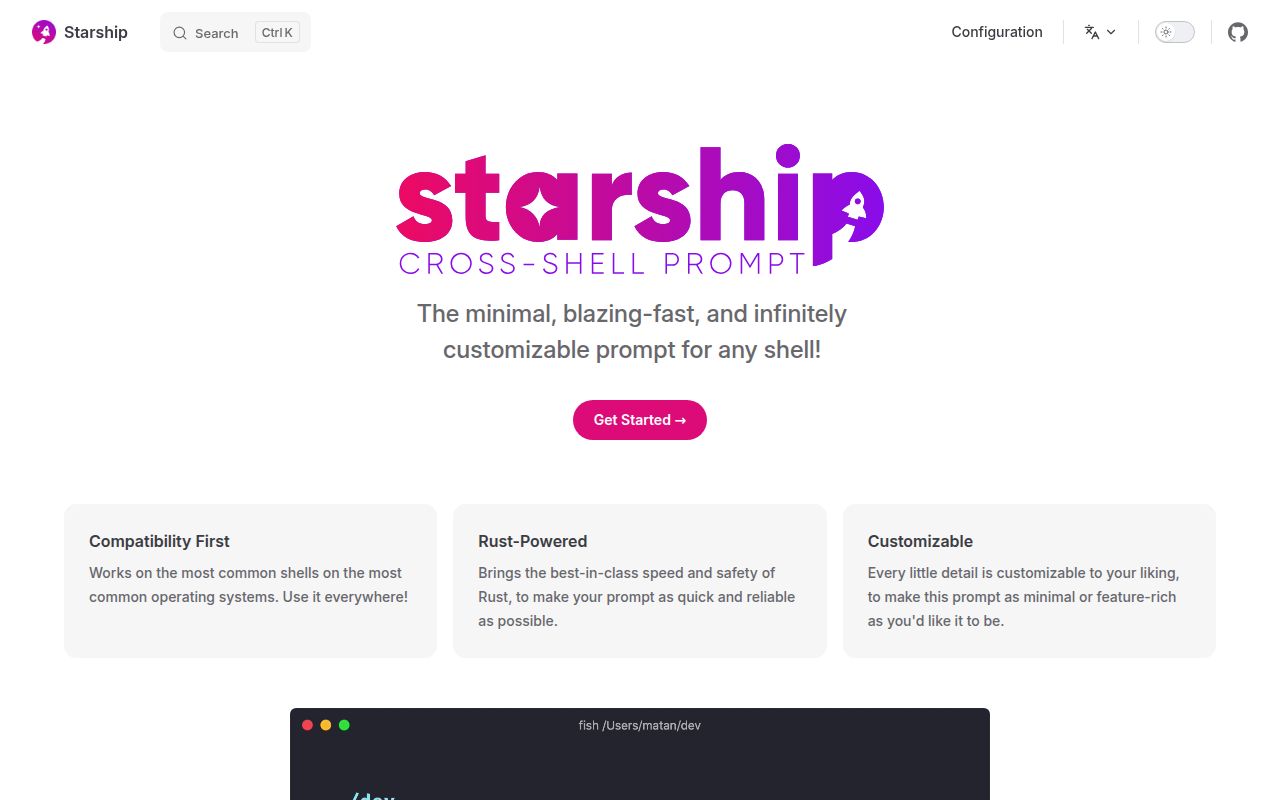
Starship puts prompt rendering in one Rust executable instead of reimplementing the same information in each shell's scripting language. The README documents setup for Bash, Zsh, Fish, PowerShell, Cmd through Clink, Elvish, Ion, Tcsh, Xonsh, Nushell, and several others. A user adds one initialization line to the shell profile, while ~/.config/starship.toml controls layout, symbols, colors, and which modules run.
The payoff is strongest for people who regularly switch between macOS, Linux, Windows, or multiple shells. Directory and Git information can look alike everywhere, and language or cloud modules appear only when relevant files or environment details are present. The repository also ships presets for users who prefer a starting design. A single-shell user with a settled prompt gains less because Starship introduces another executable and configuration format for information the shell can already produce.
The default icons require a Nerd Font and shell-specific initialization
The README names a Nerd Font as a prerequisite for its default symbols. Installing the Starship binary is only the first step: each shell needs its own initialization command in a profile file. Cmd additionally requires Clink 1.2.30 or newer. Package choices range from system repositories and Homebrew to Cargo, Conda, Chocolatey, Scoop, Winget, and a project installation script.
None of this needs credentials or a daemon. That makes rollback simple: remove the initialization line and your previous prompt returns. Font configuration is the common snag because the font belongs to the terminal emulator, while Starship runs inside the shell. If icons render as boxes, changing TOML will not fix the terminal's selected typeface. Teams rolling out a preset should document the binary source, font package, shell profile location, and config path together.
What happened when we ran it
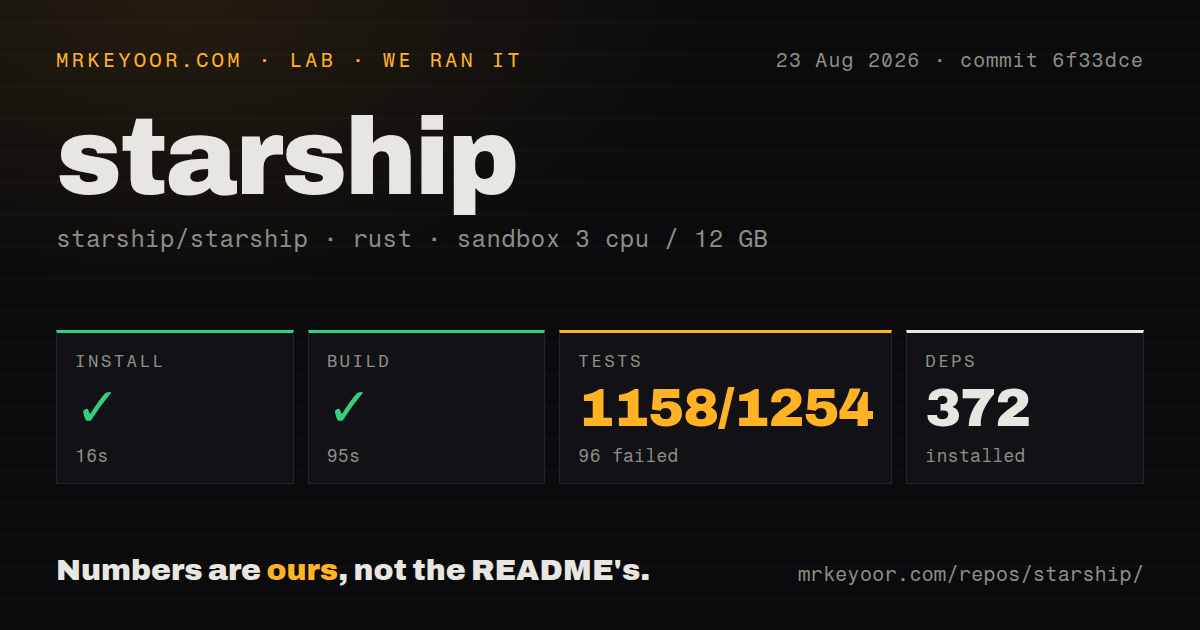
Our sandbox installed 372 Rust packages in 16 seconds from commit 6f33dce. The build then succeeded in 95 seconds. The source checkout was 21.9 MB, with 812 files and about 53,376 lines of source. We found eight CI workflow files, no Dockerfile, and no top-level tests directory. Rust tests can live beside the modules they cover, so that directory signal does not mean the project lacks tests.
The Cargo test command failed with exit code 101 after 134 seconds. Its final result reported 1,158 passed and 96 failed out of 1,254 executed tests. The log tail lists failures in prompt-printing cases such as custom_prompt, env_expands, main_prompt, right_prompt, and test_prefer_user_profile, then says to rerun with --lib. It does not provide assertion messages or a common cause in the supplied excerpt.
That result is enough to reject a clean-test claim and no more. Installation worked, compilation worked, and most executed cases passed. We cannot say whether the 96 failures came from the container environment, missing assumptions, or a regression because the available tail does not show that evidence. A contributor should rerun the library suite with full output on a supported host before changing prompt formatting code.
Prompt speed depends on every enabled module's command
A prompt runs after almost every command, so a small delay repeats all day. Starship is written for speed, but modules may still inspect a repository, read project files, or invoke another program for its version. Open issue 7639 reports that the Swift module can spend about 100 milliseconds on swift --version in a warm case and far longer after idle time on one macOS setup. That report attributes the delay to the external command rather than a measured Starship rendering benchmark.
Windows and WSL deserve their own trial. The documentation already warns that Git status can be slow in Windows directories mounted under WSL and suggests a Windows-native executable. Issue 7677 reports slow Git modules even with native Windows Starship and Git installed through Scoop. If prompt delay appears, use Starship's timing tools, test modules separately, and disable context that costs more than it helps. A beautiful Git status is a poor trade if every Enter key waits for it.
Cross-platform configuration still has platform edges
The same TOML file is a major reason to choose Starship, yet identical text does not guarantee identical rendering. Issue 7676 shows a multiline literal format producing a different trailing line on Linux and Windows PowerShell with v1.26.0. Issue 6981 reports that Git worktrees can lose the parent repository name in the displayed directory context across Fish and Nushell. These are specific workflow defects, rather than reasons to dismiss normal prompt use.
Release provenance also matters on managed machines. An open report says the v1.26.0 macOS artifact was only ad hoc signed after the release signing workflow failed, which caused endpoint-security slowdown for that user. Homebrew or a locally built binary may follow a different trust path, but an enterprise rollout should inspect the exact artifact it plans to distribute. Prompt software launches constantly and sees the working directory plus environment, so normal binary verification rules apply.
August pushes and June v1.26.0 show active maintenance
GitHub recorded the last push on August 27, 2026. The latest release was v1.26.0 on June 28, and the repository had 59,621 stars plus 1,041 combined issues and pull requests when fetched. Recent open reports and pull-request updates cover Windows performance, worktrees, prompt formatting, new shells, and language modules. The large combined queue should not be read as 1,041 bugs.
Starship has enough installation choices, translations, presets, and module documentation to make a low-risk personal trial. Its strongest case is portability: one executable and one configuration can replace several prompt implementations. The failed source suite keeps the contributor score below perfect, and the platform reports justify testing your slowest repository and strictest managed machine. For most developers, that test takes less effort than maintaining a comparable prompt separately in every shell.