The 1.4 MB checkout indexes words and returns IDs
Sonic's 1.4 MB checkout contains a search server with a deliberately small data model. You push text beside an object ID into a collection and bucket. A query returns matching IDs, which your application resolves against its primary database. Sonic never stores the full document in its v1 index. This arrangement is a good fit for messages, contacts, or help articles that already live in a database and need a separate keyword index.
The repository still contains 291 files and about 44,836 lines of source because the small interface sits on real storage and language machinery. Sonic uses RocksDB for identifier data and a finite-state transducer for words. It can detect language, remove stop words, correct some typos, and suggest word completions. The README lists more than 80 languages for lexing, with stemming available for a smaller subset. Chinese and Japanese tokenizers are optional build features.
What happened when we ran it
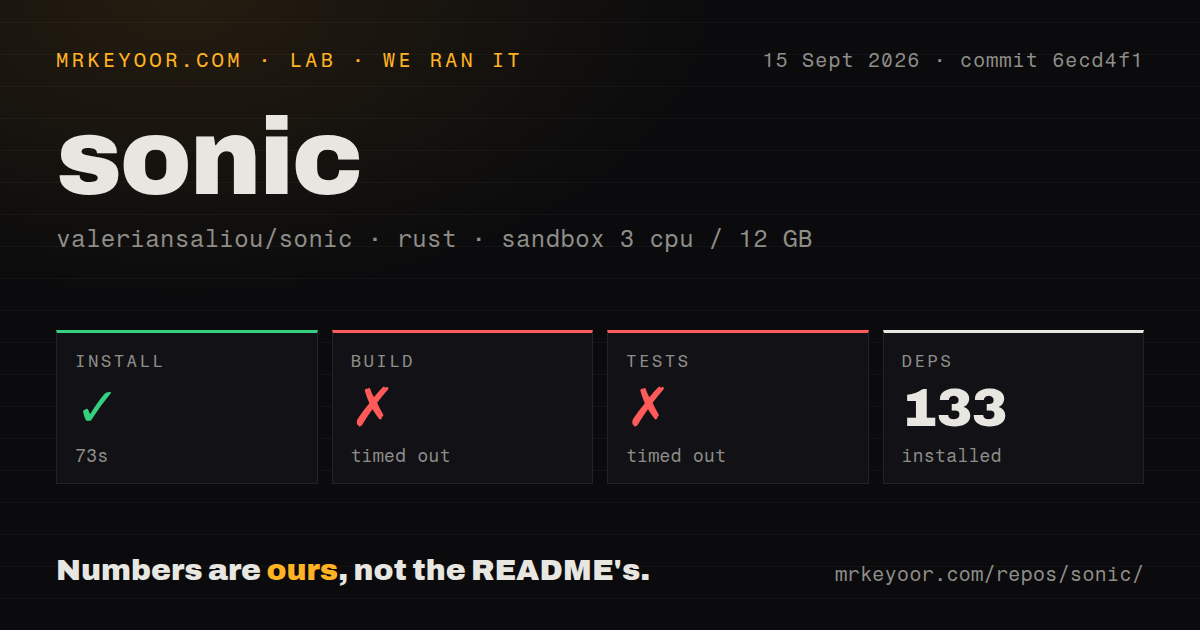
Our sandbox installed 133 packages in 73 seconds at commit 6ecd4f1. The build then reached the 900-second limit without finishing. The checkout had 4 CI workflow files and a Dockerfile, while the lab scanner reported no tests directory. These measurements came from an unprivileged Debian container with 3 CPUs, 12 GB of RAM, no secrets, and the lab-rust:1 image.
The test command also timed out after 900 seconds. Its final lines showed Cargo compiling tinytemplate, criterion, parquet, hf-hub, tokio, and other crates. There was no assertion failure or completed test summary in the supplied log. We therefore have no test count and no runtime search measurement to report. The accurate finding is that neither source compilation path completed inside a 15-minute window on our stated box.
Version 1.9.1 still speaks its own TCP protocol
Sonic v1.9.1 listens on TCP port 1491 by default and uses Sonic Channel for search, ingestion, and control. A connection starts in one of those modes and authenticates with the configured password. The project lists official Node.js, Rust, and PHP clients, plus community libraries for several other languages. If your stack lacks a suitable client, the protocol document is detailed enough to implement one, including asynchronous response markers and command size handling.
There is no HTTP endpoint. That keeps the server interface compact, though it puts a translation layer between Sonic and any web or serverless code that only speaks HTTP. Search results contain IDs without document bodies or match snippets, so one user query becomes at least one Sonic request plus a database lookup. Our 900-second build result does not change that architecture. It tells you the source toolchain is another component to budget alongside the runtime integration.
One thousand recent links per word is the default
The default retain_word_objects value keeps 1,000 object links for each indexed word, clearing older links as newer ones arrive. You can change the limit, yet the sliding window remains part of the design. Sonic also works at the word level rather than the sentence level. It can autocomplete a word and try alternate spellings. It cannot model sentence meaning, return the next likely word, or replace vector retrieval for conceptually similar text.
Issue 402 states that Sonic v1 cannot return snippets because original text is absent from the index. Maintainer updates show experimental v2 work on storing originals and scoring windows, which is useful activity rather than a shipped v1 feature. Suggestions have their own delay: the FST graph is rebuilt in batches, with a 180-second default consolidation interval. An operator can trigger consolidation sooner when newly pushed terms must appear immediately.
The v1.9.1 package is easier than compiling RocksDB
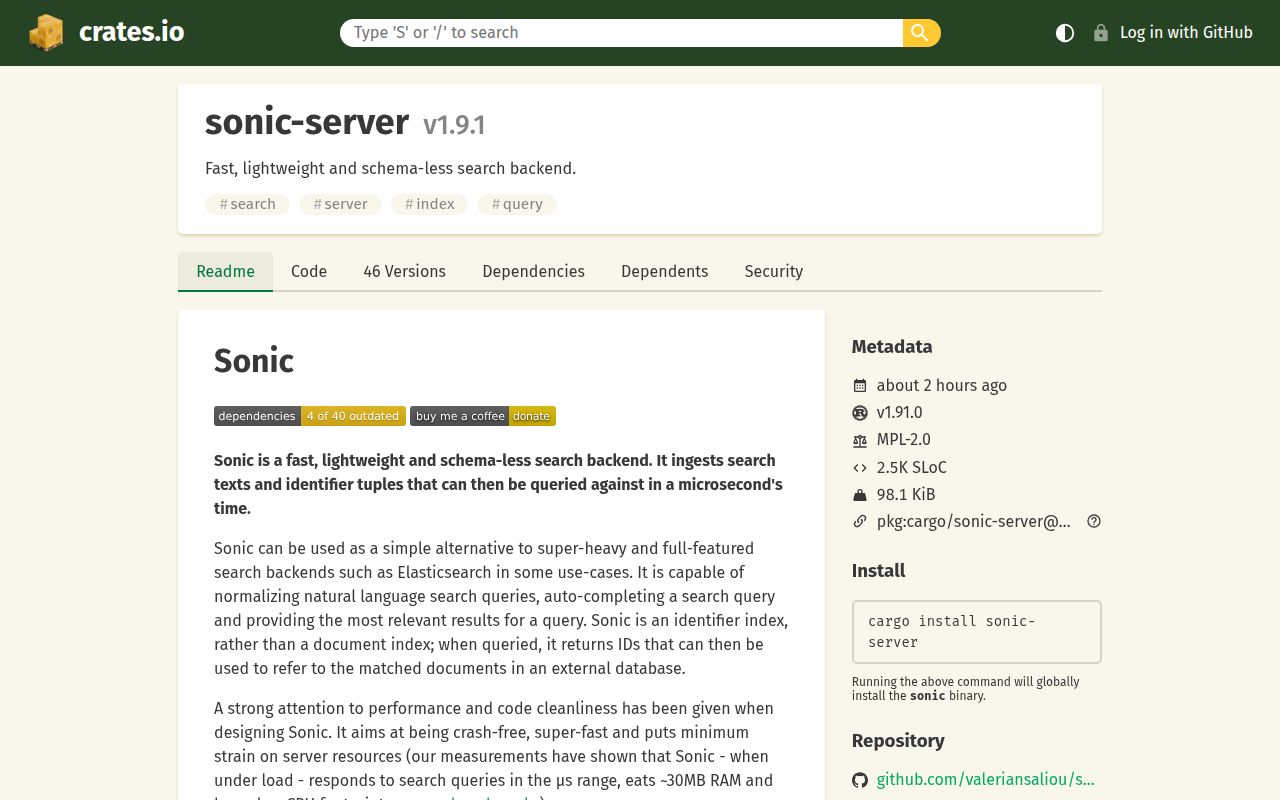
The official binary package targets 64-bit Debian 12, and the source declares Rust 1.91.0 as its minimum. Building locally also requires build-essential, Clang, LLVM development headers, a C library development package, and a C++ compiler for RocksDB. Prebuilt packages or the Docker image avoid waiting for that native dependency chain on each clean machine. The README's Docker example has a copy-and-paste trap: it pulls v1.9.1, then runs v1.4.9.
Configuration can live in TOML or SONIC_ environment variables. The default listener is local, while containers need an explicit external bind. Authentication is optional in the configuration schema and recommended by the project. Persistent deployments must mount both the KV and FST paths and keep them on SSD storage because searches make random disk accesses. Changing normalization or tokenization settings can require a full re-ingestion, so those choices belong in deployment review before indexing production data.
A same-day v1.9.1 release shows active maintenance
GitHub recorded a push and the v1.9.1 release on September 15, 2026. The repository had 21,340 stars and 63 combined open issues and pull requests, split into 61 issues and 2 pull requests. Version 1.9.1 changed the Docker base and fixed a panic when a channel read fails. Version 1.9.0 had shipped earlier that same day, and v1.8.1 followed a breaking v1.8.0 configuration change in August.
Issue activity has substance. Issue 389 tracks lock contention that can delay reads during storage work, and it contains tests and maintainer discussion rather than a bare complaint. Issue 402 has recent implementation notes for snippets. The current release cadence and same-day bug fix indicate active ownership. They do not erase the boundary around v1 features, and a team should pin patch versions because the August configuration regression required an immediate corrective release.
Choose Sonic only when narrow search is the requirement
Our 900-second build timeout makes Sonic a poor source dependency for disposable CI jobs, although a published package can skip compilation. Choose it when you need keyword lookup or autocomplete over IDs and already have the database around it. Skip it when search must return documents, snippets, filters, semantic matches, or HTTP by itself. Our run did not verify speed because compilation never completed. Benchmark v1.9.1 on your SSD and count the extra database fetch before deciding that the smaller index is cheaper.