Tantivy 0.26.1 is an embedded engine, not a server
Tantivy creates and searches local indexes inside a Rust program. It has no built-in cluster, user management, hosted dashboard, REST contract, or automatic sharding. The README explicitly sends people who need distributed search to Quickwit, which is built on Tantivy. That boundary is useful when search must live inside a command-line tool, desktop application, or custom service. It is disqualifying when the team wants a ready network product.
The library covers the inner search loop. It tokenizes text, builds an inverted index, ranks matches with BM25, handles phrase and range queries, and retrieves stored fields. Facets, JSON fields, numeric fast fields, compressed document storage, aggregations, memory-mapped directories, and configurable term positions cover many serious search workloads. A project still needs to prove its own relevance and resource behavior with representative documents and queries.
Language analysis has defined boundaries. The README lists stemming for 17 Latin languages. Chinese, Japanese, and Korean depend on named third-party tokenizer crates. A multilingual product should test recall, segmentation, and ranking separately for every supported language. A long tokenizer list does not show that one schema or analyzer configuration will serve every language well.
What happened when we ran it
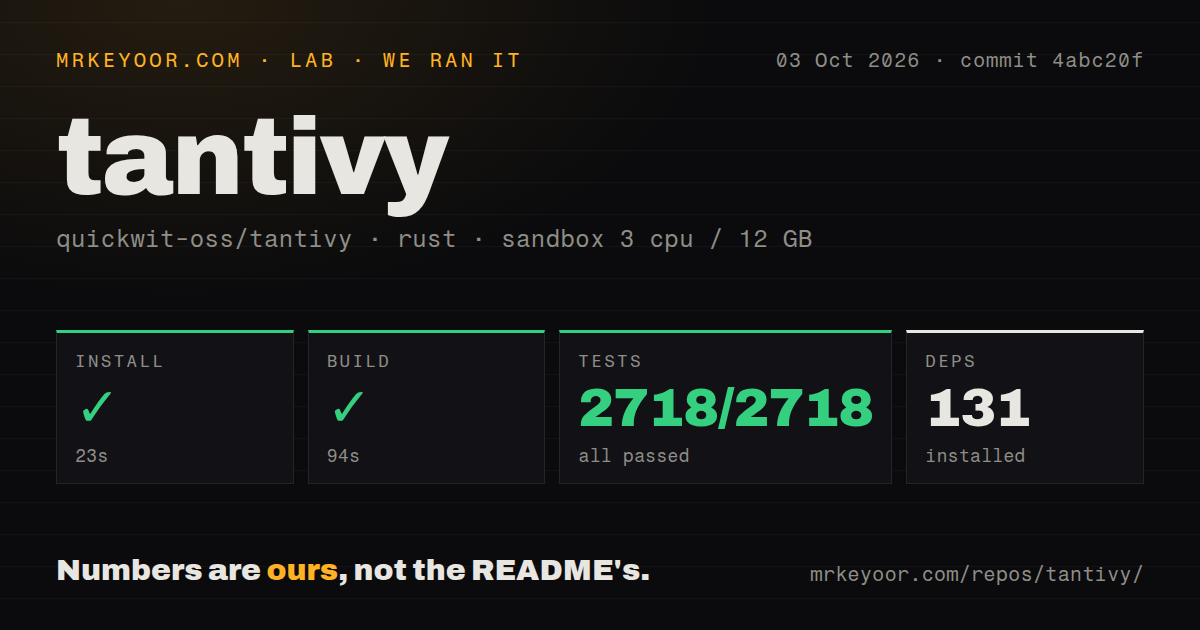
Our sandbox installed 127 packages from commit 266a6c4 in 31 seconds. The checkout contained 532 files, about 153,419 source lines, and 32.1 MB. The Rust build succeeded in 111 seconds in an unprivileged Debian container with 3 CPUs and 12 GB of RAM. No hosted service, account, or secret was needed.
Cargo tests completed in 268 seconds with 1,270 passed and 0 failed out of 1,270. The repository has 4 CI workflow files and a tests directory, though no Dockerfile. That is an unusually strong first run for a search library with storage, parsing, indexing, and aggregation code. It does not measure query latency, index size, recall, or performance on an application's actual corpus.
The project links its own public benchmark and warns that results vary with query shape and load. We did not rerun that benchmark, so our review makes no speed comparison with Lucene or another engine. The useful result from our box is narrower: source installation, compilation, and all discovered tests completed successfully within 410 seconds combined after checkout.
Commits and reloads define when 1 document becomes searchable
A schema declares each field and whether it is tokenized, indexed, or stored. Omitting stored data can reduce index size, but search results then cannot reconstruct that field from Tantivy. An IndexWriter receives documents and must commit before they become durable and searchable. Existing readers must reload, and only a newly acquired searcher sees the changed snapshot.
There can be only 1 writer, although it can index across threads. Searchers use immutable snapshots so a group of queries can see consistent state while another thread writes. Those rules are predictable, but the application owns commit frequency, reload policy, writer memory, and failure recovery. Frequent commits improve freshness and may create more segment work; infrequent commits delay visibility and increase the amount of uncommitted work.
Documents are immutable. Editing one means deleting it and indexing a replacement. That fits append-heavy documents, logs, catalogs, and mail archives better than rows changing on every request. Your service also owns stable document IDs, idempotent ingestion, migrations, backups, replication, tenant boundaries, request limits, and observability. Tantivy supplies the search engine core, not those surrounding guarantees.
Four-character malformed queries can hang a caller
Issue #3031 reports that strict parsing panics on malformed strings such as - * instead of returning its documented error type. The reporter says one production query aborted a search node. Issue #3032 covers a separate lenient-parser path: the 4-character input a:(^ did not terminate and sometimes led to very large allocation requests during longer randomized runs. Both reports remain open.
These are narrow reproductions, yet they matter for public search boxes because a short remote input can consume or terminate execution. Validate query length and syntax before parsing, bound request time and memory outside the parser, and consider isolating parsing from a multi-tenant process. A lenient function name is not a security boundary. Add both published reproductions to regression tests for any service that accepts user-written query syntax.
Windows has a separate commit warning. Issue #2847 describes an internal merge thread racing with the next commit while both update .managed.json. The reported result on Windows is PermissionDenied; the author also raises a possible last-writer-wins problem on Linux. The issue targets Tantivy 0.25.0 and remains open, so rapid repeated commits deserve platform-specific stress tests even though our Linux suite passed.
An August 26 push matters more than the 0.x version
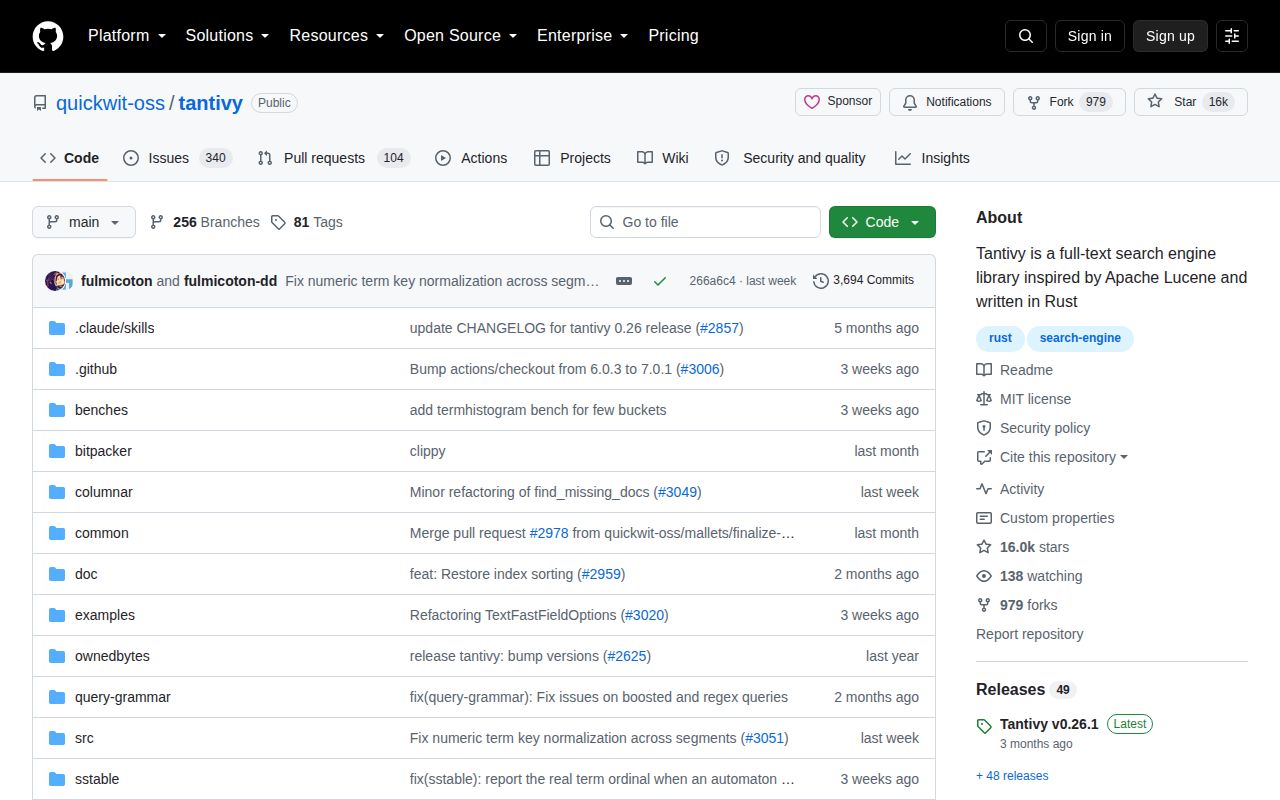
Release 0.26.1 arrived on May 10, 2026 with query grammar, aggregation, performance, overflow, and Boolean-query work. GitHub recorded another push on August 26. The repository had 15,988 stars and 445 open issues and PRs combined when fetched, with parser and in-memory-index discussions active that day. The queue includes proposed changes as well as reports, so it is not a defect count.
The project has a long history, MIT licensing, docs.rs references, examples, a CLI tutorial, benchmark code, and a candid non-features section. It also includes Claude Code skills for contributors. The pre-1.0 version still warrants pinned dependencies and release-note review, but the 1,270-test pass is stronger evidence than version-number anxiety. Pick Tantivy for embedded Rust search; pick Quickwit or Meilisearch when the service layer is the feature you need.