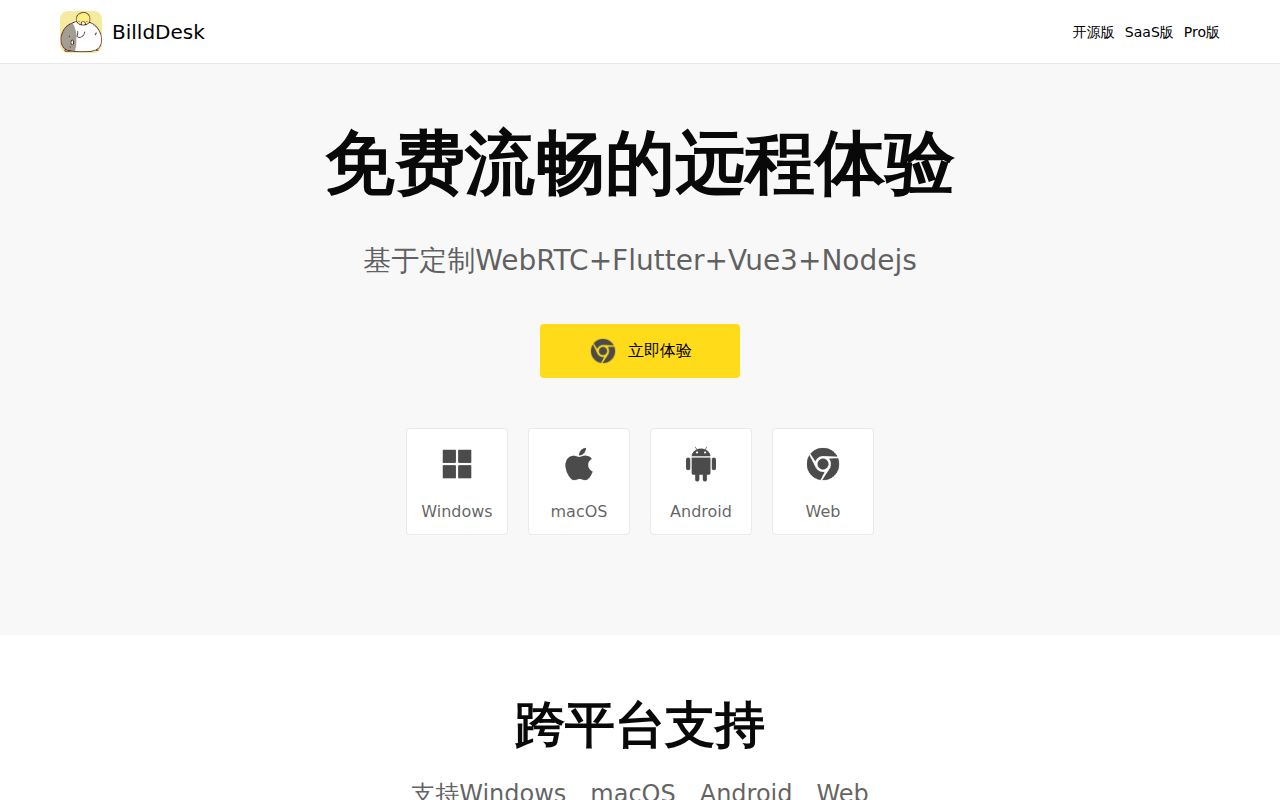
BilldDesk's main page presents Pro, while its public-edition guide advises against production use. Before evaluating remote support features, establish which edition you intend to deploy and which source terms apply.
Public source and Pro need separate decisions
The public-edition guide says BilldDesk has not released a stable version and advises developers against production use. It describes permission and control problems that the author considers almost impossible to fix within the existing architecture. Those are upstream statements. Our run did not reach a session that could reproduce either problem.
The main README says Pro is not open source and that its source requires purchase. The public guide describes Pro as a rewrite that fixes the known problems. We did not test Pro, so that claim cannot stand in for evidence about the public checkout or a Pro deployment.
For a developer studying desktop control, the public code is a candidate for investigation. For a support operator, the production warning is a reason to defer deployment until the selected edition and required functions have been evaluated.
What happened when we ran it
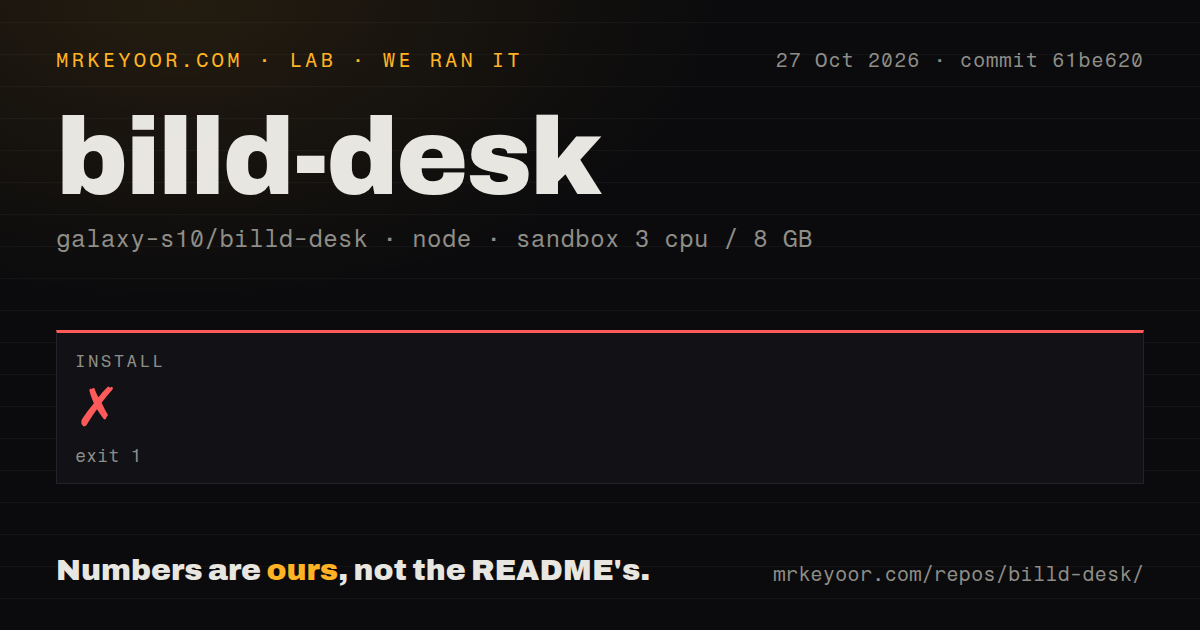
Our BilldDesk installation failed with exit 1 after 593 seconds at commit 61be620 on October 27, 2026. The checkout contained 191 files, approximately 14,659 source lines and 5.5 MB. The recorded sandbox configuration specified 3 CPUs, 8 GB RAM and image lab-node:22. That image label does not establish the actual runtime or operating-system version.
The pnpm log reports a metadata decoding error from registry.npmmirror.com for @nut-tree/node-mac-permissions. The response was missing a versions field, and the log includes ERR_PNPM_META_FETCH_FAIL. This identifies what failed during dependency installation. The package name does not establish a macOS permission failure on the host.
The log also reports a failed lockfile supply-chain policy check without enough detail to identify the policy or call a dependency malicious. A retry would need to preserve and investigate both messages. No successful retry is supplied.
No build, test or vulnerability-audit result follows. The scan found a tests directory, zero CI workflow files and no Dockerfile. A tests directory supplies no passing-test count. Connection establishment, input handling and session behavior remain unmeasured.
Setup instructions are still unverified here
The startup guide recommends Node 18 and pnpm 9 and asks developers to fill in src/spec-config.ts. These are documented instructions, not a setup we successfully reproduced. The supplied log does not connect the installation error to either recommended tool version.
The public guide lists separate client, server and administration projects. Its backend technology list includes MySQL and Redis. Before attempting a private deployment, identify the services you will operate and how the client settings connect to them.
The startup guide says packaging first invokes standard-version and requires an initialized Git repository. We did not reach packaging. Its listed build commands establish a documented workflow, not a successful build in our sandbox.
Verify the target platform and unattended behavior
Linux support and unattended operation were not verified in our run. The supplied public-guide extract does not preserve the checkbox states needed to establish the claimed contradictions between its feature and platform lists. Treat the required operating system, startup behavior and authorized input control as acceptance checks for the exact edition you evaluate.
The reviewed README and startup guide are Chinese; the packet supplies no English setup guide. In issue 105, the owner says multilingual support will be considered. That response does not establish an available English interface or a delivery date.
Choose alternatives by the job
RustDesk documents a choice between its rendezvous/relay service and infrastructure you operate yourself. Consider it when that infrastructure choice is central to remote support. This BilldDesk run provides no head-to-head reliability or setup comparison.
Sunshine describes itself as a self-hosted game stream host for Moonlight. Consider it when game streaming to a Moonlight client is the requirement. Its README also documents browser-based configuration and client pairing.
For a BilldDesk trial, start by selecting the edition and checking its terms. Then reproduce a connection and authorized control on the intended endpoints before evaluating unattended access.