mrkeyoor.com_
Fri 30 Oct 21:37 UTC
Self-Hostedevaluationupdated 30 Oct 2026

Free-GST-Billing-Software review

Free GST Billing Software is a local billing application whose README describes invoices, customer records, inventory and Indian GST exports. It also describes international billing, but country-specific tax labels do not establish compliance with another jurisdiction's requirements. Our source evaluation covers commit c40309e; it does not establish the operation of the later v1.10.83 release.

Verdict

Our source build at c40309e failed after 20 seconds, and the overall test command failed after 1 second. Playwright explicitly refused the logged Node.js 18.20.8 runtime; the separate build exception remains unexplained. A controlled local evaluation may be useful if the documented workflow fits your business, but the later v1.10.83 release, restoration and required invoice outputs still need verification before moving real books.

We ran it

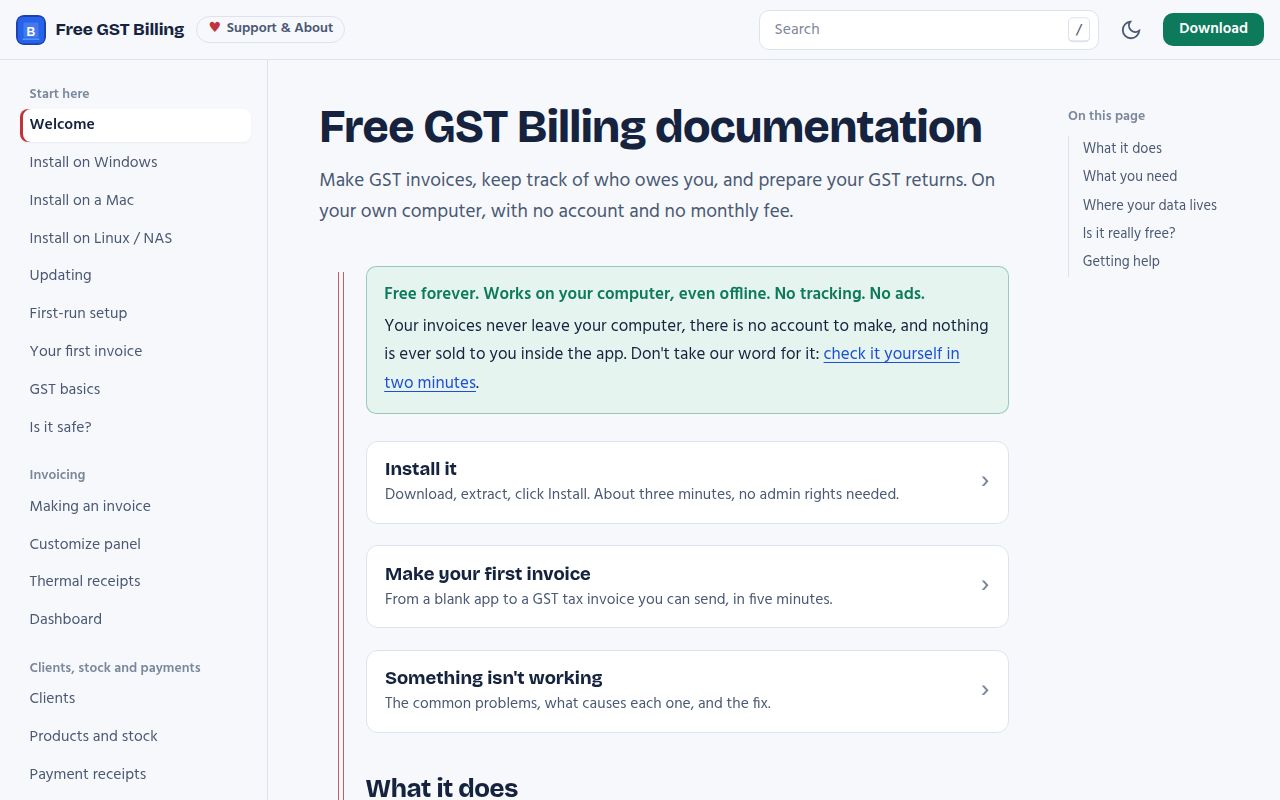
Lab card: what happened when we ran Free-GST-Billing-SoftwareScreenshot of Free-GST-Billing-Software (dicecodes.com/free-gst-software-documentation)
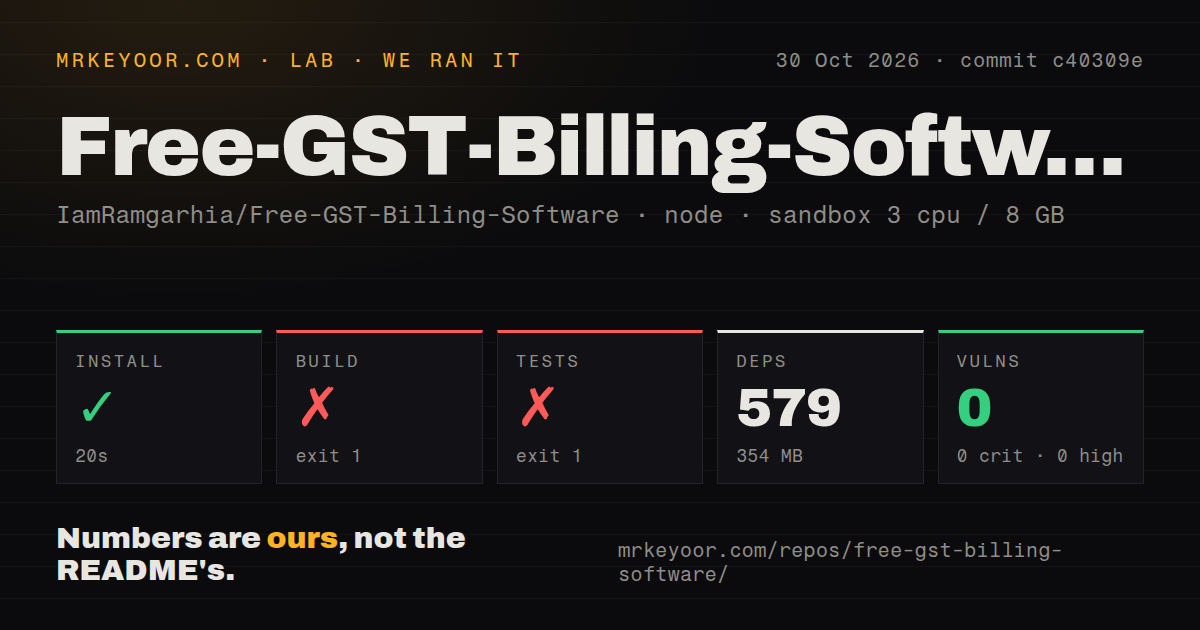
Install✓ · 20s579 packages · 354 MB
Build✗ · 20s
Tests✗ · 1sran, no count parsed
Known vulns00 critical · 0 high · 0 moderate · 0 low (npm audit)
Repo182 files~44,131 lines of source · 8.3 MB · 0 CI workflows · tests dir

Answers from our run

Does Free-GST-Billing-Software build from source?

Dependencies installed in 20 seconds (579 packages), and the build failed. We cloned commit c40309e into a clean Debian container with 3 CPUs and no project-specific setup.

Do Free-GST-Billing-Software's tests pass?

No. The project's own test command exited unsuccessfully after 1 seconds, and its output did not expose an individual test count.

Does Free-GST-Billing-Software have known vulnerabilities in its dependencies?

npm audit found none in the dependency tree at the time of our run.

Who should not use Free-GST-Billing-Software?

Teams requiring an internet-facing billing service: the README says the server has no login and must not be put online.

What are the alternatives to Free-GST-Billing-Software?

Frappe Books, superseded Electron/Vue variant, ERPNext. Our source build at c40309e failed after 20 seconds, and the overall test command failed after 1 second.

SetupN/AInstallation succeeded, but build and test commands failed. Playwright identified an unsupported runtime; neither a supported-runtime retry nor a release-launcher evaluation is supplied.
DocsN/AThe supplied excerpts document launchers, storage, backups and hosting restrictions, but do not substantiate the claimed LAN conflict used for the previous rating. Instruction accuracy was not established through a completed setup.
CommunityN/ARepository activity and sampled issue closures do not establish sustained support quality, response reliability or maintainer capacity.
MaturityN/AThe supplied run established no working billing session, restoration exercise, invoice-output verification or GST-portal acceptance.

Who it’s for

Small-business owners and technical advisers considering billing records stored on a local computer.
Indian freelancers and shops prepared to check invoice and return outputs with their accountant before relying on them.
Developers willing to investigate the measured source-workflow failures or evaluate a release package separately.

Who it’s NOT for

Teams requiring an internet-facing billing service: the README says the server has no login and must not be put online.
Operators requiring a reproduced successful source build before adoption: our build and overall test command both failed.
Businesses requiring verified migration, recovery or GST-portal acceptance before transferring their books: those outcomes were not established in our run.

Setup reality

Our October 30, 2026 sandbox run at commit c40309e began at 12:10 UTC. Installation succeeded in 20 seconds, recording 579 dependencies and 354 MB on disk. The build failed with exit 1 after 20 seconds. The overall test command failed with exit 1 after 1 second. Npm audit reported 0 known vulnerabilities.

The build tail reports ReferenceError: crypto is not defined in serialize-javascript, with the loading path continuing through @rollup/plugin-terser. The test tail shows Passed: 50, Failed: 0 before Playwright reports Node.js 18.20.8 and requires Node.js 20 or higher. That partial summary does not establish a passing overall test command. The configured sandbox had 3 CPUs, 8 GB RAM and image lab-node:22; the image label does not establish the actual runtime or operating-system version.

The README documents release launchers for Windows, macOS and Linux. Release metadata identifies v1.10.83 as published at 19:21 UTC that day, after our run. We did not test that release, a launcher, backup restoration, printing or GST-portal acceptance.

The source route stopped before working billing was established

Free GST Billing Software installed its dependencies in our sandbox, then its build stopped with ReferenceError: crypto is not defined. A business considering a move from existing books still needs a working launch and verified outputs before it can judge the billing workflow.

The README describes local invoices, customer records, inventory and Indian GST exports. Those features make it a candidate for a controlled local evaluation. Our run did not establish that the application starts, prints correctly, restores records or produces files accepted by the GST portal.

What happened when we ran it

Our October 30, 2026 run began at 12:10 UTC and evaluated commit c40309e. Installation succeeded in 20 seconds, recording 579 dependencies and 354 MB on disk. Our source build failed after 20 seconds. It exited with code 1, and the overall test command also exited 1 after 1 second.

The build tail points to generateUID in serialize-javascript, with the loading path continuing through @rollup/plugin-terser. That identifies where execution stopped; it does not establish the underlying cause.

The test tail shows date-import checks followed by Passed: 50 Failed: 0. Playwright then reports that Node.js 18.20.8 is running and requires Node.js 20 or higher. The earlier summary is a partial result inside a failed command, not evidence that the full suite passed.

The sandbox configuration listed 3 CPUs, 8 GB RAM and image lab-node:22. The explicit runtime message establishes Playwright's reason for refusing to run. The image name does not override it or identify the operating-system version. The supplied results contain no supported-runtime retry, and the Playwright message does not explain the separate build exception.

Npm audit reported 0 known vulnerabilities. The checkout contained 182 files, approximately 44,131 source lines and 8.3 MB. The scan found a tests directory, no CI workflow files and no Dockerfile. These observations describe the measured checkout; they do not certify software safety or establish whether checks exist elsewhere.

Release launchers remain a separate evaluation

The README distinguishes the release ZIP from a source-code download and documents Windows, macOS and Linux launchers. Our failed source workflow does not establish that those launchers fail.

The supplied release metadata identifies v1.10.83 as published at 19:21 UTC on October 30, 2026, after our 12:10 UTC run. That release was not tested. The measured commit and the later release must remain separate when interpreting these findings.

The README says invoices, clients, products and settings are stored as local JSON files. It also describes automatic backups and optional Google Drive backup. Those are documented capabilities, not recovery results from our sandbox.

For a local trial, use disposable records. Create an invoice, record a payment, export the data and attempt restoration into a separate evaluation copy. Reconcile the restored balances and invoice outputs before transferring real books. We did not perform that exercise.

Keep the server off the public internet

The README says the server has no login and must not be put on the internet. That rules out this documented setup for a business requiring a publicly accessible billing service.

The supplied introduction also describes a server listening only on 127.0.0.1. We did not inspect a running server or verify access controls. Businesses needing shared access or employee permissions should establish those requirements against the selected release before adoption; this review does not verify them.

Check GST outputs before relying on them

The README describes generating GSTR-1 and GSTR-3B data for use on the GST portal. Its filing walkthrough calls for exporting GSTR-1 JSON for upload and copying the GSTR-3B summary into the portal. This documents an intended workflow for India. Our run did not validate tax calculations, statutory correctness or portal acceptance.

The supplied issue feed includes closed reports about product-import fields and a rejected GSTR-1 upload, along with open requests concerning Tally integration and Vyapar backup restoration. Issue closure does not verify a fix. A request also does not establish every supported or unsupported migration format. Test a small, reconciled sample of your own records before transferring history.

The README's international currency and tax-label descriptions likewise do not establish compliance outside India. Check the invoice requirements for the jurisdiction where the documents will be used.

Alternatives have different scope and lifecycle limits

The frappe/books repository says its Electron/Vue variant has reached end of life and is superseded by Frappe Books. Its README describes double-entry accounting and local SQLite storage for that old variant. Those details cannot be transferred to the successor, whose source was not supplied. The old repository is not a recommendation for a new installation.

ERPNext documents accounting, order management and manufacturing. Evaluate it when billing needs to connect to wider business operations. Its README describes managed hosting and self-hosting, and labels the disposable Docker demo as an evaluation environment. That demo is not the documented production deployment path. We did not run ERPNext or compare tax-output correctness between the applications.

What to establish before adopting it

The source run leaves setup incomplete, while the release launcher remains untested. Documentation coverage alone cannot establish operating reliability, and the supplied excerpts do not support a numerical documentation rating. Setup ease, community support quality and billing maturity also remain unassessed.

The next useful result is a successful launch of the exact version you intend to use, followed by a restored sample whose balances, invoices and required GST outputs you can reconcile.

Alternatives

ProjectWhat it isPick it when
Frappe Books, superseded Electron/Vue variantThe supplied repository declares this Electron/Vue variant end of life and superseded by Frappe Books.Use this repository only as historical evaluation context, not as this review's recommendation for a new installation. The successor was not evaluated from supplied primary-source evidence, so the old variant's desktop and SQLite descriptions do not establish successor capabilities.
ERPNext gh↗A broader business system whose README documents accounting, order management and manufacturing.Evaluate it when billing must connect to wider business operations and you can choose a managed or self-hosted production deployment. Its disposable Docker demo is for evaluation; this review did not test ERPNext or its tax outputs.

What people are saying

  1. [github-trending] IamRamgarhia/Free-GST-Billing-Software

Sources

  1. Free GST Billing Software README
  2. Frappe Books superseded Electron/Vue repository README
  3. ERPNext README
  4. Free GST Billing Software repository metadata
  5. Recent billing issues and pull requests
  6. Latest release metadata

More self-hosted reviews

AiSOC · billd-desk · ha-mcp · umami · mathua · redlib · the whole board →