Typesense is built for product search, not a general data platform
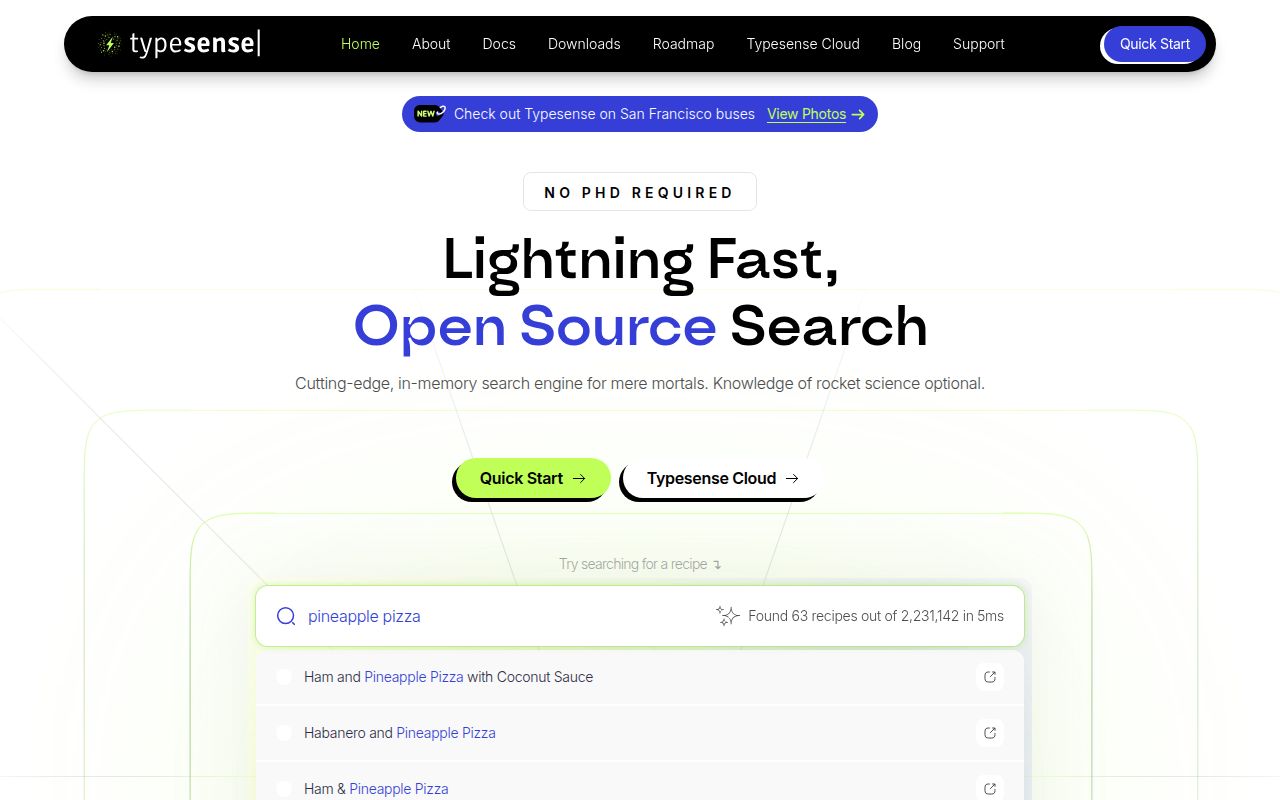
Typesense accepts structured records, indexes selected fields, and exposes search through an HTTP API and official clients for JavaScript, PHP, Python, and Ruby. Typo tolerance, faceting, filtering, grouping, sorting, geo search, synonyms, curated hits, and scoped API keys cover the usual work behind an online store, documentation site, or application search box. Vector, hybrid, image, voice, conversational, and natural-language search extend that base without turning the server into a log-analysis suite.
The scope is the attraction. Elasticsearch and OpenSearch can solve more kinds of data problems, but that breadth brings more settings and operating decisions. Typesense asks teams to describe collections and query behavior through a smaller API. The trade is equally plain: its README says built-in personalization and server-side search analytics are absent. If either drives the product, client-side instrumentation or another service must fill the gap.
One binary makes the first node easy, while source builds need Bazel
Users can download a Linux or macOS binary, run the official Docker image, or buy a managed Typesense Cloud cluster. The Docker quick start needs a mounted data directory, an API key, and port 8108. That is enough to create a collection, insert a record, and search it. Official clients add retry behavior for high-availability deployments, while any HTTP client can call the API directly.
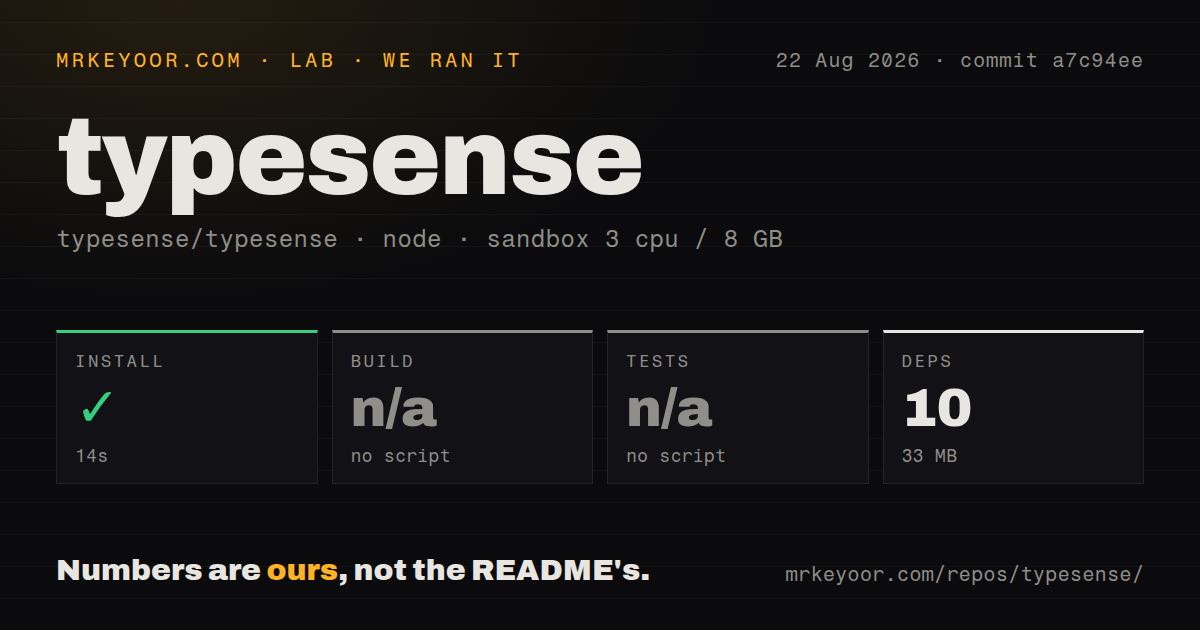
Building the server is a different job from running a release artifact. The README names Bazel, a compatible C++ compiler, Snappy, zlib, OpenSSL, curl, and ICU. It warns that a first build downloads and compiles third-party libraries. Our 14-second dependency install did not exercise that toolchain, because the detected Node project lived under api_tests/ rather than at the C++ server root.
What happened when we ran it
Our sandbox cloned commit a7c94ee into an unprivileged Debian container with 3 CPUs and 8 GB of RAM. The checkout had 503 files, about 274,311 lines of source, and occupied 12.3 MB. Bun installed 10 packages for api_tests/ in 14 seconds, leaving 33 MB on disk. Installation itself succeeded without a credential or service error.
No build script or target was detected, so the harness skipped the build. It also found no test script or target, so it skipped tests even though the repository contains a tests directory and 2 CI workflow files. The repository root had no Dockerfile. These findings do not say that Typesense cannot build or that its upstream tests fail. They say the generic Node path found neither operation at this commit.
We did not start a server, index documents, send queries, measure latency, or form a Raft cluster. The lab result therefore supports only a narrow setup claim: the api_tests/ dependencies installed quickly. A useful evaluation still has to run the published server or the documented Bazel build against representative data, query shapes, and write traffic.
Memory sizing follows the fields you index
Typesense keeps search-oriented structures in memory and persists data to disk. The README says memory consumption grows according to the number and types of indexed fields. That makes schema restraint an operating feature. A large stored payload does not always need to be searchable, and every facet, sort field, embedding, or reference can change the shape of the index. Capacity planning should begin with production-like records rather than a tiny demonstration collection.
Semantic and conversational features add another layer. Typesense can work with built-in embedding models or outside providers, which may introduce model downloads, provider keys, network dependencies, and new failure modes. Teams should first prove keyword relevance, filtering, and ingest behavior. Adding generated answers before the underlying retrieval is dependable makes search errors harder to see.
Concurrent bulk writes deserve a release-specific test
Release v30.2 was published on April 19, 2026 with fixes spanning filters, highlighting, union search, vector search, scoped API keys, caching, health checks, and HTTP/2 import cleanup. The breadth of that maintenance is reassuring and also shows how many paths interact inside a modern search server. An upgrade should replay saved queries and imports, not merely check that the process starts.
Open issue 3028 is especially relevant to write-heavy stores. Its reporter reproduced concurrent bulk upserts returning HTTP 200 search responses whose hit lists were shorter than the reported count, including on a v30.2 production cluster. Issue 3032 separately reports an indexing lane wedging under sustained imports on v30.2 and a v31 release candidate. These are reports, not findings from our sandbox, but both include detailed reproductions worth adding to an adoption test.
Current activity is strong, and the open queue is large
GitHub showed 26,480 stars, a last push on August 18, 2026, and 873 combined open issues and pull requests when fetched. Recent entries covered write pressure, synonyms, geopoint filtering, natural-language search, and cluster recovery. The combined count is not a defect total. It does show a busy product with a substantial support and review surface.
Typesense is a sensible shortlist choice when a team wants user-facing search without owning the full Elasticsearch model. The focused API and single-binary release path lower the first barrier. The decision should come after a real corpus trial that checks ranking, memory, imports, backups, version upgrades, and failover. Our 10-package install is the start of that work, not its conclusion.