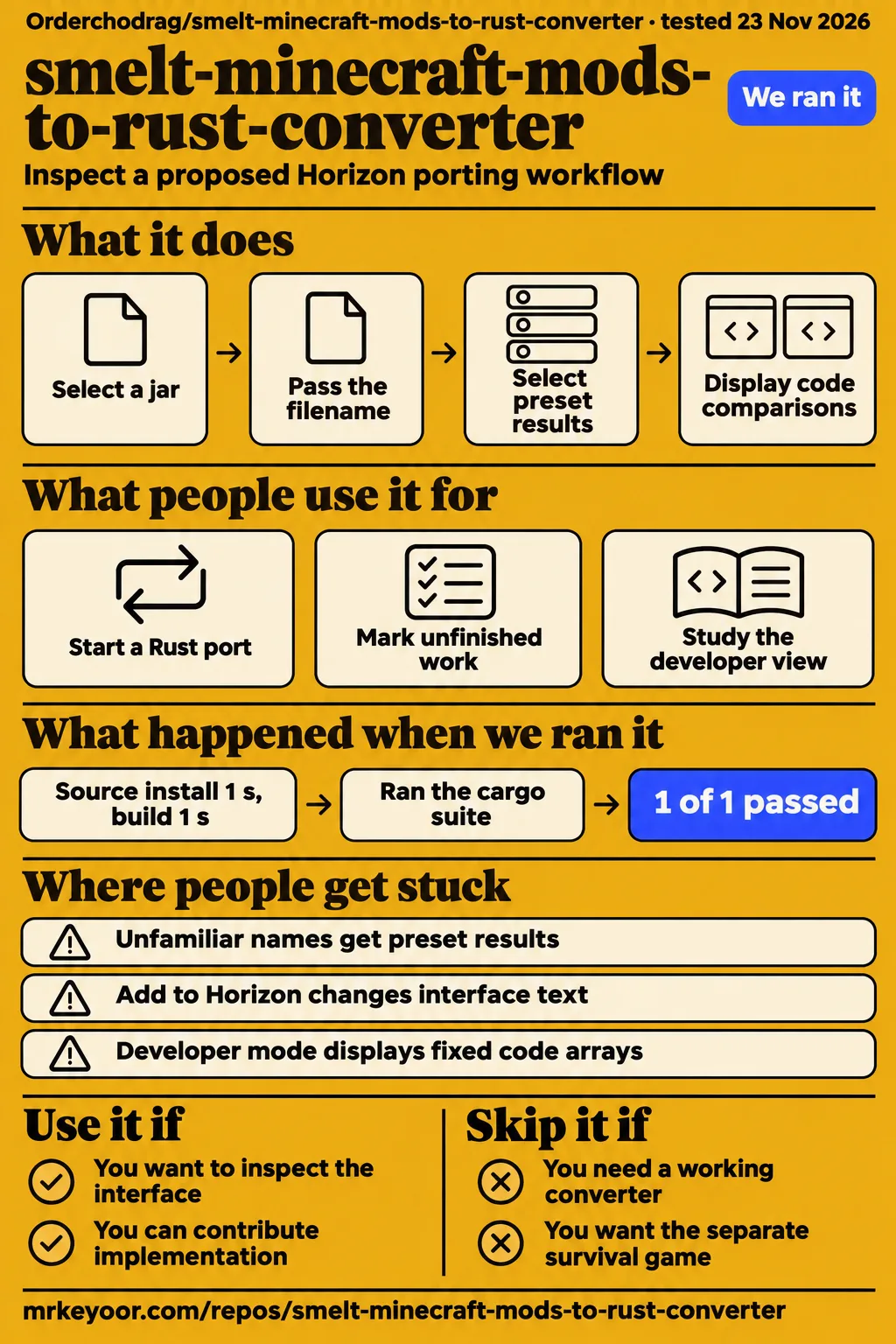
Our sandbox build succeeded in 1 second and its single test passed, but Smelt's CLI at commit 5625997 prints a banner rather than handling conversion commands. Use it to inspect or contribute to a proposed Horizon porting workflow. Skip it if your immediate task requires a working converter: the pinned CLI source and filename-based interface explain that distinction.
The README identifies Horizon as an open-source rewrite of Minecraft: Java Edition 26.3 in Rust. Here, Rust means the programming language; the target is not the separate survival game. That distinction determines whether Smelt even addresses your task. Its advertised workflow concerns Java Minecraft mods and Horizon, while the Rust server-plugin guides that also appear in search results concern a different game and platform.
What you can do with smelt-minecraft-mods-to-rust-converter
Smelt's checked interface demonstrates a proposed Fabric-and-NeoForge-to-Horizon workflow through preset results. The README describes dropping a jar into the window and pressing Add to Horizon. The implementation offers a narrower starting point for contributors: screens for successful, partial and rejected results, a developer view, and presentation code connecting those states. These are concrete interface materials to inspect when designing a converter.
The CLI's entire main function prints the product name and package version. The Rust core defines Works, Partly and Won't run labels, with a function returning the corresponding text. Those files give a contributor a small command-line entry point and a verdict vocabulary. They do not contain the jar-reading and rewriting operations described in the README's account of that core.
A useful contribution starts by separating presentation from processing. The interface already has places to display output filenames, status messages and code comparisons. Implementing the advertised workflow would require connecting those displays to actual input processing and generated output. For a mod author deciding whether to schedule migration work, that distinction is more consequential than whether the screens look finished or the source builds successfully.
What people use smelt-minecraft-mods-to-rust-converter for
An Indonesian-language Threads post introduces Smelt as a way to start a Rust port for Horizon and mark unfinished work. Jimmimohtar's project introduction links the Orderchodrag repository and describes crates, traits and a working build. The post provides a concrete statement of the intended use: beginning a port that a developer continues. It is a promotional description of that workflow, rather than a report naming a completed input-to-gameplay conversion.
The README describes two related tasks: adding a converted mod to Horizon and continuing work through Developer mode, Export port plan and Open Rust project. The developer workflow description is useful for understanding the intended audience. In the checked JavaScript, however, the developer view renders embedded Java and Rust arrays. A contributor can study that presentation without treating it as output generated from a selected jar.
Search-result ambiguity also affects the apparent use cases. The Lucky Mining announcement in the X results concerns another Minecraft mod, while the Rust sorting tutorial concerns storage adapters and conveyors in the survival game. Neither describes using Smelt. The useful distinction is between a source that discusses this converter and one that merely shares words such as Minecraft, mods or Rust.
What happened when we ran it
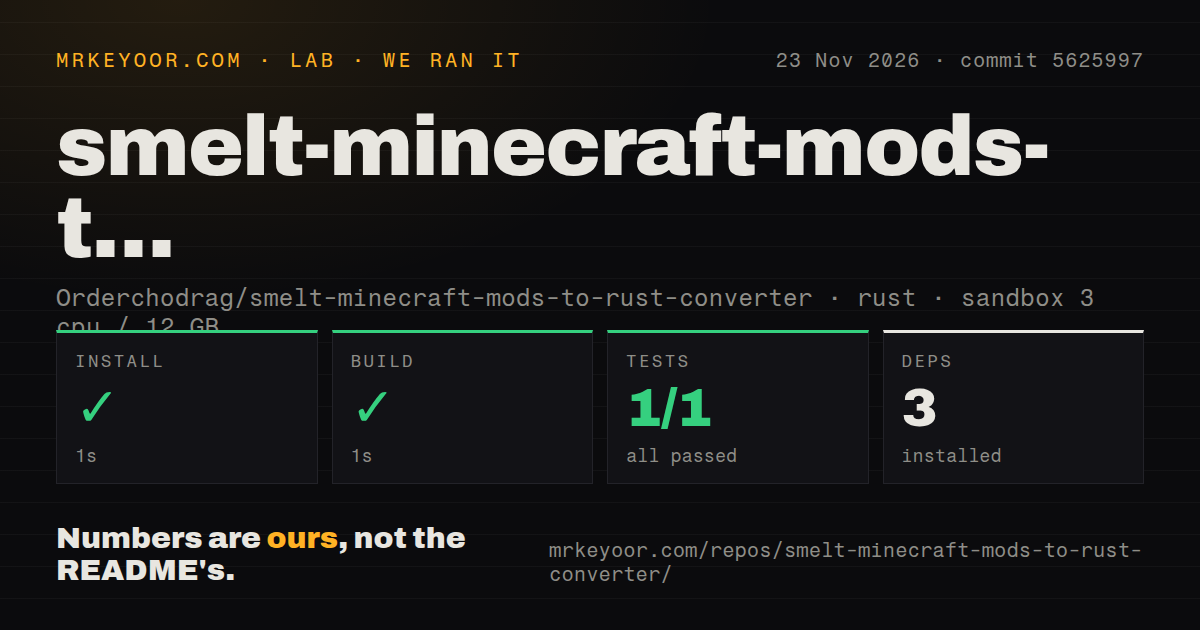
Our November 23, 2026 sandbox run at commit 5625997 recorded install, build and tests succeeding in 1 second each. The recorded sandbox had 3 CPUs, 12 GB RAM and image label lab-rust:1. The results below separate successful source checks from the separate hands-on attempt that stopped at its Compose prerequisite.
| Recorded check | Result | Meaning for your decision |
|---|---|---|
| Install | Succeeded in 1 second; 3 dependencies recorded | The recorded dependency step completed |
| Build | Succeeded in 1 second | This source built in the sandbox |
| Tests | Succeeded in 1 second; 1 passed, 0 failed of 1 | The recorded test passed |
| Repository scan | 45 files; approximately 467 source lines; 5.1 MB checked out | These are checkout measurements |
| Project signals | 1 CI workflow; no Dockerfile; no tests directory | These are file-layout observations |
The test called labels_are_plain_words checks that the Won't run enum value produces its expected label. Its assertion in smelt-core explains what the passing test exercises. The test lives inside the source file, which also explains why Cargo can report a passing test while the repository scan finds no tests directory. The recorded success concerns that assertion, rather than the conversion stages displayed in the interface.
The separate hands-on attempt failed its safety step because none of compose.yaml, compose.yml, docker-compose.yaml or docker-compose.yml existed. The runner required a Compose file. Its word "unsafe" names that admission rule; the failure is a prerequisite rejection, not a diagnosis of malicious application behavior. The missing file is the recorded reason the attempt stopped.
The hands-on summary says the application deployed with its own Docker Compose and every port bound to 127.0.0.1, but the failed prerequisite contradicts that deployment description. We therefore count the attempt as blocked before application use. The teardown entry reports "teardown: ok". Keeping those entries together prevents the summary wording from becoming a claim of successful deployment.
Where people get stuck: a success screen can come from a filename
The checked interface chooses its displayed result from a filename, including a successful fallback for unfamiliar names. In app/ui/app.js, both the file chooser and drop handler pass the selected file's name into run. The function looks up that name in VERDICTS. If it finds no matching entry, it uses the Spyglass Zoom result and replaces its displayed name.
That fallback explains why a new filename can produce a Works screen without changing the underlying example. The Reading the mod, Rewriting it in Rust and Packing it for Horizon stages advance through timer waits in the same function. Their labels describe the proposed processing sequence, while the checked code advances the animation and then displays the selected preset. The filename and animation are enough to drive this interface path.
The Add to Horizon handler changes the button and shows a toast. The same script's add function changes the button class, inserts Added to Horizon text and displays current.added. Developer mode also draws its Java and Rust columns from fixed arrays. These details explain the visible success and code-comparison states without assuming that either state represents conversion or installation work.
| What you encounter | What the checked source does | Useful response |
|---|---|---|
| An unfamiliar jar gets a Works result | Uses the preset Spyglass Zoom fallback | Treat the label as an interface example |
| Add to Horizon becomes Added to Horizon | Updates button markup and displays a message | Distinguish the displayed message from an output file |
| Java and Rust appear together | Renders fixed code arrays | Trace the arrays before interpreting them as generated source |
| The hands-on runner rejects missing Compose | Stops before application use | Read this as the runner's prerequisite failure |
These findings come from reading the pinned source files, rather than from user complaints. GitHub repository metadata recorded zero open issues and PRs on November 23, 2026. That metadata observation is different from retrieving an empty public issue list: it supplies an open-item count, not a separate endpoint response or a history of maintainer discussions.
Smelt's safety and licensing statements
The README says code-bearing mods run unsandboxed in Horizon and asks users to trust each one. Its safety answer recommends converting only mods users would trust on Java Edition. That is the project's stated trust model. The README also says processing happens on the user's PC and nothing is uploaded; these statements should be read as project documentation alongside the source behavior described above.
Smelt is MIT licensed according to its README license section. The same document names separate SIL Open Font License 1.1 terms for Geist and Pixelify Sans. It also answers the sharing question by telling users to check the original mod's license first, because a converted mod remains its author's work. Those are separate licensing subjects: the converter, its bundled fonts and the mod being converted.
smelt-minecraft-mods-to-rust-converter vs Fabric and NeoForge development templates
Fabric Example Mod and the NeoForge MDK provide starting projects for mod development, while Smelt describes conversion into Horizon. The practical choice is whether to continue building a mod on the Java platform or contribute to the proposed conversion workflow. The two templates have documented setup purposes that can be compared directly; they are not advertised here as automatic converters or as equivalent implementations of Smelt's promised behavior.
| Choice | What its project documents | Pick it when |
|---|---|---|
| Smelt | A Java-mod-to-Horizon workflow; the checked CLI prints a banner | You want to inspect the interface or contribute implementation |
| Fabric Example Mod | A template with Fabric setup documentation and a CC0 license | You want a starting project for Fabric development |
| NeoForge 1.21.1 NeoGradle MDK | A template that can be cloned to start a new mod | You want to develop using that NeoForge template |
Fabric Example Mod directs users to Fabric documentation for IDE-specific setup. Its README also permits learning from and incorporating the template under CC0. That gives it a concrete role in this comparison: a reusable starting project with setup guidance. Choosing it means taking on mod development directly, rather than expecting an existing jar to become a Horizon mod through Smelt's displayed workflow.
The NeoForge MDK README says its template can be cloned to start a new mod. Its installation instructions then tell users to open the clone in an IDE, recommending IntelliJ IDEA or Eclipse. Oxide/uMod and Carbon belong to a different comparison: the Rust server-plugin guide describes C# files loaded by those frameworks, rather than Java Minecraft mods targeting Horizon.
What the other reviews get wrong
GitTrend's drop-a-jar description omits the unfinished work acknowledged by AwesomeRepos and the preset behavior visible in this checkout. GitTrend describes getting a Rust mod back, while AwesomeRepos says unfinished parts are marked. The live README itself describes Works, Partly and Won't run outcomes. Even at the level of promotional descriptions, an unconditional successful conversion is too broad a summary.
GitTrend gives October 29, 2026 as the last push, whereas AwesomeRepos lists a November 7 push and November 8 release. Those GitTrend maintenance details and AwesomeRepos timeline entries concern listings under Ropesehypnotize. Orderchodrag's repository metadata instead records a November 18, 2026 last push. Keeping each owner attached to its observation avoids treating the directory timeline as Orderchodrag's confirmed history.
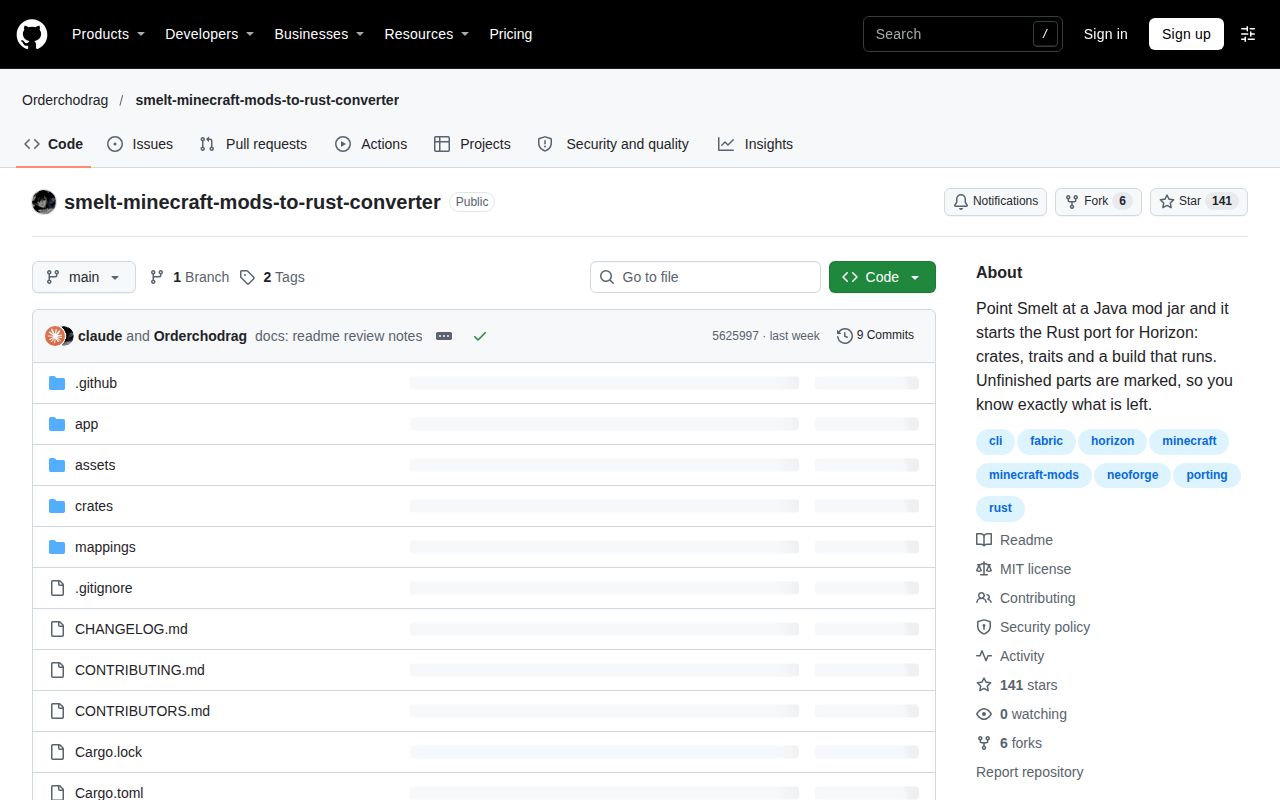
GitTrend lists 187 stars and zero forks, while AwesomeRepos lists 196 stars and 10 forks. These are conflicting directory snapshots, not interchangeable current totals. Orderchodrag's repository metadata records 141 stars on November 23, 2026. AwesomeRepos also reports that GitHub did not find the Ropesehypnotize repository on November 23. None of those counts measures whether a mod converts successfully.
Questions people ask
Smelt describes a Fabric and NeoForge converter for Horizon, but the CLI at commit 5625997 prints its banner. That answers the central product question more precisely than the repository description alone. The questions below appear in the directory listings or the Horizon-port discussion; their answers separate the README's stated purpose, the checked implementation and the dated repository metadata without treating those three kinds of evidence as interchangeable.
What does smelt-minecraft-mods-to-rust-converter do?
The README describes rewriting Java mods for Horizon, a Minecraft implementation in Rust. The pinned CLI prints a banner, while the JavaScript interface selects preset verdicts. The result is a proposed conversion interface that contributors can inspect. For a reader choosing a tool, the documented purpose and these implementation details answer different questions: what the project promises and what these source paths actually contain.
Can Smelt help start a Rust port of a Java mod for Horizon?
The README advertises a retained Rust project and a Markdown port plan. The checked developer view displays embedded Java and Rust arrays, giving contributors an example of the intended presentation. A developer considering this repository should plan around implementing processing and output generation, rather than assuming that selecting a jar already produces the project shown by those interface controls.
Is smelt-minecraft-mods-to-rust-converter actively maintained?
Orderchodrag's repository metadata records a November 18, 2026 last push and zero open issues and PRs when observed on November 23. Those are dated activity and count observations. They support saying that the repository had a recent push at that check, while the conflicting Ropesehypnotize directory timelines belong to the correction section above. A push timestamp is a specific maintenance signal, rather than a promise about support response times.
What license does smelt-minecraft-mods-to-rust-converter use?
The README identifies Smelt's license as MIT and names separate font licenses. Its sharing answer says a converted mod remains its author's work, so the original mod's license is also part of a redistribution decision. The MIT statement answers the converter-license question; it does not replace the README's separate instruction to check permission before sharing someone else's converted mod.
What language is smelt-minecraft-mods-to-rust-converter written in?
GitHub repository metadata classifies Smelt primarily as JavaScript, and the checked project also contains Rust crates. The JavaScript interface and Rust CLI make that division concrete. Calling the entire checkout a Rust converter would collapse the interface language, the small Rust entry point and the advertised output language into one description. English documentation is available in the README.
How many stars does smelt-minecraft-mods-to-rust-converter have?
Orderchodrag's repository metadata records 141 stars on November 23, 2026. The owner and date are necessary parts of that answer because the directory pages identify Ropesehypnotize and show different totals, detailed above. The count describes attention to a particular repository at an observation time. The build result, source behavior and label test provide the separate evidence relevant to deciding whether to rely on conversion.
What we have not tested yet
Our successful execution evidence consists of the recorded source checks and the single label test, with no named jar converted into a compiled, playable Horizon mod. The blocked Compose attempt adds no gameplay, generated-source, repair-effort or conversion-throughput measurement. We did not run the Windows download, inspect its signing certificate, test offline behavior or compare the downloadable binary with the pinned source. The image label also leaves actual runtime and operating-system versions unknown.
The README's advertised Fabric and NeoForge coverage, target-version compatibility, dependencies and handling of unsupported behavior need evaluation with actual input mods. The same boundary covers export plans, retained projects, batch conversion and installation into Horizon. Our implementation findings concern commit 5625997 and the inspected files; they are not a binary audit or proof of every file's behavior. There is also no measured production adoption, long-term reliability result or security audit here.
The relationship between Orderchodrag and Ropesehypnotize is unexplained. Release identification also needs reconciliation: the README badge says v1.1.21, while the latest-release endpoint returned v1.0.1 dated November 18, 2026. The evidence does not connect a particular downloadable artifact to the tested revision. The next useful evaluation would connect one identified jar, an exact converter revision, resulting files and a Horizon session showing the original behavior before a migration commitment.