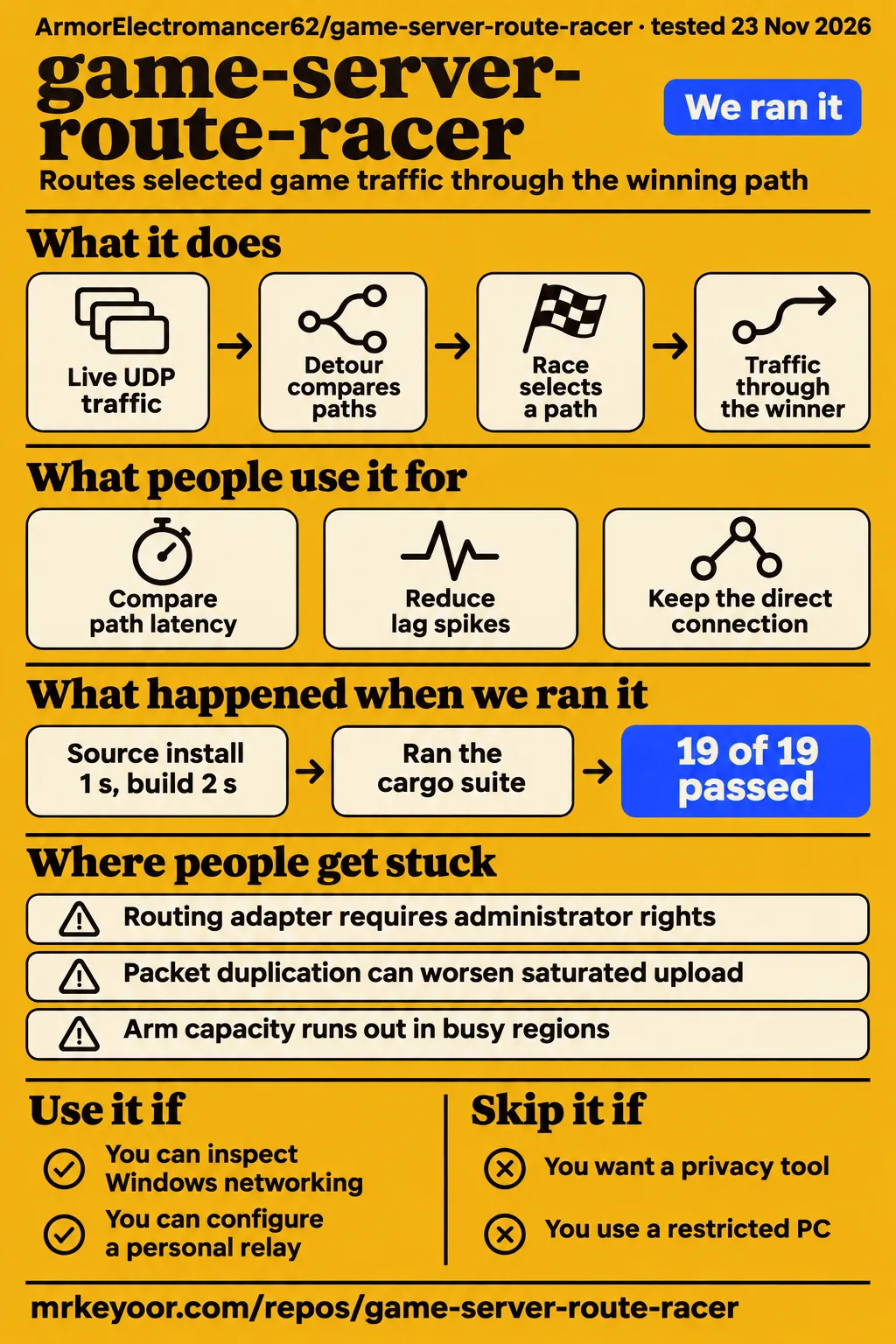
Our run passed all 19 tests at commit dd1e00f, while the separate deployment attempt stopped at a missing Compose prerequisite. Use game-server-route-racer for source evaluation if you can inspect Windows networking behavior and the README's cross-owner release links. Players who require operation without administrator rights should skip it: the README says its routing adapter requires those rights, despite its download section saying otherwise.
What you can do with game-server-route-racer
The Detour README describes comparing network paths and sending selected game traffic through the winning route. A relay is an intermediate server that forwards the game's packets. The documented design keeps browser activity, Discord, downloads and the game's login on their usual connection. That makes the routing target a particular game-server connection rather than every application running on the PC.
The README describes detecting a game's executable through games.toml, then learning its server address from live UDP traffic through Windows event tracing. It routes that address into a Wintun adapter, which the README identifies as the WireGuard project's tunnel driver. This gives a source reader specific parts of the workflow to inspect: executable detection, destination discovery and the rule that selects traffic for the adapter.
According to the README, probes run every 5 seconds, and switching requires a 5 ms lead for 3 consecutive races. The initial race selects a path; later races apply that switching threshold. The 5 ms figure describes the decision rule rather than an expected improvement for every connection. The project explains the repeated-race requirement as a way to avoid switching routes back and forth during a round.
What people use game-server-route-racer for
The documented use cases are comparing direct and relay latency and duplicating packets to reduce delivery spikes; ByteSprint attributes both examples to Detour itself. Its Paris example concerns the delay to a particular destination, while the duplication example concerns packets arriving late or being lost. Those are related problems, but a lower average ping and fewer individual spikes describe different outcomes.
| Task | Who reported it | Reported outcome and what it means |
|---|---|---|
| Compare direct and relay paths for VALORANT connecting to Paris | ByteSprint, describing Detour's own example | Ping fell from 74 ms to 46 ms through Frankfurt. |
| Send duplicate game packets over two paths to reduce lag spikes | ByteSprint, describing Detour's own measurement | One minute showed 11 spikes falling to zero, with about 13 kB/s of extra VALORANT upstream traffic. |
ByteSprint describes multipath as assigning each packet a sequence number and sending two copies toward an exit relay near the game server. The relay forwards whichever copy arrives first and drops the late duplicate. The proposed benefit follows from that mechanism: one copy can arrive while the other is delayed. The extra upstream traffic is part of the same design, rather than a separate optional cost to omit from the example.
ByteSprint also says the direct path usually wins the race. Keeping the ordinary connection is therefore one of the described outcomes, alongside choosing a relay. This is useful when interpreting the Paris illustration: the article presents a particular route through Frankfurt, while the application's described decision process also includes leaving the route alone when the direct connection wins.
What happened when we ran it
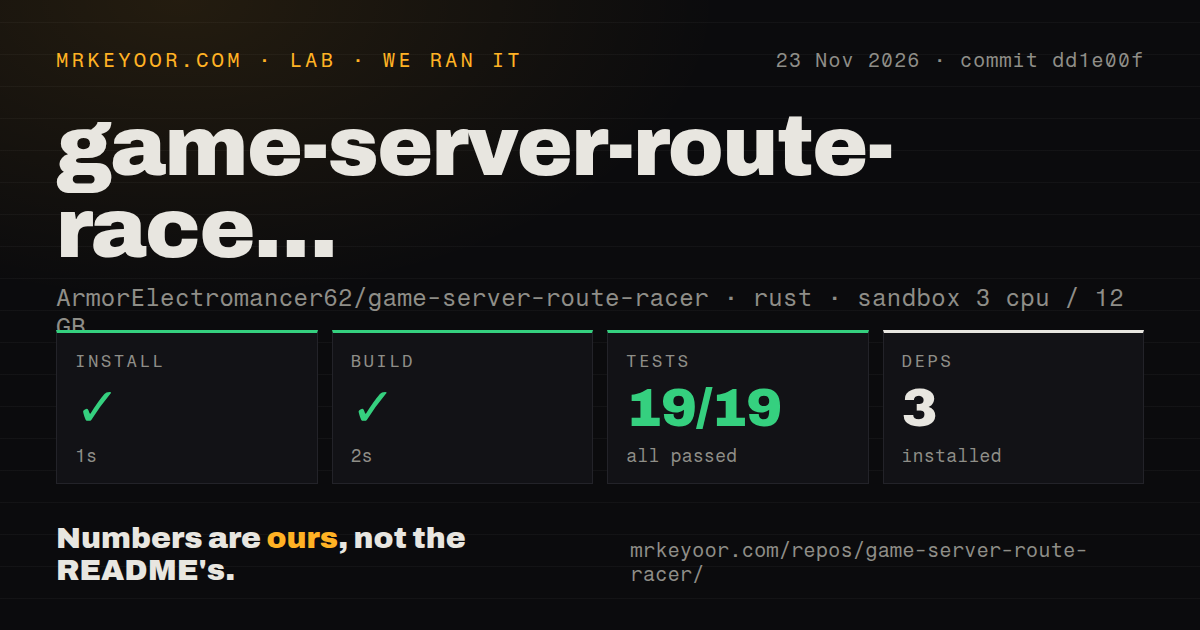
Our November 23, 2026 source run installed successfully in 1 second, built in 2 seconds and passed all 19 tests in 2 seconds. The separate deployment attempt failed its safety step because no Compose file existed. The first result records source checks at dd1e00f; the second records the deployment harness stopping at its required-file check.
| Question | Answer | Verdict | Why |
|---|---|---|---|
| Did dependency installation complete? | Succeeded in 1 second; 3 dependencies recorded | Passed | The sandbox recorded a successful install step. |
| Did the build complete? | Succeeded in 2 seconds | Passed | The recorded build step completed successfully. |
| Did the tests pass? | Succeeded in 2 seconds; cargo test: 19 passed, 0 failed of 19 | Passed | This is our executed test count for the checkout. |
| Did the deployment safety check pass? | None of compose.yaml, compose.yml, docker-compose.yaml or docker-compose.yml existed | Failed | The harness required a Compose file. |
| Did hands-on teardown complete? | teardown: ok | Cleanup reported successful | Teardown was recorded separately from deployment. |
The source run used commit dd1e00f, with a recorded allocation of 3 CPUs and 12g RAM and image label lab-rust:1. The checkout contained 44 files, approximately 1,442 source lines and 2.7 MB of checked-out data. The scan recorded one CI workflow file, no Dockerfile and no separate tests directory. The test result comes from execution; the directory finding comes from the repository scan.
The deployment error was unsafe repo: none of compose.yaml, compose.yml, docker-compose.yaml, docker-compose.yml exists (rule: a compose file is required). The phrase unsafe repo belongs to the harness's required-file rule. The README describes a Windows desktop application, so the concrete outcome here is a failed Compose prerequisite. The error names neither a desktop launch failure nor a failed game-routing operation.
The run summary says it was deployed with its own docker compose, and also records every port bound to 127.0.0.1. That summary conflicts with the safety step's missing-file error. We count the failed step as the deployment outcome and preserve the contradictory summary as part of the run record. Teardown's successful status does not change the failed prerequisite.
Where people get stuck: permissions, upload load and relay capacity
The README's adapter explanation requires administrator rights, while its download section says no admin rights. The contradiction affects a basic installation decision: whether the intended PC permits adding the routing adapter. A portable zip avoids an installer, but the README separately describes an adapter operation requiring elevated permissions. Those statements concern different steps in the documented workflow.
| Obstacle | What the named source says to do | Status of that advice |
|---|---|---|
| Administrator access is unavailable | The README says adding the Wintun adapter requires administrator rights | Its download section makes a conflicting no-admin claim. |
| Upload capacity is already saturated | ByteSprint says to stop a bandwidth-heavy task before testing | Published troubleshooting advice. |
| Oracle free Arm capacity is unavailable in a busy region | ByteSprint says Detour retries automatically | Described retry behavior. |
| You do not want to configure a personal relay | ByteSprint recommends community relays for avoiding that setup | Shared capacity is the described alternative. |
ByteSprint warns that packet duplication can make an already saturated upload connection worse. Its advice is to stop a bandwidth-heavy task before comparing paths, so background traffic does not dominate the result. That warning belongs beside the reported 13 kB/s overhead: sending a second copy uses upload capacity even when the relay itself carries no subscription charge.
The README's source instructions require Rust 1.85 or newer and Tauri prerequisites for the desktop app. Its clone command names DolphinBridge36's repository, then uses cd detour, although the clone URL ends in game-server-route-racer.git. The directory mismatch is a concrete instruction problem. The README also distinguishes the relay build from the desktop build, so a successful Rust source check should be read alongside the component being built.
The download instructions point to another owner
ArmorElectromancer62's README links its downloadable zip and clone command to DolphinBridge36/game-server-route-racer. Separately, GitHubRepo.cloud labels its listing ShineFinancialStrut/game-server-route-racer, and Jimmi's Vault credits DolphinBridge36. Those are three distinct owner names attached to matching project descriptions. The download destination matters because it identifies the release a reader reaches by following this README.
GitHub's repository metadata classifies ArmorElectromancer62/game-server-route-racer as a non-fork repository. That field describes GitHub's repository classification. Our measured source revision is dd1e00f under ArmorElectromancer62, while the README's executable link targets DolphinBridge36. Keeping those identities visible prevents a passing source test result from being silently attached to a differently owned download.
Relay rules describe the forwarding scope
The README says a relay forwards only UDP to the registered game-server address and refuses private addresses and ports below 1024. It also describes rate limiting. These are specific forwarding rules for the relay component, which the source instructions name detour-relay. They explain the project's intended restriction to game traffic rather than ordinary web browsing through a general proxy.
The README says the community list in relays.toml is signed and that Detour downloads that list. Its FAQ says the selected game's packets go to the relays shown on the path, while browser activity, Discord, downloads and login traffic keep their ordinary connection. It also states that Detour has no account, analytics or telemetry and explicitly describes it as something other than a privacy tool.
For anti-cheat questions, the README says Detour injects nothing, reads no game memory and changes no game files. It says the game sees packets arriving from a relay address, as with a routing service. The same FAQ states that no tool can promise what a publisher decides. The source's answer therefore contains both a description of its approach and the publisher's authority over the game's rules.
game-server-route-racer vs ExitLag, NoPing and the direct connection
Detour's README names ExitLag and NoPing as paid-server alternatives, while describing Detour's volunteer and personal relays. ByteSprint adds a practical distinction between sharing community capacity and configuring a dedicated path. The comparison below follows those descriptions and includes the direct connection because the article says it usually wins the route race. Relay ownership and routing outcome are separate decisions.
| Option | Why you would choose it | What you take on |
|---|---|---|
| Keep the direct connection | ByteSprint says it usually wins the route race | Your ordinary route stays in use. |
| Detour community relays | ByteSprint describes avoiding relay setup with shared capacity | Shared relay capacity. |
| A personal Detour relay | ByteSprint describes a dedicated path with additional setup | Cloud setup and available Arm capacity. |
| ExitLag | Detour's README names ExitLag as a paid-server alternative | The paid-server model described by Detour. |
| NoPing | Detour's README names NoPing as a paid-server alternative | Another paid-server option named by Detour. |
For a personal relay, the README describes deployment through relay/cloud-init.yaml to an Oracle Cloud Always Free Ampere A1 Arm machine, including 10 TB of outbound data a month. ByteSprint says Oracle asks for a card at signup and that free Arm capacity sometimes runs out in busy regions. Community relays avoid that personal cloud setup while using shared capacity.
For CS2, Dota 2 and Deadlock, the README says Detour stays off because those games already use Valve's relay network. That is a direct product-selection answer for someone installing it solely for one of those games. The README also says it stays off when the normal path wins, making the existing connection an explicit part of its routing policy.
What the other reviews get wrong
GitHubRepo.cloud describes 10 stars gained in 30 days as about one star per day; the arithmetic is approximately 0.33 per day. Its listing contains both the 10-star total and the daily description. The listing identifies ShineFinancialStrut as the repository owner, so correcting that calculation does not make its totals measurements of ArmorElectromancer62's repository.
GitHubRepo.cloud also advertises cross-platform runtime support and package-manager installation. The ArmorElectromancer62 README documents a Windows 10 and 11 desktop zip and separately describes the relay as buildable for any OS. The desktop and relay are different components. A comparison that combines them into a single platform-support claim loses that distinction and obscures which executable a reader would install.
GitHub reported zero open issues and PRs on November 23, 2026. The same metadata recorded 134 stars and a November 18, 2026 push for ArmorElectromancer62. These observations identify this repository's dated metadata rather than the differently owned directory listing. Stars count attention to a repository; the open-issue figure counts open items at the observation date.
FAQ
The README says game-server-route-racer compares direct and relay paths and sends selected game traffic through the winner. This answers the basic product question before the setup details: Detour is described as a game-routing tool, with Windows destination discovery and a separate relay component. The questions below distinguish that workflow from whole-device traffic routing and explain the dated maintenance evidence.
What does game-server-route-racer do?
Detour compares network paths and routes selected game traffic through the winning path, according to its README. The described measurements include ping, jitter and loss. It detects executables listed in games.toml and learns the destination from live UDP traffic. Browser activity, Discord, downloads and the game's login keep their usual connection rather than following the selected game route.
Is game-server-route-racer actively maintained in 2026?
GitHub recorded a November 18, 2026 push, which establishes recent repository activity at the November 23 observation. GitHub also reported zero open issues and PRs on November 23. Those fields answer when code was pushed and how many items were open. They do not describe the contents of closed discussions or the time a maintainer took to answer a support request.
How do I lower ping in games for free?
ByteSprint describes comparing the direct connection with Detour's free relay paths after addressing local Wi-Fi and upload problems. Its project-attributed VALORANT example reports 74 ms falling to 46 ms through Frankfurt. The article also says the direct path usually wins. In that case, keeping the existing connection is the described result rather than choosing a relay simply because one is available.
Why is my ping high in games even on a fast connection?
ByteSprint identifies bad Wi-Fi, a bufferbloated router and background traffic saturating the uplink as problems a relay cannot fix. Its explanation places those problems before any relay on the connection. A download-speed figure and packet delay describe different aspects of a connection. The article says Detour checks local problems first, before deciding whether changing the route is worth doing.
What is a split tunnel for game traffic?
A split tunnel sends selected traffic through another path while other traffic keeps its normal connection. The README describes routing one game server's UDP traffic into a Wintun adapter. It leaves browser activity, Discord, downloads and login traffic outside that route. The same explanation says Detour does not hide your IP, which separates its stated routing purpose from privacy protection.
What we have not tested yet
Our successful source checks cover commit dd1e00f; the deployment attempt stopped at the missing-Compose requirement. Desktop launch, game detection, direct-versus-relay latency, packet duplication and a real match were not assessed. The run contains no screenshots or known-answer gameplay tasks. The lab-rust:1 image label does not identify the actual Rust toolchain or operating-system version, and the measurements do not connect this commit to a release tag.
The relationship between ArmorElectromancer62, DolphinBridge36 and ShineFinancialStrut is unresolved. Repository histories, shared maintainership, release equivalence and the linked executable's signing and provenance were not assessed. ByteSprint's improvements remain project-attributed examples rather than our checkout's performance results. GitHub's zero-open-items metadata is not an all-state issues response; support-response history was not assessed. Search results about other networking products do not provide Detour user experience.
Anti-cheat compatibility, crash recovery, route cleanup, disconnect behavior and relay logging or operator privacy practices were not assessed. The same applies to busy-relay performance, sustained upload overhead, cloud-account charges, successful capacity retries, package-manager installation and non-Windows desktop operation. ExitLag and NoPing were not run alongside Detour; their comparison here comes from Detour's README. A useful next evaluation would connect this exact revision to a Windows build, record permission prompts and examine traffic returning to its ordinary route when the application closes.