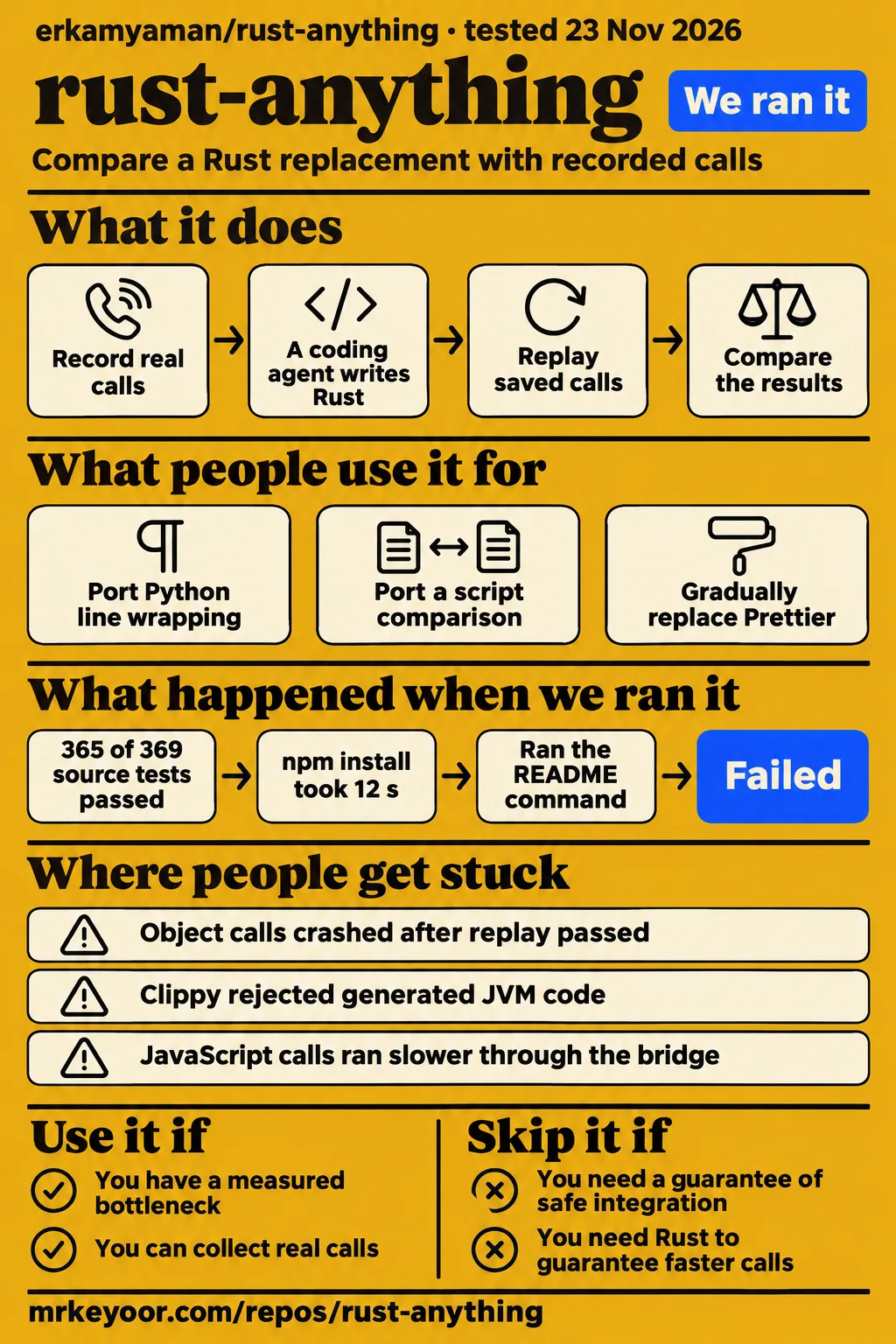
Use it for a measured bottleneck, with application tests beside replay
Our sandbox built rust-anything successfully, then cargo test failed with 365 passed and 4 failed out of 369. Use it if you own a slow function and can collect real calls, inspect the Rust replacement and test the application that uses it. Skip it if you need replay to guarantee a safe replacement: a reported wasm integration crashed after its recorded cases and gate had passed. That failure in version 3.3.0 is a better guide to the adoption decision than a headline speedup.
rust-anything records observable behavior and compares it with a rewrite that you or a coding agent writes. A bridge is the wrapper that carries calls between the original language and Rust. The README describes incremental function ports and whole applications, with unported work falling back to the original. You get a repeatable comparison workflow. You still own the choice of inputs, the generated interface and the decision to ship.
What people use rust-anything for
GitHub AI Repo's Python demonstration and the author's Prettier experiment show two different jobs: moving expensive work across a language boundary and gradually replacing an application.
| Who used it | What they moved | What happened |
|---|---|---|
| Kahtaf Alam at GitTested | Python shell-style splitting and line wrapping, on Linux at commit b87820f | Splitting passed its checks. Wrapping rejected None; changing the binding to treat it as false made the recorded calls and gate pass. GitTested's independent review describes the repair. |
| GitHub AI Repo, using Claude Code and version 1.2 on an M1 Pro | The slow part of a difflib script comparison | The presenters report 14x faster execution on one core after repairing the first build and replay failures. Their music-generator experiment also matched tested tracks, but depended on an edited generated file and the working directory. Their video shows both outcomes. |
| Project author erkamyaman | Prettier behind a Rust command-line front door | The author reports roughly 17 hours of migration work and a 19x CLI speedup. The launch post acknowledges fallback to real Prettier. The r/ClaudeAI account is the author's measurement. |
| Project author erkamyaman | All eligible functions in x18n's core | Recorded behavior matched, but the ports ran slower when JavaScript called them through the bridge. The project's case study advises measuring before shipping. |
The difflib demonstration earns attention because the input was the channel's own script comparison, rather than just the project's demo. It also shows the repair work between a request and a usable replacement. GitHub AI Repo says the first replay disagreed with the original, and the agent corrected the Rust. Later, slightly different error messages passed because the check compared error types. Matching the result you inspect and preserving every detail a caller depends on are separate requirements.
What happened when we ran it
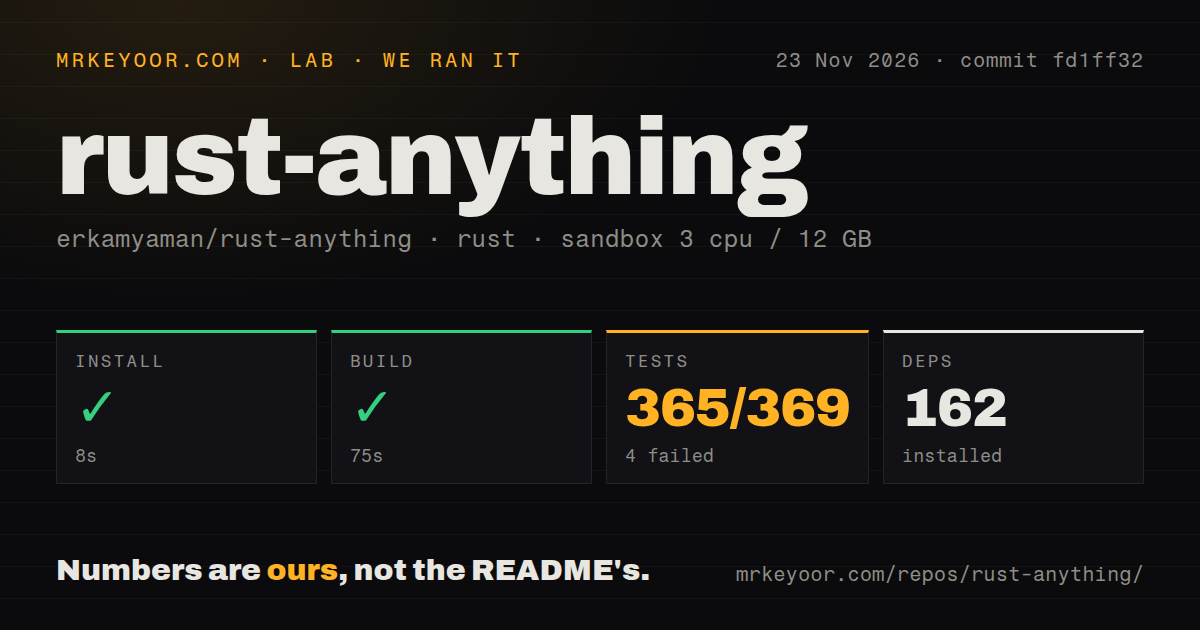
Our November 23, 2026 sandbox run at commit fd1ff32 installed successfully in 8 seconds, built successfully in 75 seconds and failed its test step after 75 seconds. The recorded configuration was 3 CPUs, 12 GB RAM and image label lab-rust:1.
| Step | Our recorded result | What that tells you |
|---|---|---|
| Install | Succeeded in 8 seconds; 162 dependencies recorded | The recorded installation completed. |
| Build | Succeeded in 75 seconds | The measured checkout built in this sandbox. |
| Tests | Exit 101 in 75 seconds; 365 passed, 4 failed out of 369 | This run did not produce a passing suite. |
The install completed, then the build completed. The test command was where the run went wrong. Its final failing target was --test app; the tail names c_cli_records_and_replays, python_cli_lifts_to_pure_rust and python_cli_records_and_replays. It reports four failures but exposes only those three names in the excerpt. Within that target, the summary says 16 passed; 4 failed and gives its own duration of 20.51 seconds. That target duration is narrower than the outer test step.
The earlier summary lines show successful groups of 311, 37 and 1 tests, plus a group with no tests. Those lines help locate the failure within the run. They don't explain it. No assertion, missing-package message or runtime diagnostic accompanies the named failures, so blaming Python, a C compiler or the product itself would go beyond the log.
A separate November 23 CLI check followed the README's eslint-rs package instructions, rather than exercising a new rust-anything migration. Its run record names commit fd1ff327605b and an unprivileged Node container. The checkout step completed, the package command completed, and the version command returned v10.15.0. Then the usage step stopped: it recorded no runnable eslint-rs command in the README's usage/examples sections. The check ended with successful teardown. That check reached CLI discovery, not a linting task or a Rust port; its package results must stay separate from the Rust sandbox above.
Where people get stuck: a green replay can precede a broken caller
Issue #204 reports normal JavaScript object calls crashing after a wasm port passed replay and gate, because enable connected callers to raw wasm exports instead of the generated wrapper.
The distinction is concrete. The raw exports expected serialized strings; the wrapper accepted ordinary JavaScript values and handled their conversion. The reporter found that disabling the port restored the application. The current v3.4.0 release notes list the wrapper correction through PR #205. That release evidence supports a stronger status than the older issue excerpt alone: the correction is listed in a release, while the lesson about testing callers survives the fix.
| Report | What failed | Repair and status |
|---|---|---|
| wasm integration, #204 | enable bypassed index.cjs, causing memory access out of bounds |
Use the generated wrapper. Version 3.4.0 lists the correction in its release notes. |
| Generated JVM code, #310 | A zero-argument fallible function received a redundant closure, so clippy rejected generated code | Reporter lwher200-arch replaced the closure with the function item locally. Issue #310 is open in the captured thread. |
| Python input shapes, #30 | Synthetic arguments produced irrelevant failures for nominal object types | Reporter elfenomenokim says real dataclass instances and changed error agreement removed the bad-shape failures in 1.5.1. They closed #30 without needing the proposed typed-only flag. |
| TypeScript configuration, #84 | A later tsconfig base with unrelated options erased an earlier alias map |
A contributor reproduced it and offered a regression fix. The captured #84 discussion ends with permission to proceed, rather than confirmation of the implemented repair. |
The 3.4.0 JVM report is especially relevant if you expect the gate to accept everything the generator emits. Its local correction is small, but changing generated output creates work when you regenerate it. Keep the correction attached to the affected version and a reproducer, so the next generated crate doesn't quietly reintroduce it.
Missing recordings can hide a meaningful difference
The project's PHP experiment found a wrong port that passed because the original's non-UTF-8 result never entered the JSON recording.
In the real-world languages report, an entity-decoding input combined ' with . The original produced an ISO-8859-1 result that JSON could not hold, so that answer was skipped. Inputs whose results stayed ASCII exposed the port's mistake. Adding more random inputs wouldn't answer the first question you need to ask: did the important call actually reach cases.jsonl, the file of saved cases?
The same report describes a Java slugify port whose benchmark strings and recording omitted troublesome Unicode categories. The correction changed both the Rust implementation and the string traps used for recording. For your own port, inspect examples that represent production bug reports, encoding boundaries and important exceptions. Keep a separate application test for behavior whose failure would matter even if every saved case still matches.
A faster Rust function can make the complete call slower
The x18n core case study reports matching recorded cases and passing gates, followed by slower calls through the JavaScript bridge.
That is a reason to retain the original implementation. The author explicitly attributes the loss to the bridge costing more than the work. Moving a larger loop can change the balance because data crosses less often. It also changes what you are comparing: the sidebar-search report attributes part of its improvement to algorithm changes and parallel execution, and includes a TypeScript comparison using the same narrowing of candidate matches.
Equal timing boundaries matter as much as equal output. The project's corrected Java batch comparison found Java faster when worker counts matched and copies stayed inside the timer. The report says its Go batch result, measured using the earlier method, had not been rerun. You shouldn't borrow either headline to estimate savings in a different application.
Allocator choice is another local decision. In issue #96, Ttimmahlax discloses maintaining rusty_alloc and reports gains on slugify, followed by smaller or absent gains on a second workload. The maintainer retained mimalloc as the default because of its production history; rusty_alloc became an opt-in. That is a useful precedent for your port: change the default only when your workload and maintenance requirements justify it.
Recording executes your original program
The README warns that code writing files, calling a database or using the network does that once per recorded case.
Its safety instructions call for a project copy, a test database and no production credentials. Follow those before giving an agent a command to record. A replay workflow can multiply a side effect that looks harmless in a single manual invocation. The README documents optional recording of outgoing effects, including email, so identical terminal output needn't conceal a duplicated send.
The security decision belongs before recording, not after inspecting the generated Rust. Use disposable data, decide which external endpoints the original can reach, and read generated commands before execution. These are operating recommendations derived from the documented execution behavior, rather than a claim that the tool supplies an isolation boundary. The agent still writes code that you will have to review and maintain.
rust-anything vs PyO3, Cython and keeping the original
Direct PyO3 is a candidate for one Python extension; rust-anything adds the record-and-replay migration workflow around a replacement.
| Choice | Pick it when | What you still own |
|---|---|---|
| rust-anything | You need repeated comparisons with the old implementation, or a staged application migration | Input coverage, generated wrappers, application tests and performance measurement |
| PyO3 with maturin | You already know the Python function to replace and want to build its Rust extension directly | Your own parity checks and migration process; GitTested recommends considering this simpler route for one function |
| Cython | You want to optimize Python-oriented code without choosing a Rust rewrite | Which code to compile and how to check behavior; GitTested names it as a Python speed alternative |
| Keep the original | The complete Rust call loses after crossing the bridge | Existing implementation and optimization work; x18n's core provides a concrete example |
PyO3 supports native Python modules written in Rust, and its README recommends maturin for trying that route. Cython translates Python code to C/C++ and supports manual tuning with C types. These are choices about how you want to own the replacement, not measured winners against rust-anything.
Existing Rust tooling can also remove the need to commission another port. In the Prettier discussion, Reddit user oyvindi reports already using oxfmt and oxlint happily. On X, theyshippedwhat promotes fast-anything around porting only slow functions. That overlaps rust-anything's documented hot-function workflow; the post supplies no head-to-head result.
What the other reviews get wrong
Gurtop's review describes continuous AST verification and an unchanged code structure, while the project's documented workflow records behavior and checks an implementation written by a person or agent.
That Gurtop article also promises zero regression risk and presents a verify command. Finite recordings cannot support that guarantee. The README calls unit replay diff, and whole-application replay app replay. Its own x18n example contradicts the idea that CPU-bound work automatically gains a large speedup merely by moving to Rust.
Other differences are dated descriptions rather than invented mechanisms. TechMeasured describes PHP and C# unit bridges as future work; the current README documents PHP FFI and C# P/Invoke bridges, mechanisms for calling a native library. PHP unit bridging is limited to top-level functions. The Sulat article's version 2.0.2 snapshot is historical coverage: GitHub now lists the November 23 v3.4.0 release.
The project's own pages need reconciliation too. The examples page still says every language wins in batches, but its linked real-world report retracts the Java comparison. And a matching Prettier result may have come from Prettier itself. Issue #118 challenged the earlier headline; the current README explicitly separates fully Rust coverage from fallback. Read the corrected experiment before quoting the shorter claim.
Questions people ask
Matching every recorded case does not guarantee that a rewrite cannot break: the reported wasm port passed its saved cases before normal object calls crashed through the enabled integration.
When does the time saved by a Rust port justify the migration effort?
There is no demonstrated universal break-even point. In r/claudeskills, totheendandbackagain asks exactly that question. Compare savings across your expected number of runs with migration, review and ongoing maintenance effort. An occasional script and a frequently called service warrant different budgets; a speed ratio alone leaves that decision unanswered.
Does matching every recorded case really mean the rewrite cannot break anything?
No. The Java correction found Unicode behavior missing from both the benchmark and recording, while #204 exposed an integration problem after replay passed. Saved-case agreement is useful evidence about those calls, not a guarantee about every future call or the wrapper that will receive it.
How does rust-anything handle commands whose output depends on time or the network?
The README says network calls execute during recording; changing outputs need explicit handling before a comparison is meaningful. Troy Lauren Lazaro asks about timestamps and networking under André Lindenberg's post. TechMeasured describes normalizers or wildcards for timestamps and UUIDs. Preserve checks on meaningful values when choosing what to normalize.
What happens when the original has a data race or behavior that does not translate directly to Rust?
Recording outputs doesn't settle concurrency correctness. Dizzzzza raises the data-race question on r/coolgithubprojects. A related concrete boundary appears in the project's C report: it records crashes from out-of-contract calls and accepts any Rust behavior for those cases because the C behavior is undefined. That acceptance is not proof of preserved semantics for valid concurrent callers.
Do rapid GitHub star gains demonstrate real demand for rust-anything?
No. Stars record attention, while completed migrations and continued use answer different questions. Magislaw challenges the rapid growth in the launch discussion; speculation there supplies no proof of purchased stars. GitHub reported 8,699 stars and a November 23 push when checked, alongside active issue discussions, including the generated-code regression. Popularity doesn't resolve that defect.
Can rust-anything handle critical C infrastructure such as ffmpeg?
The author reports a port of ffmpeg's libavutil routines, not a complete ffmpeg replacement. The README describes roughly C-level performance, with faster and slower cases. That narrows the answer to the routines exercised; a recording-based comparison is insufficient grounds to replace an entire critical infrastructure project.
Could an ESLint-compatible Rust port preserve exactly the same behavior?
The README describes an ESLint port that falls back to pinned ESLint for uncovered work. The documented split includes configuration lookups, plugins and parsers on the original side. Identical output through fallback answers a compatibility question, while fully replacing ESLint is a different claim. Our CLI check stopped before a usage task.
Where can I follow updates on the author's larger migration experiments?
Erkamyaman directed readers to GitHub Discussions #127 and later #165 in the r/BestGitHubRepos thread. Those are concrete destinations for the experiments, rather than a promised update schedule. The release history is the place to distinguish an experiment or local correction from shipped changes.
Does PHP support fit rust-anything's roadmap?
PHP unit bridging is documented now, through FFI for top-level functions. The README also describes whole-app recording and replay. Public static methods stay in PHP, so a PHP support label shouldn't be read as permission to replace every class or file without examining its contents.
How much of the matching Prettier corpus actually runs in Rust rather than falling back?
The current README says 15,861 of 17,224 recorded runs execute fully in Rust; remaining cases match through Prettier fallback. That explicit coverage statement is more useful than the earlier all-matching headline. It tells you both whether outputs agreed and how much of the replacement actually handled them.
Can recording and replay separate invalid typed arguments from meaningful port mismatches?
In issue #30, elfenomenokim reports that bad-shape failures fell to zero in version 1.5.1. Real dataclass instances and changed error agreement addressed that trial. The eight remaining differences were known value differences, and the reporter dropped the proposed typed-only flag. That is a resolution for the reported trial, not a reason to ignore unusual legitimate inputs.
Why does analyze lose TypeScript aliases when tsconfig extends multiple base files?
The #84 report says a later base containing unrelated settings erased an earlier paths map. Isnaenihidayat reproduced the issue and offered regression coverage. The discussion closes without an implementation confirmation in the captured exchange, so inspect the alias map produced by your chosen version before trusting the migration plan.
What we have not tested yet
Our fd1ff32 run establishes successful installation and build steps followed by a failed test suite; it contains no measured migration workload or performance comparison.
We have not reconciled the four app-target failures with full assertion logs. The image label doesn't identify the actual Rust toolchain or operating-system version. The separate eslint-rs check reached version and help output, then stopped before usage. It supplies no lint-correctness, fallback-coverage or migration result. Neither run establishes production reliability, dependency security or maintenance cost.
We have not reproduced GitTested's Python gains, GitHub AI Repo's demonstrations, the author's Prettier or libavutil work, the allocator comparison or the corrected Java benchmark. We also have not rerun the wasm integration after its released correction, the JVM generator after its local workaround, or the TypeScript alias reproducer on today's release. GitTested found that a module docstring preceding __all__ caused unintended Python helpers to be exported, and that replay accepted error differences. Its line-wrapping example produced TypeError: 'None' is not an instance of 'bool'. Those Python export and error findings need targeted checks against the current bindings rather than an assumed resolution; v3.4.0's release notes describe changes to custom exception classes, not a blanket resolution of every earlier observation.
Platform claims here come from documentation: the installation guide describes native Windows MSVC integration coverage and explicitly excludes the GNU target from CI. We have not exercised either Windows target, Android, PHP or C# in a migration. Continued maintenance of a port as its original changes is also unmeasured. For an adoption decision, the missing result that matters most is your application's behavior and complete-call timing after its real callers switch to Rust.