Short answer: choose SLOOP for arranging songs
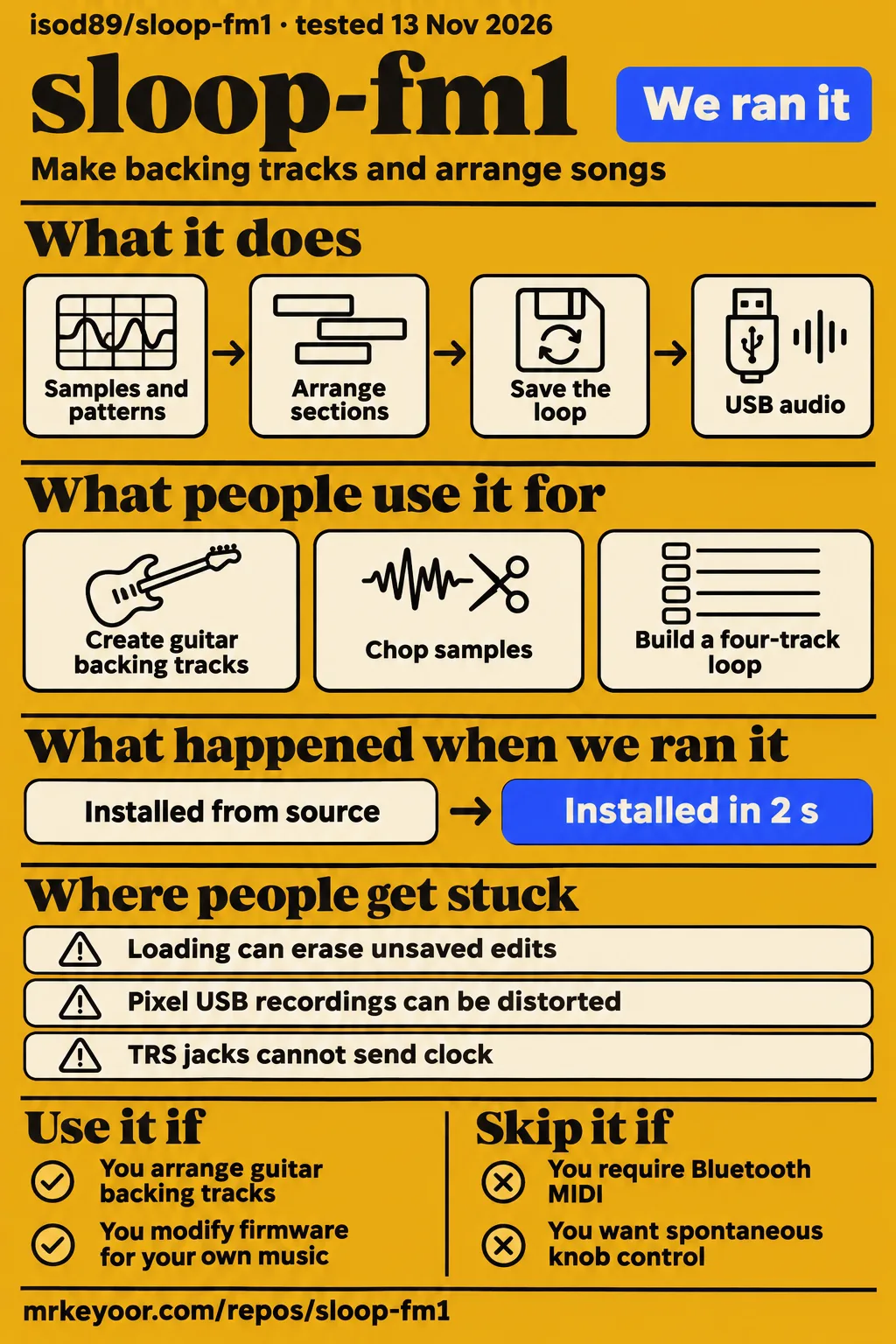
SLOOP is free, GPL-3.0 firmware for the M-VAVE FM-1, and one owner reports making guitar backing tracks in minutes. Sequencing and arrangement are the clearest reasons to shortlist it. The SLOOP README describes four tracks: three synths and a drum machine. Song mode, samples and the browser editor give those tracks an arrangement workflow; the number of synthesis engines is a separate consideration from how you want to build a song.
An FM-1 owner seeking accompaniment has a concrete example to follow in the backing-track account. Someone seeking spontaneous patch playing has a different signal: the same owner found knob experimentation awkward and considered a second FM-1 for BaudGirl. For an arrangement-focused evaluation, use a disposable song: save its sections, export an editor backup, reload it and record into your intended app. Those tasks address the saving and recording problems reported in the supplied discussions.
What people use sloop-fm1 for
Reddit user u/charbaba reports making guitar backing tracks in minutes with song mode. Their account describes playing patterns for arbitrary numbers of measures and in any order, connecting the feature to a specific musical job. The supplied research also records this owner's source modifications and sample chopping, plus a separate shared four-track performance. These are attributed uses of the firmware, rather than musical tasks performed during our sandbox run.
| Who used it | What they did | Why it matters |
|---|---|---|
| u/charbaba's backing-track account | Made guitar backing tracks in minutes. | Song mode gave this guitarist a way to arrange accompaniment. |
| u/charbaba's source modifications | Added dotted eighth-note delays and extended maximum step time to two measures. | The owner changed the firmware for their musical needs. |
| u/charbaba's sampler account | Described sample chopping through the web interface for drum breaks or a vocal sample. | Small sample jobs were useful in this owner's workflow. |
| substatica's shared performance | Shared a performance described as a simple four-track SLOOP loop. | The post provides a musical example of the four-track format. |
The sampler account describes a couple of drum breaks or a vocal sample as useful material for this workflow. The backing-track praise is more specific than a general recommendation for every player: the author values constructing songs but dislikes the difficulty of spontaneous knob changes. For a guitarist arranging accompaniment, that distinction favors exploring song mode. For someone buying the FM-1 mainly to play synth patches, the same account points toward comparing the playing controls first.
What happened when we ran it
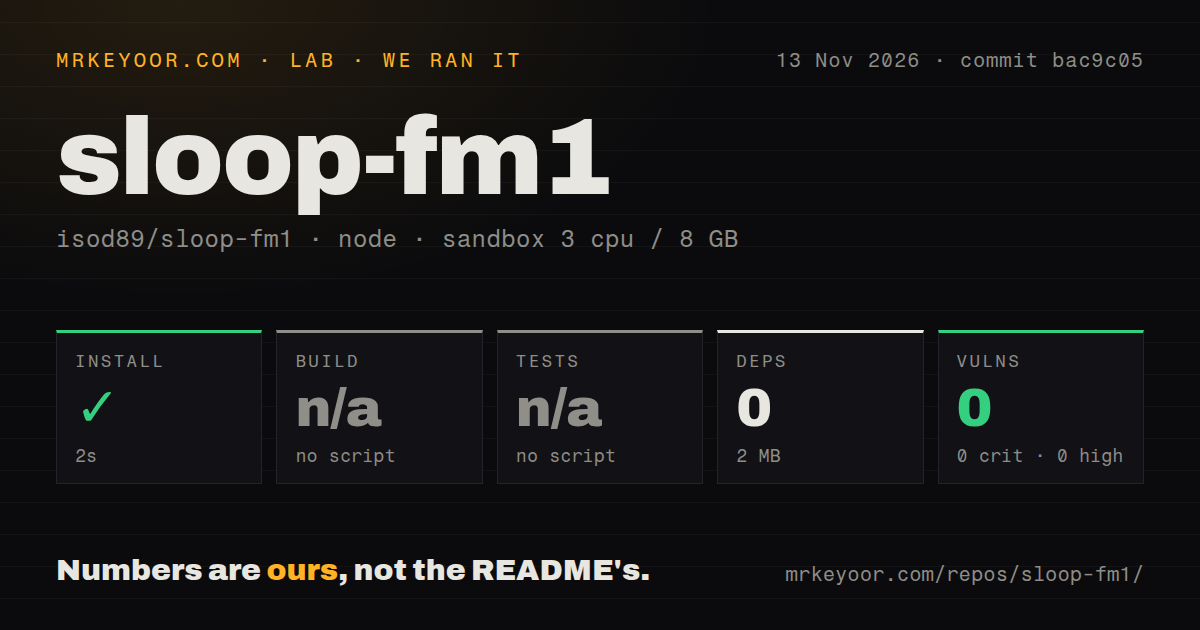
Our run completed npm install in the web workspace in 2 seconds; the separate hands-on attempt failed its Compose safety check. The failed safety record names all four missing filenames: compose.yaml, compose.yml, docker-compose.yaml and docker-compose.yml. Its rule required a Compose file. The recorded failure occurred at that harness requirement, before it could provide an observed musical outcome on the FM-1.
| Question or recorded check | Answer | Verdict | Why |
|---|---|---|---|
| Did the hands-on safety step pass? | FAILED: no required Compose file. | Stopped | The harness required one of four named Compose files. |
| Did hands-on teardown finish? | ok | Cleanup recorded | The teardown record reports success. |
| Did npm install in ./web/ finish? | Succeeded in 2 seconds. | Passed | The installation exited successfully. |
| What dependencies and disk usage were recorded? | 0 dependencies; 2 MB on disk. | Recorded | These are the installation figures in the measurement block. |
| Did the build run? | Skipped: no build script or target found. | Skipped | The harness found no applicable build target. |
| Did tests run? | Skipped: no tests script or target found. | Skipped | The harness found no applicable test target. |
| What did npm audit report? | 0 known vulnerabilities: 0 critical, 0 high, 0 moderate, 0 low. | Recorded | These are the web workspace audit results. |
| What did the repository scan count? | 343 files, about 57,822 source lines, 14.9 MB checked out. | Recorded | These figures describe the scanned checkout. |
| What automation signals appeared? | 0 CI workflow files, no Dockerfile, a tests directory present. | Recorded | The scan counted files and directories. |
The generic hands-on run entry says deployment used the repository's own Docker Compose with every port bound to 127.0.0.1. The specific safety entry instead records missing Compose files and failure. The table reports the specific failed step; the generic deployment statement conflicts with it. The hands-on teardown entry records cleanup as ok. These entries describe a blocked attempt and its cleanup, rather than a demonstrated successful deployment.
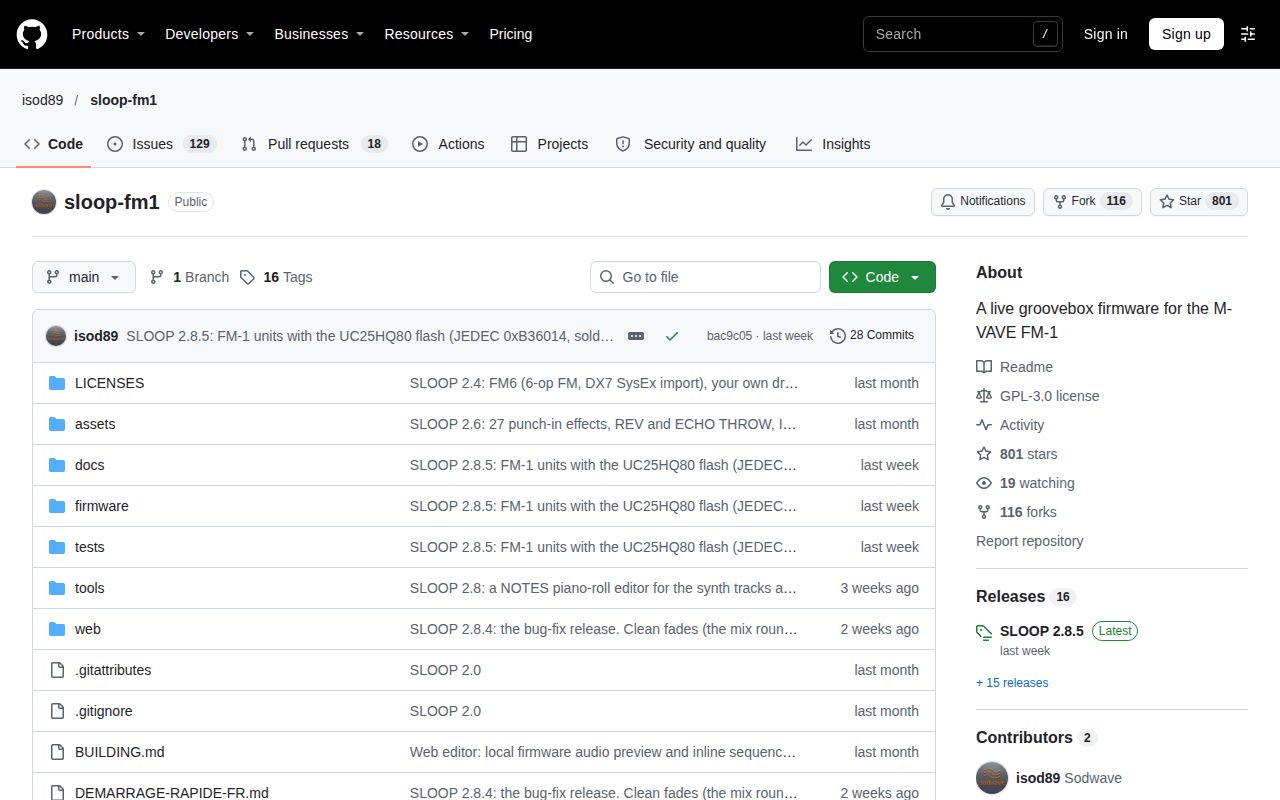
The sandbox measurement used commit bac9c05 on November 13, 2026, with 3 CPUs, 8 GB RAM and image label lab-node:22. The supplied release metadata identifies v2.8.5, dated November 4, 2026. The measured checkout is bac9c05; the reported latest release is v2.8.5. Installation, dependency, disk, audit and repository-scan figures above come from the supplied measurement block, and the installation result belongs specifically to ./web/.
Where people get stuck: loading can erase unsaved edits
Issue #232 reports lost unsaved sections, including a reproduction on SLOOP 2.8.5. One participant saved A, recorded B and pressed SAVE plus key 1 instead of 6; B was gone. The section-loss discussion proposes undoable loads, clearer labels and confirmation when stopped with unsaved changes. The README assigns section loading and section saving to different white keys while SAVE is held, making the key positions a consequential part of learning the instrument.
| Reported problem | What the record supports doing | Status in the supplied evidence |
|---|---|---|
| Unsaved section replaced, issue #232 | Learn the separate load and save keys; save before switching sections. | Open, with a 2.8.5 reproduction. |
| Distorted Pixel USB recordings, issue #99 | Compare Take Taker raw capture with the intended recording app. | Participants report a working workaround. |
| TRS keyboard sends no notes, issue #13 | Check receive channel, effects channel and Type-A cable operation. | The reporter replaced a bad cable and got notes. |
| Android offline editor denied SysEx, issue #105 | The maintainer recommended the online editor and later reported a fix. | Maintainer-reported fix. |
| Return-to-stock stalls, issue #186 | Follow the documented M-UPGRADE route. | The historical Windows/Chrome report includes updater advice. |
In the supplied USB recording discussion, participants report clean Take Taker raw capture alongside distortion through the standard Android path. A later report names Pixel 7, SLOOP 2.7.1 and the same result in either rate mode. Recorder choice therefore matters alongside the firmware setting. The TRS keyboard discussion has a different resolution: replacing a bad MIDI cable with a working Type-A cable solved the reporter's input problem.
The supplied issue #13 synthesis also identifies two settings relevant to external keyboards: the receive channel must match the notes being sent, and an effects-channel assignment can route those notes to punch-in effects instead. The maintainer's explanation of USB WAIT is equally specific: it means no computer is connected. For a wired keyboard setup, these checks address channel routing and connection state before treating an apparent lack of notes as a firmware defect.
Flashing and backups: use the documented return path
The supplied README describes an editor backup followed by M-VAVE's M-UPGRADE with official FM-1 V16 for returning to stock. It also names Clipper's installer page as a fallback when M-UPGRADE does not find the FM-1, and says installing Clipper itself is unnecessary. The SLOOP recovery documentation is the relevant starting point for that route; the older issue below concerns a different official firmware version.
The Windows return-to-stock report names SLOOP 2.7.1 and official V15. The process stopped at "Verify 75," and SLOOP started again after a restart. A separate interrupted-update account describes disconnection followed by a black screen, an illuminated power LED and no PC recognition. The first device booted SLOOP again; the second account describes a device that the computer could no longer recognize. Those outcomes call for different troubleshooting decisions.
Dense arrangements deserve an early listening check
X user iamsolum_ reported chord and melody notes disappearing after adding many effects, followed by further deterioration after adding bass. The effects-heavy beat account describes a session with custom drums. A useful evaluation task is an arrangement resembling the music you intend to make: add its parts and effects gradually, listen for changes and save a backup. This recommendation follows the reported sequence of events without assigning a technical cause to it.
The upstream README describes changes in 2.7.1 to second-core crash handling and changes in 2.8.3 involving held notes, busy-beat kicks and second-core reads. These are upstream release descriptions. The FM1 Move manual identifies a separately named eight-track firmware with SLOOP 2.6 inside. Its eight-track specification belongs to FM1 Move, while this review's four-track specification comes from the supplied SLOOP README.
sloop-fm1 vs BaudGirl, Skiff and Groove OS
One SLOOP owner preferred its groovebox sequencing but found BaudGirl more enjoyable for simply playing. Workflow is therefore the useful comparison axis in these accounts. A separate discussion names Skiff and Groove OS in response to a request for more tracks and traditional arrangement. The table preserves what those people recommended and why, so readers can choose an alternative around patch playing, section construction, additional tracks or a particular connection requirement.
| Alternative | What the supplied comparison says | When to evaluate it |
|---|---|---|
| BaudGirl | u/charbaba found SLOOP less fun to play and preferred BaudGirl's virtual analog engine. | Playing patches and spontaneous knob changes matter most. Owner comparison |
| Skiff | Rob Saunders recommended Skiff with six tracks and knob automation. | Extra tracks and recorded knob changes are shortlist criteria. Community recommendation |
| Groove OS | An owner seeking traditional arrangement considered it but objected to its cost relative to the hardware; Jon Kelly reported a good experience. | Paid firmware is acceptable and arrangement is the priority. Owner discussion |
| Stock FM-1 firmware | The Tao of Mac reviewer reported Bluetooth MIDI working with an iPad. | Wireless MIDI is central to the setup. iPad review account |
The VI-Control firmware question asks about SLOOP, Jiant FM and Skiff for FM synthesis, DAW recording and portable composition. These jobs need separate acceptance tasks: playing a patch, arranging a section sequence and recording into the intended app. The backing-track account speaks to arrangement, the BaudGirl preference to playing, and the Pixel thread to recording. That division gives an FM-1 owner more useful selection criteria than a single overall winner.
What the other reviews get wrong
Noizefield's nine-engine description concerns version 2.2; the supplied current README lists twelve engines. Its historical SLOOP coverage describes an earlier specification, rather than the current engine inventory. The supplied research also records an unconditional claim that users can always revert to official firmware. Issue #186 supplies a concrete failed return attempt, while the interrupted-update account describes a separate black-screen outcome. Recovery advice needs those actual device states alongside the documented updater route.
The Tao of Mac review reports USB audio and MIDI working with AUM on an iPad. The Pixel reports describe a different host and capture path, including distortion through the standard Android pipeline. The supplied synthesis also records Ars describing SLOOP as eight-track. The upstream README describes four tracks; FM1 Move explicitly advertises eight tracks with SLOOP 2.6 inside. For this review, the upstream SLOOP specification supplies the track count.
The older Reddit review expresses frustration with DX7 import and project storage, while today's supplied README describes FM6 DX7 import, section storage and additional songs kept as editor backups. Those documented features answer whether the functions exist in the supplied current description. Issue #232 addresses a different problem: losing an unsaved section through an accidental load. The presence of section storage does not resolve that reported key-selection mistake.
English documentation gives beginners a starting point
The SLOOP README links a complete guide, a manual and a French guide, alongside the browser editor and releases. Its controls table explains the layered interface: holding a function button changes the jobs of the white keys and knobs. While holding SAVE, keys 1-4 play sections A-D and keys 5-8 save the loop into those sections. That distinction explains why pressing key 1 instead of 6 matters in the 2.8.5 section-loss report.
The supplied repository metadata records a last push on November 4, 2026, and the latest release endpoint identifies v2.8.5 on the same date. The issue extracts include maintainer replies about cables, Android permissions and controller features. For a beginner, the controls table offers a more direct starting point than those activity signals: learn the layer controls, follow the instructions for the task at hand, then consult the issue matching the planned recorder or MIDI connection.
FAQ
The SLOOP README's controls table assigns separate keys to section loading and saving; learn those before switching between sections. Start with the linked guide, then check the MIDI connection and recorder app you intend to use. The questions below come from the supplied user discussions and issues, with answers tied to documented controls, named devices or attributed outcomes rather than a general assurance about every setup.
Where can I find a beginner guide to using SLOOP on the M-VAVE FM-1?
The SLOOP README links the complete guide and manual and includes a controls table. Begin with the layered buttons, especially SAVE, before following instructions from videos about other firmware. The beginner's request describes confusion caused by tutorials with different firmware instructions. Matching the firmware name gives that reader a specific starting point for learning the controls used in this review.
Should I choose SLOOP, Jiant FM or Skiff for both FM synthesis and portable groovebox work?
The supplied VI-Control question names all three for FM synthesis, DAW recording and portable composition. SLOOP's owner account supplies an arrangement example, while the Skiff recommendation emphasizes six tracks and knob automation. Rank those tasks first, then evaluate the patch controls, section sequence and recorder connection that matter to you. These accounts support task-specific shortlist criteria rather than a universal recommendation.
What alternatives to SLOOP offer more tracks and a traditional arrangement workflow?
The alternatives discussion names Groove OS and includes Rob Saunders's recommendation of Skiff with six tracks and knob automation. The original poster wanted traditional arrangement and more tracks, but objected to Groove OS's cost relative to the instrument. Those attributed preferences provide concrete criteria for choosing what to evaluate: arrangement controls, track count, automation and willingness to pay for firmware.
How can I recover an FM-1 that has a black screen after an interrupted SLOOP update?
The supplied README describes USB RESCUE as holding OCT- at power-on. The black-screen report says the developer's key combination had already been tried and the PC still failed to recognize the device. A commenter suggested another computer, cable and USB port. That advice concerns restoring device recognition, whereas the separate return-to-stock issue describes an FM-1 that still booted SLOOP after restarting.
Why does SLOOP USB audio sound distorted on my Pixel phone but clean on a laptop?
Participants in issue #99 report clean Take Taker raw capture alongside distortion through the normal Android path. A later Pixel 7 report names SLOOP 2.7.1 and says both rate modes behaved the same. Compare the intended recorder with the reported raw-capture workaround. In that participant's account, changing the rate mode alone left the recording problem in place.
Can I play SLOOP with an external keyboard through the 3.5 mm TRS MIDI input?
Issue #13's reporter confirmed that a working Type-A cable solved the MIDI input problem. The supplied TRS troubleshooting synthesis also identifies receive-channel selection and effects-channel conflicts as checks. USB WAIT means no computer is connected. For this setup, the concrete checks are a working cable and the channel routing, with the reporter's replacement cable providing the documented successful outcome.
Can I synchronize two FM-1s running SLOOP with a single TRS cable?
Issue #212 identifies the TRS jack as input-only, so the proposed connection has no TRS output to send clock from one FM-1. The two-device synchronization discussion also says USB synchronization would require one device to act as a host. The participant tried Type-A and Type-B adapter combinations; changing those adapters does not supply the missing output direction.
Does SLOOP support MIDI clock synchronization over Bluetooth?
The supplied Bluetooth request received a maintainer reply saying Bluetooth was a larger job and was not planned at that point. The Tao of Mac account also describes Felucca-based variants such as SLOOP as omitting Bluetooth. The README documents USB and TRS clock input, so its documented synchronization routes are wired. Readers requiring Bluetooth MIDI should choose firmware around that requirement.
Does SLOOP support MIDI Program Change, Control Change and sustain messages?
The supplied current README documents Program Change, CC mappings and sustain, including version-specific additions. The historical controller-message issue includes a maintainer acknowledging a mistaken closure and unstable feature testing. Sound-preset selection and section switching are separate operations in these records. Match the documented message to the intended operation and release instead of using the issue's closed label as the feature specification.
Can SLOOP be ported to the SMK-37?
Issue #24 records requests for an SMK-37 port and includes a link to another firmware's manual. The SMK-37 request shows interest in that keyboard, while the supplied SLOOP README identifies the product reviewed here as firmware for the M-VAVE FM-1. A request for a port is a different kind of record from installation instructions naming supported hardware.
Could the community Android app be incorporated into SLOOP?
In issue #66, the maintainer says the Android version needs to match the editor and calls for reviewing the entire codebase for stability, performance and compatibility. That exchange describes prerequisites for incorporation. The supplied README separately describes an installable web app. Its documented installation route and jahlib's community Android codebase are distinct options in the supplied material.
Can section loading ask for confirmation so I do not accidentally lose unsaved work?
Issue #232 proposes confirmation when stopped with unsaved changes, undoable section loads and clearer LOAD/SAVE labels. The 2.8.5 reproduction explains the request: pressing the load key while holding SAVE replaced the recorded section. The README's controls table assigns separate keys to loading and saving. Learning those positions addresses the immediate control mistake described by the participant.
What we have not tested yet
Our measurements cover the web workspace and a Compose-blocked deployment attempt; we did not flash an FM-1 or perform a musical task. Actual runtime and operating-system versions require raw logs. Firmware compilation, the host test suite, audio quality, latency, controller-message completeness and dense-arrangement limits remain outside this run. The npm audit covers the recorded web workspace, and its zero finding is not a firmware security assessment.
The supplied evidence contains no independent retest of the Android offline-editor fix, confirmed recovery of the black-screen device, demonstrated direct two-FM-1 synchronization, shipped section-load protection or matched comparison of competing firmware. A Reddit commenter reports uploading hats through the editor and finding no new device sounds, without a resolution. The effects-heavy missing-note report supplies neither a firmware version nor a confirmed cause; FM1 Move's load-management description cannot diagnose that SLOOP session.
The alternatives table preserves owner preferences and community descriptions rather than independently checked competitor specifications. The record supplies no active-user count, support-capacity measurement or musical reliability rate, and all four score cards remain unassessed. No published-page inventory was supplied for a site-wide duplication check. Rendered layout, related links, recommendation modules and other template elements are outside this text review. A useful next recorded task is to save, back up, reload and capture a disposable song on the exact hardware and app combination you intend to use.