
One API covers more than language-model generation
SIE addresses a recognizable platform mess. Search needs embeddings and reranking, uploaded files need parsing or OCR, structured work needs schema-aware output, and risky content may need a guard model. Superlinked puts those jobs behind one server and a catalog of more than 100 configured models. OpenAI-compatible routes handle embeddings, completions, chat completions, and Responses, while the Python and TypeScript SDKs expose task-specific calls.
This is an operating layer, not a new foundation model. The README names dense, sparse, multi-vector, vision, extraction, document, safety, and generation families. Models load on demand and least-recently-used eviction lets several share finite hardware. That design is useful once a team has multiple services to consolidate. With one embedding model, it adds a control plane you probably do not need.
The 14-second build is easier than the production deployment
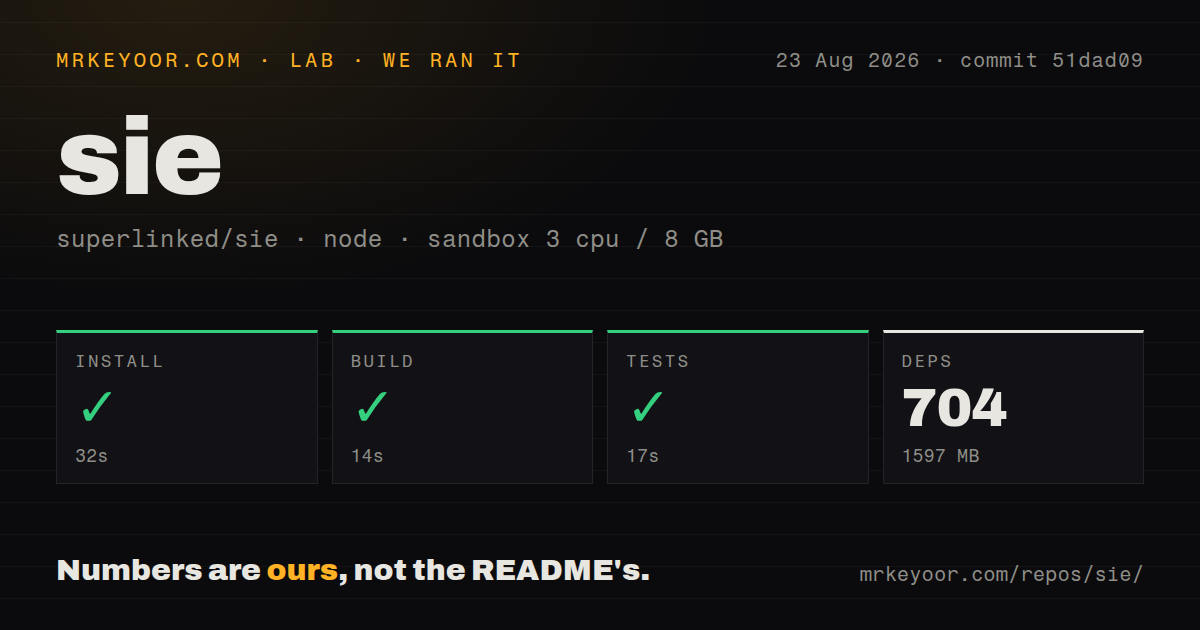
We cloned commit 51dad09 into a fresh unprivileged Debian container with 3 CPUs and 8 GB of RAM. The pnpm install succeeded in 32 seconds, adding 704 packages and consuming 1,597 MB on disk. Its build then passed in 14 seconds, followed by a successful 17-second test step. Those results make the repository itself less intimidating than its scope suggests.
The checkout was still large: 1,902 files, roughly 411,844 lines of source, and 104.6 MB before dependencies. Our scan found a workspace monorepo but no CI workflow file, Dockerfile, or tests directory. That does not erase the passing command we ran. It does mean a buyer should inspect how the published images and upstream checks are produced instead of assuming those controls are visible at the repository root.
What happened when we ran it
Our run installed 704 pnpm packages in 32 seconds, built in 14 seconds, and passed the available tests in 17 seconds. Nothing in the supplied log showed a failed install, compiler error, or test failure. Disk use after installation was 1,597 MB, which is a meaningful local cost before any model weights arrive.
The sandbox measured repository mechanics, not model quality or inference speed. We did not download a catalog of weights, provision a GPU, run OCR, or measure request latency. The README itself says first calls fetch model weights and that latency depends on the model, task, hardware, and batch size. Any throughput claim would need a separate workload on the hardware you intend to buy.
Separate images keep incompatible model families apart
The quick start has credible local paths. Python 3.12 can run the native server on Apple Silicon or Linux. Linux users can choose CPU or NVIDIA images, check /readyz, and send an embedding request with curl. The SDK follows the same endpoint shape, so trying encoding, reranking, extraction, or generation does not require learning a different client for each family.
The phrase "one cluster" needs careful reading. LightOnOCR and GLM-OCR use a Transformers 5 bundle, while the default image intentionally omits them. Text generation uses the CUDA SGLang image, and Apple Silicon generation follows an MLX path. These boundaries are sensible because model dependencies conflict, but operators still choose images, route jobs, cache weights, and decide which models stay warm.
A first request also has a cold-download cost that our 31 seconds of build and test time does not include. LRU eviction helps a catalog share hardware, but it can turn alternating workloads into repeated loading. Before adoption, list the actual model set, weight sizes, acceptable first-response delay, and GPU memory available per lane. SIE centralizes those decisions; it does not remove them.
Kubernetes is part of the value and the price
Production support goes beyond a model demo. SIE includes a load-balancing gateway, KEDA scale-to-zero behavior, Grafana dashboards, a Helm deployment, and Terraform modules for GKE, EKS, and AKS. Different GPU lanes can handle different model classes. Apache-2.0 licensing makes the code usable without a commercial runtime license from Superlinked.
Running that stack calls for cloud credentials, a Hugging Face token where models require it, pinned chart versions, node sizing, secret rotation, monitoring, and a cold-start policy. Anonymous telemetry sends the SIE version, operating system, architecture, and GPU type by default. The README says it excludes IP addresses, hostnames, and request data, and documents SIE_TELEMETRY_DISABLED=1 and DO_NOT_TRACK=1 for opting out.
The MCP edge sends smaller document artifacts to agents
SIE also supplies an MCP edge for private document jobs. Its tools cover conversion, summaries, entity extraction, PII redaction, grounded questions, image descriptions, and constrained output. A Claude or other MCP client can send work to the edge, which calls the cluster and returns a compact result rather than pushing the entire source document into the agent context.
The separation is thoughtful, but it adds another service. The edge holds a cluster API key, while users receive connector secrets. Operators must secure its route, rotate both credential types, and map each tool to a suitable model and hardware lane. Generated packs include Claude Code skills, so the relevant tags are MCP and Claude Code, but installation assets do not reduce the need for access control.
August activity shows maintenance, while extension stays curated
The repository was pushed on August 21, 2026. Release v0.7.1 followed on August 9 with OCR work and fixes, and GitHub listed 13 combined issues and pull requests when checked. One current issue asks how to add a translation model outside the configured catalog. That is a useful reminder that "100+ models" describes breadth, not arbitrary compatibility.
The documentation is unusually specific about task families, image choices, first-call downloads, deployment, integrations, and telemetry. That earns SIE a trial for a private multi-model platform. The deciding question is whether consolidation saves more effort than Kubernetes, model caching, and several runtime bundles consume. For a team already paying that operating cost across separate servers, the answer may be yes.