Shrimply is an editor you can automate, not a safe daily driver
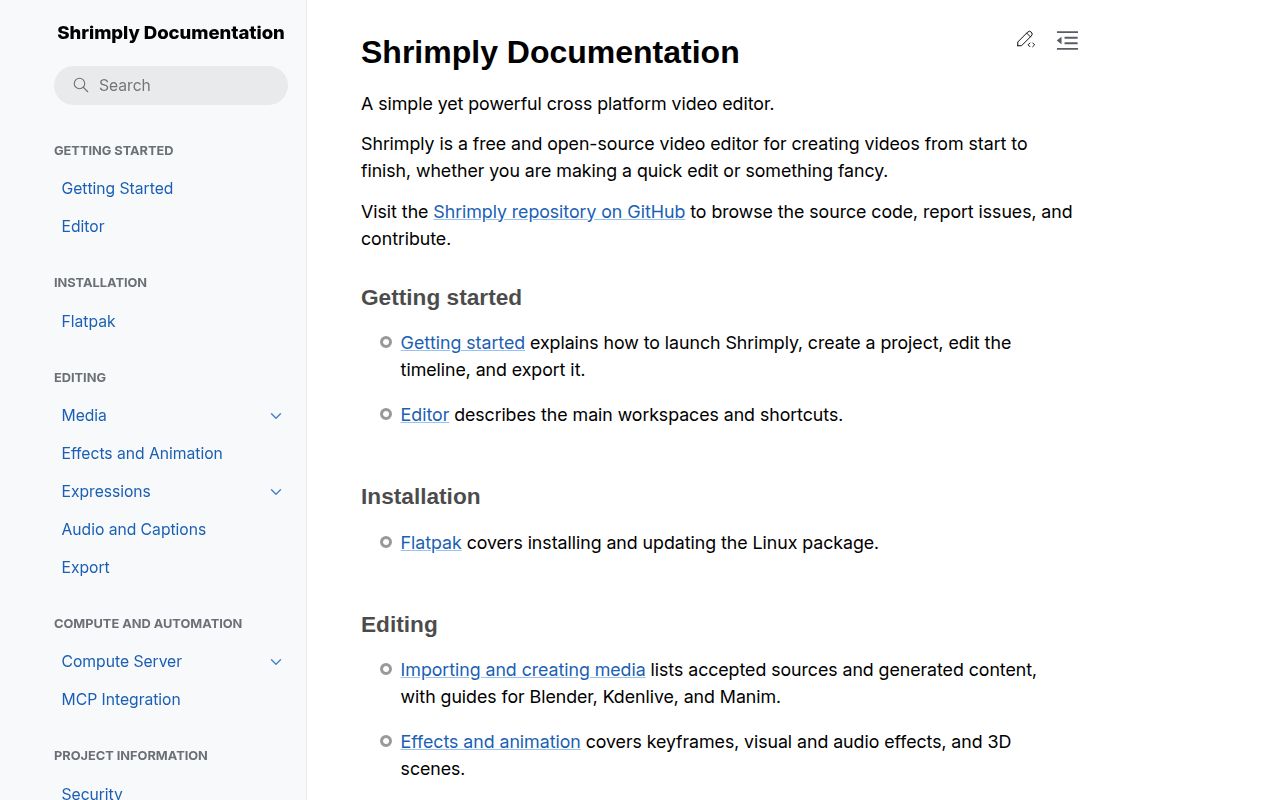
Shrimply combines a multitrack video editor with a large set of media and automation experiments. A new .shrimp project starts with caption, video, and audio tracks. The editor has preview controls, an inspector, timeline trimming, ripple cuts, snapping, grouping, and undo history. It can open its own format plus JSON, OpenTimelineIO, and Kdenlive projects. The repository's warning matters more than that list: the application is pre-alpha and may corrupt project files.
The unusual part is how much sits behind the timeline. The source tree includes transcription, text-to-speech, lip sync, stabilization, paint, layered images, Manim, Blender, video generation, and an MCP integration. Its MCP tools can inspect editor state and apply typed edit operations as one undoable action. That breadth makes Shrimply interesting to contributors. It also explains why the checkout has about 397,561 lines of source before dependencies.
MCP access is tied to the open editor rather than a second project model. Resources expose editor state, project clips, individual clip details, and the typed edit API. A script can validate an ordered batch against a cloned project, then install the batch as 1 undoable history action. The same interface can insert text, configure speech generation, transcribe addressed audio clips, or import files with explicit collision behavior. That is a credible automation surface even while the desktop application remains risky.
NVIDIA Linux and Apple Silicon are the practical targets
The README requires an NVIDIA or Apple Silicon GPU and lists Wayland or macOS 15 and newer. Linux development targets Fedora, while the checked-in Nix environment targets x86_64-linux and still needs a compatible NVIDIA driver. The build documentation specifies CUDA Toolkit 12.9 and says the current package embeds kernels for compute capability sm_86. Those are narrower requirements than the phrase cross-platform video editor suggests.
Open issue 1 states that the project has little cross-platform support and proposes moving more rendering work toward Slang or WGPU. AMD and Intel support each have an open port request, and WinUI 3 has another. A macOS 15 user also reported a v0-era build crashing because an interface class available on newer macOS was missing. These reports do not prove that every current machine fails, but they make platform testing a first step rather than a final check.
What happened when we ran it
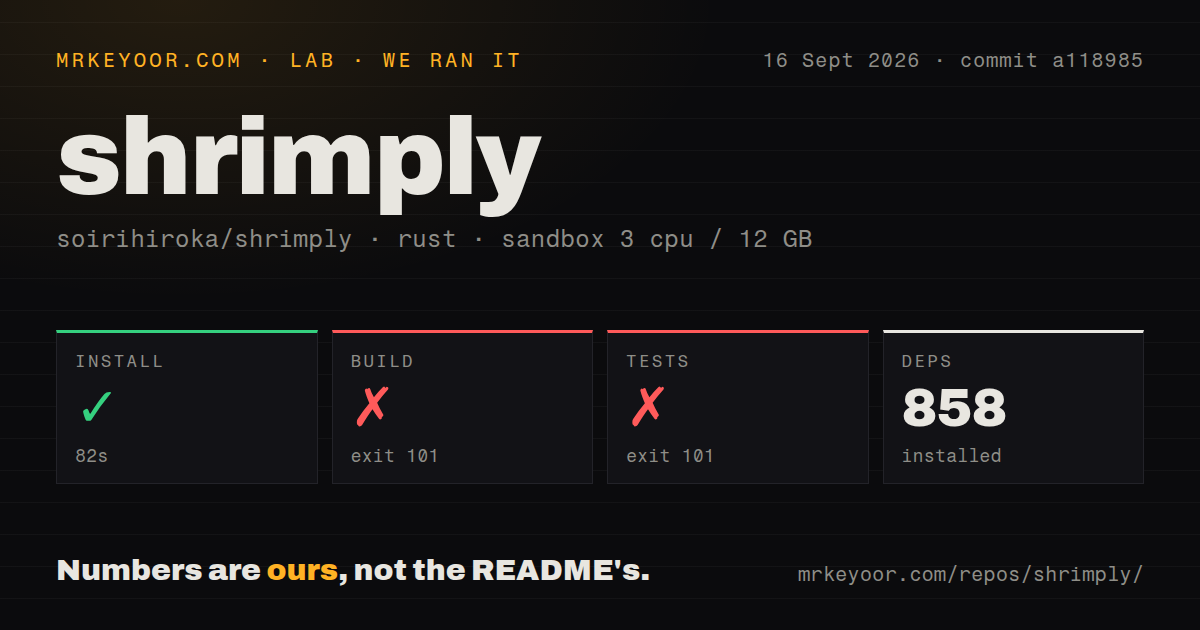
Our sandbox installed commit a118985 in 82 seconds and pulled 858 packages. The repository itself occupied 51.7 MB, with 2,065 files and roughly 397,561 source lines. The build then failed after 65 seconds with exit code 101. This happened in an unprivileged Rust container with 3 CPUs and 12 GB of RAM.
The error came from a native library check. pkg-config found Pango 1.50.12, while pango-sys required Pango 1.57 or newer. The log also said PKG_CONFIG_PATH was unset, but it had already identified the installed Pango version and declared it too old. We cannot turn that into a Rust compiler finding because compilation stopped at the system dependency gate.
Tests failed after 24 seconds with the same exit code 101 and the same Pango requirement. The supplied log showed no passed or failed test count, so none should be inferred. Our scan found 4 CI workflow files and a Dockerfile, but no top-level tests directory. The failed local run still matters: the project documentation's Fedora target includes native versions that a fresh Debian-based environment may not provide.
The editor already covers serious timeline work
Shrimply can export H.264, H.265, GIF, several caption formats, and JSON project data. The 2 video codecs require NVENC and have no software encoder fallback. Caption export includes SRT, WebVTT, ASS, YTT, and plain text, with format-specific handling for styling and timing. The Kdenlive importer preserves some track and media details but explicitly omits transitions, track effects, title clips, and other unsupported MLT features.
That honesty is useful. It tells an editor which round trips are impossible before a project is moved. Security documentation does the same for executable sources: Blender and Manim files can run code with the user's permissions. Shrimply asks the user to trust individual files or folders, then remembers that choice outside the project. The approval is not a sandbox or malware scan, so shared projects deserve a careful source review.
September activity is strong, while releases are still absent
GitHub recorded the last push on September 19, 2026. The repository had 1,137 stars and 15 open issues and pull requests when fetched, and platform discussions were updated through September 22. GitHub returned no latest release. Issue 36 explicitly ties downloadable binaries to reaching a safer level of stability, which matches the README's pre-alpha label.
Shrimply is easier to recommend as a contribution target than as a production tool. The 858-package install and Pango 1.57 floor show the cost before CUDA, codecs, and GPU behavior enter the picture. If its MCP editor control or mixed media timeline solves a problem you cannot test elsewhere, use disposable projects and keep exports outside the .shrimp file. For routine work, Kdenlive or Shotcut asks you to accept far less risk.