SeaweedFS spreads file metadata across volume servers
SeaweedFS attacks a specific storage problem: central metadata becomes painful when a system holds enormous numbers of small files. Its master tracks volumes rather than every object, while each volume server manages the locations of its own files. A client receives a file identifier and contacts the relevant volume server directly. The mapping from volume ID to server changes infrequently enough to cache, keeping reads away from a central hop.
The implementation is correspondingly large. Our checkout contained 3,935 files, roughly 919,530 source lines, and 219.6 MB. One binary exposes several roles, including master, volume server, filer, S3 gateway, WebDAV, and administrative commands. The optional filer adds directories and POSIX attributes through a selectable metadata database. FUSE mounts, replication, erasure coding, cloud tiering, Kubernetes CSI, and cross-cluster copying sit around that core.
This design fits archives, media systems, data pipelines, and other workloads where object count hurts more than individual file size. It also creates choices that simpler S3 servers avoid. Operators select replication by rack and data center, decide when warm volumes move to erasure coding or cloud storage, choose a filer store, and plan master and filer availability. Those decisions affect durability, cost, and repair behavior.
weed mini is a demo path, not a cluster design
A single command can start master, volume, filer, S3, and admin services, create a bucket, and install supplied credentials. The same path runs from the published container image. It is a good way to test an SDK against the S3 endpoint or inspect the filer UI. The README explicitly positions it for development, learning, testing, and single-node use.
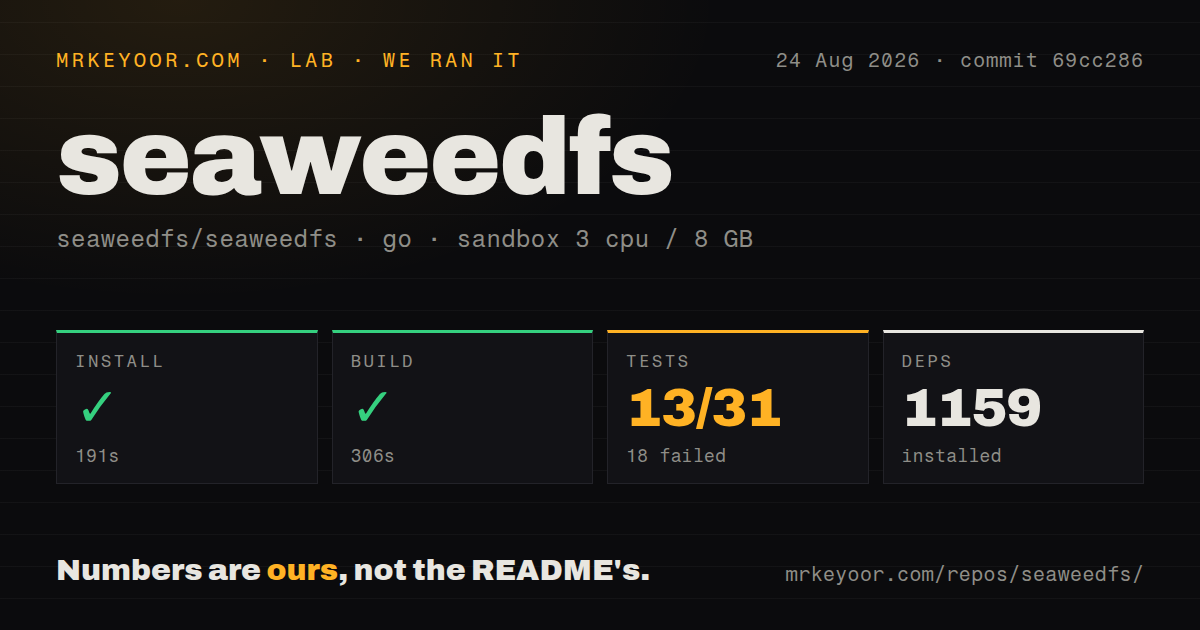
Our source setup took 191 seconds and installed 1,159 Go packages before the 306-second build. Production effort begins after that successful compile. Multiple volume servers need separate failure domains, while master failover, filer metadata replication, authentication, TLS, metrics, backups, and recovery procedures must be designed. A single weed mini process cannot demonstrate how a cluster behaves when a disk, rack, metadata store, or network link disappears.
One default deserves immediate attention: if the quick-start access-key variables are omitted, S3 runs in unauthenticated Allow All mode. That is convenient on loopback and dangerous on a reachable interface. Issue 10838 also reports that the default mini admin gRPC port can collide with Linux's ephemeral range in a specific startup sequence, leaving other endpoints briefly healthy while requested buckets are never created. Pinning ports is reasonable in repeatable deployments.
What happened when we ran it
Our dependency step succeeded in 191 seconds and installed 1,159 packages. Building at commit 69cc286 completed successfully in 306 seconds. The repository had 72 CI workflow files and a tests directory, evidence of many supported paths, although our signal scan found no Dockerfile in the checkout. Published images and source-build layout are separate facts.
The test command did not finish within 900 seconds. At the cap, Go reported 13 passing packages and 18 failing packages out of 31. The final lines came from S3 tagging tests. Cleanup could not list buckets, and a versioned-object test could not create a bucket because a request to a localhost endpoint failed after 3 attempts. The excerpt does not show why that local service was unreachable.
That result is more serious than a slow suite alone. There were already 18 failed package results when the timeout arrived, so this was not a green run cut off during harmless cleanup. Our 3-CPU, 8 GB, unprivileged Debian sandbox had no secrets. A prospective operator should reproduce the repository's expected integration environment and require the S3 tests relevant to their workload to pass before comparing features or performance.
S3 compatibility remains an active engineering surface
SeaweedFS exposes an Amazon S3-compatible API over filer data, including versioning, policies, tagging, and multipart behavior. Its README candidly says it is trying to catch up with S3-focused systems in areas such as UI, policies, and versioning. The 900-second run reinforces that caution because the visible failures concern tagging on versioned buckets, even though the log points to service connectivity rather than a demonstrated semantic bug.
Open issue 10663 is a separate, narrowly described durability risk. The reporter says a failure while removing multipart-upload metadata can leave completed object chunks referenced by both the object and a leftover upload directory. A later cleanup job may then delete those chunks. The report calls the window low risk and supplies a reproducer. Storage operators should verify whether their chosen release contains the proposed fix and include interrupted multipart completion in failure testing.
Another report, issue 10810, describes version 4.37 consuming about one CPU core while idle because an S3 metadata subscription loops against persisted logs. The reporter found an identical binary without the problem, suggesting state helps trigger it. Current release 4.44 is newer, so the report is not proof that every current node spins. It is a reason to baseline idle CPU, memory, queue depth, and log growth after upgrades.
Filer flexibility transfers database choices to you
The filer can place directory metadata in SQLite, PostgreSQL, MySQL, Redis, Cassandra, Elasticsearch, MongoDB, and other stores. That flexibility lets organizations use infrastructure they already understand. It also means two SeaweedFS deployments can have very different consistency, backup, scaling, and failure characteristics. The object bytes may be healthy while the namespace needs its own repair or restore.
GitHub showed 34,271 stars, 760 open issues and pull requests combined, a push on 2026-08-26, and release 4.44 from 2026-08-22. Activity is intense across S3, erasure coding, filer behavior, metrics, startup, and recovery. SeaweedFS is alive and ambitious. Our 18 failing packages mean the buying decision should start with a workload-specific pilot and failure drills, not the feature checklist.