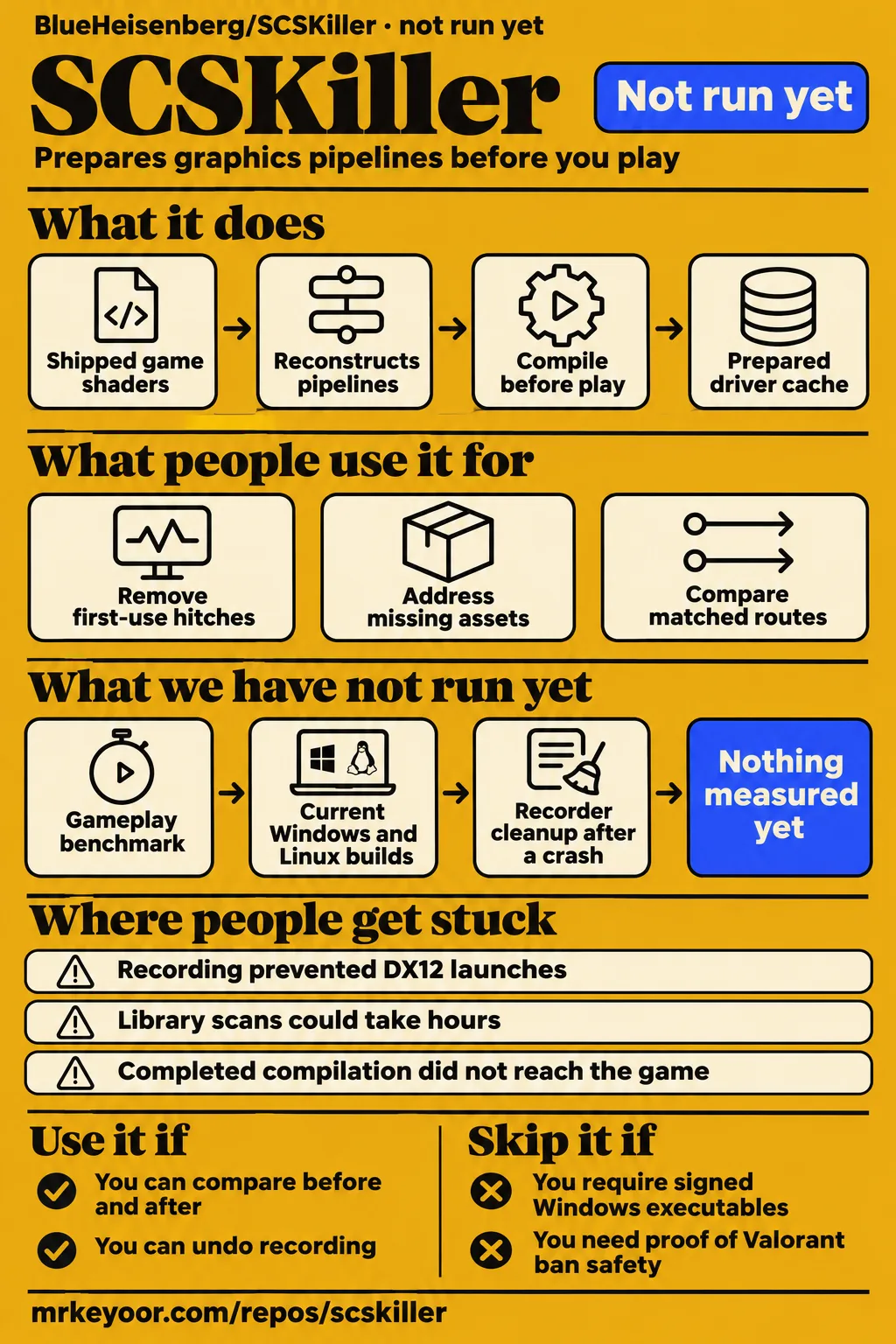
SCSKiller removed RoboCop: Rogue City's largest freezes in Digital Foundry's tests, while TechSpot found no meaningful frame-time improvement in its Hogwarts Legacy tests. That makes it worth trying for a troublesome game you can compare before and after. Skip the blanket library treatment, and keep it away from an online account whose safety depends on a guess. Our sandbox attempt stopped before execution, so the gameplay results here belong to the named reviewers, not MrKeyoor.
What people use SCSKiller for
Independent reviewers have used SCSKiller to remove first-use hitches and missing geometry, with outcomes that differ sharply by game.
| Who used it | What they did | Reported outcome |
|---|---|---|
| Wccftech's Sebastian Castellanos | Prepared Final Fantasy VII Rebirth before playing | Roughly 3 GB of NVIDIA PSO binaries; shader compilation stutters were basically eliminated in the tested gameplay. Hands-on report |
| Digital Foundry | Repeated matched RoboCop: Rogue City routes with equivalent cleared driver caches | The largest freezes disappeared; smaller interruptions associated with traversal remained. Controlled comparison |
| Digital Foundry | Prepared Silent Hill f before loading the tested scenes | Previously missing assets rendered immediately and background compilation overhead fell; traversal stutters persisted. Visual and frame-time findings |
| Digital Foundry | Built Beast of Reincarnation's pipeline cache | Geometry pop-in was fixed at a cost of nearly an hour, roughly 16 GB of disk cache and approximately 6 GB more RAM. Preparation costs |
| TechSpot / Hardware Unboxed | Compared Jedi: Survivor with and without preparation | Average FPS rose 25% in its first test and around 14% in another section, with higher RAM use. Other sections performed similarly and traversal stutter remained. Results and methodology |
RoboCop is the clearest reason to care. Digital Foundry described heading upstairs in the police precinct and hitting a freeze lasting more than two seconds. Preparation removed that severe interruption, without removing every smaller hitch. The review used a Ryzen 5 5600 and RTX 4070 Ti Super, cleared caches for both conditions and repeated identical routes. That is stronger evidence than watching a second pass look smoother after the first pass already populated the cache. Digital Foundry
Hogwarts Legacy supplies the necessary counterexample. TechSpot tried different presets and ray tracing settings, saw additional RAM consumption, and could not reproduce the developer's improvement. A successful compile can therefore buy you more cached data without buying better play. Choose the next game you actually intend to play, rather than treating preparation as routine maintenance for everything installed. TechSpot
What happened when we ran it
We did not run SCSKiller: our November 13, 2026 sandbox harness did not support its C# ecosystem, and the checkout had no Dockerfile.
| Recorded item | Result | What it means |
|---|---|---|
| Checkout | commit a996cfe | Identifies the code selected for the attempt |
| Sandbox configuration | 3 CPUs, 8 GB RAM, image n/a | Configuration only, without an established runtime or operating-system version |
| Execution | Not run: unsupported C# ecosystem; no Dockerfile | No installation, build, test or gameplay result |
| Separate hands-on safety step | Failed because no Compose file existed | The container deployment attempt stopped before launch |
| Teardown | Recorded as ok | Cleanup status, without evidence of a working application |
The safety record says none of compose.yaml, compose.yml, docker-compose.yaml or docker-compose.yml existed. That is a harness requirement, not a claim that a desktop game utility ought to ship a container deployment. The cleanup record reports teardown as ok.
A generic run label describes a Docker Compose deployment, but conflicts with that failed prerequisite and the explicit not-run result. It cannot substantiate a deployment, a localhost service or a gameplay session. The useful finding from our attempt is the execution boundary itself. The independent tests elsewhere on this page are separately attributed.
Where people get stuck: recording can stop a game launching
Issue reports show that recording and offline compilation need separate troubleshooting paths: a game can compile successfully and still fail with its recorder installed.
| Report | What the thread says | Recovery or status in the supplied thread |
|---|---|---|
| Street Fighter 6, issue #62 | Users reported recording crashes, driver resets and continued crashes after a request to test 1.4.5 | The maintainer advised leaving recording off and clearing both driver caches and the game's own shader files to escape the crash loop. The thread is open. |
| Satisfactory, issue #154 | Recording prevented DX12 launches; some users also questioned whether preparation took effect | Disabling recording restored DX12 launches for a reporter. Another recovered using Steam's -dx11 launch option. The recorder and cache behavior stayed under investigation. |
| Dragon's Dogma 2, issue #252 | One Windows reporter said 1.4.4 worked, while other reports continued through 1.4.5 | Reported routes included recording off, renaming winmm.dll on one Linux setup, and REFramework nightly. Those are individual outcomes in an open thread. |
| Resident Evil Requiem, issue #2 | The recorder first produced nothing; in 1.4.5 a crash left enough data to offer Add to queue | The reporter could compile but had to disable or remove the recorder to play. The issue remained open. |
Start with the recorder switch when a previously working game stops launching after you enable recording. Satisfactory's thread is instructive: the original reporter tried cache deletion, exiting the app, Steam's integrity check and a reboot without restoring launch. A different reporter then isolated recording as the change that prevented DX12 launch. Closing SCSKiller and removing its recorder are different actions. Issue #154
Keep the recovery scoped to the relevant report. The Street Fighter 6 maintainer's cache-clearing advice addresses that crash loop. It is a poor routine for a healthy library because it discards prepared work. Save the game's report and logs before removing evidence if you want the maintainer to investigate. Dragon's Dogma 2's thread specifically distinguishes the in-game crash report from SCSKiller's own Report a problem identifier. Issue #62, issue #252
Monster Hunter Wilds needs more careful wording than “the hooks crash it.” In issue #169, a Linux reporter reproduced the crash with recording removed and Proton's own d3d12.dll copied beside the game executable. That reproduction involved none of SCSKiller's files. It narrows the investigation to the presence or loading of a local DLL on that setup, rather than proving the recorder hooks were responsible. Removing the recorder restored normal launches in that reporter's earlier comparison.
The later v1.4.7 release claims a recording fix through the preloader for non-NVIDIA Streamline games, including Monster Hunter Wilds. That release note and the Linux reproduction describe different evidence. A named fix deserves a retest on the affected configuration before anyone calls the whole game compatible.
Large libraries hurt before you reach the Compile button
HDD mode defers reading a game's files until you open or compile it, which directly addresses the slow-library problem reported in issue #51.
The scan thread contains users waiting hours while the app inspected installed games. The maintainer explained that engine detection read part of each game's files, then added scan progress, immediate display of the previous library and HDD mode. A later request to exclude a drive or directory still received the answer that 1.3.0 could not do that. Deferred work helps you reach the library sooner, but it doesn't make preparing each selected game free.
Shader reading has its own memory boundary. Issue #220 reports PlanTooBigException in Days Gone and We Happy Few. A user later confirmed Days Gone compilation completed with 1.4.4 after the reader changed. The combined issue stayed open while the maintainer requested confirmation for both games. Calling it simply “unfixed” because the issue is open would erase a useful, game-specific result.
The reverse mistake appears in issue #65. It is closed, and the maintainer described changes that skip pipelines that crash the driver and continue compilation. An RX 6600 user nevertheless reported the same problem in 1.3.2. Skipping a failing pipeline and eliminating driver failures are different achievements. Read the latest relevant reply, not just the issue badge.
Linux cache delivery can fail after compilation succeeds
The maintainer confirmed in issue #298 that completed compilation did not reach the game in a reported Faugus setup, and that disabling Steam shader pre-caching prevented cache use on a test PC.
This is a more useful Linux check than asking only whether the progress bar finished. The cache-delivery thread discusses Steam's shadercache directory, PROTON_LOCAL_SHADER_CACHE and desktop-session cache variables. A reporter initially blamed MESA_DISK_CACHE_SINGLE_FILE, then corrected that explanation. Don't turn the first proposed cause into a configuration recipe.
The maintainer said the Steam message was wrong and described changes intended to copy as much prepared data as fits into the cache for Heroic, Lutris or Faugus games. The thread ends without a confirmed resolution. For your own comparison, inspect whether the game is consuming the prepared cache, alongside its frame-time behavior. Repeating compilation into an unused directory adds work without answering that question.
Linux usage itself is documented by the AppImage reports and the Linux changes in v1.4.7. That is enough to reject an unconditional Windows-only description, while leaving launcher-specific behavior to the relevant report. The README's opening still presents a Windows utility, so read the selected release's platform notes rather than extrapolating from that headline. Linux report, release notes
Recorder opt-in and unsigned downloads deserve a deliberate choice
The official FAQ permits explicit opt-in recording in supported anti-cheat games at the user's own ban risk, so automatic detection is no safety guarantee.
The README says anti-cheat detection can miss a game. It describes per-game permission and confirmation at each launch, and warns that recorder files left beside a game when it starts online could lead to a ban. Its ordinary preparation path and its optional recorder have different consequences: the recorder places files in the game folder. Turn recording off before deleting a portable copy, as the project's instructions require.
The same README says local use needs no account, with Patreon sign-in adding supporter features. That makes the basic decision about trust in the downloaded program and its interaction with the game, rather than a mandatory cloud account. It does not remove the recorder's risks.
The v1.4.7 notes say the build is unsigned, describe a possible SmartScreen warning and state that Windows Smart App Control blocks unsigned apps outright. They also distinguish checksum integrity from proof of who built the download: the posted checksums are unsigned too. Use the official release page, and don't treat a matching hash as a security audit.
SCSKiller vs native compilation, Steam pre-caching and Advanced Shader Delivery
Well-implemented native compilation is the first choice when it already solves the game's problem; SCSKiller earns its place where preparation is incomplete.
| Alternative | Reason to choose it | How it relates to SCSKiller |
|---|---|---|
| A game's native shader preparation | Digital Foundry found smooth frame delivery in the patched Last of Us Part I without an external utility | Use the working native path before adding another preparation step. Digital Foundry |
| Steam shader pre-caching | It is part of the actual cache-delivery path in the maintainer's Linux test | Treat the relationship as configuration-dependent. Turning it off prevented the game reading SCSKiller's compile in that test. Issue #298 |
| Microsoft Advanced Shader Delivery | Reddit participants distinguish downloaded, cloud-prepared shaders from local compilation | Their October discussion explains the distinction, not a current game-and-store support list. Discussion |
| Radeon driver background compilation | A participant in the same discussion recommends deciding by game because the driver's results differ by title | A Radeon model name alone cannot settle whether additional preparation helps. Discussion |
For Radeon RX 9070 XT owners, the practical answer is to compare the game you play, rather than accept either side of that Reddit argument as a hardware-wide rule. The supplied discussion contains disagreement. It supports the reader's question and a conditional decision, not a universal performance ranking between vendors.
For emulators, the author suggested checking for UberShaders in the emulator itself, describing emulation as a different domain. That is a more relevant starting point than assuming a DirectX game preparation workflow transfers unchanged to emulation. Author's reply
What the other reviews get wrong
Claims of universal compatibility and permanent recorder exclusion from anti-cheat games exceed the evidence, while some older platform descriptions have fallen behind releases.
Shattered's October 7 article says no covering outlet had performed a fully independent, controlled retest. Wccftech's October 4 report already contained its own Rebirth hands-on result, though it did not supply Digital Foundry's explicit controlled methodology. Digital Foundry later documented cleared caches and repeated routes. The accurate distinction is between a short hands-on report and a controlled comparison, not between developer figures and no independent evidence at all.
Shattered also says the recorder never activates in anti-cheat-protected games and broadly says the tool doesn't touch game files. The official FAQ allows recorder opt-in at the user's own risk and explains that the optional recorder installs files into the game folder. Its offline preparation behavior cannot stand in for that exception.
Earlier unsupported-Intel and unsupported-AMD-DX11 statements need version labels. Igor's Lab's 1.3.0 report describes AMD DX11 support and experimental Intel Arc support disabled by default. Experimental support is a reason to inspect the release and your configuration, not permission to declare every Arc game working. The current README still carries older-looking support language, which is part of why documentation receives a qualified score here.
TweakTown's “virtually every game” claim goes too far. Engadget's Dave Meikleham found most of his installed games initially marked unsupported. A recorder can expand coverage, but the Requiem report above shows why “has a recorder” and “works” are different findings.
HD OPTI's guide labels a game “Silent Hill Downfall” and describes perfect frame-time delivery. The supplied tests concern Townfall. Digital Foundry reported minimal overall impact there, so eliminating counted shader stalls in a selected sequence cannot justify a claim of perfect delivery throughout the game.
Questions people ask
SCSKiller prepares driver-cache data before play, and its official repository is the place to get the tool and check the selected release.
What is SCSKiller and what does the tool do?
SCSKiller, short for Shader Compilation Stutter Killer, reads shipped game shaders, reconstructs graphics pipelines and asks the driver to compile them before play. Its target is shader compilation hitches. Traversal and streaming stalls can persist. Project explanation
Where is the official SCSKiller GitHub repository and download?
The official SCSKiller GitHub repository is BlueHeisenberg/SCSKiller, and downloads come from its Releases page. The README explicitly warns that these are the only official downloads.
Does SCSKiller work with Valorant, and what anti-cheat risks apply?
The supplied evidence contains no Valorant compatibility test or ban outcome. SCSKiller's general anti-cheat FAQ permits opt-in recording at the user's risk, which cannot answer the Valorant-specific question. I would leave the recorder off and avoid putting that account at risk for an unsupported promise. Official warning
Which games work automatically by engine, and which need a recording?
The author describes engine readers for UE4/UE5, Unity, RE Engine, FromSoftware titles and a generic DX12 route, with recording for information those readers cannot obtain. That list is not a compatibility promise for every title. In the Requiem thread, the maintainer says RE Engine games require a recording before compilation. Use the game's actual status and explanation. Engine explanation, RE Engine requirement
Can I add a custom game installation folder?
Yes. The maintainer's 1.3.0 scan update says you can add folders of games yourself, and the current README also describes games you add yourself. Adding a folder does not solve an unsupported reader or an incorrect executable choice. Scan update
Does SCSKiller need to stay open while I play?
No. The README says you can close SCSKiller after compilation. Leaving it open lets it check whether preparation reached the cache the game uses, and recording adds session frame-time information. Usage instructions
Should I run SCSKiller before or after the game's built-in shader compilation?
The author says either order works because both populate the same driver cache. Digital Foundry completed built-in compilation for its baseline and used equivalent cleared-cache conditions for its comparison. Let the game's own required step finish rather than skipping it on the assumption that external preparation replaces it. Author's answer, test method
Will SCSKiller overwrite shaders already in my driver cache?
The author says SCSKiller requests pipeline creation through the driver rather than editing cache files directly. Existing entries produce cache hits and new work adds entries. Driver updates and eviction can remove prepared entries, so a completed job is not permanent. Cache explanation
How to read the documentation score
Documentation earns 3/5 because the English README explains the normal workflow and recorder risks, but its platform and support statements need reconciliation with later release evidence.
For this documentation score, 1 means the basic path is missing, 2 means instructions leave major operating questions unanswered, 3 means a usable explanation with material inconsistencies, 4 means detailed and internally consistent guidance, and 5 adds corroboration across the documented paths. This is an editorial scale for documentation only. English material exists in the README, release notes and the cited issue discussions, so reading the basic instructions does not require translation.
Setup, community and maturity remain unscored. Our skipped execution cannot assess installation, and the collected issue exchanges are insufficient for a support-service rating or a claim about reliability across games. They do show concrete maintainer investigations and individual recoveries. Use those details directly instead of turning them into a numerical promise.
What we have not tested yet
MrKeyoor has no executed SCSKiller installation, source build, test suite, shader preparation or gameplay benchmark at a996cfe; the sandbox attempt stopped before those stages.
We have not reproduced the named reviewers' frame-time results, compared GPU families, assessed Intel's experimental path, or tested current Windows and Linux builds on matched routes. The supplied issue outcomes are version-specific reports. In particular, the v1.4.7 preloader fix has not been checked against the Linux Monster Hunter Wilds reproduction, and the cache-delivery thread supplies no confirmed final fix for its launcher configurations.
Valorant compatibility and ban safety remain unanswered. We have not audited the binary, anti-cheat detection, recorder cleanup after a crash, or the security of updates. TechSpot explicitly says its cited AMD cache-capacity limit was not independently confirmed with AMD, so it should not become a universal capacity rule here.
The supplied video extracts provide no full transcripts, the blocked forum page provides no discussion evidence, and there is no long-term compatibility dataset. The next useful test is one affected game on a recorded configuration: compare the same route with equivalent starting caches, check that the game reads the prepared data, and measure RAM alongside frame times. A finished compile is only the beginning of that comparison.