An official execution layer for one broker
Scalable CLI has a narrow job and explains it clearly: give Scalable Broker customers a supported command line for 1 broker instead of forcing them to automate a website. This tool exposes deterministic commands and structured JSON, making it more suitable for local scripts and agent-driven workflows than Selenium glued to a brokerage account.
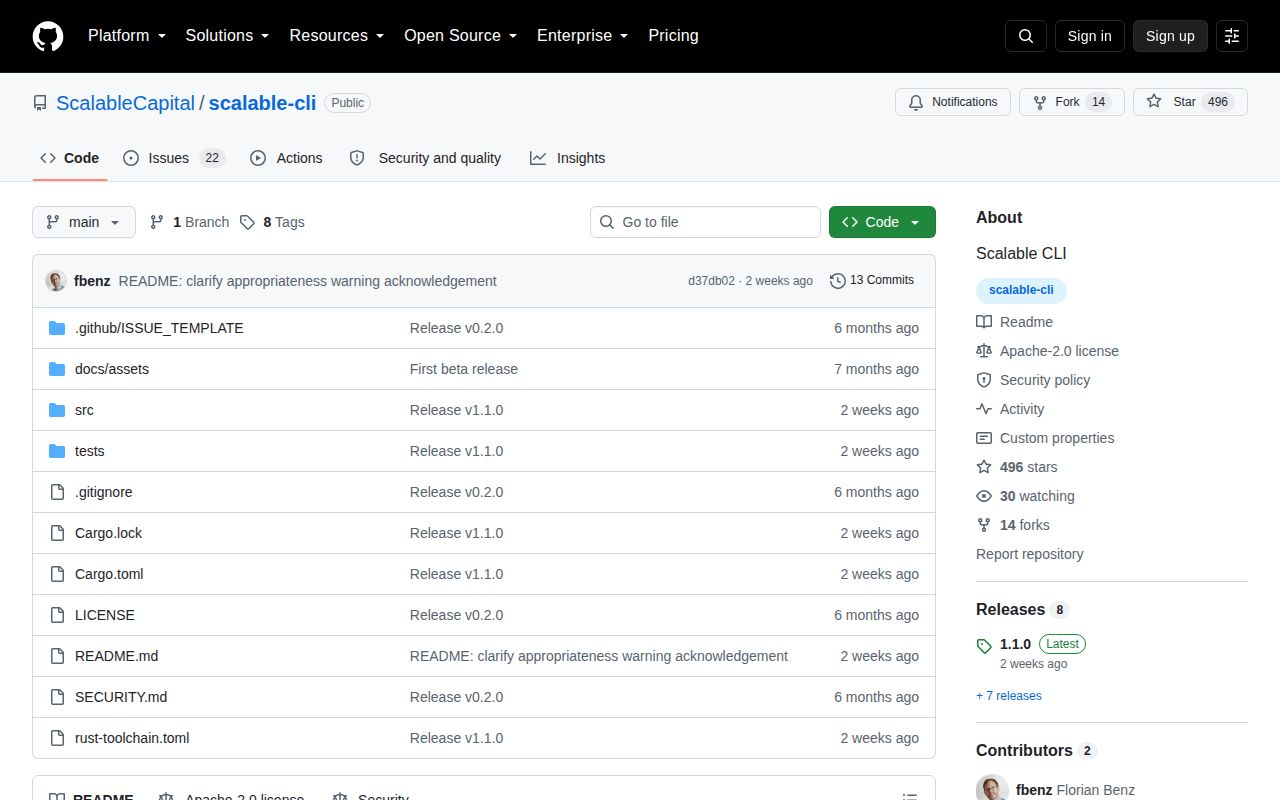
The project is written in Rust, carries an Apache-2.0 license, and had 427 GitHub stars when reviewed. Version v1.0.0 was released on August 25, 2026, followed by a repository push on August 26. The available evidence shows recent shipping and development, not a long record of stable releases.
Its clearest audience is a technically comfortable Scalable customer. More than 10 documented read commands cover identity, account capabilities, broker overview, analytics, transactions, holdings, portfolio groups, charts, quotes, watchlists, search, derivatives, security news, and overnight savings. The README also calls out details such as cursor pagination, filters, and stable JSON shapes, which are exactly the operational facts script authors need.
What happened when we ran it
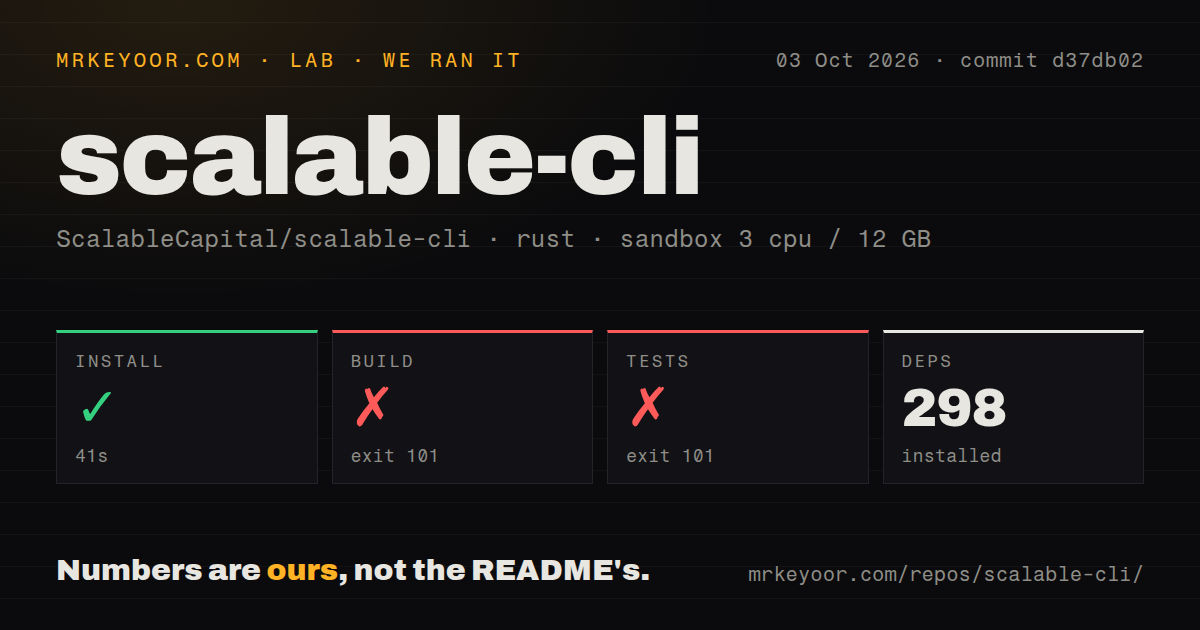
Our run used commit cb3df92 in an unprivileged Debian container with 3 CPUs and 12 GB of RAM. Installation succeeded in 29 seconds and pulled 297 packages. The checkout contained 68 files, about 51,553 lines of source, and occupied 1.9 MB. We had no secrets, so we did not attempt authenticated account actions.
The source build then failed after 127 seconds with exit code 101. The compiler reported five errors, including missing AUTH_AUDIENCE and AUTH_CLIENT_ID values in generated_dev_channel. The test command also failed with exit code 101 after 51 seconds because the library and library tests could not compile. That means we measured neither passing tests nor runtime behavior. The honest result is simpler: dependency installation worked, but the measured source checkout did not produce a working build on our box.
It does not prove that the official macOS package, Homebrew formula, or Linux archive is broken, and the log does not establish why the generated values were absent. There were 0 CI workflow files in the checkout and no Dockerfile to provide an obvious reproducible path, although a tests directory was present. Contributors should expect to investigate the generation or configuration step before doing useful source-level work.
The security design is unusually concrete
Broker automation deserves stricter defaults than a typical developer utility, and the README shows good judgment here. Login uses an OAuth 2.0 device-code flow and explicitly tells the user to complete authentication personally, rather than delegating it to an agent. Sensitive changes use a 2-step confirmation flow. There is also a --local-read-only login option that blocks write commands locally while leaving reads and local context selection available.
Across 3 artifact formats, release provenance gets more attention than most young command-line tools provide. The project publishes checksums plus a minisign signature for the checksum manifest, and the README gives verification sequences for Linux tarballs, a macOS PKG, and the Homebrew runtime ZIP. The examples also add platform checks through pkgutil, spctl, and codesign. For software that can reach financial accounts, this detail is a genuine strength.
Useful automation, with deliberate boundaries
The CLI fits best as a local execution layer behind a script, scheduled job, or supervised agent. JSON output from commands such as capabilities, overview, holdings, and transactions can feed reporting or reconciliation code without parsing terminal decoration. The documented behavior for selecting exactly 1 active savings account, and requiring an ID otherwise, is a good example of avoiding a risky guess.
Two boundaries stand out. It is less convincing as the sole foundation for unattended production trading. The README excerpt provides many read examples and mentions lifecycle commands, but it deliberately preserves human login and confirmation around sensitive work. The optional read-only mode is locally enforced, not a separate backend permission, so security architecture should not treat it as an account-level control. Keep secrets and authorization outside the agent, validate JSON fields, and retain a human approval boundary for writes.
Documentation is ahead of build reproducibility
The README is strong at user-facing setup. It separates official binaries from self-built or redistributed artifacts, tells users where to enable Agentic Investing, offers basic verification commands, and gives concrete examples rather than vague promises. It also explains semantic details, including that broker overview reports absolute return rather than a percentage. Version v1.0.0 therefore reads like a product with considered workflows, even if its contributor experience did not match that polish in our run.
The largest rough edge is the gap between downloadable-product instructions and source-build reality. A source project of roughly 51,553 lines benefits from an explicit contributor prerequisites section, a documented code-generation step if one exists, and visible automation that proves clean builds. We cannot say those additions would resolve the observed errors, only that the current log points to missing generated constants. Prospective contributors should reproduce the build before planning integrations or patches.
Choose it for Scalable, choose trackers for breadth
The 3 alternatives, Ghostfolio, Portfolio Performance, and Rotki, solve adjacent rather than identical problems. They are better candidates when the primary need is tracking assets across providers, running a portfolio dashboard, or analyzing investments without issuing Scalable Broker commands. Conversely, Scalable CLI should not be stretched into a multi-broker wealth system merely because its JSON is convenient.
For an existing Scalable Broker user, the decision is reasonably clear. Start with the signed official v1.0.0 binary, enable access through the web profile, log in yourself, and begin in local read-only mode. Confirm capabilities before wiring any automation, and treat every write as an approval event. For source contributors, wait for or identify the missing build inputs first. The project has promising security choices and recent activity, but our 127-second failed build keeps it below production-ready maturity from source today.