Short answer: use it as a starting point you will maintain
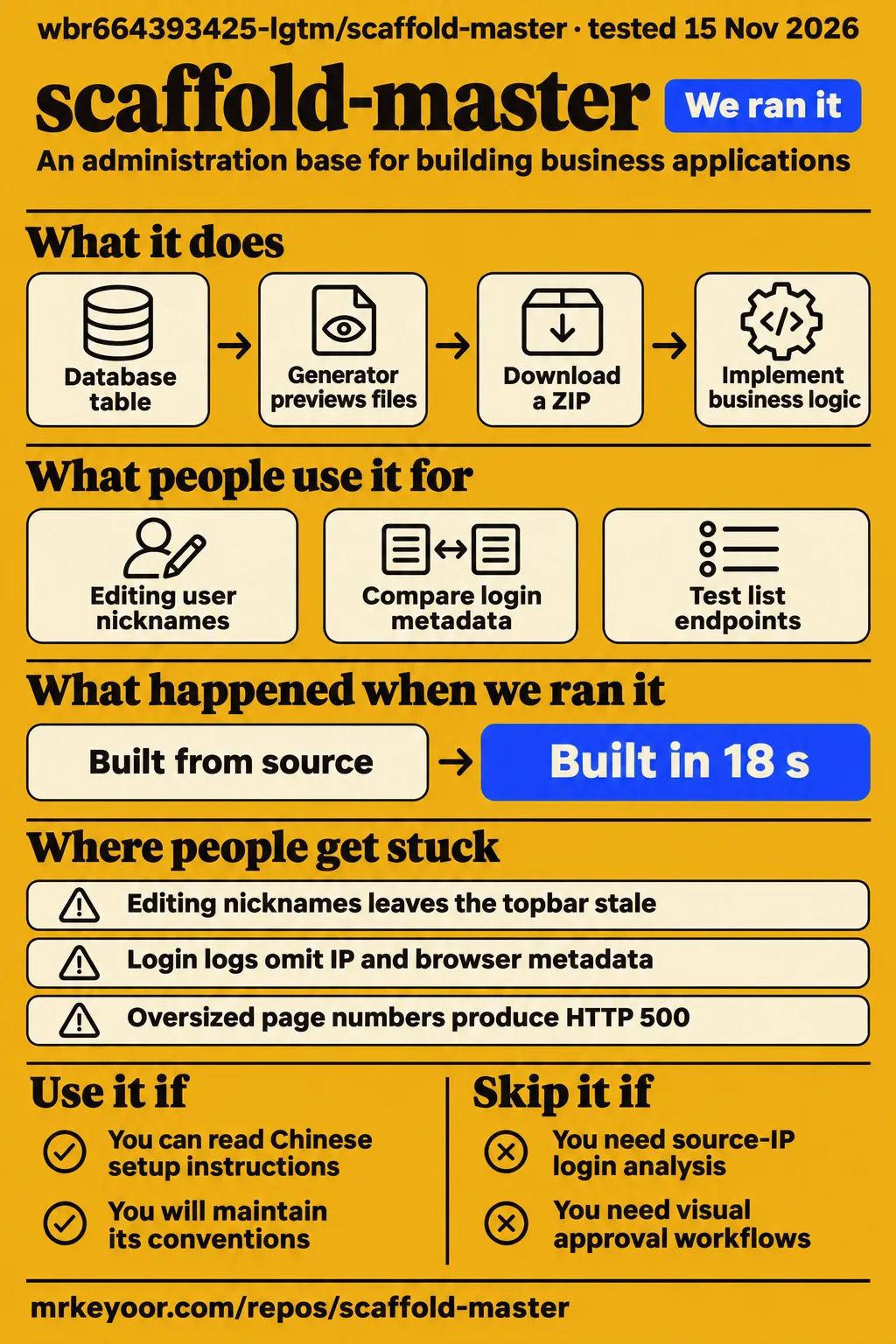
Our sandbox built scaffold-master's Vue project in 18 seconds, while issue reports against the same commit describe missing login metadata, stale nicknames and pagination errors. Use it if you're a Spring Boot/Vue developer who wants an administration base and can investigate those paths before adding business features. Skip it if you need a ready-made approval system or dependable source-IP analysis from the supplied login logs.
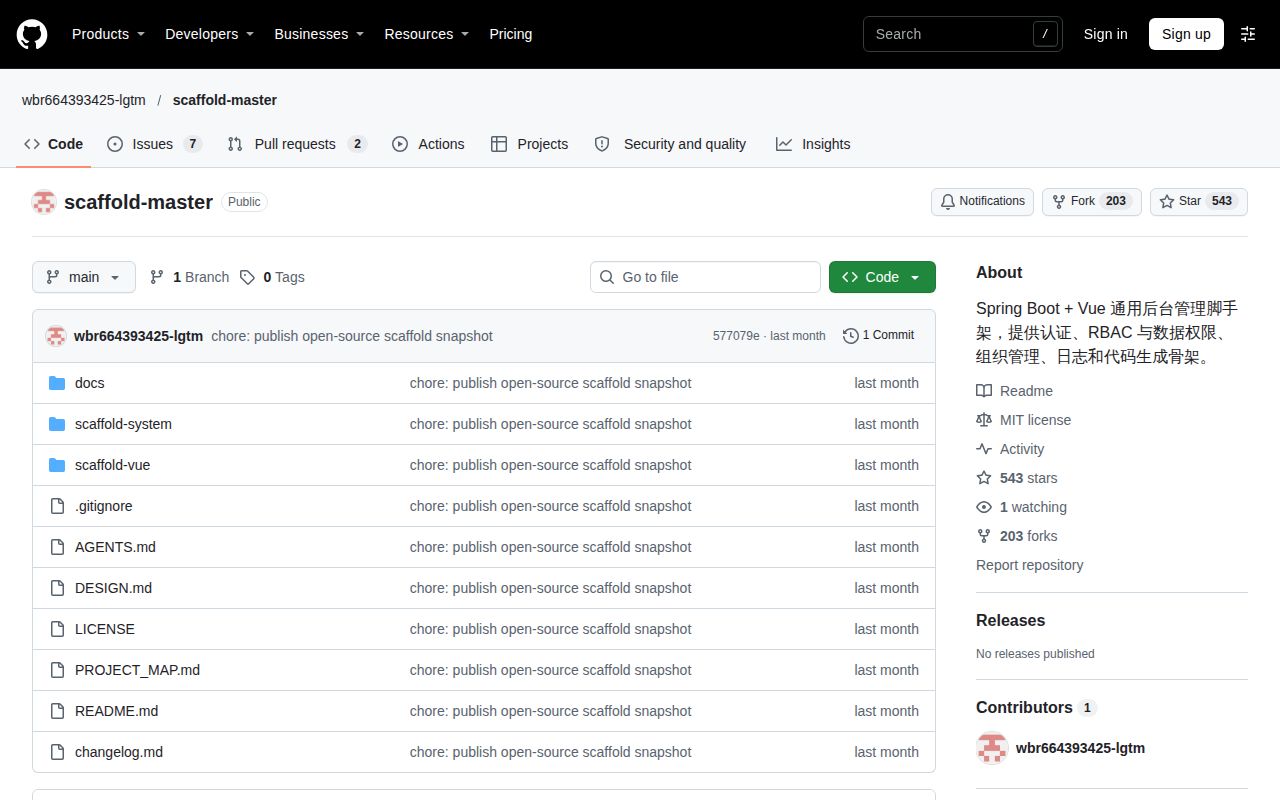
This review concerns wbr664393425-lgtm/scaffold-master, a Chinese-first administration scaffold. The project README describes authentication, permissions, organization management and a code-generation skeleton. That last word matters: generated files still need business logic. The useful decision is whether you want to inherit this particular application structure, including its operating responsibilities.
What you can do with scaffold-master
The README describes a Spring Boot backend and Vue 3 administration interface for building your own business modules. It separates the backend under scaffold-system from the frontend under scaffold-vue, with SQL initialization scripts alongside the backend. The feature set supplies common administration work: users, menus, button permissions, data permissions, organizations, dictionaries, parameters, logs and a dashboard.
For a team building an internal application, the attraction is starting with those connections already designed. The README tells developers to reuse the shared pagination and exception handling, permission components and list/form components. New pages also need registration in the component map and corresponding menu and button permissions. You are adopting conventions across both halves of the application, so review those conventions before committing a business module to them.
The code generator previews files and downloads a ZIP, according to the README. It leaves Controller, Service and Mapper business CRUD for the developer to implement, and generated frontend pages also need work. Downloading the ZIP does not write files into the project. Choose this route when an editable skeleton is useful; a team expecting a working new application from a database table will still have substantial implementation work.
What people use scaffold-master for
The strongest concrete usage evidence is two issue reporters' deployed checks of commit 577079e, rather than named production customer stories. Both are useful because they follow a normal administration task far enough to expose behavior behind the screen. Their results belong to the reporters, separate from our sandbox build.
| Who used it | What they did | Reported outcome |
|---|---|---|
| Reporter of issue #5 | Built and deployed the project, then edited the signed-in administrator's nickname in user management | The user table changed immediately; the topbar, dropdown and dashboard greeting kept the old nickname until another login |
| Reporter of issue #6 | Examined login records and compared their metadata with operation logs | All 31 login records lacked IP, location, browser and OS metadata; all five operation records had IP values |
The nickname example is especially easy to recognize. An administrator saves a change, sees the new value in the table, then looks up and sees the old value beside their avatar. The report says logging out and back in updates the topbar. That is a reported workaround for a display synchronization problem, not evidence that saving the database value failed. Issue #5 is open in the supplied record.
The login-log investigation is more consequential. The reporter compared two log tables in the same deployed application, so the complaint is specific to login logging rather than a general claim that the server cannot observe IP addresses. For someone choosing a base partly for its audit screens, that distinction deserves more weight than a screenshot of an apparently complete log table.
What happened when we ran it
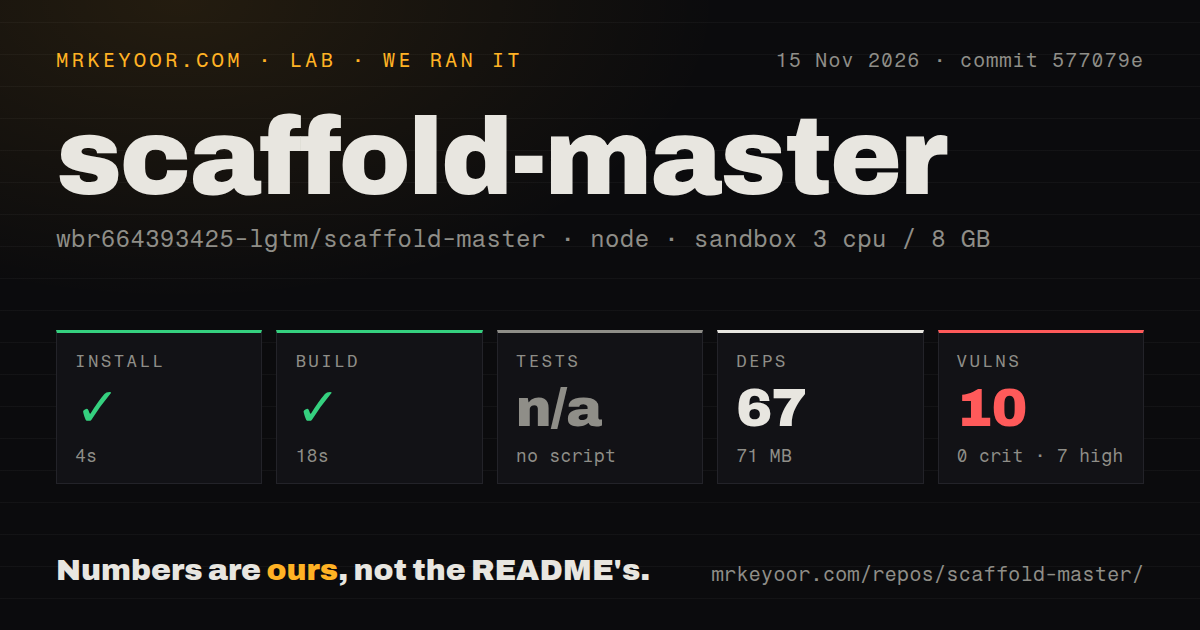
Our November 15, 2026 sandbox run at commit 577079e installed the npm project in 4 seconds and built it in 18 seconds. The separate hands-on deployment attempt failed its safety step because it found no Compose file. Those are different checks with different outcomes.
| Sandbox check | Recorded result | What it means for your evaluation |
|---|---|---|
npm install in scaffold-vue/ |
Succeeded in 4 seconds | Dependency installation completed in this sandbox |
| Frontend build | Succeeded in 18 seconds | The measured frontend build completed |
| Tests | No tests script/target; skipped | No passing test result comes from this run |
| Dependencies | 67 recorded; 71 MB on disk | This is the measured dependency footprint |
| npm audit | 10 known vulnerabilities: 7 high, 3 moderate, 0 critical, 0 low | Dependency remediation needs attention before deployment |
| Repository scan | 0 CI workflow files, no Dockerfile, no tests directory | These are observations from the recorded scan |
The sandbox configuration was 3 CPUs, 8 GB RAM and image label lab-node:22. The checkout contained 241 files, approximately 21,781 source lines and occupied 1.3 MB. The frontend lives in a subdirectory; treat these results as evidence about the measured npm project rather than a completed database-backed administration session.
The hands-on safety record says none of compose.yaml, compose.yml, docker-compose.yaml or docker-compose.yml existed. Its rule required a Compose file, so the attempt stopped at that check. The word "unsafe" in that runner message names the runner's prerequisite classification. It is not a finding that the project contains malicious code.
There is a conflict in the hands-on records: the run summary describes a deployment with the project's own Docker Compose and ports bound to 127.0.0.1, while the step record says the required file was missing. We give the failed step priority when describing what completed. The teardown record reports successful cleanup.
Where people get stuck: saving a row does not refresh the session
Issue #5 reports that editing the current user's nickname refreshes the user list while leaving session-backed displays stale. The reporter traces the current-user state to browser storage and says the save handler reloads the list. Switching routes within the session does not trigger the refresh described in the report.
| Report | Practical consequence | Workaround or repair status in the record |
|---|---|---|
| #5: stale nickname | The person editing their own account sees inconsistent names | Logging out and back in is a reported workaround; the issue is open |
| #6: missing login metadata | Login failures lose their source-IP distinction | The reporter proposes carrying request metadata into the insert; the issue is open |
| #7: pagination overflow | Oversized page numbers produce HTTP 500 on tested lists | The report identifies unbounded page numbers and integer offset arithmetic; the issue is open |
For nickname handling, the acceptance check should cover the table, topbar, dropdown and dashboard greeting after saving the signed-in account. Checking only the list would reproduce the blind spot in the report. Refreshing shared current-user state after a self-edit is a sensible repair direction, but the record supplies a workaround rather than a completed patch.
These reports also help you order the work. An outdated greeting is annoying; missing source information affects how an administrator interprets login activity. Start by deciding which built-in features your application will rely on. If login analysis is one of them, its persistence path needs attention before the dashboard's visual polish earns your trust.
Pagination breaks at the arithmetic boundary
The reporter of issue #7 received HTTP 500 from five list endpoints when sending pageNum=21474838&pageSize=100. The tested paths were users, roles, posts, configuration and operation logs. The record includes a MariaDB syntax error near a negative offset, -2147483596, and explains how integer multiplication produces that value.
This is a boundary-input defect, not a measured database capacity limit. The request can name an enormous page without the database containing that many rows. In the reporter's example, the offset calculation crosses the signed integer boundary before SQL executes. A larger page number can even wrap back to a positive value, which is why accepting one huge number is a poor substitute for checking the arithmetic.
A useful repair review would inspect both input bounds and the offset type, then exercise the boundary through the real endpoints. The reporter also names dictionary and login-log pagination methods found during code inspection. Keep those separate from the five endpoints actually exercised. The issue is evidence for a shared calculation worth inspecting, not a load test of every list screen.
Security starts with the secret and the log writer
The README requires a JWT signing secret of at least 32 bytes, and issue #6 reports that the login-log insert omits IP, location, browser and OS. Those facts address different responsibilities: configuring authentication and recording enough context to investigate its use.
According to the README, the backend reads process environment variables and does not automatically load a .env file. Put the secret in the actual launch environment. The documentation says a missing or short secret stops backend startup, and changing the secret invalidates older tokens. It also instructs operators to replace the seeded development password and configure their own database and Redis credentials before real use.
The login-log problem needs a code-path repair. The reporter shows an insert containing username, status, message and login time, with no metadata parameters. They also show failed-login analysis grouping by IP. When every source has a null IP, the analysis collapses those failures into the same group. Adding columns to the screen cannot recover values that were never written. The proposed change passes request IP and user-agent data through the controller and service into persistence.
Our npm audit separately reported 10 known vulnerabilities, including 7 high-severity advisories. The severity totals are a reason to inspect the affected dependency paths; they are not proof of a demonstrated exploit in this application. For an administration base that will control users and permissions, I would put dependency review and login-log correctness ahead of adding more management screens.
English readers will need to work from Chinese documentation
The README and the supplied issue discussions are in Chinese, and the README links no English edition. Its directory names and code identifiers make some navigation possible without translation, but the startup explanations, role behavior and repair discussions still require reading the Chinese material.
That matters most around destructive or security-sensitive instructions. The README warns that the database initialization tool's fix argument deletes the target database. It also explains that seeded roles other than the super administrator start without assigned menus. An account showing no available menu can therefore reflect configuration described by the project. Read those instructions before treating an empty navigation screen as a broken installation.
scaffold-master vs RuoYi-Vue and vue-element-admin
RuoYi-Vue is a relevant full-stack comparison; vue-element-admin is relevant when you mainly want a frontend administration base. Their own READMEs support that distinction. Choose the layer you need before comparing screenshots or code-generation claims.
| Project | Documented scope | When I would consider it |
|---|---|---|
| scaffold-master | Spring Boot/Vue administration base with business code left in its generated skeleton | You want this project's shared components and conventions and will own the reported defects |
| RuoYi-Vue | Its README describes a Spring Boot backend and Vue frontend with permissions and code generation | You want to compare another complete Java/Vue administration structure before adopting this one |
| vue-element-admin | Its README describes a Vue and Element UI frontend administration solution | You already have a backend and mainly need an administration frontend |
RuoYi-Vue's documentation lists dynamic permission menus and a generator that produces frontend and backend files. That makes it a closer comparison than an unrelated command-line scaffolder. Compare what each generated module still leaves you to implement, then look at the permission conventions your team will need to follow.
vue-element-admin's README says request data is simulated with Mock.js. That changes the adoption task: you would connect the interface to your own services. Its English README is useful to an English-speaking team, but a frontend demonstration should not be mistaken for a ready backend. Neither alternative gets a speed or reliability advantage from our scaffold-master build result.
The shared name can send you to the wrong instructions
Abjcodes/scaffold-master is a separate repository whose documentation describes an npm boilerplate package. The supplied npm-project record belongs to that owner, not wbr664393425-lgtm. Installing a same-named npm tool is therefore not an evaluation path for the Spring Boot/Vue application reviewed here.
The research results also include construction-inspection products and unrelated videos. The supplied X search excerpt discusses AI harness engineering rather than a demonstrated task in this repository. Those records cannot serve as customer adoption or setup evidence for this project. Match the GitHub owner as well as the project name before borrowing instructions, vulnerability counts or licensing claims from a search result.
Questions people ask
The supplied online-demo request is open with no comments; it provides no demo address. Issue #1 asks the maintainer for a place to try the application. The other questions below come from this repository's issue tracker, including requests for easier deployment and visual workflows.
Is there an online demo of wbr664393425-lgtm/scaffold-master?
Issue #1 requests an online experience address and is open with no comments in the supplied record. The request is evidence that someone wants a demo, rather than proof that a hosted instance exists. Use the documented local setup as the concrete evaluation route described in the README.
How can I deploy scaffold-master locally with Docker, and is there a setup guide?
Issue #3 asks for a local Docker script and guide; the supplied record is open with no comments. The README instead describes local Java/Maven and Vue startup with MySQL and Redis. Our Compose-based hands-on attempt stopped because the required Compose file was absent. Follow the documented local path rather than assuming an npm command starts the complete system.
Can the author share the prompts used for scaffold-master?
Issue #2 asks the author for prompts and has no comments in the supplied record. There is no prompt collection in that discussion. The request alone says nothing about which prompts produced particular files, how much code was generated, or how the author checked it. Judge the application from the code and behavior evidence.
Can scaffold-master support visual approval workflows and low-code form configuration?
Issue #4 requests visual approval processes, forms and workflow nodes, plus low-code form configuration. It is an open feature request in the supplied record. The README says workflow modules were removed. If those features are your reason for adopting a scaffold, this evidence argues for choosing a project that already documents the workflow you need.
Why does changing my nickname leave the topbar showing the old name until I log in again?
The issue #5 reporter traces the discrepancy to cached current-user state while the save handler refreshes only the list. Logging out and back in is their reported workaround. The issue remains open in the supplied record, so the workaround should not be described as a shipped synchronization fix.
Why are IP, location, browser and OS always NULL in scaffold-master login logs?
The issue #6 reporter shows that the login-log insert never includes those fields and its callers supply no metadata arguments. Their sample contains 31 login records with none of those values populated. The proposed repair passes request metadata into the insert. The supplied record shows an open issue, not a completed implementation.
Why do large pageNum values cause HTTP 500 errors on scaffold-master list endpoints?
The issue #7 reporter shows integer overflow turning the pagination offset negative, followed by MariaDB rejecting the resulting limit clause. Five endpoints were exercised. Bounds checking and safe offset arithmetic are the relevant repair areas to examine; raising a timeout would not address the calculation described in this report.
What we have not tested yet
Our own completed checks cover npm installation and frontend build at 577079e; tests were skipped and the Compose safety step failed. We have not reproduced a complete backend deployment, database initialization, permission enforcement, the three reported bugs, their proposed fixes, or an authenticated browser session. The issue reporters' deployments supply the behavior evidence described above.
The raw toolchain logs are needed to identify actual runtime and operating-system versions; lab-node:22 is only the recorded image label. The README documents verification commands, but that does not change the lab's skipped-test result. Our scan's absence of a tests directory also cannot erase commands or checks described by the documentation. The contradictory hands-on summary needs reconciliation before anyone can claim a successful lab deployment.
We have not measured concurrent users, database growth, request latency, backup recovery, mobile usability or either alternative. No advisory-level audit details, named production adoption, support response history, English UI coverage or current repair confirmation accompanies this evaluation. All four score dimensions are therefore N/A: a frontend build and a set of open reports are too narrow to rate the whole product's setup, documentation quality, community or maturity fairly.
Before using this base for an application that relies on login analysis, the next useful result is a login record with the expected source metadata, followed by an endpoint check at the reported pagination boundary. Those outcomes would resolve more of the adoption decision than another dashboard screenshot.