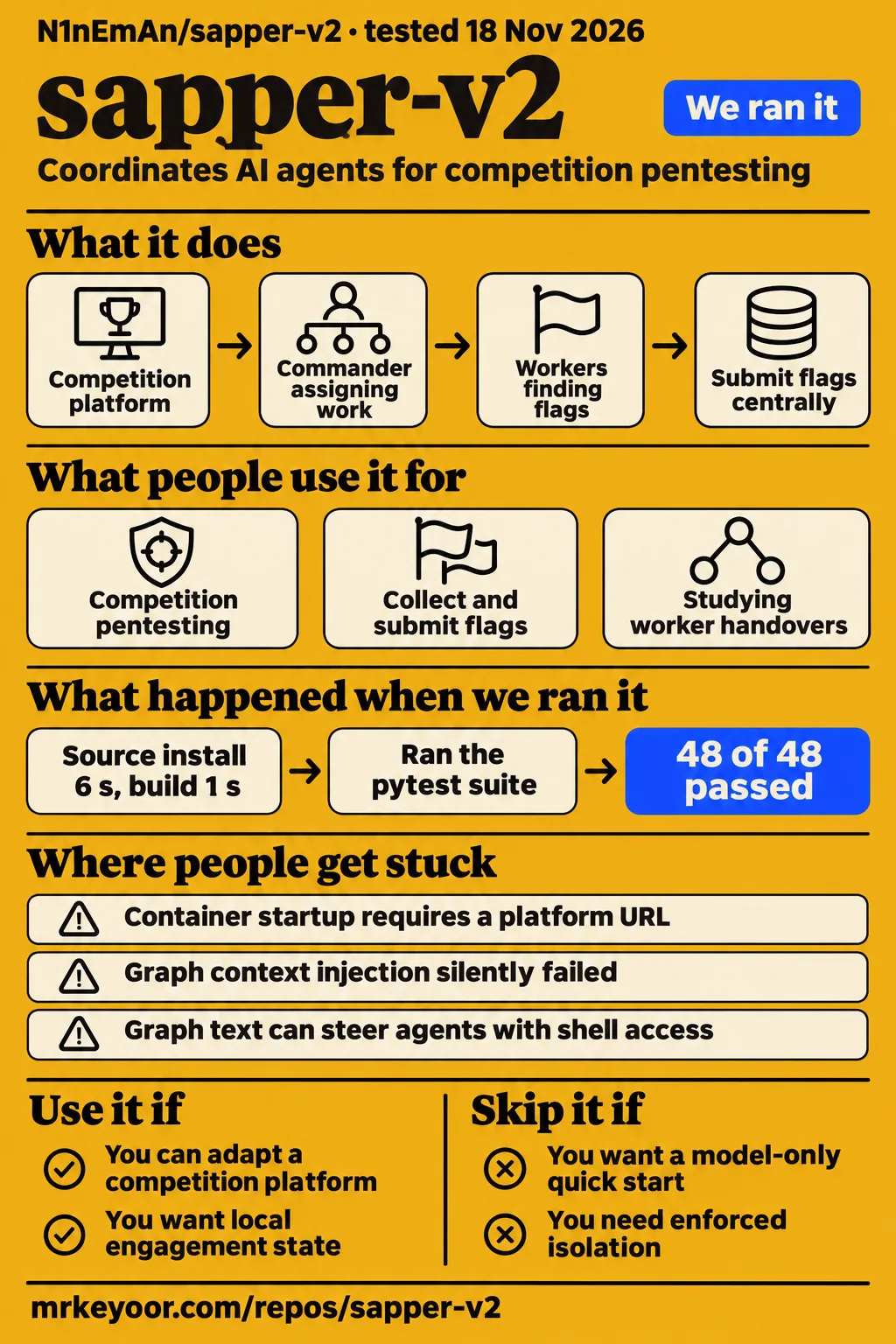
Our sandbox passed all 48 tests, but the later deployment attempt stopped at a missing-Compose-file safety check. Use sapper-v2 if you're an experienced security researcher adapting a multi-agent harness to an authorized competition arena. Skip it if you want a scanner that starts with a model key and produces an enterprise assessment. The competition platform is part of its wiring.
What people use sapper-v2 for
N1nEmAn's sapper-v2 coordinates AI workers for competition pentesting and gives them a shared record of findings, rather than asking one chat session to remember the whole campaign. Its English README describes a commander, generals, scouts and soldiers, with a script supervising their continued operation. The practical attraction is continuity: another worker can pick up recorded work after a session ends. Project README
The strongest use cases in the records include both a reported competition campaign and people trying to make the released software work:
- N1nEmAn / VarFusion Lab reports first place among 634 teams in the Tencent Cloud Intelligent Attack-Defense Challenge online qualifier, with 80.18 points, 85 flags and eight unattended hours. That is the author's competition account. It is different evidence from our Python checks. Competition account
- The same author describes workers finding flags but mishandling submissions. The commander reportedly created a dedicated signalman to collect unsubmitted flags and submit them centrally. For a researcher studying coordination, this is a more useful example than the leaderboard position: finding an answer and delivering it were separate jobs. Signalman account
- GitHub users Logider and buty tried starting the container with a GLM gateway configured and encountered the missing competition-platform URL error. Buty also reported an image-architecture warning on Apple Silicon. Their experience exposes a dependency that a model-only quick start misses. Issue #5
- The reporter of issue #2 executed the graph hooks directly and from a newly initialized project, reproducing a missing-module crash. The maintainer subsequently reported correcting the import and checking both hooks in a fresh project. This is a concrete maintenance interaction, with a reproduction and a reported repair. Issue #2
Those examples give you two sensible reasons to investigate: reproducing competition orchestration, or studying shared memory and worker handovers. They don't make the container a general-purpose deployment recipe. The README itself directs people pursuing office, research or engineering workflows toward the separate Nüwa foundation.
What happened when we ran it
Our November 19 hands-on attempt stopped at the safety step because the checkout had none of the Compose filenames the runner required. The record says hands-on step safety: FAILED and lists compose.yaml, compose.yml, docker-compose.yaml and docker-compose.yml as absent. This was our runner's prerequisite, so the stop is a finding about that deployment path, rather than evidence of a scanner crash.
The run-summary record nevertheless says the project was deployed with its own Docker Compose and localhost-bound ports. That conflicts with the failed prerequisite. We treat the failed step as the controlling evidence and do not count the summary as a successful deployment. The teardown record says teardown: ok.
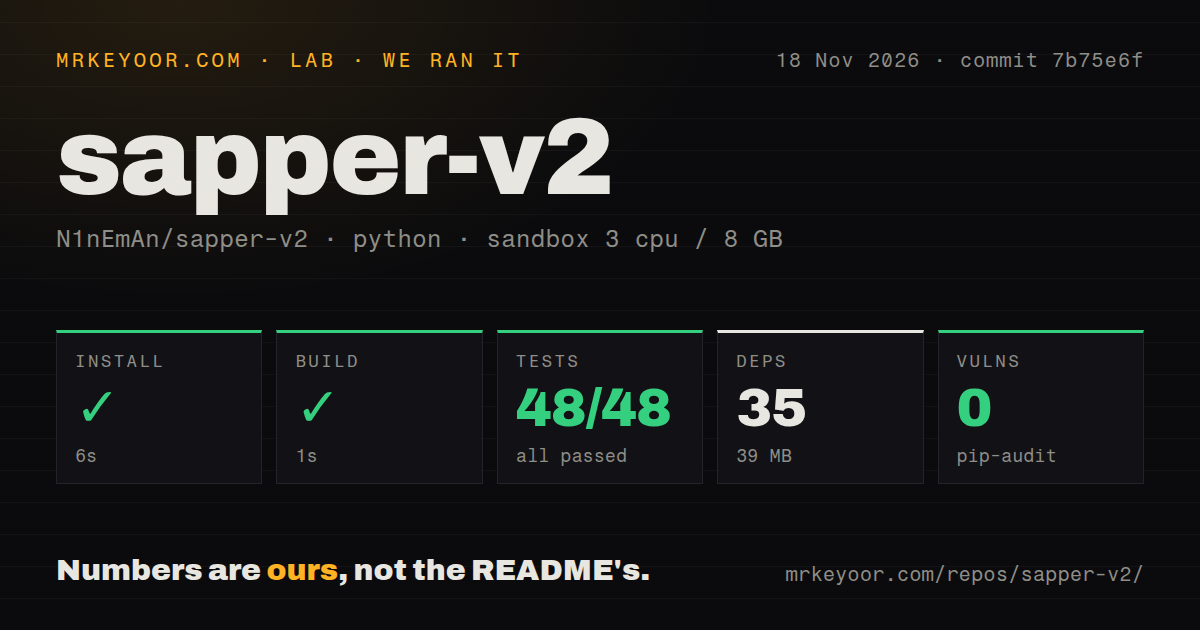
The earlier source-check run, on November 18 at commit 7b75e6f, completed successfully. In our sandbox, installation took 6 seconds, the build took 1 second, and pytest passed all 48 tests in 5 seconds. Those are repository checks, not a completed autonomous attack campaign.
| Check | Our recorded result | What it tells you |
|---|---|---|
| Install | Succeeded in 6 seconds; 35 dependencies; 39 MB on disk | The measured Python setup completed |
| Build | Succeeded in 1 second | The recorded build step completed |
| Tests | Succeeded in 5 seconds; 48 passed, 0 failed of 48 | The recorded pytest suite passed |
| Dependency audit | pip-audit: 0 known vulnerabilities | The audit reported no known advisories |
| Checkout | 106 files; about 8,709 source lines; 29.8 MB | The measured source checkout was modest |
| Repository signals | 0 CI workflow files; no Dockerfile detected; tests directory present | These are scan results for the measured checkout |
| Later deployment attempt | Safety step failed because a Compose file was required | This attempt stopped before a demonstrated workload |
The configured source-check sandbox had 3 CPUs, 8 GB RAM and image label ghcr.io/astral-sh/uv:python3.12-bookworm. That label records the selected image. Actual runtime and operating-system versions require the raw toolchain logs. Also keep the scan's “no Dockerfile” result separate from the README's named docker/Dockerfile.commander build path: the automated signal is not a file-by-file assessment of every container artifact. README
Where people get stuck: the arena URL comes before the model
A GLM gateway does not replace BENCHMARK_BASE_URL: the competition container checks the arena interface at startup. In issue #5, the maintainer says this behavior is intentional because the competition environment supplied that platform address. Outside it, you must adapt the platform interface, model gateway and credentials, and watchdog budget. Filling in a random URL won't provide a compatible arena. Maintainer's explanation
| Symptom | What the source says | Practical response | Recorded outcome |
|---|---|---|---|
BENCHMARK_BASE_URL is not set |
Logider configured the GLM gateway without the platform address | Follow the platform-adaptation checklist as well as model configuration | Maintainer explained the requirement; issue #5 is open in the supplied record |
| amd64 image versus arm64 host warning | Buty reported the warning on Apple Silicon | Treat architecture compatibility as a separate requirement from the URL | The record supplies no architecture-specific repair |
| Graph state never appears in prompts | Issue #2 reproduced an old fg import after the module had become sapper |
Use source containing the reported import correction and check hook output | Maintainer reports repair in c91881d; issue closed |
| Sluggish operation compared with ARTEX | Issue #4's reporter described slow interaction | Record the slow stage, gateway, model and worker configuration before comparing | Maintainer explained the competition focus and requested specifics; issue closed |
The hook failure deserves particular attention. The reporter could use the CLI while the automatic context injection silently failed. Running the hook itself exposed ModuleNotFoundError: No module named 'fg'. The maintainer acknowledged the stale import and reported checking actual hook execution, including a fresh-project setup. A working graph command therefore wasn't enough to demonstrate that the agent was receiving the graph. Hook reproduction and maintainer response
The ARTEX thread ends differently. The maintainer points to gateway quality, model selection and worker or budget configuration, and explains that the defaults target a long competition campaign. A closed thread here records an explanation and a request for more detail, not a measured speed improvement. Issue #4
Long campaigns need handovers and a spending limit
The README describes a watchdog that relaunches a crashed commander, rotates keys and wraps up at the deadline, while written handovers preserve work between sessions. The watchdog is a script with no strategic role. Planning stays with the agents. That distinction matters if you're investigating how agents keep running unattended: process recovery and deciding what to do next are different mechanisms. Runtime design
The author's account of saturated worker contexts describes recycling a worker and leaving written lessons for its successor. Its signalman example describes another kind of failure, where completed work wasn't reaching the scoring system. For your own arena, make “work recorded,” “work checked” and “result submitted” separately observable. That's our recommendation drawn from the campaign story, not a feature result measured in our sandbox.
The author reports using 1 billion tokens. The README reports 4.5 billion for the runner-up. Treat those as reported consumption figures. To set your own spending limit, you need your providers' rates and the split between models, plus the budget and deadline configuration described by the project. Our advice is to record spending alongside accepted results when evaluating a fork. The watchdog's ability to keep sessions alive is a reason to set a limit before starting, not a reason to leave billing unattended. Reported token totals and configuration
The container bypasses permissions; the graph defense is textual
The container entrypoint sets bypassPermissions and launches its commander with --dangerously-skip-permissions. That is consequential configuration for software whose agents have shell access. A diagram separating commander and worker roles doesn't tell you what commands those processes are allowed to execute. Read the launch path as well as the architecture explanation. Container entrypoint
The project-local setup documentation is unusually direct about graph injection. Recorded facts, intents and hints become part of the executor's prompt, and attacker-controlled text can attempt to steer it. The prompt tells the executor to treat those records as untrusted data. The documentation explicitly calls this a textual defense rather than a sandbox and recommends permission prompts instead of blanket permission skipping for untrusted graphs. Graph security guidance
That gives an evaluator a concrete inspection list: the trustworthiness of .sapper/, the agent's permissions, the files exposed to its shell, and the arena it can reach. Keep competition credentials and model credentials separate in your thinking, because the entrypoint requires both kinds of service. The README labels the project for authorized security testing only. Its proposed taggant mechanism is described as a community design effort, with possible future inclusion, so don't count it as an existing protection. README safety statement
English documentation exists; troubleshooting crosses languages
The repository provides an English README and a Chinese README, while the sampled setup and performance issue threads are in Chinese. An English-speaking developer can understand the architecture and quick start from the main page, then use the issue reproductions and translated maintainer replies for the failure details. The full design article linked by the README is also labeled Chinese. README, platform issue
The supplied YouTube transcript for “Sapper-v2: The Rise of Autonomous AI Hacking Forces” introduces conventional tools such as Nmap and Nuclei before discussing the agent story. It is explanatory material, rather than a deployment result we can use as a benchmark. The record lacks a channel attribution, so we identify it by title. A beginner should pair that conceptual introduction with the actual README and issue #5 before attempting the full container. Video transcript
On X, Marco_Ramilli repeats the unattended competition result. WojakTheDev outlines a lab-oriented CLI start and the full swarm. These posts show how people introduce the project, but the maintainer's platform-adaptation instructions are the better starting point for your own setup. Search results also mix in unrelated Svelte Sapper tutorials and gaming videos. Neither belongs in an adoption count for this security project. X records, unrelated tutorial record
sapper-v2 vs ARTEX, nvwabase and Cairn
The best alternative depends on whether you want competition orchestration, general agent memory or a different coordination model. Start with nvwabase when you want the underlying graph without sapper's competition doctrine. Consider Cairn when you want workers coordinating through a shared board. ARTEX appears in a user's responsiveness complaint, which gives us a comparison question rather than a performance ranking.
| Choice | Documented distinction | Pick it when |
|---|---|---|
| sapper-v2 local graph CLI | Project-specific JSON graph and Python CLI, presented as an alternative to a database, API server and web UI stack | You want inspectable local engagement state |
| A database/API/web UI commander stack | The architecture comparison in the supplied project description contrasts that service stack with local files | You already need a service-oriented control plane and accept owning those components |
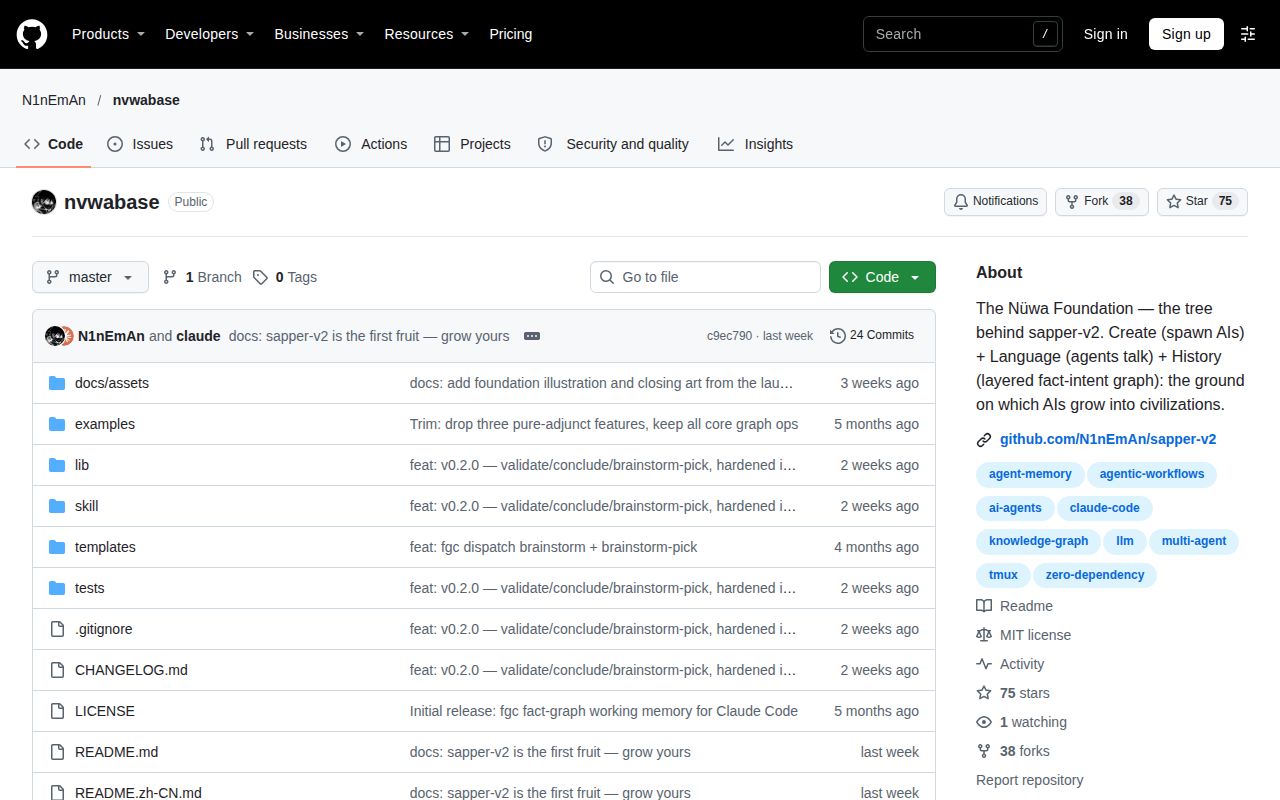
| nvwabase | Its README describes the History pillar: graph memory, project hooks and sub-agent dispatch | You want a general-purpose foundation without importing competition strategy |
| Cairn | Its README says workers coordinate exclusively through a shared board, with no fixed roles | You want to evaluate board-based coordination against sapper's named roles |
| ARTEX | Named by issue #4's reporter as feeling more responsive | You want to investigate that report on the same workload yourself |
The local-files comparison comes from the supplied project description. The alternatives' own nvwabase README and Cairn README supply their architectural descriptions. Notice that nvwabase's own scope statement describes complete Create and Language orchestration as living in sapper's battle layer today. Read that narrower statement before treating it as a ready-made replacement for the whole swarm.
What the other reviews get wrong
LatGenHub's enterprise-scanning description goes beyond the maintainer's competition-focused setup instructions. It describes autonomous CI/CD integration without manual effort, whereas issue #5 explains the work required just to run outside the original platform. Choose sapper for a team prepared to own that adaptation. A directory category is a poor substitute for a deployment guide. LatGenHub, maintainer response
Explainx's ARTEX answer uses the 1-billion-versus-4.5-billion token comparison. The README calls the other competitor the runner-up without identifying that team as ARTEX. Explainx also frames commander and worker separation as separate trust domains. The setup documentation instead describes untrusted graph text entering executor prompts and calls its defense textual. Use the permission configuration to judge that boundary. Explainx, README, setup security guidance
ThakiCloud attributes the reported win to agent organization rather than model intelligence. The author's campaign account combines role organization, model tiering and other choices in the same run. It offers no controlled experiment isolating those factors, so the causal explanation exceeds the evidence. A reader can find the coordination design worth studying without accepting an explanation of why it won. ThakiCloud
Questions people ask
BENCHMARK_BASE_URL identifies the competition platform, so configuring a GLM model gateway alone leaves a required startup input missing. That is the maintainer's answer to issue #5. Platform requirement
Why does sapper-v2 say BENCHMARK_BASE_URL is not set when my GLM gateway is configured?
The container checks a competition-platform interface as well as the model gateway. The maintainer says running elsewhere requires platform adaptation, credentials and watchdog budgeting. Start with that checklist, rather than changing the model key repeatedly. Issue #5
Why does sapper-v2 feel slower than ARTEX?
Issue #4 contains one user's report of sluggish operation. The maintainer explains that the defaults target unattended competition work and points to gateway quality, model selection and worker configuration. The thread supplies an explanation, without comparative timings. Performance discussion
Why are sapper-v2's project hooks failing to inject graph context?
Issue #2 reproduced ModuleNotFoundError: No module named 'fg' from a stale import. The maintainer reports a correction in c91881d and fresh-project hook checks. Check the source used by your installation and the output of both registered events. Hook issue
Does sapper-v2 have an API or a desktop client?
The project documents a local CLI, project hooks and a Docker/tmux runtime. LatGenHub labels its platforms “API, Desktop,” but its label doesn't supply a documented standalone desktop client or public service contract. Use the project's actual interfaces when planning integration. README interfaces, directory listing
What are the best alternatives to sapper-v2?
The maintainer recommends nvwabase for general-purpose work outside the competition setting. Cairn is another candidate for studying graph-based coordination, with its README describing workers that communicate exclusively through the board. These are architectural choices, not measured speed winners. Maintainer recommendation, Cairn
What happens when sapper-v2 runs for eight hours unattended?
The author reports 85 flags and first place among 634 teams in the Tencent qualifier. The account describes worker replacement, inherited lessons and centralized flag submission. Marco_Ramilli's X post repeats that result; it isn't a second competition run. Author's account, X post
Which authorized lab or CTF should I try sapper-v2 on?
The documented setting is Tencent's competition arena, and the maintainer requires platform adaptation elsewhere. Pick an arena you are authorized to test and whose interface you can adapt. The supplied evidence gives no tested compatibility shortlist for other CTF platforms. Project scope
Where should a beginner start learning about sapper-v2?
Start with the English README's distinction between the local graph and full competition runtime, then read issue #5. The supplied introductory video can help explain the tool categories, but the platform checklist is what determines whether your intended setup can start. README, introductory video
How can agents keep running unattended for hours?
The README describes scripted watchdog recovery and graph-backed handovers between agent sessions. Recovery keeps a process available, while the commander and workers still decide which tasks to pursue. Both mechanisms matter in the author's long-running campaign account. Runtime explanation
Is running sapper-v2 unattended for eight hours legal?
The README restricts the project to authorized security testing. Its reported competition duration grants no permission to test a different target. This review gives no legal clearance for an engagement. Project's authorization statement
Can I fork sapper-v2 for bug bounty hunting?
The project is MIT licensed and its README discusses forking, while explicitly requiring changes to environment wiring as well as doctrine. That license is separate from permission to test a bounty target. Read the program's scope before treating a fork as suitable for it. Forking instructions and license
Does sapper-v2's watchdog use an LLM?
The README describes the watchdog as a pure script with no strategy: it relaunches the commander, rotates keys and handles the deadline. The agents perform the strategic work. Watchdog description
What we have not tested yet
Our successful source checks cover commit 7b75e6f; the later hands-on deployment path stopped at its Compose requirement. We have not tested a complete autonomous campaign, a successful Apple Silicon run, noncompetition platform adapters, interactive scanning latency, false positives, CI/CD integration or isolation under malicious graph input. The audit's zero known vulnerabilities is not a security assessment of permission bypass or agent behavior.
We have not independently reproduced the author's competition results or corroborated them with an organizer ranking in these records. The reported token totals lack a dollar-cost breakdown and a controlled comparison isolating model choice from organization. Inclusion of the hook correction in the frozen v18-champion image remains unverified. The live GitHub facts show a November 11, 2026 push, and the sampled issues contain both a reported repair and setup discussion; those facts support recent maintenance activity, not a promise of production support. GitHub repository facts
One final operational detail is documented rather than exercised here: uninstalling the global CLI leaves each project's graph and hook settings behind. The setup guide provides project-level sapper teardown, which retains graph data, and sapper teardown --purge, which deletes it. When you finish an evaluation, decide whether to keep the engagement record before removing it. Teardown documentation