Short answer: use the public site for personal calligraphy experiments
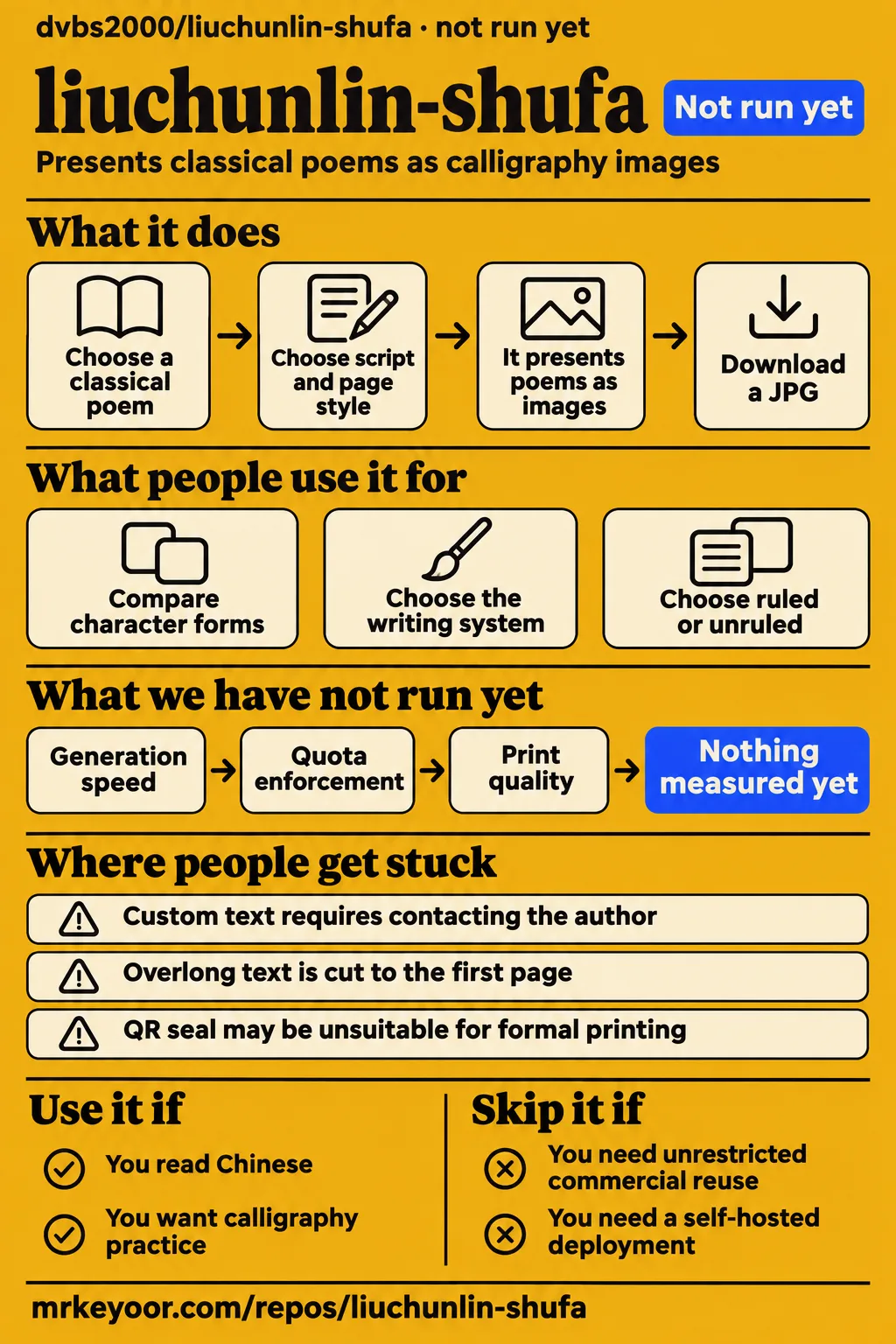
liuchunlin-shufa advertises Chinese calligraphy images and JPG downloads, while our lab attempt stopped before execution. Use the public site if you read Chinese and want to try a classical poem in Liu Chunlin's small regular script style. Skip it if you need unrestricted commercial reuse or a self-hosted deployment supported by a successful independent installation. The project README describes personal non-commercial use and requires written permission for commercial work.
The useful distinction is between choosing a poem on a hosted website and owning the system that produces its image. The official page advertises an anthology, script variants and a downloadable picture. Those are concrete reasons to try it. They don't settle whether a developer can reproduce the service from a checkout. Our recommendation is limited to evaluating the public experience for personal use, with the output judged as a generated interpretation of a calligraphy style.
What people use liuchunlin-shufa for
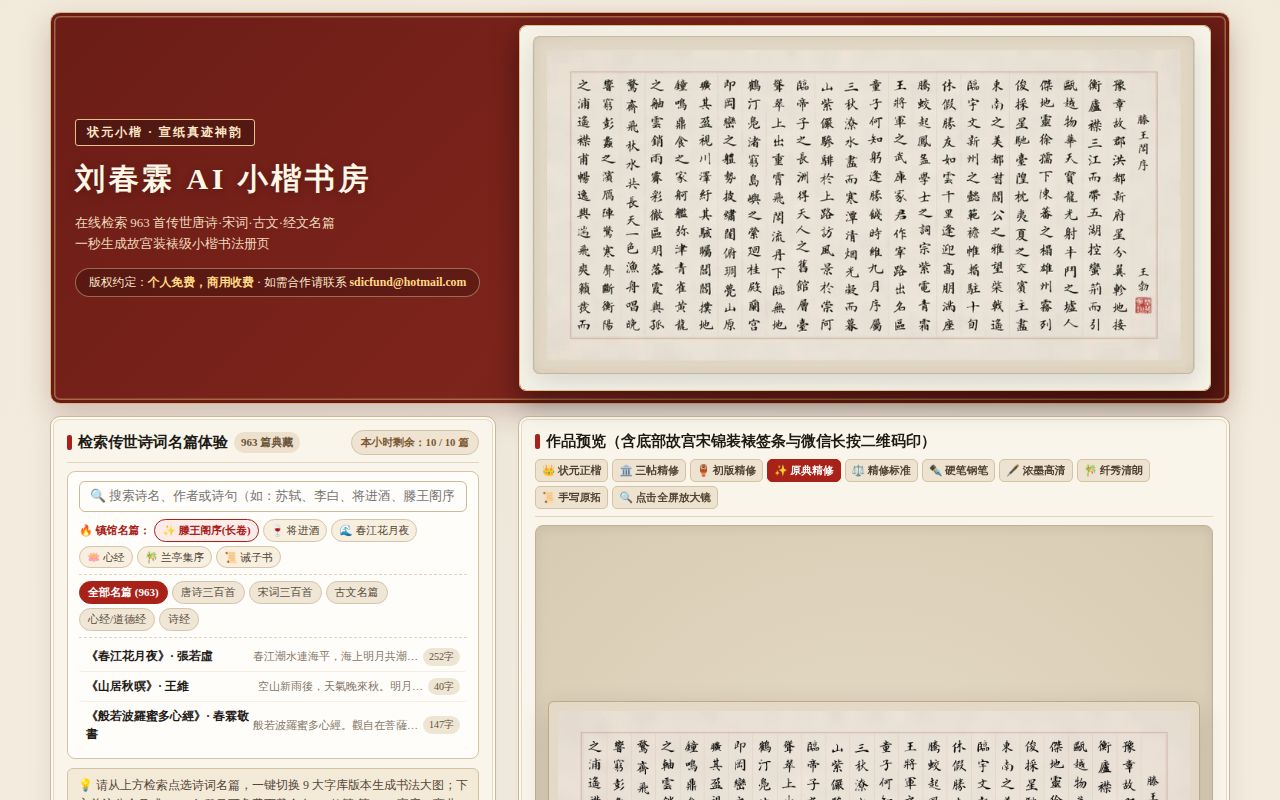
The project's official site displays classical-text examples, including a comparison with original calligraphy and a long-scroll selection. These are the author's examples, rather than customer case studies. They help you decide whether the page composition suits your purpose before spending time on a different text.
| Who presents it | Text and displayed outcome | What to look for |
|---|---|---|
| The official site | 《长恨歌》 appears in an original-calligraphy versus generated-image comparison. Official gallery | Compare individual character forms and spacing, rather than treating the comparison label as a quality judgment. |
| The official site | 《春江花月夜》 appears in simplified and traditional variants. Official gallery | Choose the writing system your reader expects before considering the surrounding decoration. |
| The official site | 《心经》 and 《兰亭集序》 illustrate ruled and unruled layouts. Official gallery | Decide whether visible column guides belong in the image you want to share. |
| The official site | The selected 《滕王阁序》 reports 331 characters and a 24-column long scroll. Official selection | Compare the selected text with the resulting composition before choosing a display size. |
The 《滕王阁序》 example matters because length changes the decision. Someone wanting a short poem on a square page has a different requirement from someone expecting a complete prose passage across a scroll. The site reports automatic expansion to 24 columns for that selection. The README separately describes taking the first page's capacity when text is too long. Read the selected text and the displayed layout together: the long-scroll example shouldn't become a promise that every input survives intact.
The gallery also gives a newcomer a better starting point than a style name alone. 《春江花月夜》 lets you consider script choice, while the 《心经》 and 《兰亭集序》 pair makes the ruled-paper choice visible. Start with the example closest to the composition you need. A preference for one of those pictures is a reasonable reason to experiment with the hosted tool, even without a claim about historical fidelity.
What happened when we ran it
Our sandbox did not run liuchunlin-shufa at commit c81f62a on November 17, 2026: the harness found no supported ecosystem, recorded language as null and found no Dockerfile. Its recorded configuration was 3 CPUs and 8 GB of RAM, with image marked n/a. Those describe the attempted test environment, not minimum hardware requirements or measured application memory.
| Recorded check | Outcome | Meaning for this review |
|---|---|---|
| Build/test harness | Not run: no supported ecosystem, language null, no Dockerfile | No installation, build or test result was produced. |
| Separate hands-on safety step | FAILED: none of compose.yaml, compose.yml, docker-compose.yaml or docker-compose.yml existed | The lab's required Compose path stopped at the safety check. |
| Teardown | Reported ok | Cleanup completed; it says nothing about application operation. |
The safety log calls the repository unsafe because its rule requires a Compose file. That label describes a lab prerequisite. It is not a finding of malicious code, and the missing file is not evidence that the public website is broken. There is no package error here to diagnose and no successful rendering task to retell.
One record needs special care. The generic run summary says the project was deployed with its own Docker Compose, but the specific safety result says the required file was absent. We use the failed step to describe the outcome and do not count the summary as a successful deployment. The teardown record reports cleanup only. That leaves setup ease unassessed rather than assigning a poor score to software the harness never launched.
Where people get stuck: custom text and finished artwork need attention
Baffox's October 25, 2026 write-up describes a public workflow built around selecting anthology entries, with arbitrary custom text requiring contact with the author. The README describes pasting poems or articles and recognizing their title, author and form. Those statements address different access paths. For a visitor, the sensible starting point is the public anthology, rather than assuming every README capability is available anonymously. Baffox's account
| Friction described in the evidence | Practical response | Evidence status |
|---|---|---|
| Public custom-text access requires contacting the author in Baffox's account | Ask about access before choosing it for a particular inscription | A dated description of the public path, not a failed task in our lab |
| Rendering happens on a backend, according to Baffox | Treat the hosted renderer as part of the service you depend on | No offline remedy is supplied in that account |
| Output includes a promotional QR seal and mounting strip | Decide whether the decoration belongs in your finished image | Baffox suggests cropping or assessing it before formal printing |
| README says overlong text is cut to the first page's capacity | Compare the intended passage with the output | Documented behavior, alongside the site's specific expanded-scroll example |
Baffox's cropping suggestion is editorial advice, not a demonstrated fix. There is also a permission detail to read before editing: the license asks personal users to keep the studio strip or name the source. For a commercial print, ask the author about both the use and the changes you want. A picture that looks suitable in the preview can still be the wrong deliverable if the attribution or licensing terms don't fit the job.
The public quota is 10 generations per IP per hour
The official site advertises 963 anthology entries and 10 free generations per IP per hour. That is the service's posted allowance, not a throughput result from our sandbox. The distinction matters if you're choosing between trying a few poems for yourself and organizing a group activity around repeated generation. Posted anthology and quota
An IP-based allowance also changes how to plan a shared session. Don't budget the posted allowance as though every person automatically receives a separate allocation. Ask the operator how a shared connection is handled before promising a classroom or workshop unrestricted use. For personal exploration, pick the text first, then compare script and page style deliberately. The allowance makes endless variation a poor assumption for a timed activity.
The same page advertises a JPG download and labels some controls as administrator-only, including clean output without a watermark, high-resolution output and automatic expansion. Read those labels as access distinctions. They aren't a reason to promise an ordinary visitor the same options as the administrator. For a print project, agree on the required output and permissions before treating a browser preview as the final asset.
Chinese is the working language; the license has an English summary
The README and public interface are Chinese-first, and the license includes an English summary of personal and commercial use. The README we read has no English usage guide. An English-speaking developer can read the licensing summary, but choosing the poem and assessing its characters still calls for someone who can read the text. README and license
The names help explain the controls. Xiaokai means small regular script. The site offers traditional and simplified choices, plus a ruled style associated with 《心经》 and an unruled style associated with 《兰亭集序》. Those are meaningful composition choices. Have the intended reader confirm the script and complete passage before you share it, especially when the title is familiar but the body is too long to inspect casually.
Personal use is free; commercial work requires written permission
The license says personal study, calligraphy practice and non-commercial personal sharing are free, while commercial use requires a prior written commercial license. Its Chinese text asks personal users to retain the studio strip or credit the studio. For a developer evaluating reusable assets, those conditions are a reason to read the license before taking the GitHub repository's availability as permission to build a commercial product around it. Project license
The README names brand promotion, packaging, publishing and commercial integration among the uses requiring authorization. That is a concrete reason for a business to stop and arrange terms before preparing artwork. A hobbyist choosing a poem for private practice has a much simpler decision. Neither reader benefits from calling this unrestricted open-source software when the project's own terms reserve commercial use.
Repository attention does not answer the safety question
GitNova explicitly says its star-growth assessment does not establish whether the project is safe to run. Its listing also identifies its product description as an automated README summary that may contain inaccuracies. Use that page as a discovery aid, not a security recommendation or a record of successful deployments. GitNova's explanation
OpenToolsHub describes server-side rendering with Pillow and an Ubuntu deployment script that keeps fonts outside the web root. Those are that directory's descriptions of the architecture. They don't supply a completed installation report. For an operator, separating the browser page from the rendering host is the useful architectural question: which components and assets would you actually need to control? OpenToolsHub's account
The anonymous GitHub API response on November 17, 2026 recorded a last push on November 13 and zero open issues and PRs. Recent repository activity is visible, but an empty open tracker supplies no examples of how support requests were handled. We leave community and maturity unscored rather than translating a quiet tracker into a claim of reliability. GitHub repository facts
liuchunlin-shufa vs 中华古诗词 and chinese-poetry
Choose liuchunlin-shufa for its calligraphy-page presentation; choose a poetry search site or text collection when finding the words is the task. Baffox specifically suggests 中华古诗词 for checking a poem's source before deciding whether to make a calligraphy page. That comparison is about workflow, with no claim that the alternatives reproduce Liu Chunlin's lettering. Baffox's recommendation
| Project | Evidence-supported role | Pick it when |
|---|---|---|
| liuchunlin-shufa | Official examples of classical texts in calligraphy layouts, with JPG download | You want to explore a poem as a finished-looking image under the project's use terms |
| 中华古诗词 | Baffox recommends this static search site for checking poem sources | You need to identify or check the text before making an image |
| chinese-poetry/chinese-poetry | Its README describes a classical Chinese literature database distributed as JSON | You are building a tool around the text collection itself |
The chinese-poetry README describes distributing its database in JSON to help people start their own projects. That gives a developer a different starting material from a rendered JPG. Select it for a text-data requirement, then make a separate decision about presentation. For a reader who only wants to recognize a quoted line, the static search site recommended by Baffox is the more relevant comparison than a general image-generation platform.
Questions people ask
Personal non-commercial use is free under the project's stated terms; commercial use requires written authorization. That answers the first practical cost question before you choose between the public site and a commercial arrangement. The questions below cover access and output, using the README and official page rather than assumptions about what a GitHub download grants. License
Can I use the generated images commercially?
Commercial use requires a prior written commercial license, according to the license's English summary. It specifically includes distribution, product packaging, publishing and commercial integration. Contact the author before using a generated image in one of those settings. The README gives the same commercial contact, sdicfund@hotmail.com. License
What can I download from the public site?
The official page advertises a high-definition JPG download. It also says following its WeChat account or using GitHub login allows downloading its font collection. A rendered image and a font file are different deliverables, so decide which one the job needs before following the download path. Official download labels
Can it handle a poem longer than one page?
The README says text exceeding its single-page capacity is truncated to the first page, while the official page displays an expanded 24-column 《滕王阁序》 selection. These descriptions warrant inspecting the chosen layout and the actual passage together. Don't assume that selecting a long work guarantees a complete image for every access level or input. README and official long-scroll selection
What we have not tested yet
Our evidence contains no completed application run, independent calligraphy-quality assessment or reproduced self-hosted installation. We have not tested generation speed, quota enforcement, print quality, arbitrary custom-text access, font downloads or whether long passages remain complete across layouts. The administrator labels and official gallery describe the product; they aren't results from our sandbox.
The supplied X search returned no posts, and the Bilibili search returned unrelated titles rather than a project walkthrough. Neither supports a user-success story. No sampled GitHub issue discussion or security audit accompanies this pack. The runtime and operating-system versions also require raw toolchain logs: the recorded image value is n/a, so it cannot identify either.
For a self-hosting decision, the next useful evidence would be a complete installation from the reviewed checkout with the required rendering assets, followed by an output checked against its input. For a personal user, start with one anthology entry you can read, inspect the whole generated passage and keep the attribution the license requires. A recognizable poem is a better first check than a decorative image whose text you cannot judge.