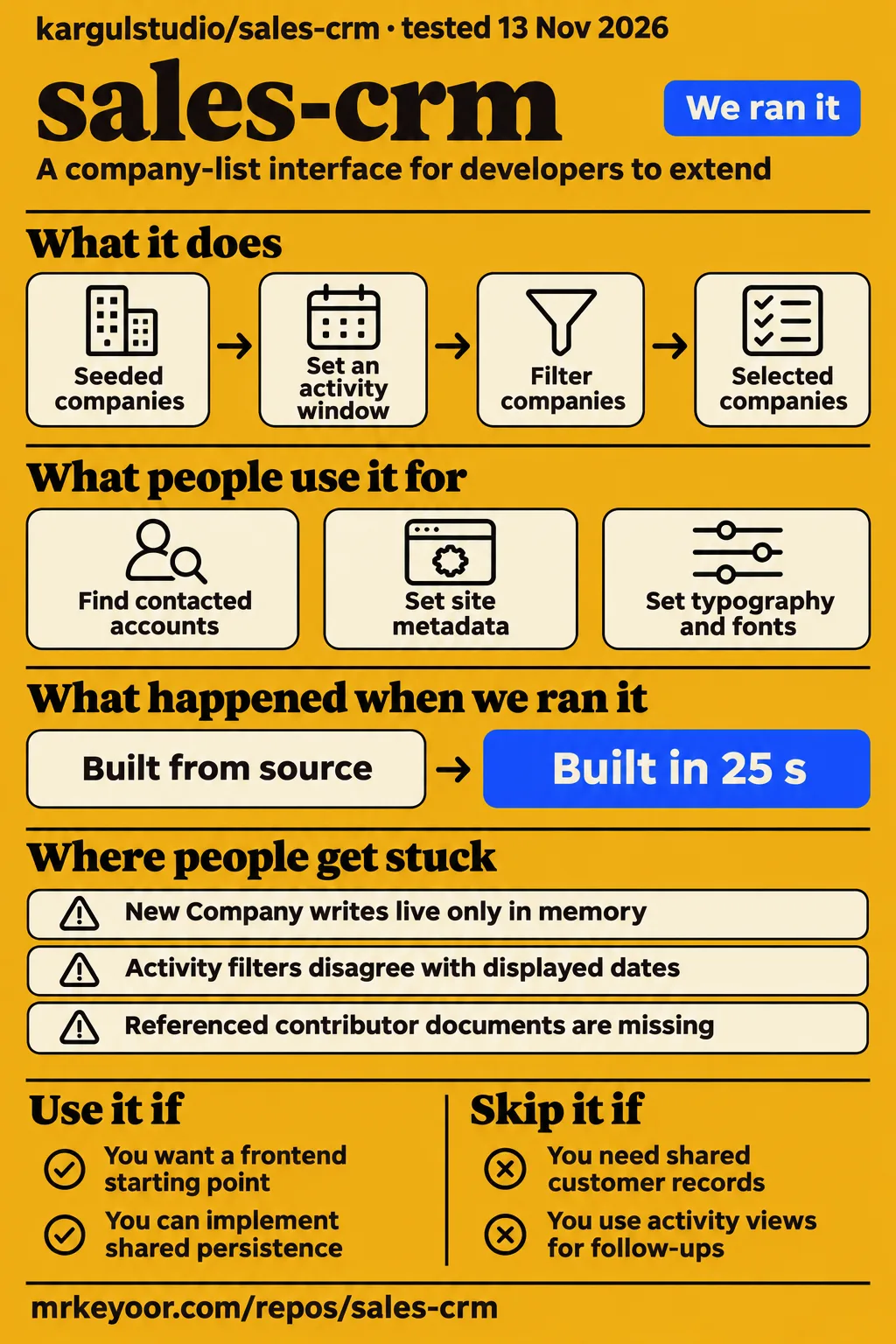
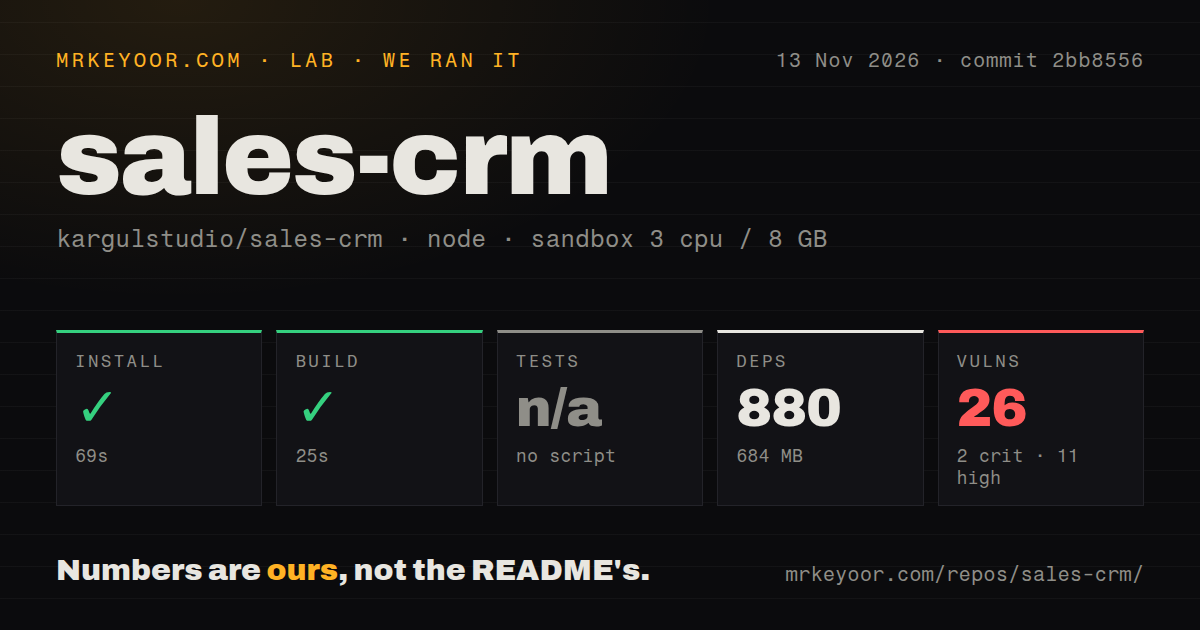
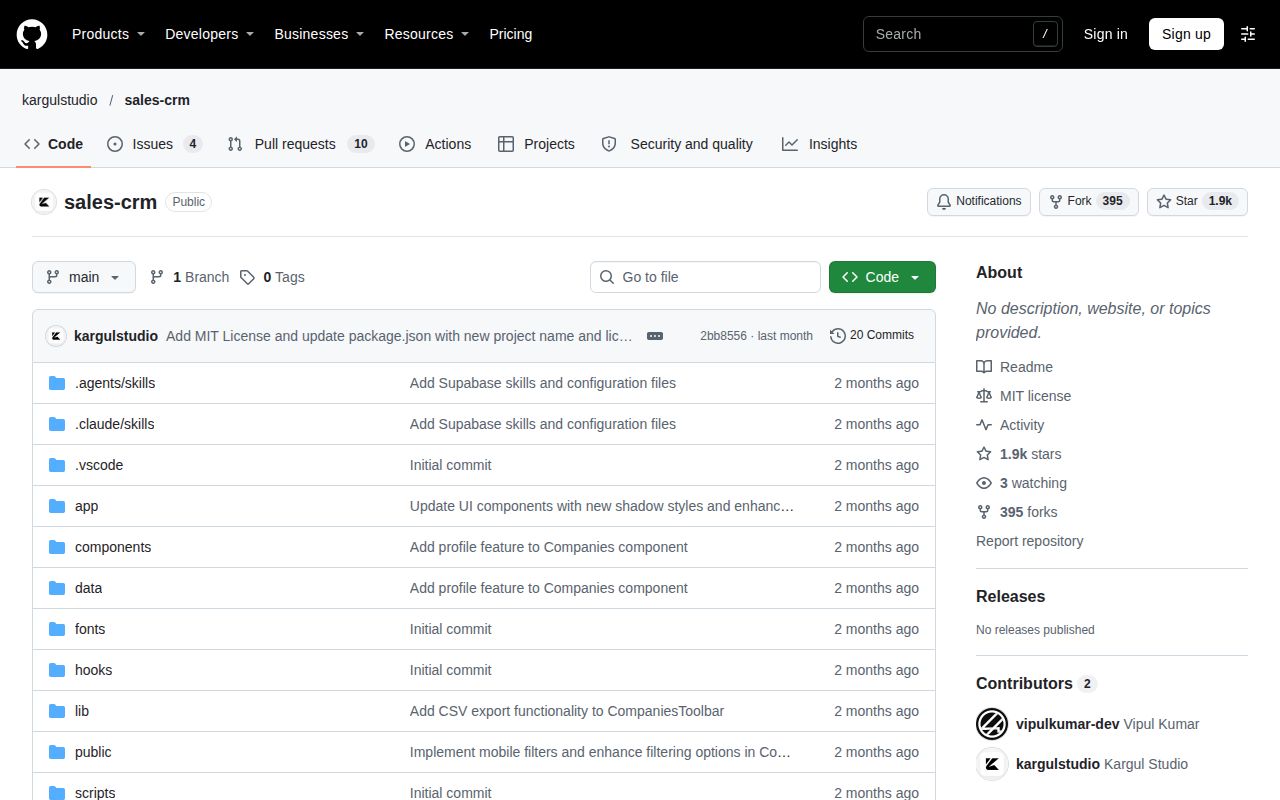
Issue #12 reports that sales-crm's New Company writes live in client-side memory. That makes storage the first decision for anyone considering this repository for customer records. The project is kargulstudio/sales-crm, whose README calls it Kargul Starter. Our sandbox installed its dependencies in 69 seconds and built it in 25 seconds at commit 2bb8556 on November 13, 2026.
For a frontend developer, the company list and activity controls provide an interface to extend. For a sales team choosing a shared record system, the persistence report changes the evaluation: the next question is how a saved company reaches another session or colleague. This review follows that distinction through the measured setup results, reported filtering defects, agent-access proposal and documented alternatives.
What people use sales-crm for
The reporter of activity-filter issue #15 checked seeded companies against their displayed interaction dates and reported contradictory selections. Their examples describe a specific use of the interface: choosing an activity window to find recently contacted accounts. The report gives developers concrete cases to investigate, including a company omitted from a seven-day view and companies included outside wider windows.
| Who did it | Activity | Reported outcome |
|---|---|---|
| Reporter of issue #15 | Compared the seven-day filter with Stripe's displayed interaction | Stripe was hidden despite a September 9 interaction, five days before the fixed reference date |
| Same reporter | Checked wider activity windows against displayed dates | Zoom and Slack appeared in the 30-day view despite interactions 37 and 33 days earlier |
A developer adapting this interface can use those cases to discuss the intended follow-up workflow with a sales team. The toolbar, dated interactions and activity windows described in the issue give that discussion specific controls and expected selections. For example, a seven-day view should include an interaction five days before its reference date. That expectation is useful when deciding how the adapted application should calculate recency.
The sales-crm README describes Next.js 16, React 19 and Tailwind CSS 4 boilerplate. Its setup guidance addresses developers: install dependencies, run the development server, then set site metadata, typography and fonts. This documentation fits someone building an application around the interface. The named companies in the activity report are explicitly seeded companies, so their appearance describes sample data rather than customer adoption.
What happened when we ran it
Our run at commit 2bb8556 installed successfully in 69 seconds and built successfully in 25 seconds on November 13, 2026. The recorded sandbox configuration allocated 3 CPUs and 8 GB RAM with image label lab-node:22. The checkout contained 288 files, approximately 7,949 source lines and 2.6 MB of files. Installed dependencies occupied 684 MB, a practical storage consideration when preparing a development environment.
| Recorded check | Result | What it means for an evaluator |
|---|---|---|
| npm install | Succeeded in 69 seconds | Dependency installation completed in our sandbox |
| Build | Succeeded in 25 seconds | The source build completed at commit 2bb8556 |
| Dependencies | 880 recorded, 684 MB on disk | Allow space for the installed development environment |
| Tests | No tests script or target, skipped | The harness skipped this step |
| npm audit | 26 known vulnerabilities: 2 critical, 11 high, 9 moderate, 4 low | Review the affected dependencies before deployment |
| Repository signals | 0 CI workflow files, no Dockerfile, no tests directory | These files and directories were absent from the scan |
The separate deployment safety step failed because none of compose.yaml, compose.yml, docker-compose.yaml or docker-compose.yml existed. The procedure required a Compose file and stopped at that prerequisite. Its run summary nevertheless claimed deployment with the project's own Docker Compose and every port bound to 127.0.0.1. These records conflict; the explicit failed step is the recorded stopping point. The teardown record says cleanup completed successfully.
For local inspection, the README gives npm install and npm run dev, then directs the reader to localhost:3000. Its script table also lists npm run build for a production build and npm run start to serve that build. These are the documented local commands. They provide a useful starting sequence for a developer examining the frontend independently of the Compose procedure used in the separate deployment attempt.
Where people get stuck: saved records and activity windows
Persistence and agent-access issue #12 reports that New Company writes live in client-side memory. Database request #2 asks for real database integration, self-hosting instructions or Dockerfile examples, and environment-variable documentation. Together, the reports identify a concrete integration question for a fork: where company records live and how every interface reads the same saved data.
Issue #15 reports a separate correctness problem across all 18 seeded companies. The filter compares stored activityDays values with the selected window, while the displayed interaction dates use a fixed September 14, 2026 reference date. Under the seven-day setting, Stripe's September 9 interaction is five days earlier, yet Stripe is hidden. Under 30 days, Zoom and Slack appear despite interactions 37 and 33 days earlier.
The same reporter says Apple and Airbnb pass the default 90-day filter despite interactions 186 and 180 days earlier. Hubspot has a September 18, 2026 interaction, four days after the fixed reference date, and sorts first by Last Interaction. The suggested repair is to calculate elapsed days from lastInteraction.date or regenerate activityDays consistently against the reference date, then correct the Hubspot entry. These details remain attributed to the issue reporter.
| Report | Specific obstacle | Repair described or needed | Recorded resolution |
|---|---|---|---|
| Issue #1 | Referenced contributor documents are missing | Restore the files or correct the references | Open in the supplied record |
| Issue #2 | Database and deployment guidance requested | Add persistence integration and operating instructions | Open request |
| Issue #12 | Browser-only operation and memory-only writes reported | Introduce a shared store and agent interfaces | Open proposal |
| Issue #15 | Activity filters disagree with displayed dates | Use consistent date calculations and correct seed data | Open report with a suggested fix |
Missing-document issue #1 says CLAUDE.md references a missing CONVENTIONS.md; a commenter also reports missing OPTIMIZATION.md. The README directs developers to both documents and calls CONVENTIONS.md the build specification. Contributors therefore face a practical documentation task: obtain the intended rules or repair the references before treating their own assumptions as project conventions. The issue gives that repair a specific target.
Agent access depends on shared records
Issue #12 proposes an MCP server, CLI and shared store so the browser and agent interfaces can use the same data. Its author describes the existing CRM as browser-operated and without an API. The proposal connects two pieces of application work: exposing company operations to agents and making their changes available to the interface that a person uses to inspect those records.
The requested operations include listing and searching companies, creating and updating them, changing tags, logging interactions, importing CSV files with a dry run, exporting CSV and producing pipeline summaries. The proposal also describes Agent Skills for workflows such as ingesting leads and recording outcomes. These details help an implementer define the intended interface around company operations instead of designing separate behavior for each entry point.
For a developer extending the repository, the useful design question is how a single company update travels through storage and back into the UI. Define that operation before connecting several clients to it. This is an implementation recommendation drawn from the shared-store proposal: agree on the saved record and its update behavior, then have the browser and agent surfaces use that operation. It gives an integration effort a concrete acceptance target.
Security work starts with 26 audit findings
Our npm audit recorded 26 known vulnerabilities: 2 critical, 11 high, 9 moderate and 4 low. Those figures belong to the measured checkout and environment. An evaluator should begin dependency review with that recorded severity breakdown, then identify the affected packages and their roles in the intended deployment. The total is a reason to inspect the dependency tree before importing customer information or exposing the application.
A practical follow-up is to separate packages used by the running application from development tooling, read the relevant advisories and assess available updates. After selecting changes, rerun the checks affected by those dependencies. This is a recommended review sequence. It keeps the work tied to the recorded findings and the intended deployment rather than assigning security confidence from the fact that a build completed.
Issue #12 also proposes agent endpoints that answer only on localhost unless CRM_API_TOKEN is set, with endpoints off in production builds without that token. That design belongs alongside the requested shared store and operation registry. A developer implementing agent access should review the proposed access boundary together with the operations it protects, particularly writes and bulk imports that would change the same company records shown in the browser.
How the ratings apply to this checkout
Setup earns 3/5 for the measured installation and build, while documentation and maturity each earn 2/5 for specific reported obstacles. The rubric uses 1 for an observed blocking obstacle in the assessed scope, 2 for substantial unresolved work, 3 for a workable narrow path, 4 for broad demonstrated coverage and 5 for independently corroborated operational coverage. Each score applies to the evidence described here.
The setup score credits the 69-second installation and 25-second build as a workable source-setup path. Documentation earns 2/5 because the README supplies development commands while issue #1 reports missing referenced files and issue #2 requests operating guidance. Maturity earns 2/5 because memory-only writes and inconsistent activity selection affect basic CRM tasks. These are editorial judgments with stated reasons, rather than additional benchmark results.
Community support is N/A. Four supplied issue records provide questions, defect reports and a proposal, but they are too narrow a basis for judging maintainer responsiveness or support quality. Keeping that dimension unassessed prevents a small issue sample from becoming a numerical claim about the wider project community. The other ratings remain assessed because their notes identify concrete setup results or reported application obstacles.
sales-crm vs Twenty and Frappe CRM
Twenty documents Docker Compose self-hosting, and Frappe CRM documents lead/deal pages and a Kanban board. Those primary README descriptions offer useful selection criteria beside sales-crm's starter documentation and reported storage work. The comparison helps a technical reader decide which project to inspect next: an interface to extend, a documented container deployment path, or an existing lead and deal workflow.
| Project | Evidence relevant to this choice | Pick it when |
|---|---|---|
| kargulstudio/sales-crm | Starter README, successful source build, reported persistence and filter problems | You want this frontend as the starting point for an application you will build |
| Twenty | Its README documents Docker Compose self-hosting | A documented container deployment path is part of your selection criteria |
| Frappe CRM | Its README describes a lead/deal page and drag-and-drop Kanban board | Your sales team wants to inspect an existing lead and deal workflow |
Twenty's README documents Docker Compose self-hosting. That makes its deployment instructions relevant to an evaluator whose operating procedure requires Compose, the prerequisite that stopped our sales-crm deployment attempt. Put that documented path on the evaluation checklist alongside storage and workflow requirements. The useful comparison is the presence of instructions for the deployment format your team intends to use.
Frappe CRM's README describes a consolidated lead/deal page and a drag-and-drop Kanban board. Those are concrete workflows to inspect with sales staff who need to manage leads and deal stages. If the attraction is instead sales-crm's particular company-list interface, estimate the storage and filtering work described above. That separates an application-building decision from a decision about which documented CRM workflow to evaluate.
Questions people ask
Treat sales-crm as a frontend starting point: issue #12 reports memory-only writes, and issue #15 reports inconsistent activity filtering. The README's development commands give a developer an entry point for inspecting the project. For a team choosing where shared customer records should live, the practical questions concern storage, deployment instructions and the date calculations behind follow-up views. The answers below connect those decisions to specific records.
Does sales-crm support a real database such as PostgreSQL?
Issue #2 requests real database integration, naming PostgreSQL with a spelling error, and issue #12 proposes a shared store. Its author describes a file-backed default with a database adapter that could be added later. For an implementation plan, start with the saved-company operation and the storage path every interface will use. That connects the database request to the reported memory-only write behavior instead of treating a database name as configuration guidance.
Are self-hosting instructions, Dockerfile examples, and environment-variable documentation available?
The README supplies local development commands and documents NEXT_PUBLIC_SITE_URL as a site-URL override. Issue #2 requests self-hosting instructions, Dockerfile examples and environment-variable guidance. The measured scan found no Dockerfile, and the separate deployment procedure stopped for lack of a Compose file. These records tell an operator which instructions are present and which requested operating documents to look for when assessing a deployment plan.
Can AI agents operate sales-crm through an MCP server, CLI, or API?
Issue #12 requests MCP and CLI access and describes the existing CRM as having no API. Its proposed shared store would let agent changes appear in the browser, while an operation registry would keep the interfaces consistent. For someone planning this integration, the issue provides a feature outline and a storage dependency. The first acceptance task is to make a company change through one interface and retrieve that same saved record through another.
Why does the Activity filter disagree with the Last Interaction dates?
Issue #15 says filtering uses hardcoded activityDays values that disagree with dates calculated against September 14, 2026. The reporter suggests computing recency from lastInteraction.date or regenerating the stored values consistently, then correcting Hubspot's future date. Stripe, Zoom, Slack, Apple and Airbnb provide specific expected selections to examine when reviewing that calculation. A proposed correction should account for each example rather than fixing only the seven-day view.
Where are the missing CONVENTIONS.md and OPTIMIZATION.md files?
Issue #1 reports missing CONVENTIONS.md, and a commenter reports missing OPTIMIZATION.md. The README lists both files and tells developers to read CONVENTIONS.md before writing components, sections or pages. The practical next step for a contributor is to request the intended documents or submit a correction to their references. That keeps project-specific rules tied to maintainer-provided material instead of filling the missing specification with assumptions.
What we have not tested yet
The measured harness covers installation and compilation at commit 2bb8556; tests were skipped because no tests script or target existed. Browser company creation, persistence across refreshes, concurrent users, authentication, backups, restores and production operation remain outside that work. The activity examples are issue reports rather than reproduced browser findings. The conflicting deployment records include a failed Compose prerequisite, with no browser screenshots or known-answer task results accompanying the attempt.
The image label lab-node:22 does not establish the actual Node version or operating system; those details require raw toolchain logs. The audit summary supplies severity counts rather than advisory reachability, affected execution paths or compatible fixes. No load result supports account-capacity, request-latency or serving-memory claims. Twenty and Frappe CRM were assessed through their supplied README evidence, without comparative execution, and no supplied customer outcome supports an adoption claim.
The supplied records also leave shipment of the proposed agent interfaces, token controls and persistence changes unresolved. Issue #12's retrieved page links pull requests #13 and #5, but their implementations and merge status are outside the supplied evidence. A useful next acceptance check is to create a company, close the session and retrieve that record through the intended shared storage path. That is a proposed check, not an additional result from our run.