
A large execution layer around coding agents
Ruflo does not replace Claude Code or Codex. It surrounds them with orchestration. The full installation adds agent definitions, slash commands, skills, hooks, an MCP server, persistent memory, a daemon, and configuration that routes work among specialists. Optional pieces cover browser testing, code review, retrieval, security scans, cost tracking, architecture records, planning, and federation across machines.
Ruflo wants to decide which agent handles a task, preserve patterns from earlier work, coordinate parallel jobs, and expose the state through command-line and web interfaces. For someone already operating several agent sessions by hand, a shared task and memory layer can be useful. For a developer trying coding agents for the first time, it adds too many moving parts to diagnose at once.
The project now offers two entry points. Claude Code marketplace plugins install selected commands, skills, and agents without writing project files. The ruflo-core plugin registers its own MCP server, while most other plugins do not. The full CLI initializer writes .claude/, .claude-flow/, CLAUDE.md, helper files, and settings, then adds hooks, the main MCP server, and a daemon.
What happened when we ran it
We cloned commit e21aa35 into a fresh unprivileged Debian container with 3 CPUs, 8 GB of RAM, and no secrets. The checkout was substantial: 5,603 files, about 910,673 lines of source, 82.2 MB on disk, and pnpm monorepo workspaces. The repository also contains a tests directory, 28 CI workflow files, and no Dockerfile in the measured root.
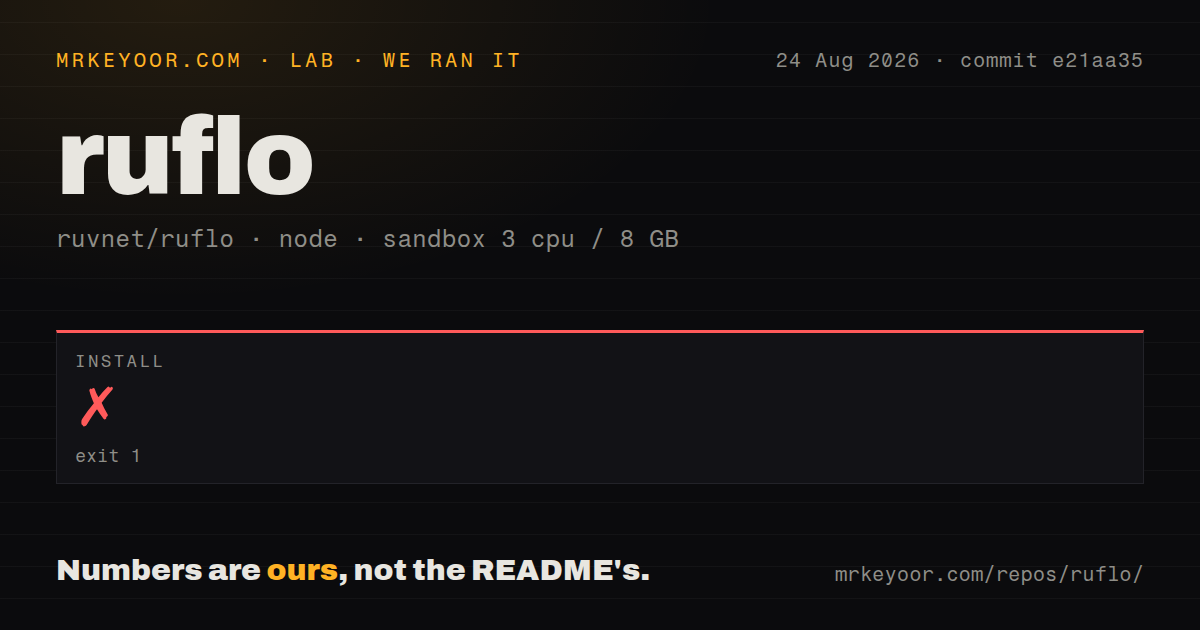
Installation failed after 32 seconds with exit code 1. The final stack frames came from pnpm 11.23.0 under Corepack and ended with ERR_UNKNOWN_BUILTIN_MODULE. The log then printed Node.js v20.20.2. It did not name the missing builtin in the supplied tail, so assigning the fault to one dependency or a specific Node version would be speculation.
Because installation failed, the lab did not run a build or any tests. There are no valid build timings, passing-test counts, or dependency totals to report. The result is narrower but decisive for source contributors: this commit did not reach compilation in the clean environment. A documented npx release path may behave differently, yet that does not repair the source checkout we measured.
Start with the plugin path
A selected plugin is the safer evaluation. It limits the commands and skills added to Claude Code, avoids project scaffolding, and makes the MCP distinction visible. Install core plus one feature, inspect the plugin files, then test a disposable repository. This creates a simple question: did that feature improve the task enough to keep?
The full initializer is appropriate only when several Ruflo systems are needed together. Its hooks can respond to prompts, command results, file writes, task events, and session shutdown. A background daemon and memory store preserve more state. MCP makes orchestration functions callable by the model. Each addition creates another place where a surprising configuration, stale command, or overbroad permission can affect work.
Issue #420 is a concrete warning. A user reported that init --force overwrote the whole MCP configuration and removed other servers. Even if the current initializer has changed, the safe practice is clear: commit or copy existing agent and MCP files, generate into a test workspace, and inspect the diff before accepting it. Do not run a forced initializer across an irreplaceable hand-tuned setup.
Breadth makes consistency difficult
Ruflo's README lists a large plugin catalog and several generations of naming. Current documentation uses Ruflo, while older issue reports and commands refer to Claude Flow. Issue #405 records disagreement among a slash command, the CLI, CLAUDE.md, and configuration over which SPARC modes existed. Issue #453 reports an older hive-mind sessions command calling forEach on a non-array. Those reports come from older alpha paths, but they illustrate the migration burden readers will encounter when searching documentation and issues.
Release verification deserves scrutiny too. Issue #2970 reports a witness script finding every manifest artifact missing in a source-only checkout, then exiting successfully. That means a green process exit could represent an inability to verify any listed artifact. Teams relying on signed or witnessed outputs should require a non-empty verification result, not only code zero.
The latest release, v3.38.20, fixed a status display that showed a hardcoded zero when local intelligence data was unavailable. It now reads local pattern data when possible and displays an unknown value otherwise. This is a sensible correction, but it also shows how visible scores can look authoritative while their data path has failed. Treat dashboard grades and learning percentages as diagnostic hints until you can trace their inputs.
Federation raises the stakes
Local swarm coordination is mostly a workspace and process concern. Federation connects agents across machines and organizations with identities, encrypted transport, trust levels, and auditing. Ruflo documents mTLS, signed challenges, trust scoring, and an optional WireGuard layer. Those controls need real deployment review. A cross-machine agent can move tasks and artifacts across a boundary even when the transport itself is secure.
Map what data each peer may receive, which tools remote work can trigger, how credentials are isolated, and who can revoke trust. Run the first federation test with synthetic data and no production secrets. The project supplies mechanisms; it cannot define your organization's authorization model.
Health and the decision
The last push was August 24, 2026, and v3.38.20 was published minutes later. Nine other listed releases landed during August. GitHub reported 836 open issues and pull requests combined, with both categories updated on August 25. Ruflo is highly active, but the pace and size make version pinning, change review, and rollback preparation necessary.
Choose Ruflo after identifying a concrete coordination problem, such as repeatable specialist handoffs or shared memory across sessions. Begin with the smallest plugin that addresses it. The full initializer may suit an experienced agent team, but our source install failed, and the project's own issue history gives enough configuration and verification warnings to rule out blind adoption.