Ruffle runs Flash on desktop and the web, with limits
Ruffle emulates Adobe Flash Player in Rust. Its desktop application opens SWF files directly, while its web build compiles to WebAssembly and can replace embedded Flash objects on a site. Browser extensions can also inject that player into pages a user visits. This gives abandoned games, animations, and interactive lessons a route back into current browsers without installing Adobe's retired plugin.
Compatibility is the qualification that matters. The README says ActionScript 1, 2, and 3 work fairly well, then says the emulator is unfinished. That is unusually useful wording because a SWF is not one predictable format in practice. Different files exercise different virtual machines, graphics paths, audio behavior, and browser APIs. A title that reaches its menu proves little about the next title in the archive.
The easiest route is a published build, not 25,661 source files
Ruffle offers a web demo, nightly downloads, browser extensions, a desktop application, a self-hosted npm package, and a Flathub package. Those choices let most people avoid compiling the repository. A curator can try representative SWFs in the demo, install the desktop build for local playback, or add the self-hosted package to a site that still has embedded Flash objects.
Source work is a different commitment. Our checkout contained 25,661 files, about 273,751 lines of source, and occupied 189.3 MB before installed dependencies. The root build needs current stable Rust and Java. Debian and Ubuntu users are also told to install development packages for audio, device access, fonts, TLS, and C++. That list belongs in any reproducible build image.
What happened when we ran it
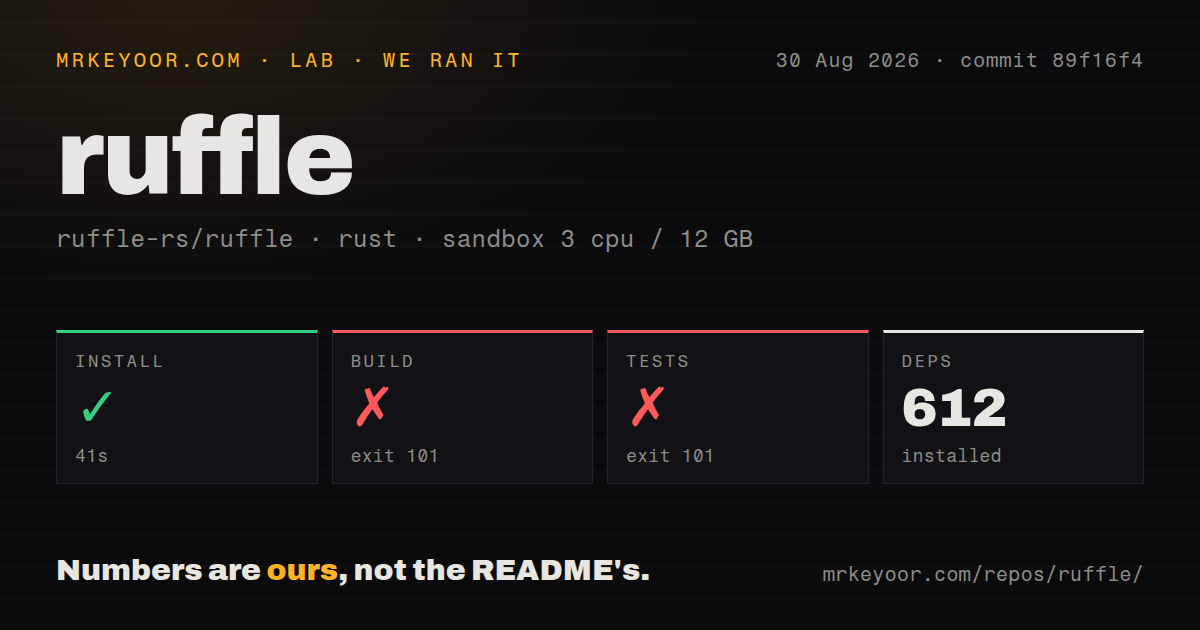
Our sandbox installed 612 packages in 41 seconds at commit 89f16f4. The build ran for 190 seconds and exited with code 101. The final error came from the custom build command for ruffle_core, whose build script reported that Java could not be found while building playerglobal_avm2. The log asked for Java to be installed before compiling again.
Tests stopped for the same stated reason after 9 seconds, also with exit code 101. They reached the ruffle_core build step before its script reported missing Java. We cannot say whether the test suite itself would pass after adding Java because this run never reached that point. The result does show that a fresh Rust container is insufficient, even though dependency installation succeeds.
The repository had 8 CI workflow files and a tests directory, but no Dockerfile in our scan. That makes the documented prerequisite list especially important for anyone assembling a clean environment. A project image that installs Rust alone will repeat our failure. The README does mention Java, including default-jre-headless in its Debian package command, so the missing component is documented rather than hidden.
Web builds add Node.js, exact wasm-bindgen, and browser setup
The web package combines the Rust player with a JavaScript interface. Building it needs the WebAssembly Rust target, Node.js, npm 7 or newer, and wasm-bindgen-cli pinned to version 0.2.127. Binaryen is optional for further WebAssembly optimization. Dual WebAssembly builds need the Rust source component because they rebuild the standard library for a less capable fallback module.
Rendering prefers WebGL for hardware acceleration, with Canvas available when WebGL is unsupported or disabled by privacy settings. That fallback widens reach, but publishers should test both paths on the content they care about. Browser integration tests also require local Chrome, Firefox, or Edge, or a BrowserStack account with credentials. None of those web checks ran in our Rust sandbox.
Specific SWFs can still expose graphics, sound, or crash bugs
Current issue reports show why archive owners need a content list rather than one pass or fail label. Issue 21515 describes high GPU and VRAM use in Pufflescape when a menu uses the Layer blend mode. Issue 24289 reports music stopping after two levels of Papa Louie 2 while sound effects continue. These are reports about named games and environments, not proof of a general performance or audio defect.
Issue 23734 describes the desktop app disappearing during Stealth Hunter 2 on Windows 11, with no crash message shown. The report names Ruffle 0.2.0, so it should not be presented as proof that v0.5.0 behaves the same way. It is still a good acceptance-test candidate if that game matters to a collection. Preservation work needs repeatable playthrough points, screenshots, sound checks, and browser coverage for the files users will actually open.
August 2026 activity supports trying it, not assuming parity
GitHub recorded 18,479 stars, 5,641 combined open issues and pull requests, and a last push on August 30, 2026. The combined count is not a bug total. Recent open reports and same-day code activity show that users are finding compatibility gaps while contributors continue working through them. Release v0.5.0 was published on August 3 with changes across ActionScript, text, XML, video, parsing, and tests.
That pace makes Ruffle a credible first choice for reviving Flash content. The decision should still be made per archive. Start with published binaries, select files that cover each site's graphics and interaction patterns, and record where playback diverges. Teams that need exact behavior for every title should keep the original environment available until their own Ruffle test set says otherwise.