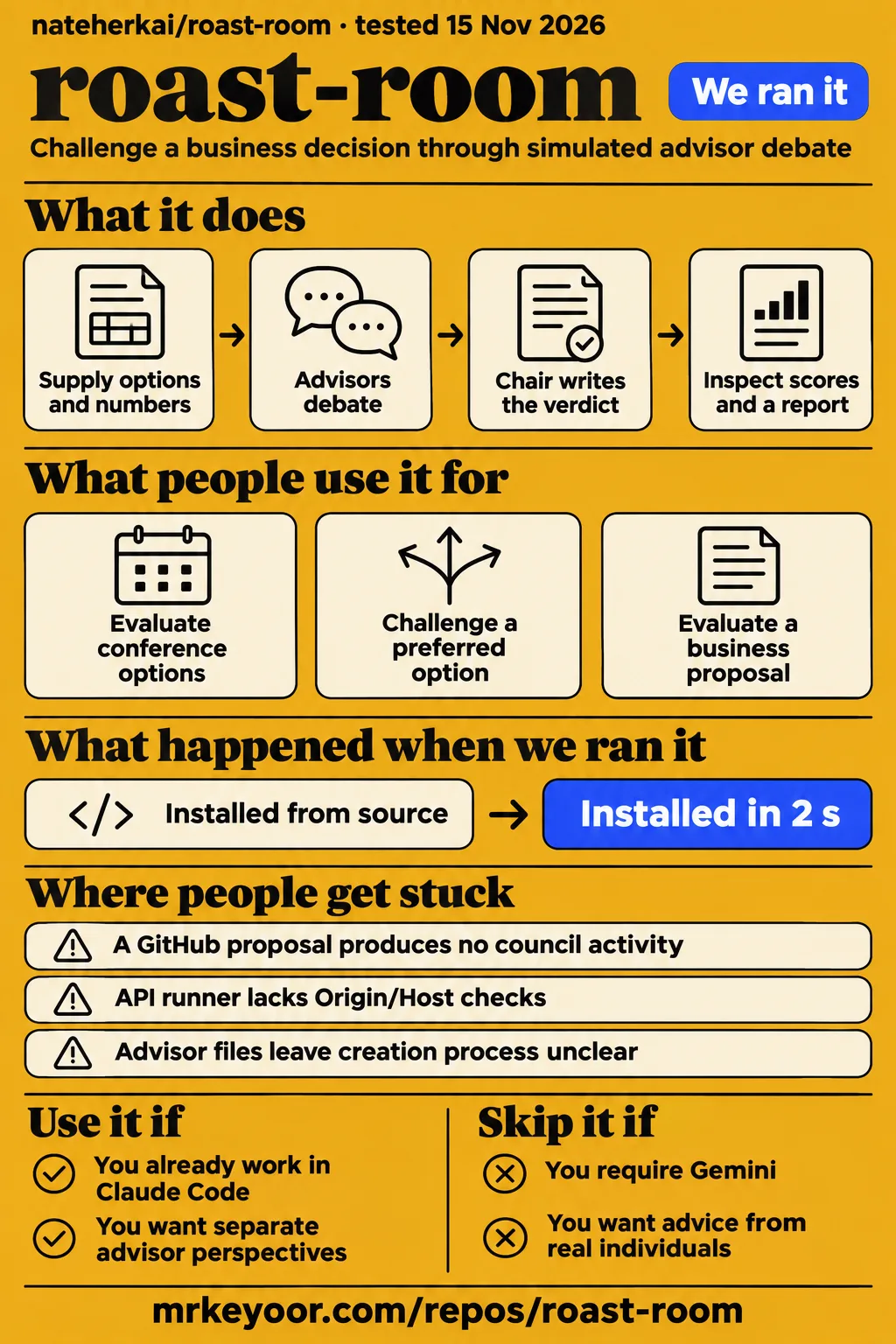
Roast Room installed in 2 seconds in our sandbox; the separate hands-on attempt failed its missing-Compose safety check. Use this Claude Code skill if you want a concrete business decision challenged through separate advisor perspectives and saved arguments. Choose another approach if your requirements include Gemini or advice from the actual people represented by the seats. The adoption question is whether the council's distinct objections justify its documented usage.
The Roast Room README describes a council that produces scores, a verdict and a downloadable PDF. Twelve simulated advisors ship with the project, with seven on the default board. Their material comes from public letters, essays, talks and videos. The README says the code is MIT licensed and explicitly states that the represented people neither speak through these simulations nor endorse the project. Read a named seat as a source-based AI persona.
Attention and repository identity
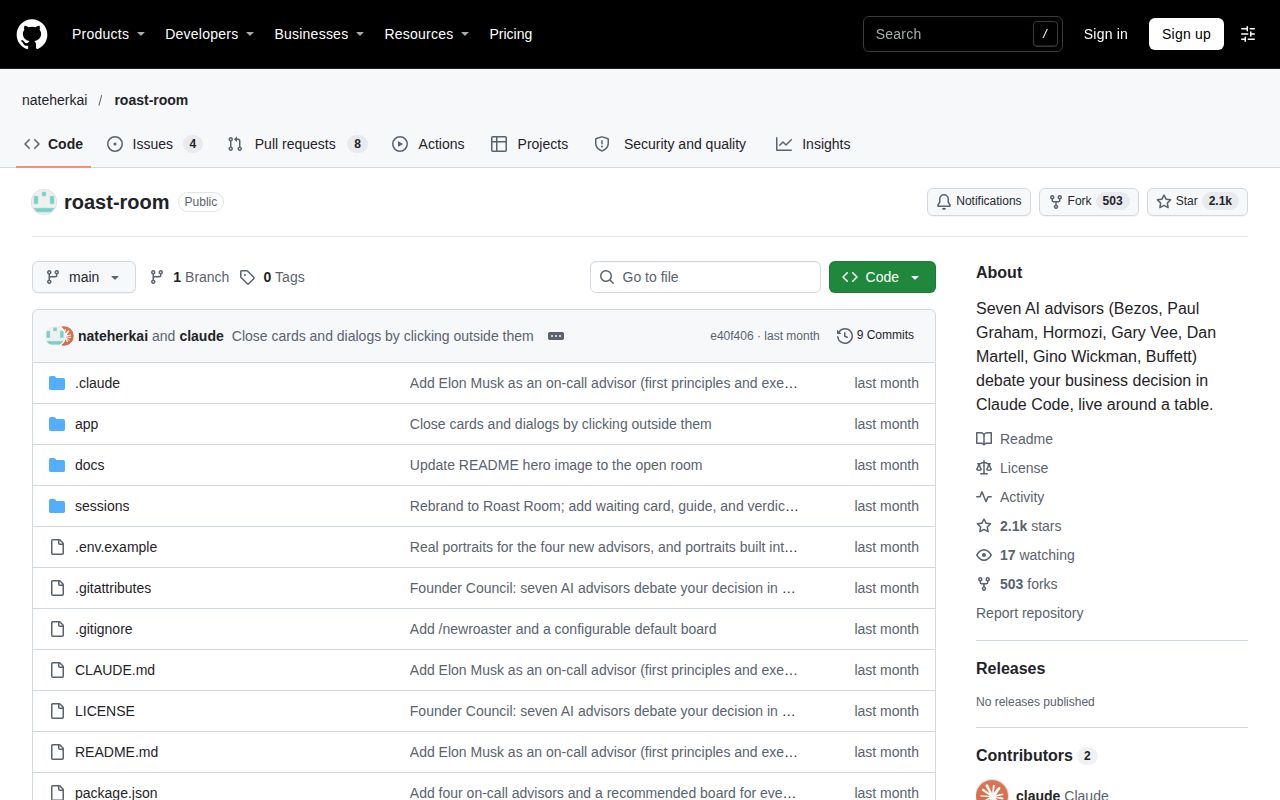
GitHub metadata recorded 2,140 stars and an October 22, 2026 last push for nateherkai/roast-room when observed on November 16. The repository metadata also records 12 open issues and pull requests combined. The sampled discussions concern advisor creation, application security and a Gemini request. Their contents give readers more specific adoption questions than the combined open-item count alone.
This review concerns nateherkai/roast-room, the Claude Code council. The supplied search synthesis also contains unrelated debate, expert-feedback and coffee-roasting products with similar names. Repository metadata records creation at 2026-10-10T20:38:58Z, which is a different event from a public announcement or an article describing a launch. Use the full repository identity when locating installation instructions, source files and issue reports.
What people use roast-room for
The supplied accounts describe a four-option conference decision, a preferred business option challenged by advisors and a proposal submitted through GitHub Issues. These are three different activities: a creator demonstration, a user's account of disagreement and an attempted evaluation through the wrong entry point. Keeping them separate helps explain both the intended use and the confusion a first-time user can encounter.
| Who used it | What they brought | What the record shows |
|---|---|---|
| The creator, in the supplied demonstration | Four conference-pricing options | MindStudio reports a round-one average of 7.1/10, followed by debate and a recommendation with pricing, capacity and go/no-go conditions. Conference account, demonstration transcript. |
| Decoding AI, Om, in an Instagram caption | A business choice and an already preferred option | The caption identifies watching the advisors challenge that preference as the useful part. User account. |
| GitHub user junoirbandio-dotcom | A proposal described in the synthesis as a voice and text translation business | The user expected seven agents to evaluate the proposal and reported that nothing happened. Proposal-submission report. |
The conference account illustrates a useful artifact to inspect: a recommendation attached to conditions. The Instagram account emphasizes disagreement with the user's preferred option. Both fit the README's request for options, numbers and a stated preference. The GitHub report exposes an entry-point problem: posting a proposal in an issue differs from invoking a skill inside Claude Code. The documented invocation gives that reader a concrete next step.
What happened when we ran it
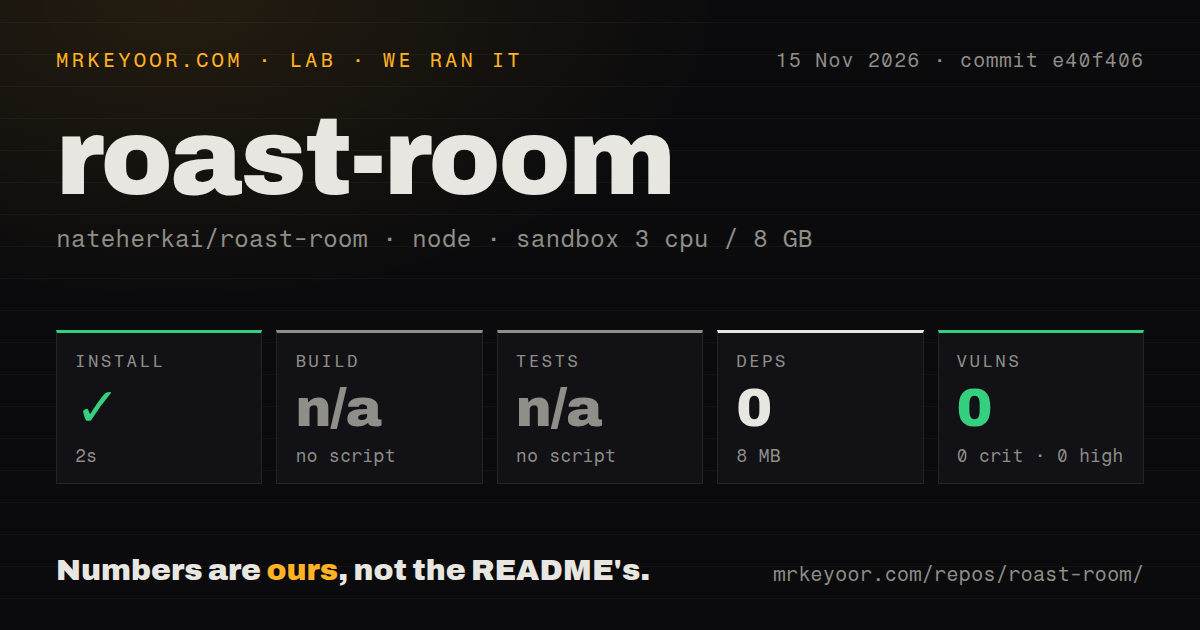
Our November 15 package installation succeeded in 2 seconds at commit e40f406. The November 16 hands-on safety step failed because its required Compose file was absent. The package run used the recorded sandbox configuration of 3 CPUs, 8g RAM and image label lab-node:22. We measured the installation and repository checks below; the separate safety attempt used a harness that required a Compose file.
| Check | Recorded answer | Verdict | Why |
|---|---|---|---|
| npm installation | Succeeded in 2 seconds; 0 dependencies recorded; 8 MB on disk | Installation passed | The package-install command completed successfully. |
| Build | No build script or target; skipped | Skipped | The run had no build target to execute. |
| Tests | No tests script or target; skipped | Skipped | The run had no test target to execute. |
| npm audit | 0 known vulnerabilities: 0 critical, 0 high, 0 moderate and 0 low | No package advisories reported | This is the recorded npm audit result. |
| Repository scan | 227 files, approximately 3,053 source lines and 4.1 MB checked out | Inventory recorded | These figures describe the checked-out source. |
| Automation signals | 0 CI workflow files, no Dockerfile and no tests directory | Files absent in the scan | The scan recorded these specific repository signals. |
| November 16 safety step | None of the four accepted Compose filenames existed | Failed | The hands-on harness required a Compose file. |
| November 16 teardown | teardown: ok | Completed | The teardown record explicitly reports success. |
The failed safety record names four accepted files: compose.yaml, compose.yml, docker-compose.yaml and docker-compose.yml. The teardown result closes that attempt. The README documents npm start for the room, a different startup path from the harness's Compose requirement. Likewise, npm audit reports package advisories, while issue #2 concerns application request handling and rendering. These records answer different questions.
Where people get stuck: invocation and custom seats
Issue #13 reports an inactive proposal submission, while issue #1 asks for the process behind the advisor files. The README addresses invocation through /roast-room and advisor creation through /newroaster. Those are separate workflows: one starts a council around a decision, while the other collects material and creates a seat that can participate in later councils.
| Sticking point | Documented next step | Record status |
|---|---|---|
| Posting a proposal on GitHub produces no council activity | Start Claude Code in the project folder and invoke /roast-room with the decision |
The user reports that nothing happened in issue #13. |
| Existing brain files leave the creation process unclear | Use the documented /newroaster workflow |
Issue #1 is closed; its extract contains the user's process questions and a Seth Godin request. |
| A custom advisor lacks a generated portrait | Use the working advisor with a placeholder face | The README explicitly permits this route. |
| A user wants Gemini | The README's execution paths use Claude Code or the Anthropic API runner | Issue #11 records the Gemini request. |
The README sequence is to clone the repository, enter its folder, run npm start and open http://localhost:4730. Start claude in that same folder, then type /roast-room followed by the decision. The visual room is optional: the README says the council also runs in Claude Code without it. These are the project's documented instructions, distinct from our package-install and safety-step records.
A useful brief includes the decision, two or three options, revenue, cash, team size, deadlines, available hours, budget and a definition of success. The README also asks which option you favor and why, so the council can challenge that preference. If context is missing, the Chair asks questions before starting. Gather the facts you want the simulated advisors to reason about before requesting their scores.
Documented usage and payment modes
The README counts 21 sub-agent runs for a full seven-seat council and about 25 API calls for a full council in optional API mode. Default operation uses Claude Code access without a separate API key. The README describes three sub-agent runs per seat, with --quick selecting four advisors for two rounds. Named seats can also be selected through --seats, or addressed individually through ask.
Optional API mode requires copying .env.example to .env, adding ANTHROPIC_API_KEY, setting COUNCIL_RUNNER=api and restarting npm start. The README says this mode bills the Anthropic API account separately. A standard /newroaster build is described as about 8 to 10 sub-agent runs. Portrait generation additionally uses a kie.ai key and Python with opencv-python; without the key, the advisor still works with a placeholder face.
Security reports and runner behavior
Issue #2 reports missing Origin/Host checks for API-mode council creation and two unescaped option-ID insertions into innerHTML. The security reporter describes unwanted council runs when COUNCIL_RUNNER=api and an Anthropic key are enabled. Their report identifies cross-origin POST requests and DNS rebinding as paths to the local viewer at localhost:4730, and proposes Host or Origin checks or a per-launch random token.
The reporter describes lower severity in default viewer mode because council creation returns 403 there. The second finding concerns option IDs at two rendering sites: the setup display and verdict scorecard. According to the report, surrounding values are escaped while those IDs are inserted directly, allowing crafted or corrupted session data to inject markup. Suggested corrections are escaping both IDs or validating their expected format. These are the reporter's findings and proposed fixes.
Roast-room vs alternatives
Roast Room supplies an advisor protocol and source folders; Claude Code is the underlying terminal assistant, while the Python SDK provides a programmable query interface. These choices suit different tasks: using the supplied council, asking a direct question, considering another coordination approach or implementing a workflow. The source-backed distinction is what each provides, rather than a numerical ranking of their decision quality.
| Choice | Reason to choose it | Evidence behind the distinction |
|---|---|---|
| Roast Room | You want the supplied advisor brains, Chair, scoring protocol and saved reports | The project README documents these components and their file locations. |
| A single Claude Code prompt | You want to ask about a decision directly in the underlying terminal assistant | The Claude Code README describes the terminal tool and natural-language interaction. |
| Claude Code agent teams | You are considering another coordination approach | MindStudio's account attributes similar answer quality, lower cost and more distinct voices to the creator's choice of sub-agents. |
| Claude Agent SDK for Python | You want to build a workflow through Python | The SDK README documents query() as an asynchronous interface for querying Claude Code. |
GoRemy's council explanation argues that separate priorities make disagreement visible rather than averaging it away. That explains the intended value of the format. A practical comparison would keep the decision brief identical and examine which assumptions each output asks you to investigate. Choose the existing skill when its protocol is what you want to inspect; choose the SDK when implementing your own workflow is the task.
What the other reviews get wrong
The README ships twelve advisors, limits --all to nine and documents an API runner alongside the default viewer. Those details help distinguish incomplete descriptions from accurate summaries. Explainx explicitly acknowledges optional API billing, so it belongs in the latter group on that point. The supplied article's API-mode statement supports the same distinction made in the project's README.
| Published description | Observation supported by the supplied records |
|---|---|
| Emergent describes a November 3, 2026 first launch on GitHub | Repository metadata records creation on October 10, and the supplied X record dates the creator's announcement to October 13. Creation, announcement and article publication are distinct events. Emergent account, announcement record. |
| Seven advisors presented as the full roster | Seven form the default board; five more are on call. Project roster. |
Nadr describes --all as the whole board without stating a cap |
The README explicitly says up to nine. Nadr account, README selection instructions. |
| Explainx distinguishes Claude-plan operation from optional API billing | Its supplied FAQ explicitly says an optional API mode bills the user's Anthropic account, consistent with the README. Explainx account, README runner instructions. |
These distinctions affect actual choices. A reader selecting advisors needs the default-board distinction and the nine-seat cap. A reader estimating usage needs to distinguish Claude plan activity from separately billed API calls. A reader checking project history needs dates attached to their events. Explainx's acknowledgment of API mode is accurate on that point and should be retained when comparing its coverage with the repository documentation.
FAQ
Roast Room is a Claude Code skill in nateherkai/roast-room that turns a business decision into simulated advisor debate, scores and a report. The questions below come from the supplied search intents and synthesis, including GitHub questions about advisor creation and invocation. Their answers describe the repository's documented behavior and the supplied reports, with the remaining evidence boundaries collected in the final section.
What is the roast-room skill, and where is its GitHub repository?
The Roast Room repository contains the council skill, advisor brains, agent definitions and local room. Claude Code acts as Chair and writes the verdict. The README describes all seats as simulations built from public work and says the represented people are unaffiliated with the project. That identity distinction applies to both shipped advisors and custom seats.
How do I set up Roast Room in Claude Code?
The README says to clone the project, start Claude Code in its folder and type /roast-room with your decision. The optional room requires Node.js 20 or newer and starts with npm start on localhost port 4730. The setup documentation places the room and Claude Code in the same folder; the room displays the council's saved session activity.
How were the advisor brains built, and is there a reusable workflow?
The README documents /newroaster as the reusable creation route: collect public work, extract thinking and voice, write the brain, check quotes, register an agent and try a sample question. Issue #1 asks for that process rather than just a description of the resulting files. The documented workflow is the starting point for building another seat.
How are source materials selected for each advisor?
The README says /newroaster looks for essays, letters, talks, long interviews and podcasts where the person is the main speaker. It asks about the business pillar and collection depth, then stores fetched material locally. Each brain has a sources.md file listing its inputs. That file gives readers a place to inspect the material behind a simulated advisor's positions and quotations.
How are advisor reasoning, voice and attributed claims validated?
The README documents word-for-word quote checks against cited sources and a sample question for a new advisor. It also describes a council quote-check script that compares quotations against the brains. Issue #1 asks more broadly about reasoning, voice and fabricated attribution. The documented checks provide specific artifacts to inspect: source-linked quotations and a sample response from the new seat.
Can I add Seth Godin or another custom advisor?
The README permits /newroaster to build a seat from a person with a body of public work, your own material or material from a consenting mentor. MrEdwards007 specifically requested Seth Godin in issue #1. The workflow asks which business question the new seat should own and whether it belongs on the default board before collecting sources.
Why is nothing happening after I submit my project for evaluation?
The documented invocation is /roast-room inside Claude Code, opened in the project folder. Posting a proposal in GitHub Issues is a different action. The user in issue #13 expected seven agents to evaluate a posted proposal and reported no activity. The README directs users to give Claude Code the decision and answer the Chair's questions to start a council.
Can Roast Room run with Gemini?
The README documents Claude Code and an optional Anthropic API runner as its execution paths. Issue #11 is titled "roast-room for Gemini" and is recorded as open with 0 comments. The documented runner choices therefore give a concrete starting point for setup: Claude-plan operation through Claude Code, or separately billed operation through an Anthropic API key.
Can Roast Room help assess whether to invest in a Malaysian IPO?
Issue #12 asks about investing in a Malaysian IPO and is recorded as closed with 0 comments. The README assigns the money-and-capital seat questions about cash, risk and long-term value. That describes a simulated advisor's perspective within the council. The project's own identity statement says the seats do not speak for the people they represent.
Which advisor is toughest on the creator's ideas?
The README requires a downside guard and a likely dissenter in each council, rather than naming a toughest advisor. Board selection is the documented mechanism: the Chair recommends advisors for the decision, explains their fit and lets the user confirm or change the selection. The supplied X synthesis includes the toughness question; the documented selection process explains how disagreement is built into a council.
Who else is available beyond the default board?
The five on-call advisors are Naval Ravikant, Codie Sanchez, Leila Hormozi, Sara Blakely and Elon Musk. The default seven are Bezos, Graham, Alex Hormozi, Vaynerchuk, Martell, Wickman and Buffett. The project roster distinguishes those groups. The Chair recommends seats for each question, and the README documents commands for changing the board or selecting named advisors directly.
How can Roast Room help me think through a decision more clearly?
The documented protocol separates advisor priorities, asks for missing context and forces an argument when agreement comes too quickly. Om's Instagram account values watching advisors challenge the preferred option. Use the resulting arguments, scores and conditions to identify assumptions to investigate alongside the business facts in your brief. That is the practical artifact the council format asks you to examine.
What we have not tested yet
Our evidence supports a successful package installation and a failed hands-on safety step, with no completed council evaluated against known outcomes. We have not tested answer quality, repeatability, PDF generation, custom advisor creation, Gemini compatibility, API billing or the proposed security corrections. The supplied records demonstrate neither an applied security fix nor a successful retest. The server excerpt ends before a listen call, leaving its bind address unsupported; actual runtime and operating-system versions require raw toolchain logs.
The generic November 16 summary says deployment used the repository's Docker Compose with every port bound to 127.0.0.1. That conflicts with the specific failed safety step, which found no accepted Compose file, so the summary cannot support successful deployment. The supplied metadata also leaves the latest-release status unresolved. There are no hands-on question-and-answer results or screenshot records in this pack.
The creator demonstration and Instagram caption supply no subsequent measured business outcomes. The agent-team account supplies no controlled benchmark or billing table, and documented run counts are not measured dollar costs. Quote checks address attribution rather than simulated judgment. The records provide no confirmed resolution of issue #13, working Gemini setup, IPO assessment or supported ranking of advisor toughness. Rendered layout, resolved links, recommendation modules and template behavior fall outside this text-and-evidence review.