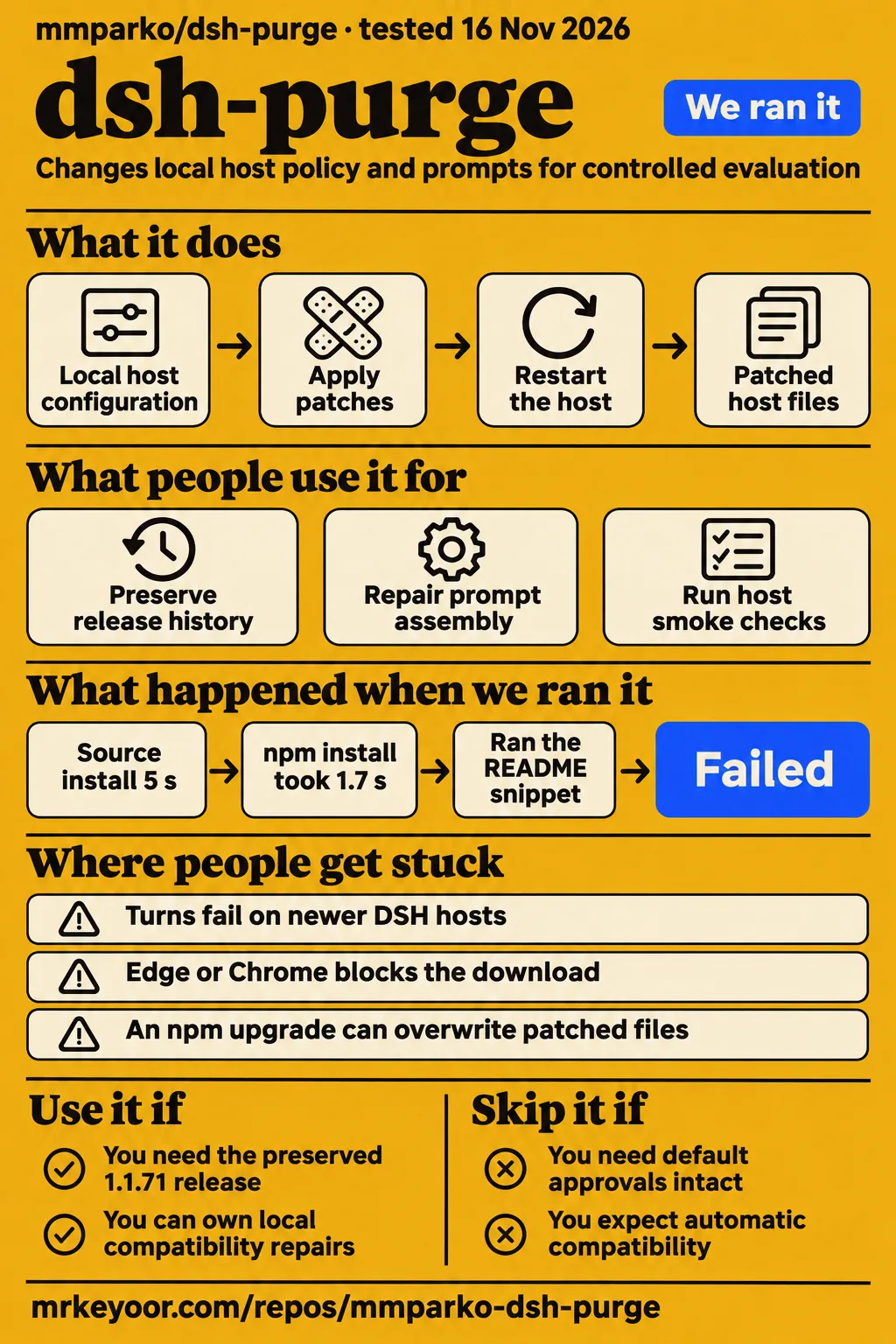
Our sandbox installed mmparko/dsh-purge in 5 seconds, but users of its 1.1.71 mirror report conversations failing before a model request on newer DeepSeek Harness hosts. Use this mirror if you need the preserved release for an isolated, version-pinned investigation and can own local repairs. Skip it if you want a plugin that follows current DSH releases without intervention. Issue #12 makes that distinction concrete: its author restored working turns locally on macOS Desktop 0.2.2-rc.3.
The name also needs an owner attached. This review covers mmparko/dsh-purge, the host-policy mirror. manbaout-08/dsh-purge is a separate project for permanently deleting session logs and workspace registrations. Choosing between them starts with deciding whether you want to change agent behavior or remove session data. Session-deletion listing.
The registry's 2026-11-15 snapshot displays 5,004 stars and no cumulative-download data points. Those are attention and data-availability signals, not a count of working installations. For someone deciding whether to use the mirror, the host-specific cards below are more useful than the star total. Registry snapshot.
What people use dsh-purge for
The clearest uses in the records are preservation, compatibility repair and host smoke checks, alongside a less specific report of mobile use.
| Who used it | What they did | What came out |
|---|---|---|
| mmparko, according to the registry listing | Preserved the upstream repository | The listing describes all branches, 73 tags and full commit history. That makes it an archive worth identifying by owner. Mirror listing |
| The author of GitHub issue #12 | Ran mirror 1.1.71 on macOS Desktop 0.2.2-rc.3, then removed obsolete prompt templates locally | Turns initially failed before any model request; the author reports normal completion after the edit. Issue #12 |
| The dsh.so registry service | Checked the pinned mirror artifact in its Windows ACL sandbox | Its historical runtime card passes on DSH 0.2.2-alpha.2, while newer release-candidate cards fail at runtime. Registry evidence |
| X user huocaijiasuo | Used dsh-purge through dsh-go on a phone for sexual writing and reverse engineering or cracking | The user praised the experience and later linked Community. The initial post leaves the build unspecified, so this is a report about the wider project family. X conversation |
The mirror's README describes a dock with Clean and Drill pages. Clean groups patch status, prompt editing, rule sets and rollback. Drill is documented for an owned host, an offline target or an exercise with written authorization. The intended technical job is to separate restrictions added by the surrounding Harness from refusals produced by the model. Mirror README snapshot.
That separation is useful for an engineer asking where a blocked turn stopped. It also explains why the phone user's enthusiasm cannot settle the mirror's compatibility question: a working Community build and an unchanged 1.1.71 installation are different artifacts.
What happened when we ran it
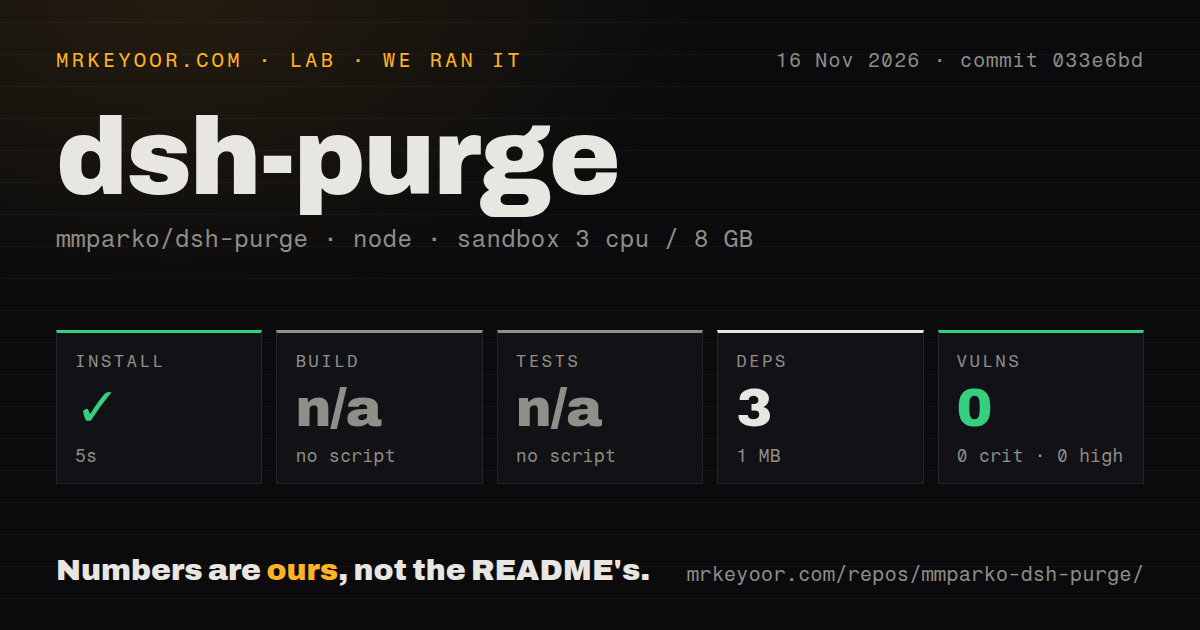
Our sandbox installed the checkout at commit 033e6bd in 5 seconds on 2026-11-16, recording 3 dependencies and 1 MB on disk.
| Our recorded check | Result | How to read it |
|---|---|---|
| npm installation | Succeeded in 5 seconds | The recorded package step completed |
| Dependency footprint | 3 dependencies, 1 MB on disk | A small recorded dependency installation |
| Build | Skipped: no build script or target | There is no passing build result |
| Tests | Skipped: no test script or target | There is no passing test-suite result |
| npm audit | 0 known vulnerabilities: 0 critical, high, moderate or low | A dependency advisory result |
| Checkout | 109 files, about 48,545 source lines, 3.7 MB | Repository footprint, separate from dependencies |
| Repository signals | 1 CI workflow file, no Dockerfile, no tests directory | File-presence observations |
The recorded sandbox configuration supplied 3 CPUs, 8 GB RAM and image label lab-node:22. The label alone cannot identify the actual runtime or operating-system version. Those require the raw toolchain logs.
Five seconds makes fetching the dependencies look easy. The adoption decision begins afterward, because the plugin's purpose involves changing an existing DSH installation. A skipped test step should not become a green check for that behavior, and an advisory count says nothing about whether a modified approval policy is suitable for your machine. Our measurement boundary is collected in the final section.
Where people get stuck: prompt assembly fails before the model
Issue #12 reports that mirror 1.1.71 inserts an obsolete {{cwd}} variable into prompt assembly on a newer host, preventing the model request entirely.
The author had Desktop 0.2.2-rc.3 on macOS. Each turn stopped with unknown prompt variable "{{cwd}}" in deployment:persona-suffix; the registered variables were provider and model. Their repair cleared the suffix in cordis.patch.yml and the CWD_ONLY_SUFFIX constant in lib/identity.js. They report that turns then completed normally. The issue remains open in the supplied record. Issue #12.
That is a more useful failure description than "the model stopped answering." The request never reached the model. Changing providers would leave the reported prompt-assembly error in place.
| Symptom | What the report identifies | Repair or status in the record |
|---|---|---|
| Every turn fails on the cwd variable | Obsolete suffix templates in mirror 1.1.71 | Issue #12's author reports a successful local edit; the thread is open. #12 |
| Clearing the profile suffix changes nothing | Runtime identity code writes the suffix back | Issue #4 describes a static replacement and removal of legacy cwd sentences, with normal conversations after restarting. #4 |
| Red-team preset is registered but broken | DSH rejects the retained toolFilter setting |
Issue #7 concerns plugin 1.1.73, not the documented mirror 1.1.71; its extract describes user-preset editing and warns about forced replacement. #7 |
| Edge or Chrome blocks the download | A user reports a virus warning | Issue #8 supplies no diagnostic result or substantive resolution. #8 |
Issue #4 adds the detail an abbreviated fix can miss. Its author says overlayOfficialIdentity() reinstates the cwd suffix even after the profile configuration is cleared. A later commenter also points to a legacy sentence that can survive the replacement logic. The useful repair target is the text produced at runtime, not just the profile setting. Issue #4.
A visible panel still needs Apply and a fresh conversation
The mirror README requires a separate Apply action, a completed restart and a new chat after adding the plugin to a profile.
Web and desktop need separate dsh-purge installations and separate Apply steps. The documented profiles are web and desktop, and each host has its own home. Before changing a manifest, identify the host you actually launch. The README says /purge status prints DSH_HOME and the patch list, which gives you something concrete to compare with the profile you edited. Mirror README snapshot.
A missing dock button belongs in that same check. The mirror's manual instructions point readers back to the selected .dsh home when the card is absent. Repeatedly adding the dependency to another profile does not address that mismatch.
The setup guide describes an npm host upgrade replacing patched files and leaving a pending re-apply state. It says startup checks attempt recovery, followed by the panel's Apply workflow if needed. Treat that as documented recovery behavior. If the actual error is the cwd exception above, repeated Apply actions do not replace the code repair described by the issue reporters. Setup guide.
Restore preserves the prompt; plugin Uninstall removes it
The mirror README says Restore keeps prompt-inject.md, while its own Uninstall action restores applied patches before deleting the inject file, rule library and plugin.
The distinction matters if you have spent time editing prompts. Restore copies back the .dshpurge.bak originals and removes those backups. Without a backup, it strips shim lines written by the plugin. Uninstall performs restoration first when patches were applied, then removes the additional plugin state. Preserve your prompt text separately before choosing the latter operation. Mirror README.
These are the plugin's named actions. Generic package removal is a different operation, and the README's rollback promise should not be silently transferred to it. For an evaluation, keep a baseline copy of the host configuration and record which action you used to return to it. A future comparison is much easier to interpret when the baseline is identifiable.
Permission changes matter more than the advisory count
The README says dsh-purge changes local permission policy and tool limits, which is a reason to keep the evaluation host separate from an agent whose default approvals you rely on.
An npm audit result addresses known dependency advisories. It does not approve the policies the plugin writes. A local patch can behave exactly as documented and still be the wrong choice for a shared workstation containing unrelated work. My recommendation is a disposable DSH profile or host with an explicit baseline and a rollback record. Documented host-policy scope.
The reported browser warning deserves a narrower conclusion. The author of issue #8 says both Edge and Chrome flag the download. The record lacks an identified detection, sample analysis or a completed resolution. It supports reporting the warning, not declaring the repository malicious or advising readers to disable browser protection.
English documentation exists; several repair threads are Chinese
The mirror provides an English README and a Chinese README, while the detailed web-host cwd report and the preset report are written in Chinese.
An English-speaking reader can follow the install, Apply and Restore documentation without translating the whole project. Searching for exact error strings still helps: deployment:persona-suffix and toolFilter is no longer supported lead to more precise material than the product name alone. Issue #12 also provides an English account of the macOS failure and local repair. Mirror, web report, preset report.
The Bilibili search record is Chinese-platform evidence, not worldwide demand data. It lists a one-click installation video by 我是一個学生党 and an update-breakage video by 虾客云. Those titles show the questions creators address. Search listings alone cannot tell us which script ran successfully or which artifact a viewer received. Bilibili results.
The supplied YouTube introduction titled dsh-purge: A native red team evaluation plugin that distinguishes between model and host strategies discusses isolating host filtering from model decisions. Its transcript provides an introduction rather than a reproducible mirror setup result. Neither its channel identity nor a completed mirror task is supplied, so it carries no weight as a hands-on endorsement here. Video transcript.
dsh-purge vs Community and the compatibility build
Community and realMisakaMikoto's compatibility build explicitly offer maintenance beyond the preserved mirror, with their own requirements.
| Project or approach | Reason to choose it | Boundary to keep |
|---|---|---|
| mmparko/dsh-purge | You need the preserved 1.1.71 release and history | The README retains a maintenance pause and warns about newer DSH versions. Mirror |
| kingcharleslzy-ai/dsh-purge Community | Its maintainer offers continued compatibility work, diagnostics, backup and migration | It is an independent, unofficial branch. Its releases are not mirror fixes. Maintainer's introduction |
| realMisakaMikoto/dsh-purge | You want a fork explicitly carrying 0.2.x compatibility patches | Its README requires Node.js >=22.13.0 with working node:sqlite. Compatibility build |
| manbaout-08/dsh-purge | You want session logs and workspace registrations permanently deleted | This is a different function despite the same repository name. Deletion plugin |
For a new installation on a newer DSH host, I would read the maintained branches' host matrices before spending time repairing the archive. The Community maintainer's issue #2 is an announcement of an independent maintenance route, not a closed mirror bug report. That distinction keeps responsibility clear when filing the next problem.
Switching providers or running an abliterated model changes another part of the stack. X user yuhasbeentaken proposes dsh-purge as a way to keep the DeepSeek Harness workflow instead. That is a proposed tradeoff, with no comparative run in the post. If your blocker occurs during prompt assembly, choose the host repair before treating a different model as the solution. X post.
What the other reviews get wrong
The registry's failure label obscures the failing stage, and the first-run tutorial contradicts the mirror's documented plugin Uninstall action.
The dsh.so card says "Sandbox install failed," but the detailed rc.3 evidence records a passed L4 stage, a ready web host and an HTTP 200 response, followed by a failed inventory query with rpc-error. Its rc.1 runtime card also fails. The older alpha.2 card passes. Read those as dated host smoke checks, not a model-refusal benchmark or proof that every newer host has the same underlying error. Registry record.
The dsh-plugin.org first-run tutorial says uninstalling leaves the policy behind and that only Restore rolls it back. The mirror README explicitly describes Clean → Uninstall as reverting applied patches and restoring Harness. Name the operation before giving rollback advice. Tutorial, mirror instructions.
The mirror's npm and Hub instructions also need their date attached. A later upstream snapshot on getdshplugins reports an npm 404 on 2026-10-24 and a stuck marketplace queue. It recommends an upstream tarball. That is a different repository destination from mmparko's pinned artifact. Treating either route as a universal installation answer discards the identity this review depends on. Upstream snapshot.
Finally, the README's broad dsh 0.2 wording is accompanied by its own warning that new versions are not guaranteed. Issue #12's newer-host failure is consistent with that warning. A mirror preserves a release; it does not promise to track the host's changing prompt interface.
Questions people ask
Mirror 1.1.71 fails with the reported cwd error because it injects a prompt variable the newer host does not register, according to issue #12.
Why does dsh-purge fail with unknown prompt variable {{cwd}} on newer DSH versions?
Issue #12 identifies obsolete suffix templates in cordis.patch.yml and lib/identity.js. Its author removed them locally and reports normal turns on Desktop 0.2.2-rc.3. Issue #12.
Why does clearing personaSuffix in my profile fail to fix the cwd error?
Issue #4 says runtime identity code writes the suffix back and can retain legacy cwd sentences. Its reported local repair changes that code as well as the configuration. Issue #4.
How do I get dsh-purge working again after a DeepSeek Harness update?
For a pending patch state, the guide recommends the startup self-check and then Apply if needed. For the explicit cwd exception, follow the separate compatibility diagnosis above. Recovery guide, cwd report.
Which maintained dsh-purge repository should I use if the old version stops working?
Community offers continued maintenance and migration; realMisakaMikoto's fork specifically carries 0.2.x compatibility work. Choose against their own host requirements, including the latter's SQLite runtime requirement. Community maintainer, compatibility fork.
Is there a one-click installer for dsh-purge 1.1.71 or the Community version?
Bilibili listings advertise both, including ikun91670's combined installer listing. The listing supplies no script contents or completed execution record. Use the chosen repository's instructions to identify the artifact. Bilibili record.
Why do Edge and Chrome flag the dsh-purge download as a virus?
Issue #8 reports the warning without evidence explaining the detection. The thread supplies no substantive resolution, so it cannot answer whether the warning is accurate. Issue #8.
Why does the red-team preset fail to load with toolFilter is no longer supported?
Issue #7 reports that DSH 0.2.2 rejects the retained configuration key. It identifies plugin 1.1.73 and user-preset editing, with forced replacement capable of overwriting that repair. Issue #7.
Why does dsh-purge appear installed but have no effect?
The mirror requires Apply, its completed restart and a new conversation in the correct host profile. A visible dock alone is not the documented completion condition. Mirror instructions.
Do web and desktop need separate dsh-purge installations and Apply steps?
Yes. The mirror documents independent web and desktop profiles and says to install and apply each separately. Mirror instructions.
Is dsh-purge a cache cleaner, an uninstaller or a host-policy plugin?
mmparko/dsh-purge is the host-policy plugin mirror. The manbaout-08 project with the same name deletes session logs and workspace registrations. Always include the owner when choosing. Mirror, deletion tool.
Why does marketplace installation get stuck at already queued?
The later upstream snapshot records the queue problem and recommends its repository tarball, but gives no queue-cause diagnosis. That upstream download should not be mistaken for mmparko's artifact. Upstream snapshot.
What should I check if the dsh-purge dock button is missing?
Check that the profile and .dsh home belong to the host you launch, then follow the mirror's quit-and-reopen sequence. Its manual instructions identify the other home as a possible source of a missing card. Mirror instructions.
What we have not tested yet
Our run establishes checkout dependency setup, not working host patches, completed conversations, successful rollback or a measured reduction in model refusals.
The pack also contains a separate quickstart-lib probe that requested npm's latest package rather than proving execution of the pinned mirror. It stopped at the snippet step because the README has no JavaScript/TypeScript code block to run. That failed probe is a recipe limitation, not a reproduced DSH failure. Its measurements are excluded from the checkout table.
We have not reproduced the issue reporters' repairs, established a released mirror fix, audited the browser detection or diagnosed the registry's RPC error. The toolFilter extract is truncated and concerns another plugin version. No supplied record gives a controlled refusal-rate comparison, production reliability result, multi-user load test or side-by-side trial of the maintained forks.
GitHub's public metadata records the mirror's last push as 2026-10-13, while the sampled issues contain later compatibility discussion and the README retains its maintenance-pause notice. That supports choosing the mirror for preservation and controlled investigation, rather than assuming ongoing host support. Stars and forks cannot fill the runtime evidence gap. For a new deployment, the next useful result is a completed conversation on your exact host, followed by a recorded return to its original policy.