It lists remote-friendly employers, not open jobs
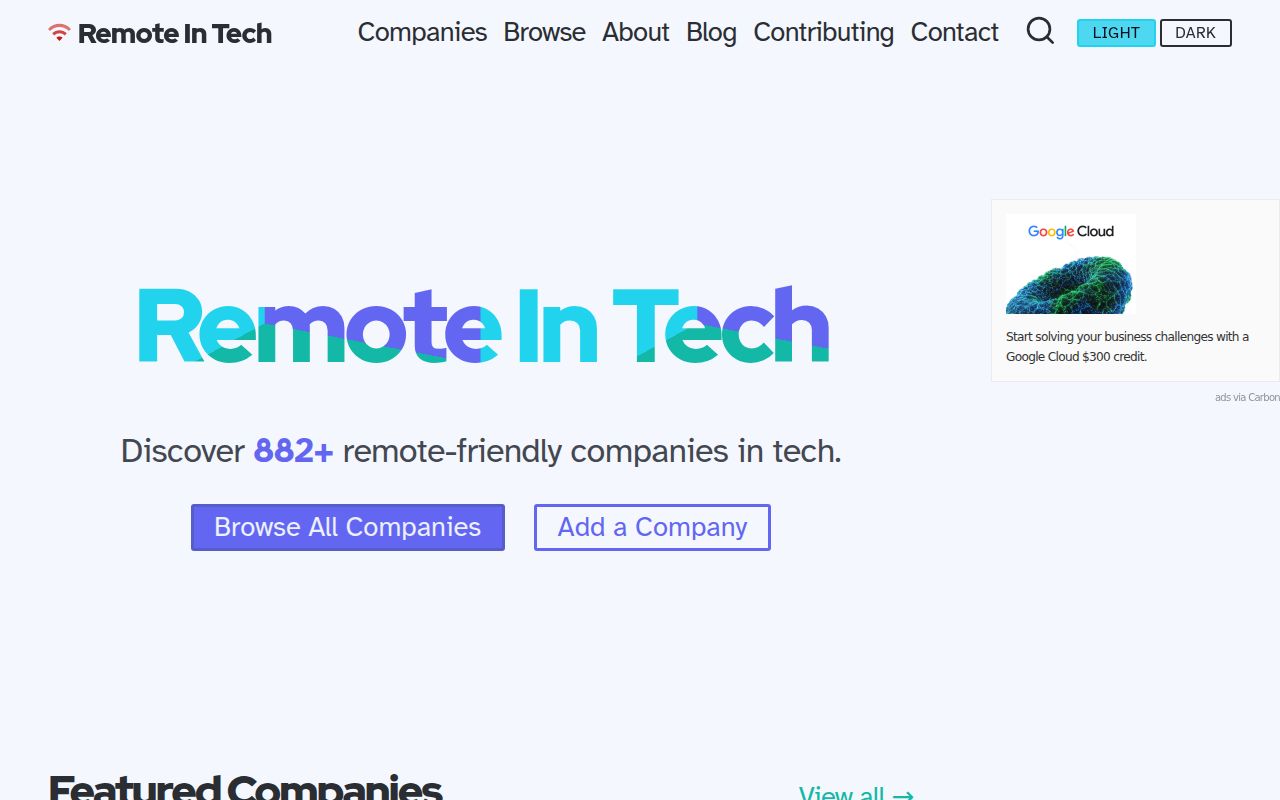
Remote In Tech is an employer directory built as an Eleventy static site. At commit b1dd8de, the repository contained 882 Markdown company profiles. Each profile can record a broad region, remote policy, company size, technologies, website, and optional careers URL. Pagefind turns the rendered pages into a searchable index. This is useful when you know the kind of employer you want but do not yet know its name.
Across those 882 profiles, there are no records for individual roles, salaries, seniority, application deadlines, or vacancy status. A profile's apply action sends you to the supplied careers page; without one, it falls back to the company website. Use the directory near the start of a search. It cannot tell you whether a matching job is open today.
6 region labels cannot settle hiring eligibility
The contribution schema accepts 6 regions: worldwide, americas, europe, americas-europe, asia-pacific, and other. Remote policy has four choices, ranging from fully remote to hybrid. Those labels are enough to cut down a long employer list, and technology tags can make a search more relevant to a developer's stack.
They do not answer the questions that decide whether someone can apply. Worldwide says nothing about payroll coverage, contractor status, residence, working hours, or visa support. Americas covers several time zones and many legal systems. There are no fields for language, salary, employment type, seniority, or a specific country. Every promising result still needs a visit to the employer's current vacancy page.
What happened when we ran it
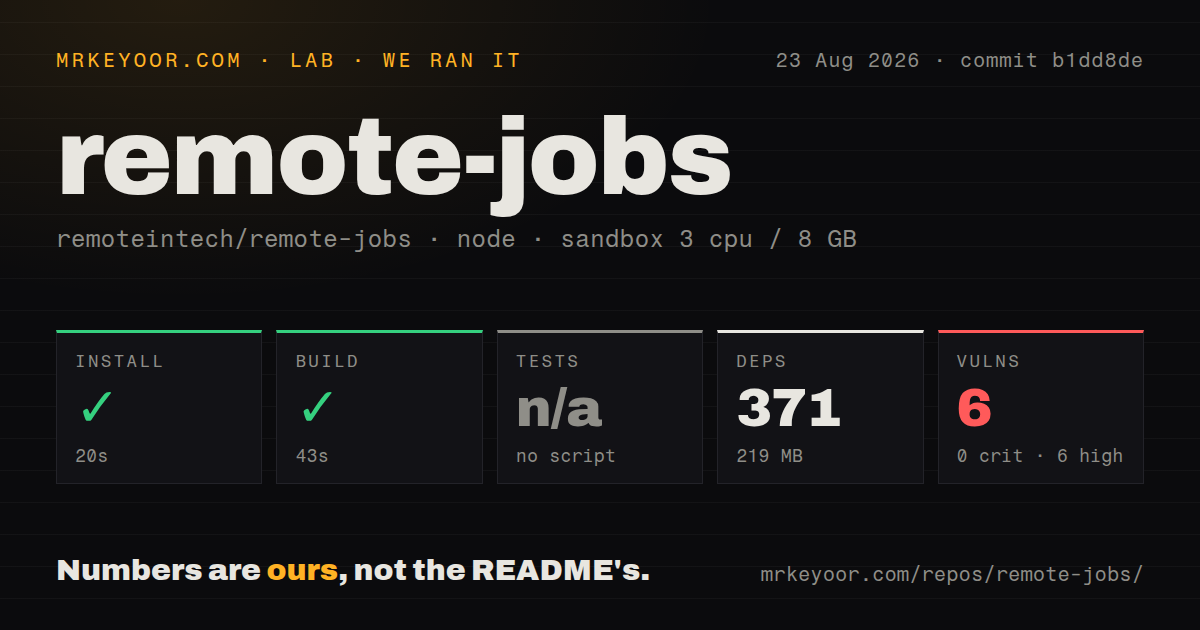
Our Node 22 sandbox installed 371 packages in 20 seconds, using 219 MB on disk. The production build completed in 43 seconds on 3 CPUs with 8 GB of RAM. That matches the README's short setup path: install dependencies, run the build, and receive a static site plus its Pagefind search index. No credentials or external services were required for that local build.
The clean build does not close the engineering question. The repository has no test script or test target, so our test step was skipped. npm audit reported 6 known vulnerabilities, all high severity, with none classified as critical, moderate, or low. We also found 3 CI workflow files, no Dockerfile, and no tests directory. A public fork should review the advisories and add checks for the behavior it depends on.
The validator checks URL syntax without opening the link
Adding an employer means creating a Markdown file, completing its frontmatter, writing the required company blurb, remote-status, and application sections, then opening a pull request. The validator checks required fields, allowed labels, filename and slug agreement, URL format, and section presence. The main branch requires one review and a passing build, according to the maintainer guide.
That process gives 882 profiles a consistent shape without requiring contributors to access a private content system. Its boundary is important: URL validation only asks whether a string is a valid HTTP or HTTPS address. The script does not request the page, confirm the company still exists, or check whether its stated remote policy remains accurate. The repository documents separate link-rot tools as ad hoc maintenance scripts.
One broken careers link shows the freshness cost
Pull request #2247 supplies a concrete warning. A company representative reported that the listed careers URL was broken, the profile described services the company no longer offered, and an office location had changed. The proposed rename also created a redirect question for an indexed URL. The PR was still open after 11 days, despite a passing validator and build reported by its author.
This is normal maintenance work for a community directory, but job seekers feel the cost directly. Companies rename themselves, move careers pages, close roles, and change remote rules between contributions. A successful validation cannot detect most of those events. Anyone forking the project inherits an editorial job across hundreds of external websites, while ordinary users should treat each profile as a lead rather than evidence.
Main-branch activity matters more than release tags here
The last repository push was August 11, 2026. On August 26, GitHub showed 13 open issues and pull requests: 4 issues and 9 pull requests. Recent activity included a company-profile update, discussion on two feature issues, dependency pull requests, and commits that repaired fork validation. That combination points to a maintained publication with a modest human review queue.
GitHub has no latest release for this project. The package identifies itself as version 4.13.4, and the maintainer guide says Netlify deploys the main branch. For a static directory, current profile work and working builds say more than a missing release tag. The 6 high-severity audit findings and absent tests still cap our maturity score because neither issue disappears when deployment is automatic.
Use it to find employers, then verify every lead
Remote In Tech is worth using when the task is employer discovery. The open Markdown data, broad filters, and static search are easy to inspect or fork, and our 43-second build confirms that the documented local path works. It is a poor substitute for a vacancy feed, and its labels cannot prove personal eligibility. Make the shortlist here, then make the employment decision from a current role page and written company policy.