One JSON file requests a free developer subdomain
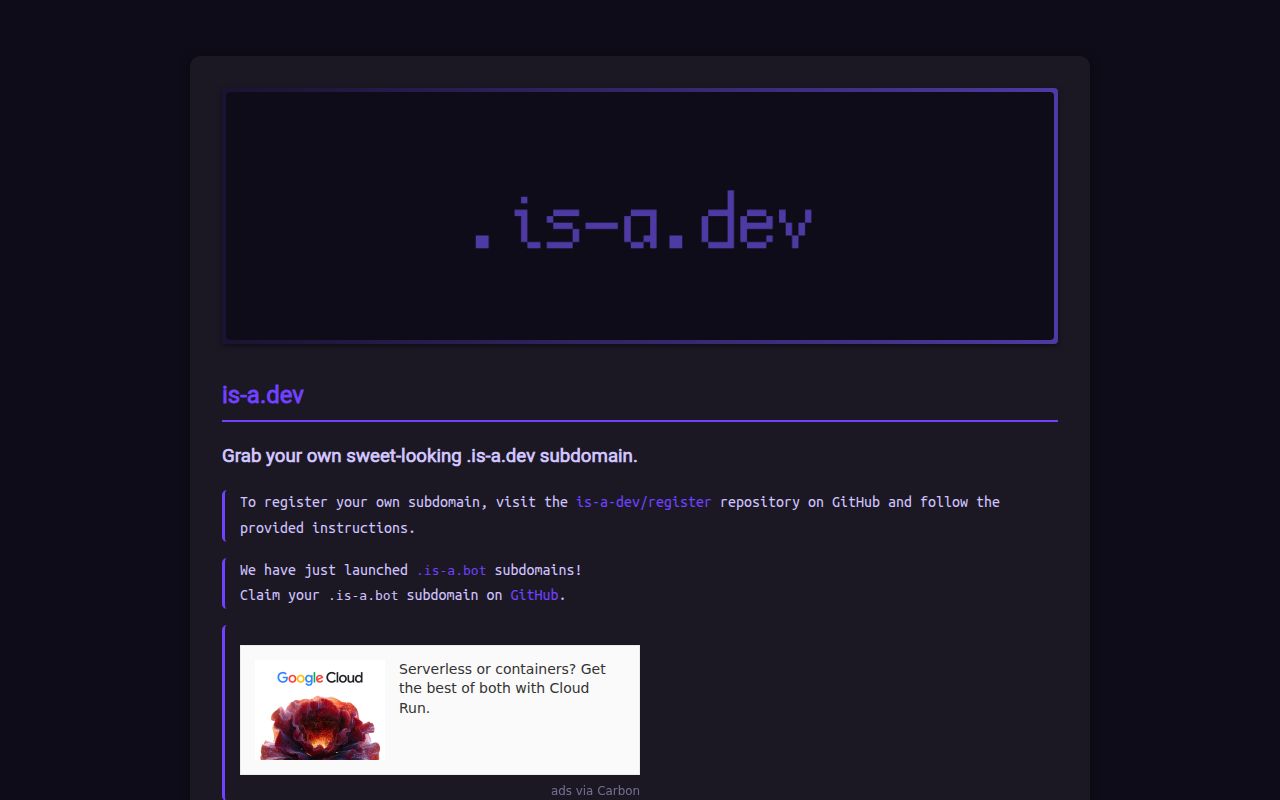
is-a.dev is a public registry for addresses such as alice.is-a.dev. An applicant forks the repository, creates domains/alice.json, names the GitHub owner, and supplies DNS records. After a maintainer approves and merges the pull request, the README says the record should publish within a few minutes. There is no account dashboard or registrar checkout. GitHub history is the application and change log.
That process is approachable if you already use GitHub. The documentation includes examples for GitHub Pages, Cloudflare Pages, Vercel, Netlify, Railway, Render, Firebase, Codeberg, and several mail or verification services. It also explains the filename and JSON shape rather than asking applicants to copy a mysterious sample. A preview link and screenshot belong in the pull request, and applicants must respond when maintainers request changes.
Eligibility excludes companies and unfinished placeholder sites
The terms limit registration to people using individual GitHub accounts. Personal portfolios, software-development blogs, developer groups, and noncommercial software projects fit. The quickstart says the destination should be at least somewhat complete, not blank or nearly empty. Commercial, for-profit, and political uses are prohibited, as are unrelated blogs, course sites, proxy services, and conversational AI products.
These are operating rules, not suggestions. The service can reject a request for any reason and terminate an existing subdomain without notice. It offers no warranty of uptime, support, or permanence. Applicants must also be at least 13 years old. A free address is reasonable for a learning project or personal landing page, but it is a poor foundation for paid work or an identity that must remain under your control.
What happened when we ran it
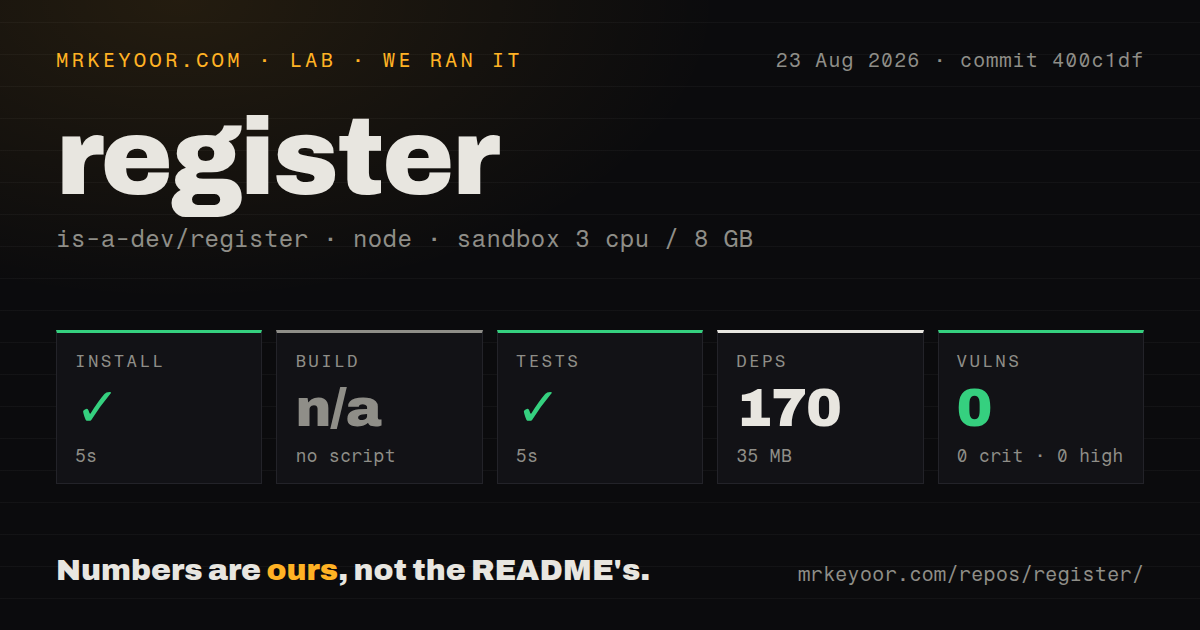
Our sandbox installed commit 400c1df in 5 seconds, adding 170 npm packages and using 35 MB. The repository has no build script or target, so there was nothing to build. Its test command completed successfully in 5 seconds. Npm audit found 0 known vulnerabilities in the installed dependencies.
The checkout contained 15,240 files but only about 1,161 lines of source, occupying 8.2 MB. That apparent mismatch makes sense: nearly all of the project is the collection of individual domain JSON records, while a small JavaScript layer validates them. We found 8 CI workflow files and a tests directory, with no Dockerfile.
The tests validate JSON structure, ownership rules for nested names, filename limits, supported record types, address ranges, and legal record combinations. For example, DS records require NS records, ordinary CNAME records cannot be mixed with other types, and nested records must belong to the root owner's GitHub account. A local pass cannot guarantee approval, since maintainers also assess eligibility, site content, and abuse risk.
DNS support is broad, while nameserver control is restricted
The registry accepts A, AAAA, CAA, CNAME, DS, MX, NS, SRV, TLSA, TXT, and URL entries. URL is a project-specific redirect rather than a DNS record. Nested names such as blog.alice.is-a.dev use dotted filenames, and the tests require the nested owner to match the parent owner. One-character names are limited to one per user to reduce squatting.
NS delegation receives much stricter review because it hands the applicant control beneath the subdomain. The FAQ says ordinary supported records should be used whenever possible. New users normally need to hold an is-a.dev name for 30 days before an NS request, and valid requests must show that another record type cannot solve the requirement. Review usually takes 24 to 72 hours, with rare cases reaching 2 weeks.
Issue 49121 shows how that rule affects a competent operator. The user wanted NS delegation to combine a static site, mail, and DNSSEC, and asked whether to start with ordinary records before applying for an update after 30 days. The question received activity the next day. The policy is restrictive by design, so anyone needing full zone control should purchase a domain instead of negotiating an exception.
AI-generated registration requests are explicitly unwelcome
The README tells applicants not to use AI to generate a request because it delays approval. The August 2026 terms are firmer: AI-created pull requests may be closed, and the author may be blocked or limited. AI-assisted website creation is allowed when the finished site complies, but the registry change itself is expected to come from the applicant.
That boundary fits the work involved. A registration file is short, while the important choices are human ones: whether the project qualifies, which host record is correct, and whether the applicant accepts the terms. Automated generation adds little and can introduce a bad username, placeholder record, invalid combination, or inaccurate pull-request statement. Read the guide and write the few lines yourself.
Same-day registry activity matters more than release tags
The project does not publish GitHub releases. That absence is not a sign of neglect because this repository is a live registry rather than packaged software. GitHub recorded a push on August 26, 2026, with 11,079 stars and 18 combined issues and pull requests. The open question about NS records was updated on August 26 as well, showing current repository and support activity.
is-a.dev is easy to recommend for a personal developer page whose owner understands the bargain. Our 5-second passing test run shows applicants can catch structural mistakes locally, and the docs cover common hosts in plain language. The address remains borrowed infrastructure under a volunteer policy. Keep the site portable, avoid using it as the sole recovery address for important accounts, and move to a domain you own when the project becomes commercial or essential.