
State changes become spring motion instead of hand-written frames
react-spring starts with a useful idea: describe where a value should go, then let a spring calculate the movement. useSpring can turn a visibility flag into changing opacity and position values, and animated.div applies them without rerendering every frame through ordinary React state.
A config object gives you declarative motion, while the function form returns an imperative controller for changing a spring later. The library asks you to learn its controllers, spring values, lifecycle callbacks, and configuration rules rather than treating animation as a CSS class toggle.
Web and Three share an engine, but target boundaries still matter
The README points browser users to @react-spring/web and React Three Fiber users to @react-spring/three. Both sit on the same core packages, with a separate parallax package in the monorepo. Peer ranges cover React 16.8 through 19, while the Three package accepts React Three Fiber 6 or newer and Three 0.126 or newer.
Shared primitives are useful when one product has interface motion and a 3D scene. Open issue #1586 shows a version 9.2.3 reproduction where importing the Three target before a web animation in another file stops the web spring. The report does not establish a current version 10 defect, but its open state is enough reason to keep a mixed-target regression in your app.
What happened when we ran it
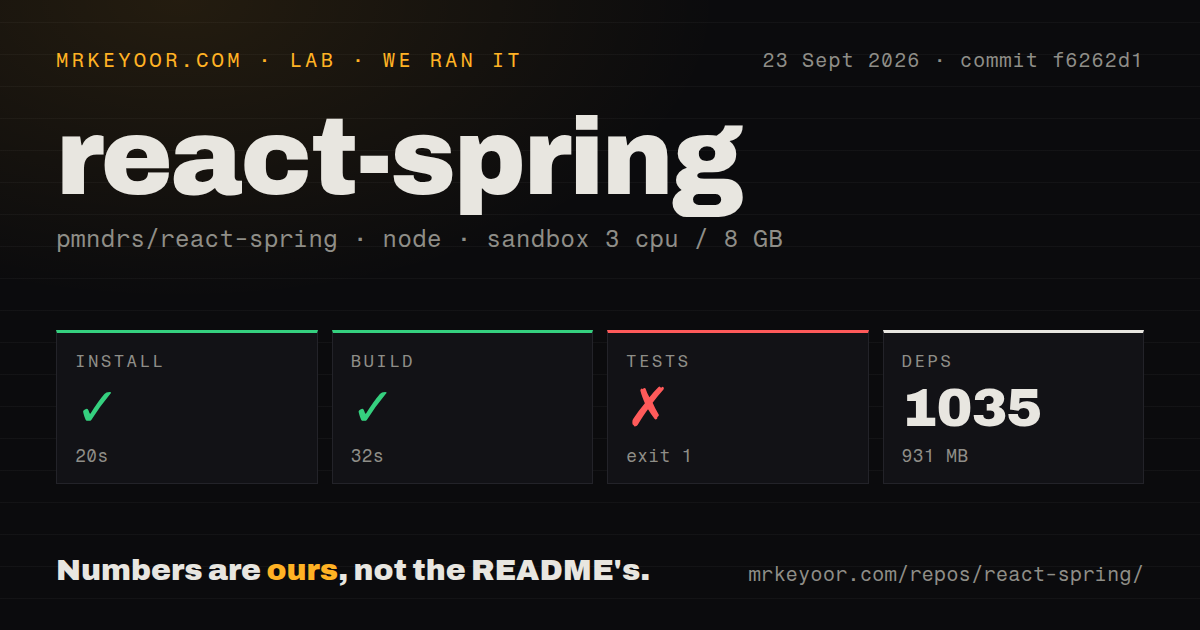
Our sandbox installed commit f6262d1 in 20 seconds, pulling 1,035 pnpm packages and consuming 931 MB on disk. The build completed successfully in 32 seconds. The checkout contained 854 files, about 34,632 lines of source, and 35.1 MB before installation, so the contributor environment is much larger than the single package an application adds.
The test command failed with exit code 1 after 10 seconds. Its Vitest summary listed 30 test files, no tests, and 1 error. The supplied tail includes a location at line 1053, column 55, followed by pnpm lifecycle failures, but it does not include the error message that would support a diagnosis. The full command did not reach a passing result in our Node 22 container.
This monorepo has 7 CI workflow files, a Dockerfile, a tests directory, and workspace configuration. Those signals do not turn our failed run green. The current next branch now requires Node 24.21.0 or newer with pnpm 12.5.1. That engine update landed after our measured commit, so the lab's Node 22 install is evidence for f6262d1 only.
useTransition is the part most likely to slow a team down
useTransition handles items entering and leaving the tree, including dialogs and changing lists. Its config differs from useSpring, and rendering uses a function that receives the calculated style and item. Open issue #2540 says developers repeatedly struggle to see where the item comes from and how exit timing works. The proposed answer is an API rewrite, not a documented release plan.
Open issue #2136 concerns different spring settings per animated property inside useTransition. In its version 9.6.0 example, the config callback receives the transitioned item where the developer expects the property name. An app that mixes a duration for opacity with a spring for movement should reproduce that pattern. A basic fade does not expose this part of the API.
Reduced motion is built in, with one loop warning
The documented useReducedMotion hook reads the operating-system preference and sets the global skipAnimation value. Springs then jump to their destination, much like the immediate option. Calling the hook at the application root gives every spring the same preference.
Open issue #2409 reports a sharp edge in version 10.0.3: combining Globals.assign({ skipAnimation: true }) with a looping SpringValue can lock the main thread. The report includes a small reproduction and remains open. It does not say every reduced-motion use crashes. Looping decorations still deserve a test with reduced motion enabled.
Version 10 is stable while the next branch carries version 11 beta
GitHub's latest release is v10.1.2, published June 24, 2026. It fixed partial from type inference, an onChange result mismatch, and a React Native Hermes crash. The repository was pushed again on September 23. Current package files identify the next line as 11.0.0-beta.0, so buyers should distinguish stable npm documentation from unreleased branch work.
GitHub recorded 29,160 stars and 69 open issues and pull requests when fetched. The combined count is not a bug total. Recent commits and a June release show active maintenance, while older open reports show that some awkward behavior has lasted across major versions. The broad surface rewards a small app-specific motion test before a design system adopts it.
Choose react-spring when the physics model earns its API cost
react-spring is strongest when motion responds continuously to state, input, or another animated value. It reaches both DOM and Three scenes. For simple fades, React Transition Group plus CSS asks less of the team. For layout and presence work, Motion offers a higher-level model.
Our failed test command keeps this from being an easy contributor recommendation. For application use, start with one target package, wire reduced motion on day one, and prototype the hardest transition rather than the landing-page fade. If that transition behaves under interruption, react-spring's spring model has earned the extra concepts.