Motion covers React, JavaScript, and Vue with related APIs
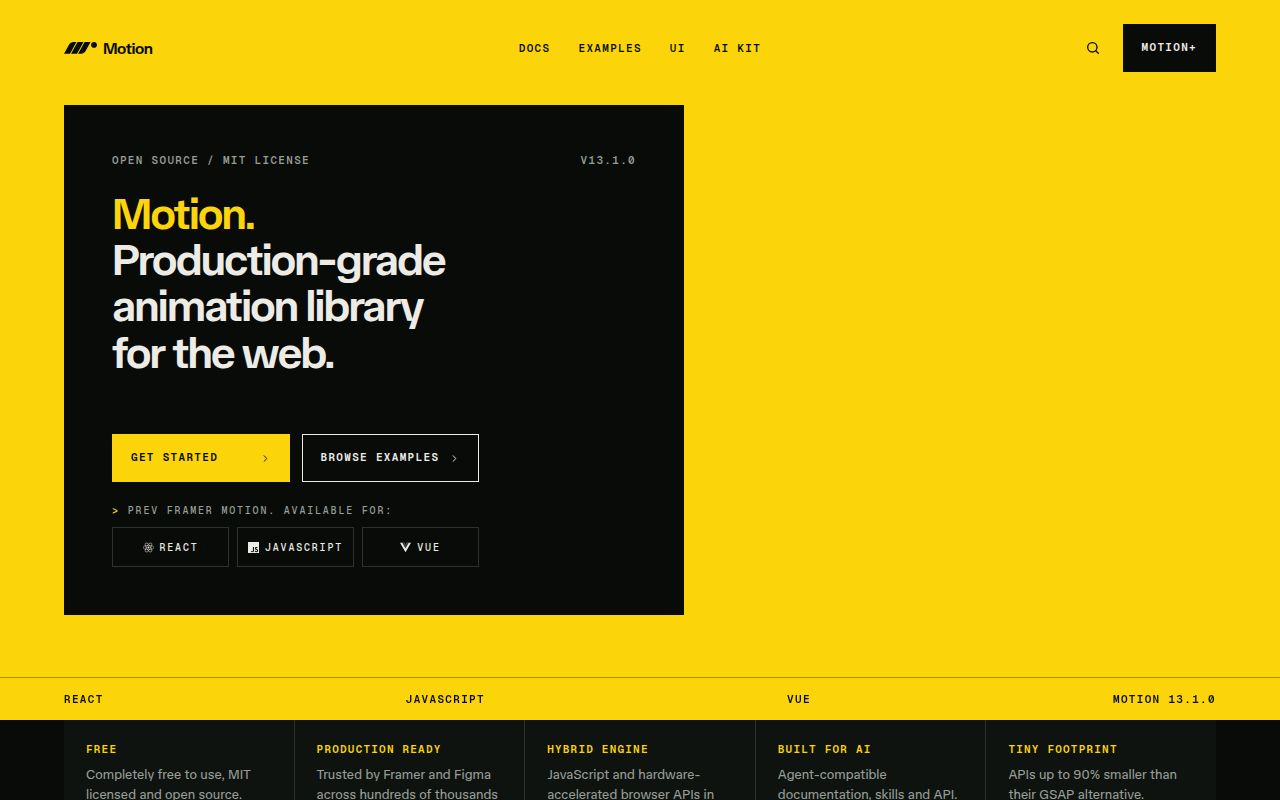
The React package provides components and hooks for declarative animation, while the JavaScript entry point can animate DOM elements directly. Vue uses the separate motion-v package. Across those routes, Motion covers keyframes, springs, gestures, layout transitions, scroll-linked effects, and timelines. The README also explains the naming change: Framer Motion is now Motion, and React users should import from motion/react.
The published API may feel compact, but the contributor repository is substantial. commit e871ba7 contained 3,201 files, roughly 110,615 lines of source, and 289.6 MB before dependencies. It is a Yarn workspace with the public packages, development applications, tests, build tooling, and size checks in one tree. Application developers install one package; maintainers entering the source have a monorepo.
The MIT core handles gestures, layout, scroll, and springs
Motion's strongest case is coordination. AnimatePresence keeps an exiting React child mounted long enough to animate out. Layout animation can move an element between measured positions, while gesture props connect hover, press, and drag state to visual changes. Motion values let several effects share changing state without forcing every frame through a React render. The JavaScript API can use native browser animation where the requested effect permits it.
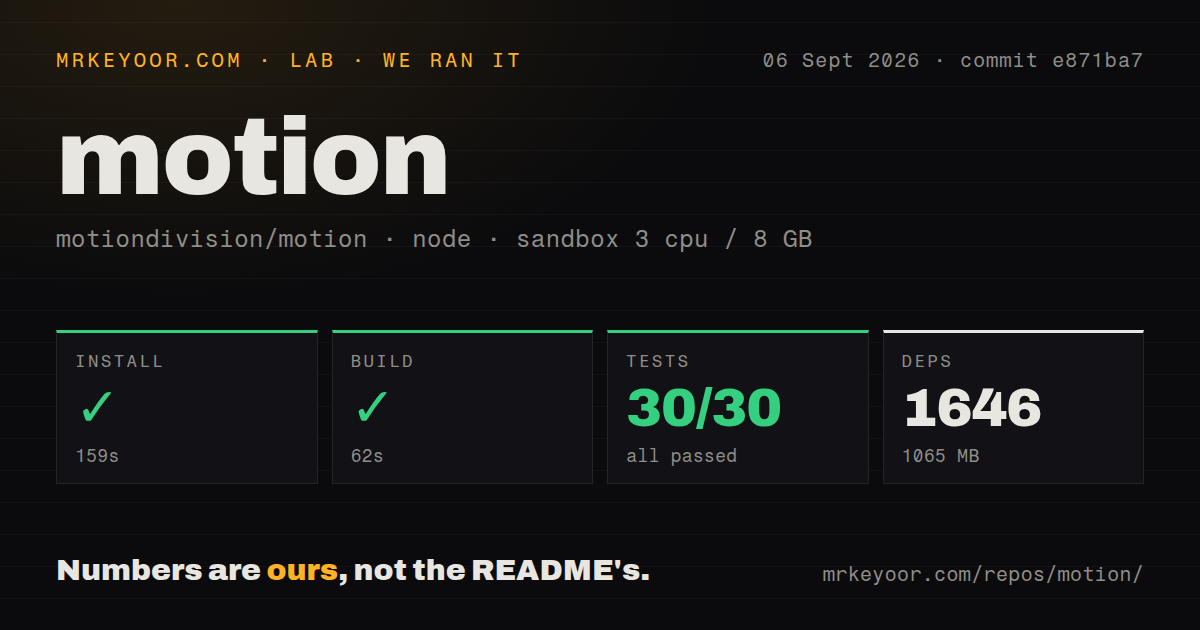
That range has a local cost. Our clean install fetched 1,646 packages in 159 seconds and ended at 1,065 MB on disk. Most product users will see a much smaller dependency path than the full workspace, and the package manifests mark their output as free of side effects for bundlers. Still, anyone planning regular upstream work or a long-lived fork should budget for the full toolchain rather than judging effort from npm install motion alone.
What happened when we ran it
Our sandbox installed the Yarn workspace in 159 seconds, built it successfully in 62 seconds, and completed the available tests in 86 seconds. Jest reported 30 passed and 0 failed out of 30. The run used an unprivileged Node 22 Debian container with 3 CPUs, 8 GB of RAM, and no secrets. Those are clean results for the checked commit, with no failed step to explain away.
The repository scan found one CI workflow, no Dockerfile, a tests directory, and monorepo workspaces. A Docker image would add little for a browser library. More importantly, the 30 passing Jest tests do not measure animation smoothness, bundle size inside a particular application, browser power use, or visual behavior under real interaction. Our 86-second test result proves the supplied command passed in the stated environment and nothing broader.
Current issues expose timing and package-manager edge cases
Open issue 3803 describes an AnimatePresence wait-mode failure when child keys change close to exit completion. In the reporter's reproduction, the latest child can stop rendering and remain stale after updates finish. Issue 3791 concerns Safari elastic overscroll being reported with the wrong direction. These are narrow cases, yet both can affect visible application state. Presence, scroll, and layout behavior deserve browser tests built around the actual interface.
TypeScript users with strict dependency layouts have a separate concern. Issue 3801 reports that Motion's declaration files import React types without declaring @types/react as an optional peer. The reporter reproduced the problem with pnpm, Yarn PnP, and Bun's isolated linker. Our 30-test Jest run passed under the repository's own Yarn setup, so it does not contradict that consumer-install report. Test the package through the same linker and TypeScript settings used in production.
Motion+ keeps specific tools outside the MIT package
The core repository and packages use the MIT license. The README separately sells Motion+ as a one-time membership with lifetime updates. It lists premium Cursor and Ticker APIs, a transition editor, AI skills, member examples and tutorials, and a private Discord. That split is clear enough, but teams should check whether a prototype copied from the site depends on member code before promising that the whole interaction can ship from the free package.
Nothing in our 289.6 MB checkout or 1,065 MB installed workspace required Motion+ credentials. The open package already covers the common work: component animation, gestures, springs, layout, presence, and scroll. Motion+ makes sense when its specific APIs or teaching material save more time than the membership costs. It is not a required license upgrade for ordinary use of the repository.
September activity supports adoption despite open browser bugs
GitHub recorded 33,507 stars, 108 open issues and pull requests, and a last push on September 2, 2026. New issue activity landed that same day, so the queue and source both show current use. The latest-release API has no GitHub release record. The repository changelog instead dates 13.1.1 to August 18 and labels 13.2.0 as unreleased, which makes the changelog and package publishing flow more useful than GitHub Releases for version tracking.
Motion is the sensible default when a React product needs more than CSS transitions and the team wants one vocabulary for interaction and layout. Our 62-second build and 30-of-30 Jest result lower the risk of evaluating its source. The open timing, scroll, and strict-linker reports are reasons to add focused regressions, not reasons to dismiss the library. If animation remains decorative and simple, CSS leaves less code for the next engineer to learn.