Every hook exits 0, so Abide advises rather than blocks
Abide watches edits made by Claude Code, Codex, OpenCode, and Pi, then compares each diff with rules compiled from your instruction files. A score of 0.8 or higher sends the agent a named repair request. Scores from 0.5 to 0.8 become notes, while lower scores stay quiet. This is useful during a long coding session because the feedback arrives while the agent still has the task in hand.
The important boundary is in the README: all hooks exit 0. If the TypeSafe key is missing, the network is down, or a check reaches its deadline, Abide logs the miss and lets the edit continue. Pi's guide also says checks happen after mutations and are not a pre-write security boundary. Use the product as an advisory repair loop. A security or compliance control needs a separate deterministic gate that can fail the workflow.
Four agent integrations share one compiled rubric
Version 0.0.9 installs into four hosts. Claude Code and Codex receive hook entries, OpenCode loads a plugin, and Pi uses an extension. User-level installation changes files under each agent's home configuration. Project mode writes the integration into the repository so teammates can receive it with the checkout. Codex asks the user to approve four new hook entries through /hooks.
The first session compiles AGENTS.md, CLAUDE.md, and other discovered instructions into .abide/rubric.json. Each rule records its source, question, phase, and optional file globs. Edit-phase rules inspect one change quickly; turn-phase rules judge the full activity diff. There are no built-in policy rules, which is a sensible choice. It also means a repository without useful instruction files gives Abide nothing worthwhile to enforce.
What happened when we ran it
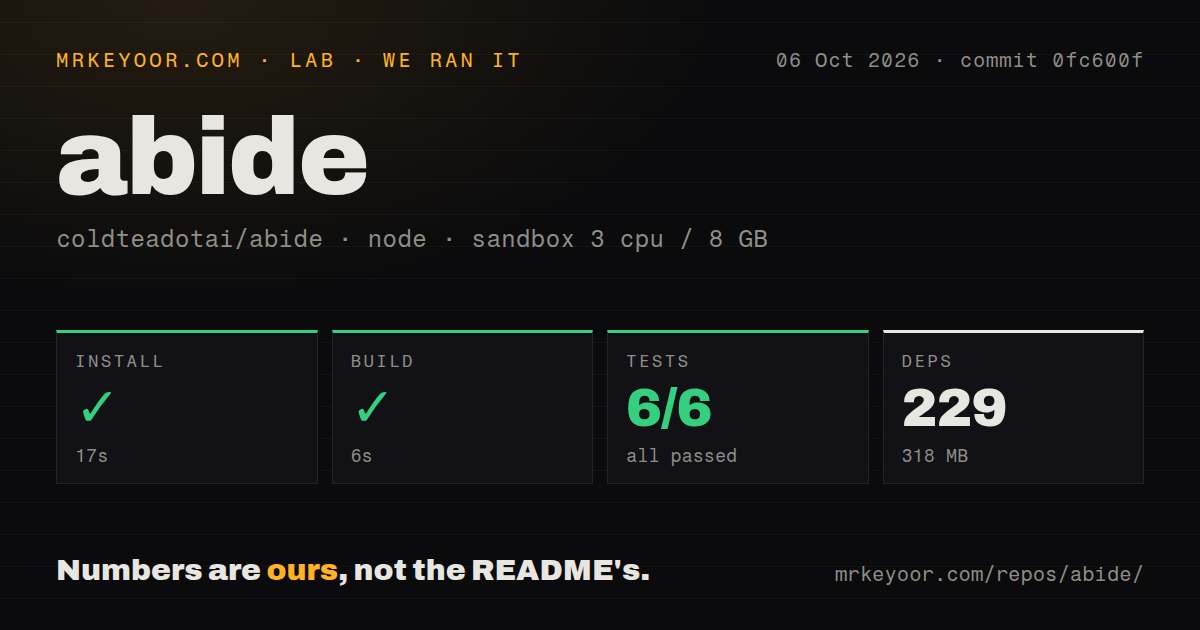
Our fresh Debian sandbox installed commit 0fc600f in 17 seconds. Pnpm added 229 packages and the installed workspace occupied 318 MB. The repository was a 10.7 MB checkout with 192 files and about 15,270 lines of source. Its monorepo build completed successfully in 6 seconds. The scan found 0 CI workflow files and no Dockerfile.
The complete test command failed with exit status 1 after 44 seconds. The schema package reported 6 passing tests. The CLI package reported 268 passed, 1 failed, and 1 skipped across 43 test files; test/ui.test.tsx had 1 failure among its 12 cases. The log tail did not include the failed assertion, so it does not support a cause. The skipped live Pi case requires configured credentials and can make a paid model call.
The replay confirmed 11 violations across 147 turns
The author's September 18 replay judged 1,256 edits and 147 turns from 93 real Claude Code sessions. An independent reviewer confirmed 10 of 39 edit flags and 11 of 15 turn flags. That is 26% precision for individual edits and 73% for completed turns in this sample. The strongest catches involved single-use abstractions, oversized files, and duplicated logic, which are exactly the rules ordinary linters struggle to express.
Those figures are evidence for trying the approach, not a universal accuracy rate. The two repositories were chosen by the author, one was private, the rubrics were specific to each codebase, and replay did not measure whether an agent repaired a catch. The benchmark also found one miss among 20 near-threshold cleared hunks. Your rule wording and diff shape will decide whether Abide helps or nags. calibrate, tune, and report exist because that maintenance is part of the product.
Diff-only checks cannot see an existing helper elsewhere
A Jev check receives the rule and changed diff, not the whole conversation or repository. Open issue 24 gives the practical example: a rule saying "reuse existing helpers" needs to know which helpers already exist. Today such rules may become deferred or weak proxies. The proposal asks for bounded, opt-in repository context, but it was still an open issue on October 6, 2026.
File capture has its own current edge case. Open pull request 34 says abide check can silently drop an untracked filename when Git quotes non-ASCII bytes, quotation marks, or backslashes. The proposed fix switches the file list to NUL separators. Until that lands, teams with such filenames should not assume a quiet check examined every new file. .abideignore adds explicit exclusions, and files larger than 64 KiB are skipped by that ignore-file path.
October 5 activity does not make version 0.0.9 settled
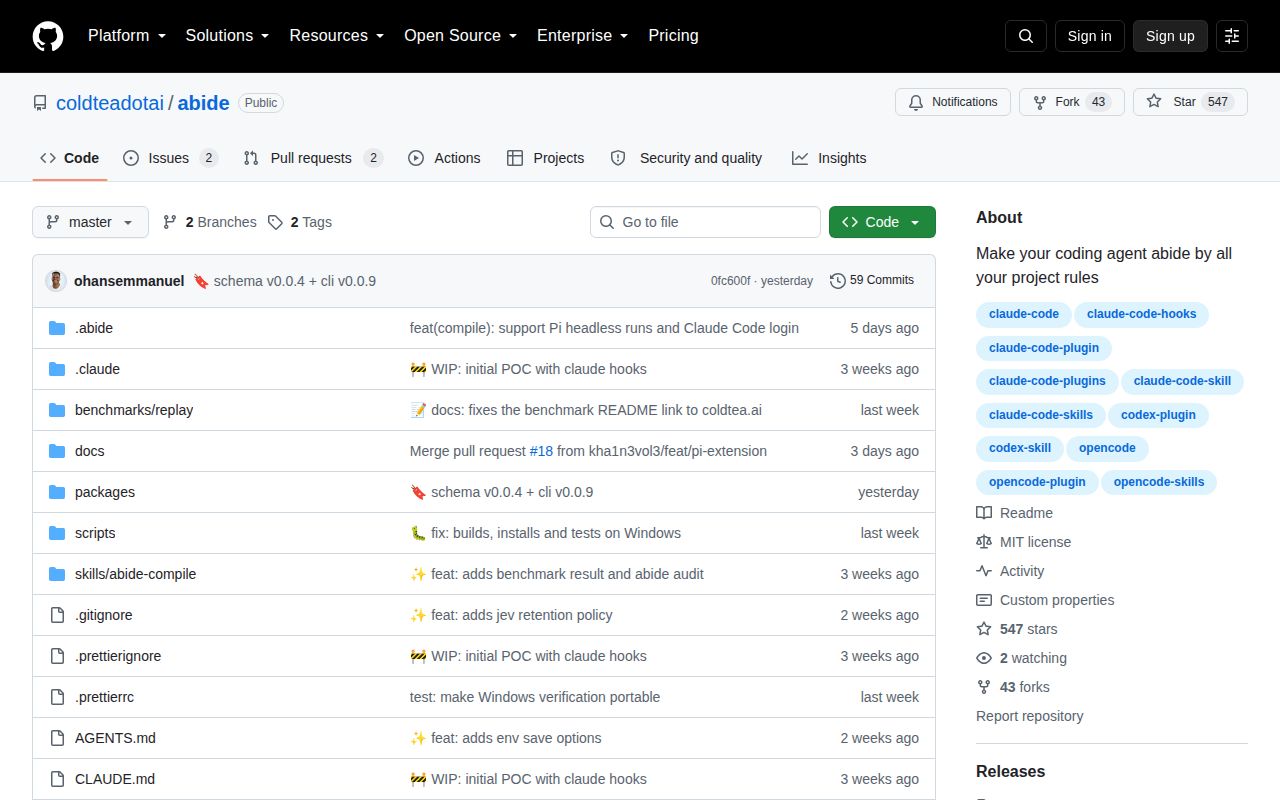
GitHub showed 547 stars and 4 open issues and pull requests on October 6. The split was two issues and two pull requests. The default branch was pushed on October 5 with the CLI at 0.0.9 and schema at 0.0.4, though GitHub had no tagged release. Recent commits fixed binary-file audits and large replay logs, which shows maintenance on real edge cases.
The pace is encouraging for a project created on September 18, 2026, but two and a half weeks is a thin operating history. Open issue 25 asks for a supported way to preserve hand-maintained rubrics without the session-start compiler replacing their questions. Combined with our failed suite, that is enough reason to pin the package, inspect configuration changes, and run abide check beside your existing gates before enabling hooks for a whole team.
A green build and failed suite point to a guarded trial
Abide addresses a real weakness in coding-agent instructions: many rules need judgment, and agents can forget them during the same session. Its 6-second build, detailed data-flow documentation, and turn-level replay results make version 0.0.9 worth testing. Start with a few rules whose violations are easy for a human to confirm, then watch the report for misses and noisy questions.
Keep Semgrep, ast-grep, tests, and review gates responsible for rules they can decide exactly. Abide fits the remaining category where a model's opinion is useful but allowed to be wrong. That division also makes its fail-open design tolerable. If the check disappears during a network outage, the deterministic controls still run, and the event log tells you which agent edits never received the extra review.