Seven download types share one desktop queue
The current package manifest identifies Rayburst v4.0.0-beta.5 as the new name for Motrix Next. It handles HTTP, HTTPS, SFTP, ED2K, BitTorrent, magnet links, and torrent tasks in one desktop application. HLS and DASH support adds track selection, subtitles, live recording, resumable transfers, and MP4 or MKV output. Tauri 2 provides the desktop shell, while a bundled Aria2 Next sidecar performs the transfers.
Our 56.4 MB checkout at commit a708bc9 contained 729 files and about 109,908 lines of source. The interface includes selective torrent downloads, scheduled speed limits, scoped proxies, SQLite-backed history, native notifications, and protocol handlers. A lightweight mode destroys the WebView when the app is minimized while Rust keeps the engine and monitoring alive. This is desktop software through and through, not a web panel intended for an unattended server.
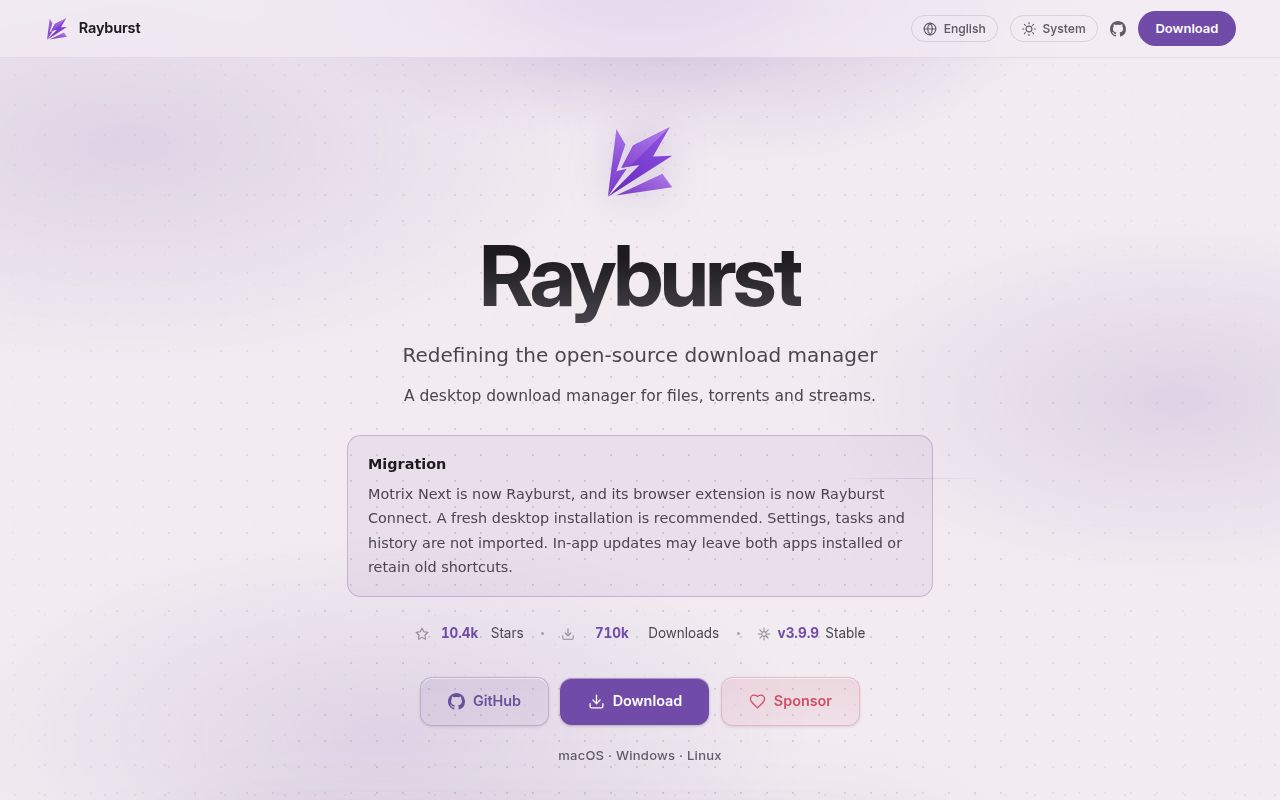
Rayburst 4 makes existing Motrix Next users start fresh
Motrix Next 3.9.9 is the latest stable release, while the current package manifest says 4.0.0-beta.5. The README recommends uninstalling the old desktop app before installing Rayburst. Settings, tasks, and history are not imported, though downloaded files remain where they are. That leaves an awkward gap between the stable binary people have and the product the repository now describes.
The split has already reached browser integration. Issue 632 says Rayburst Connect 2.0.1 expects the Rayburst 4 API contract, while Motrix Next 3.9.9 answers with its older contract. The reporter received an Unknown error even though the local service on port 29110 responded. Our a708bc9 checkout predates the completed rename, so its 729-file result says nothing about whether that live compatibility gap has closed.
What happened when we ran it
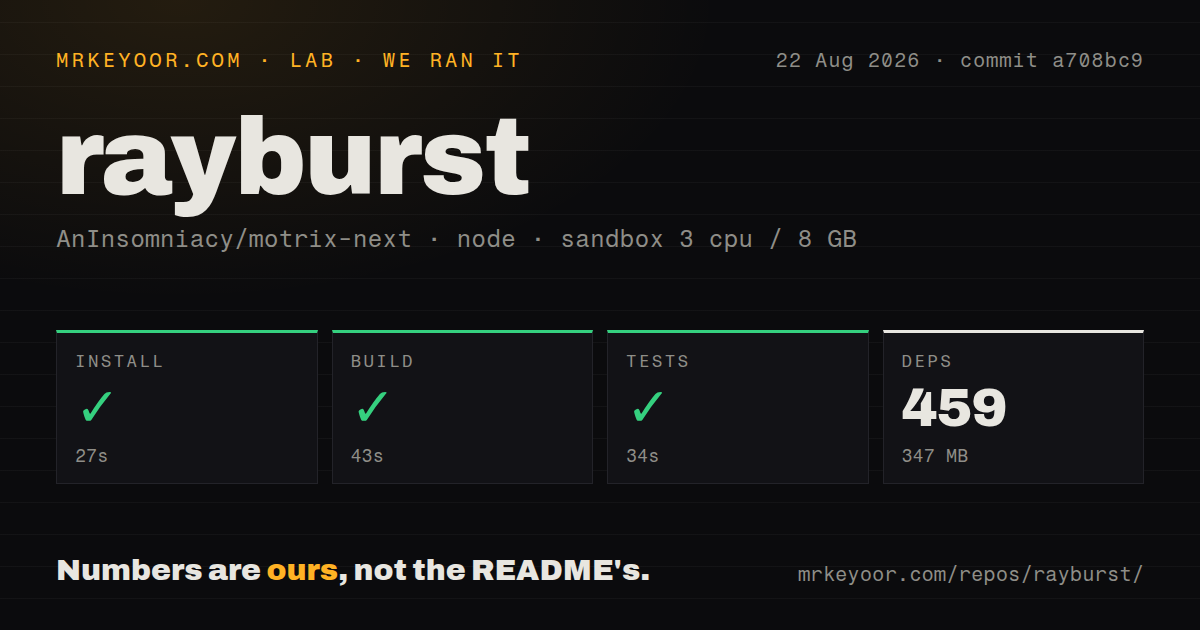
Our sandbox installed 459 pnpm packages in 27 seconds, leaving 347 MB on disk. The build then succeeded in 43 seconds, and the available tests succeeded in 34 seconds. We ran commit a708bc9 in a fresh unprivileged Debian container with 3 CPUs, 8 GB of RAM, Node.js 22, and no secrets. No install error, compiler failure, or failed test appeared in the supplied results.
The repository scan counted 729 files and roughly 109,908 source lines in a 56.4 MB checkout. It found 3 CI workflow files, pnpm workspaces, no Dockerfile, and no tests directory. The successful 34-second test step still matters, despite the absence of a directory literally named tests. Our method checked repository setup and commands. It did not open the graphical app, download a file, contact torrent peers, or register desktop protocols.
Unsigned packages turn installation into a trust choice
Release 3.9.9 supplies installers for macOS, Windows, and Linux across x64 and ARM64. The macOS builds use ad-hoc signing and are not notarized, so the README tells users to remove Gatekeeper's quarantine attribute after installation and again after upgrades. Windows signing is optional through a separate workflow. The published .sig files verify Tauri updates with minisign, but they do not give the package an operating-system publisher identity.
Source setup looked lighter on our box: 459 packages took 27 seconds and 347 MB. Building the desktop package is a different job from that container check. The README asks contributors for stable Rust, Node.js 22 or newer, pnpm 11.x, and the native requirements that Tauri brings on each platform. Flatpak has another limit: it cannot register the browser native-messaging host, and the app must already be running before Rayburst Connect can attach.
September activity is high, and transition bugs are arriving with it
GitHub showed 10,419 stars, 147 combined issues and pull requests, and a last push on September 23, 2026. Stable v3.9.9 arrived on September 10 with transfer recovery work, history fixes, browser registration diagnostics, and Linux association changes. Recent closed reports show maintainers handling installer, extension, and lightweight-mode problems. The issue queue is busy, but it is plainly active rather than abandoned.
Activity does not make every desktop path safe. Issue 610 reports an occasional WebKit process crash on Fedora 44 with Wayland and an AMD GPU, without pinning the fault on Rayburst, WebKitGTK, or Mesa. Issue 639 reports that 4.0.0-beta.5 could not rebuild its window after lightweight mode closed it. Our tests passed in 34 seconds, yet neither report falls within what a headless Debian test command can settle.
A 43-second build does not decide between Gopeed and aria2
Our 43-second build only describes Rayburst's source, so choose an alternative by workload. Gopeed is the closest comparison for someone who still wants a cross-platform graphical manager. aria2 fits JSON-RPC, shell scripts, or a headless service without tray behavior. qBittorrent narrows the job to torrents and has a Web UI. That makes sense when direct links, ED2K, HLS, and DASH are distractions.
The completed checks make Rayburst worth trying on a spare desktop: our 459-package install, 43-second build, and 34-second test run all finished. Those checks cannot decide the upgrade. A new user can accept unsigned packages and begin with an empty history. An existing Motrix Next user has to cross a product rename with no migration and a documented extension mismatch. Wait for a stable Rayburst 4 release if continuity matters more than trying the broader download engine today.