Choose by the application workflow
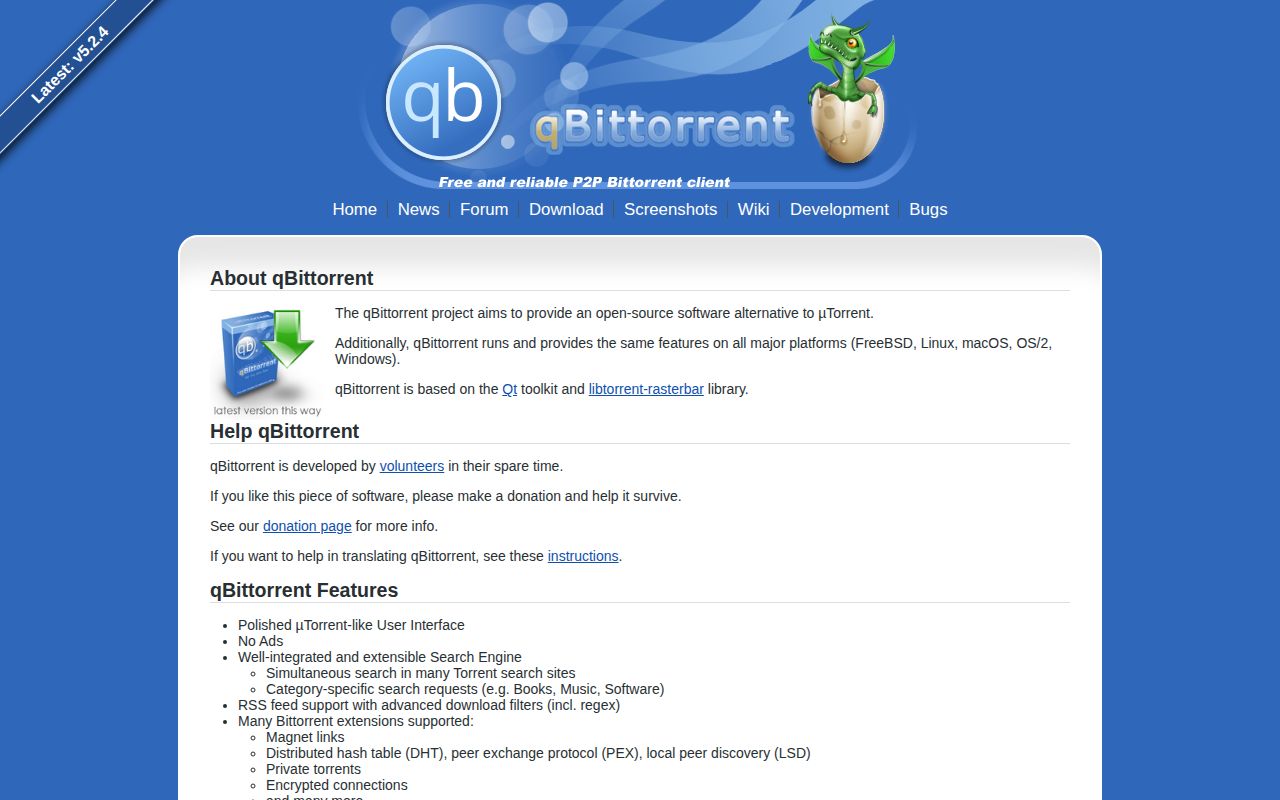
A successful Python search build does not establish whether qBittorrent suits your desktop or server. qBittorrent is a C++ and Qt BitTorrent client built on libtorrent. Its INSTALL document describes graphical and headless builds; the latter produces qbittorrent-nox. Release notes also document its Web UI.
For ordinary downloading, start by evaluating a packaged client on your machine. For a server, decide where downloads will live and how you will reach the browser controls. These are recommended adoption checks, not workflows completed in this review.
What happened when we ran it
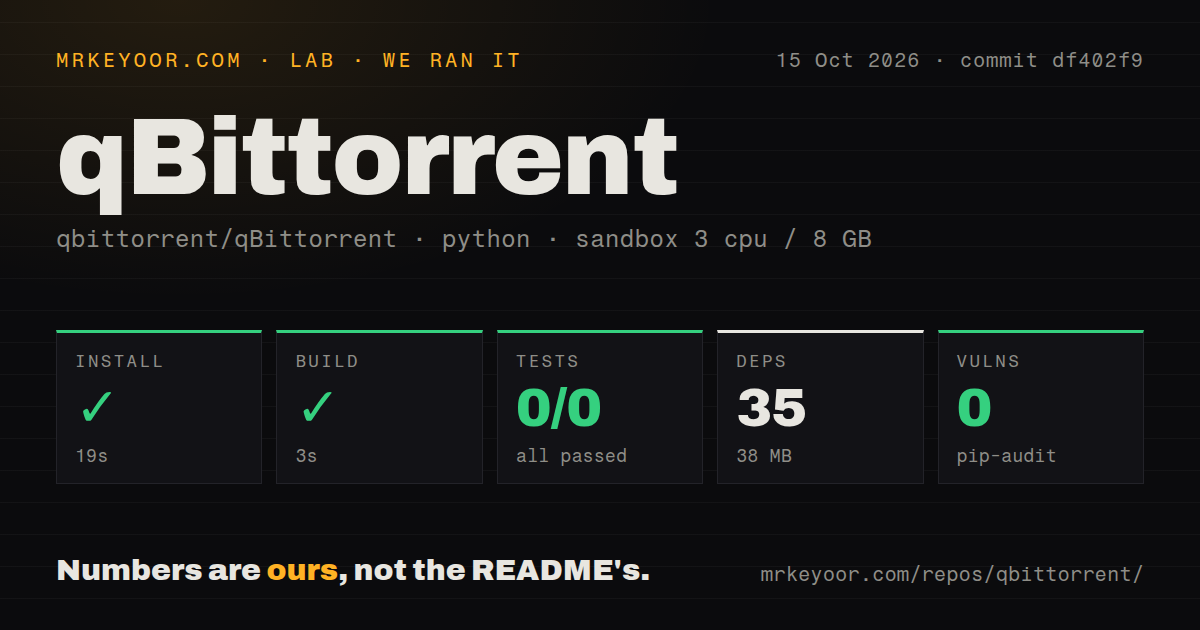
Our qBittorrent search build passed in 3 seconds, but pytest ran no tests and exited 5. The sandbox run used commit df402f9 on October 15, 2026, in src/searchengine/nova3. Installation succeeded in 19 seconds, recorded 35 dependencies, and used 38 MB on disk.
The test command failed after 4 seconds, reporting 0 passed and 0 failed out of 0. Its log ended with no tests ran in 0.00s. The supplied tail shows no assertion failure and does not explain the empty collection. This result establishes neither a passing test suite nor a broken torrent engine.
Pip-audit reported 0 known vulnerabilities. Its package coverage is unverified because the harness records packages=0 despite the 35 recorded dependencies. Do not extend that result to native libraries or separately acquired search plugins.
The checkout contained 1,762 files, approximately 1,420,009 source lines, and occupied 65 MB. The scan found eight CI workflow files, a tests directory, and no Dockerfile. Those repository signals do not replace executed tests.
The recorded sandbox configuration had 3 CPUs, 8 GB of RAM, and image label ghcr.io/astral-sh/uv:python3.12-bookworm. The label does not establish actual runtime or operating-system versions. The run did not assess native compilation, application startup, browser operation, or transfers.
Check native requirements before building from source
The current INSTALL document lists Boost, libtorrent-rasterbar, OpenSSL, Qt, zlib, and CMake. It specifies Qt 6.6 or newer within Qt 6 and Python 3.13 or newer as an optional runtime dependency for bundled search. These are current upstream requirements, separate from the measured checkout's unverified runtime versions.
Upstream says older dependency combinations may build but receive no support. If your distribution's libraries fall outside the supported configuration, consider a packaged client before taking on a source build. The documented headless source route sets GUI=OFF and produces qbittorrent-nox; this review did not execute that route.
The search report includes a recovery
Issue 25056 began with an October 12 report of plugin-loading errors and frozen error dialogs in qBittorrent 5.2.4 on Ubuntu 26.04.1 LTS.
On October 15, the original reporter said removing tokyotoshokanplugin and darklibriaplugin restored plugin loading and search was working so far. That is an attributed outcome for this reporter's setup, not a verified general fix.
A separate commenter on October 18 reported blank dialogs, no listed plugins, and a screen that would not close with version 5.2.4. The supplied discussion does not establish that this later report has the same cause or resolution.
If bundled search drives your choice, check your intended plugins on your operating system before moving your downloads. For context about the separate plugin repository, see the existing search-plugins review. The issue reports were not reproduced in the sandbox.
Read the version 5.2.4 browser changes
The September 28, 2026 release notes say the Web UI now opens only HTTP(S) URLs from RSS articles and search results. They also list escaping the add-torrent window title and using a safe property to set element titles. These are documented changes, not browser-security tests performed here.
Supplied repository metadata records a last push on October 18, 2026, and 2,730 open issues and pull requests combined when observed on October 19. The combined count is not a defect count or a measure of support response quality.
Compare alternatives by the job
Transmission provides desktop applications, a headless daemon, and a web interface. Its README supports comparing those workflows with qBittorrent, but this review did not compare their usability. Transmission also says its documentation is currently out of date.
aria2 supports command-line downloads over HTTP(S), FTP, SFTP, BitTorrent, and Metalink. Its README makes it a relevant alternative when scripts need several download protocols through one tool.
For qBittorrent, the next useful step is a packaged-client trial with a lawful torrent, your intended storage, and any search plugins you rely on. Check browser access on the actual server if you choose headless operation.