Ramda 0.32.0 curries functions and usually puts data last
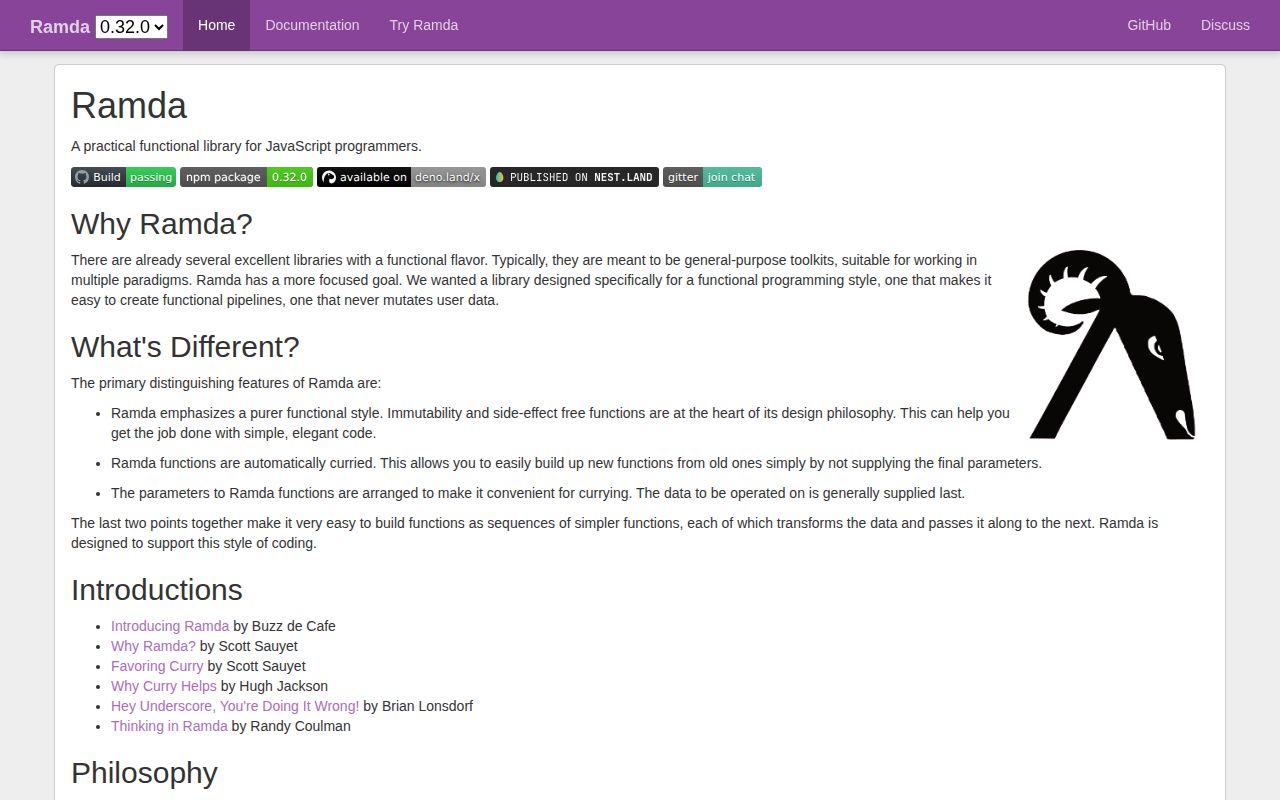
Ramda 0.32.0 automatically curries its functions and generally places the input data last. Give a function fewer arguments than it expects and you get a new function waiting for the rest. Put the collection last and helpers such as filters can be prepared before a pipeline receives its data. For developers used to composition, that removes small adapter functions and lets a transformation read as a sequence of named operations.
That style is the product, not a side feature. The 25,921 lines of source operate on ordinary JavaScript arrays and objects, and the project says it favors immutable, side-effect-free code. It does not enforce immutability. A callback can still change an object, and a mixed codebase can still alternate between Ramda conventions and native methods. The library helps only if reviewers defend the same rules that led the team to install it.
What happened when we ran it
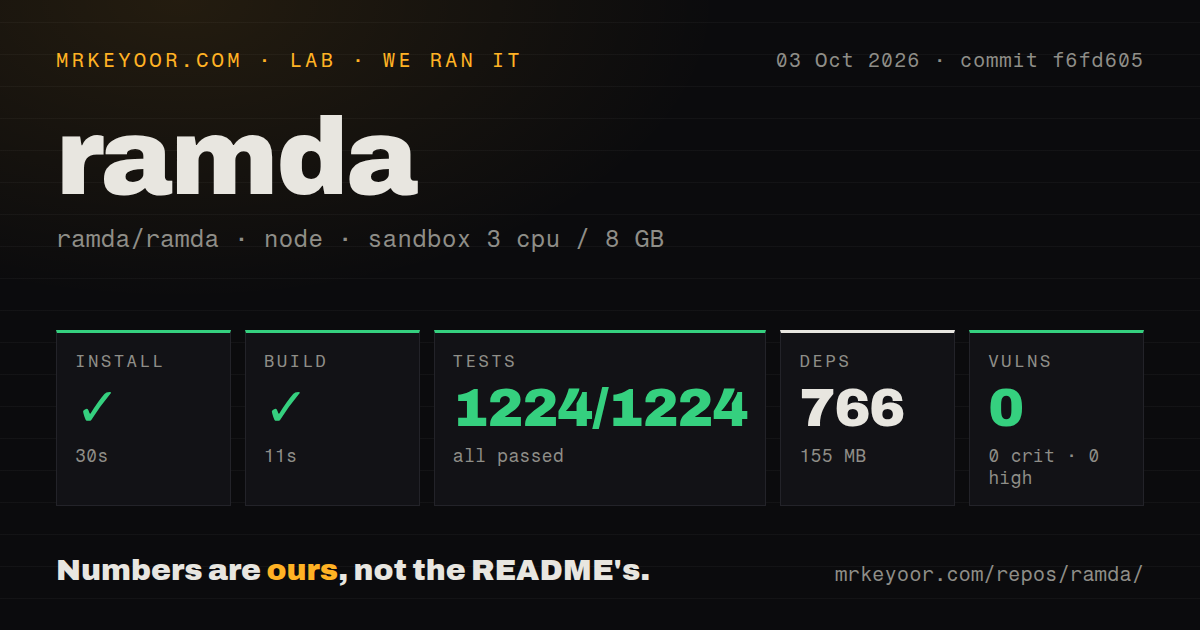
Our sandbox installed commit f6fd605 in 30 seconds. The checkout contained 712 files, about 25,921 lines of source, and occupied 1.6 MB before installation. Npm added 766 packages and raised disk use to 155 MB. Our measurement setup was an unprivileged Debian container with 3 CPUs, 8 GB of RAM, and no secrets.
The build succeeded in 11 seconds. Mocha then reported 1,224 passed and 0 failed out of 1,224 tests, also in 11 seconds. Npm audit found 0 known vulnerabilities across every severity level. Those results cover installation, compilation, the supplied test suite, and the dependency audit. They do not measure browser bundle size, application speed, or whether a functional pipeline is easier for your team to maintain.
This is a healthy contributor result, though it is heavier than the runtime package suggests. The published package declares no runtime dependencies, while the repository setup pulled 766 development packages for Babel, Mocha, ESLint, coverage, browser testing, and release work. A user adding Ramda to an application should not confuse our 155 MB contributor environment with the cost of importing one function into production. Bundle output needs its own inspection.
Version 0.32.0 exports CommonJS and ES modules
Ramda 0.32.0 exposes both CommonJS and ES module entry points. The README also warns that releases after 0.25 have no default export. Existing code that uses import R from 'ramda' needs to move to a namespace import or, preferably, import only the functions it uses. That is a small migration with an obvious failure mode.
Browser weight is less automatic. Ramda's own usage guide says destructuring from the main package does not necessarily keep a bundler from including the full library. It offers direct imports from ramda/src, a custom partial-build command, and bundler-specific advice. The 1.6 MB checkout tells you little about the JavaScript a visitor downloads, so compare the production bundle before and after adding it.
Deno users face a clearer documentation mismatch. The README imports v0.27.2 from deno.land even though npm and the latest GitHub release are 0.32.0. Open issue 3457 says the deno.land package mirrors a different, apparently inactive repository. Use a source and version you can pin deliberately; copying that quick-start line does not give you the current Ramda release.
TypeScript support comes from the separate @types/ramda package
Ramda 0.32.0 delegates TypeScript declarations to the separate @types/ramda package. That arrangement can work, but fixes to functions and fixes to their types travel through different projects. Teams whose application logic is mostly TypeScript should try representative pipelines, especially overloaded or curried calls, before standardizing on the library. Remeda is the more direct alternative when first-party types are part of the purchase decision.
Runtime contracts are also permissive. Ramda documents expected input types but does not promise to enforce them, and successful behavior can include values such as undefined where a stricter functional library would return an explicit container. Sanctuary makes the opposite choice with runtime type checking plus Maybe and Either. Ramda's 1,224 passing tests are strong evidence for its documented implementation, but they cannot choose your error model.
October commits show maintenance, while old compatibility issues remain
GitHub recorded the last push on October 3, 2026, for the same f6fd605 commit we ran. That change fixed cloning of enumerable symbol properties. The repository had 119 open issues and 34 open pull requests, so GitHub's combined count of 153 should not be read as 153 confirmed bugs. Recent work included fixes for cloning, BigInt handling, transducers, and collection keys.
Issue 3553, opened October 2, reports that scan omits its seed in one transducer path; pull request 3554 followed the same day. That sequence shows maintainers and contributors working on narrow behavioral defects. It also shows why a large utility API deserves application-level regression tests even after our entire supplied suite passed. An edge case can sit outside the assertions at a given commit.
Release discipline deserves separate scrutiny. Issue 3468 describes a downstream break after propEq changed parameter order between 0.28 and 0.29, and asks the project to reserve such changes for a major version. The current 0.32.0 upgrade guide lists its changes and an exports fix, but a team that auto-accepts minor releases should still read diffs and run its own tests. Pinning Ramda is cheap; debugging a flipped predicate after deployment is not.
A 30-second install supports adoption, not the style decision
Our run gives Ramda a firm technical baseline: a 30-second install, an 11-second build, 1,224 passing tests, and 0 audit findings. The case for adopting it still rests on code review, not those green checks. Choose it when currying and data-last composition let your team name transformations more clearly. Skip it when the same work is already readable with native array methods, or when external TypeScript types and manual bundle checks are costs you do not want to own.