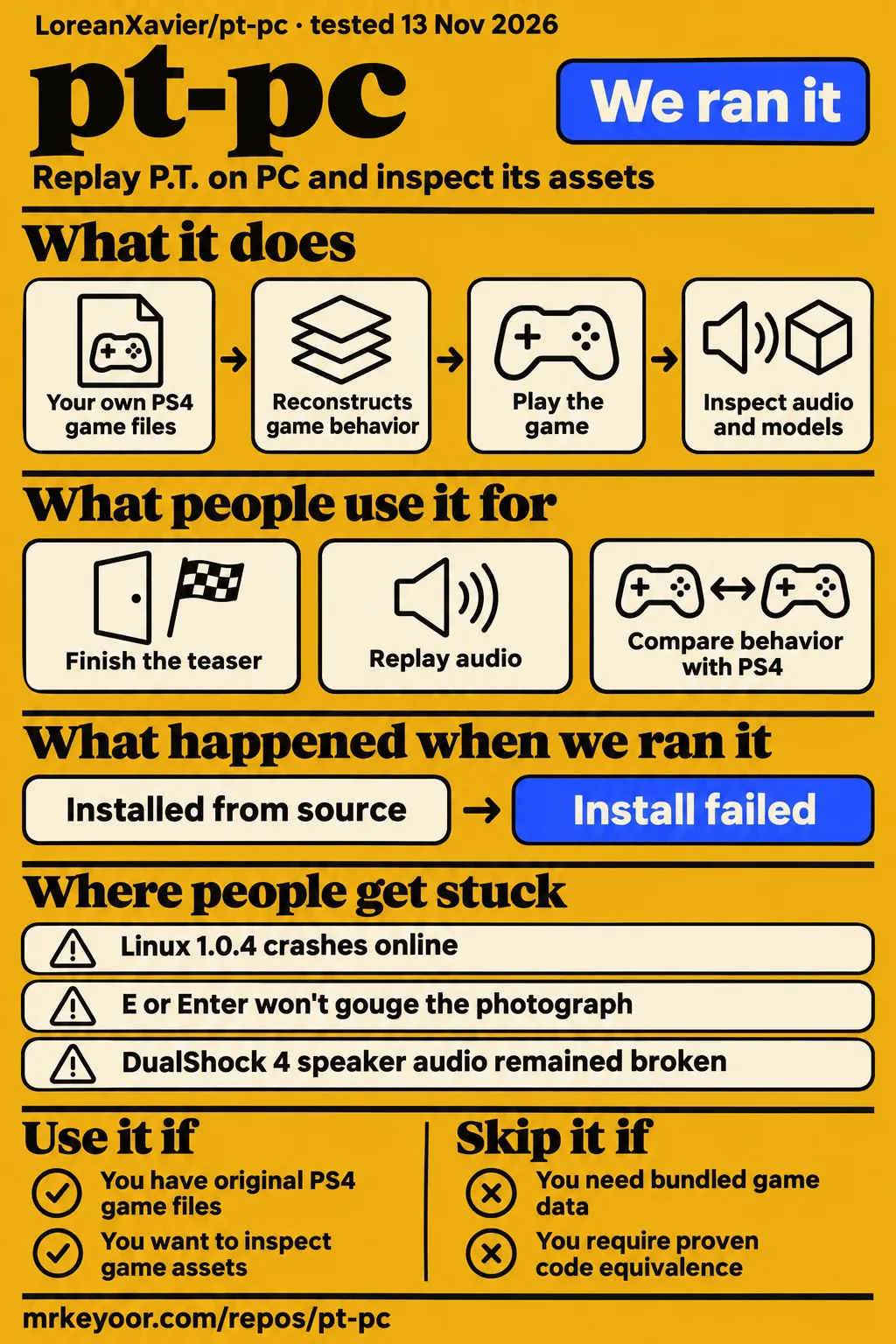

pt-pc requires your own PS4 game files, and our source installation stopped at CMake before we could play. For someone who already has those files, the reported completion, asset museum and attention to PS4 behavior make this worth trying through an official release. Skip it if you expect the download to include P.T., or if guaranteed DualShock 4 speaker playback is essential.
The useful distinction is between reproducing a game convincingly and proving that its code is identical. Players and a specialist have praised the former. The developer explicitly rejects the latter description. That distinction also changes how to read the bug tracker: an odd encounter can be faithful to PS4 behavior while a missing shadow beside it needs a fix.
Original PS4 files are the entry requirement
pt-pc runs reconstructed P.T. game logic against assets from your own PS4 copy, using its own renderer and platform code. The project README calls it a native port and describes the Hallway Engine. It contains no original game data. That makes access to an existing copy the first decision, before graphics settings or controller choice enter the picture.
For a returning player, I'd start with the Original graphics preset. The README says this keeps the PS4 look, while the other controls let you change shadows and image processing individually. In a horror game whose lighting is part of the experience, a more elaborate rendering mode is a different choice from a closer visual reference. Decide which you want before interpreting a screenshot comparison.
The museum is the other reason to consider this particular route. The README describes radio and voice material with transcripts, models, cutscenes and unused content unlocked as you progress. Those tools make it interesting after the ending, especially if your interest is in how the house works rather than simply surviving another visit. The port is also expressly unaffiliated with Kojima Productions or Konami.
What people use pt-pc for
Players report finishing the teaser, inspecting its assets and comparing its behavior with the PS4 original. The useful accounts describe what someone actually did, rather than treating a download announcement as proof that every feature works.
| Who used it | What they did and reported |
|---|---|
| An unnamed poster in the Silent Hill Lovers Facebook group | Finally completed P.T. after leaving the PS4 version unfinished, then praised replayable audio, model viewing and exploration of the ending street. Player account |
| Lance McDonald, quoted by PC Gamer | Compared the port with his knowledge of the original's undocumented behavior and praised its fidelity. This is an expert impression about behavior. PC Gamer interview |
| The Fedora reporter in issue #83 | Reported good gameplay in 1.0.3 and a startup regression in 1.0.4 on a machine with an RTX 4090. Linux report |
| GitHub user mrGalaxxyy96 | Used the Windows version through Proton, with the installer run through Lutris, as a quick solution to native Linux startup trouble. Workaround report |
| GitHub user newdisplayname | Borrowed a DualSense and reported working speaker audio after failing to get it from a DualShock 4. Controller comparison |
The completion account gives the extras a purpose: the player wanted to finish something left unfinished, then lingered with the material the port exposes. The Linux and controller accounts are equally useful because they name the boundary of the success. A working game on one release and controller tells you where to start, while preserving enough detail to recognize a different failure.
What happened when we ran it
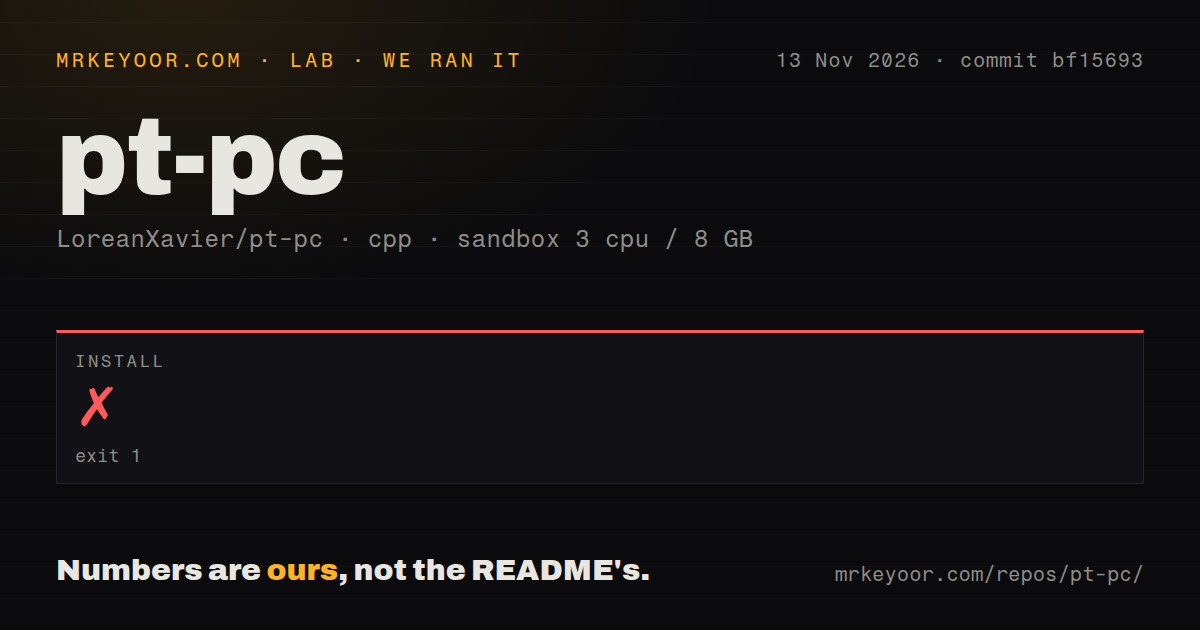
Our installation of commit bf15693 failed with exit 1 after 1 second on November 13, 2026: CMake required 3.28 or higher, while the log reported 3.25.1. That is a concrete toolchain mismatch at configuration. It prevented this source attempt from reaching a playable result and supplies no verdict on the official release binaries.
| Recorded item | What our record says | What it means for this review |
|---|---|---|
| Source installation | Failed, exit 1, 1 second | Configuration stopped at the CMake version check. |
| Sandbox configuration | 3 CPUs, 8 GB RAM, image label lab-cpp:1 | These describe the sandbox configuration, not a confirmed operating-system or compiler version. |
| Checkout | 1,027 files, about 185,181 source lines, 56.3 MB | These are source checkout measurements, not the installed game's footprint. |
| Repository signals | 2 CI workflow files, a tests directory, no Dockerfile | File presence alone supplies no passing build or test result. |
| November 14 hands-on safety step | Failed because none of compose.yaml, compose.yml, docker-compose.yaml or docker-compose.yml existed | The harness required a Compose file and stopped at that rule. |
| November 14 teardown | Reported ok | Cleanup status supplies no evidence of gameplay. |
The source log repeats the same CMake requirement and ends with configuration incomplete. The narrow fix for that observed blocker is to meet the stated CMake minimum before attempting configuration again. There is no basis in this log for blaming a graphics driver, missing game archives or the game logic. Those would be different failures at different stages.
The November 14 safety record is another harness boundary. Requiring Docker Compose makes sense for some server software, but this repository describes a native desktop game. The word "unsafe" in that record is the harness's label for a missing required file, not a demonstrated security defect in pt-pc.
There is also a contradiction in the supplied records. The November 14 run summary claims a deployment using the project's own Docker Compose with ports bound to localhost. Its detailed step says no Compose file existed and the safety check failed. We give the failed step priority and claim no successful deployment from that summary. The teardown record says only that cleanup was ok.
Where people get stuck: match the error to the release
Linux startup reports cover separate library-loading, destination-folder and update-check failures. Treating all of them as a missing GPU driver would send readers down the wrong path. The issue threads are most useful when read as a sequence of reports and responses, including replies after a maintainer initially marked something fixed.
| Symptom and source | Recorded response | How to use it |
|---|---|---|
SDL_Init: No available video device, issue #5 |
The developer says the 1.0.2 source loads versioned runtime libraries instead of requiring development-package symlinks. | Match this specific SDL error before applying its explanation. The developer requested Bazzite release-binary confirmation. |
| Installer says the folder holds something else, also issue #5 | The developer recommends a new destination folder under your home directory. | Keep this separate from the SDL change and avoid a root-level destination. |
| Native Linux 1.0.4 crashes online, issue #83 | A reporter traced the crash to update-manifest parsing; the developer says it was fixed in 1.0.5, followed by a user's successful reply. | This is a version-specific regression, with an identified update-check path. |
| Windows 11 executable appears to do nothing, issue #25 | Two participants reported recovery after updating or reinstalling Nvidia drivers. | Driver changes helped those participants. The maintainer asked for logs because startup failures had different causes. |
| First launch worked, later launches crashed, issue #2 | The reporter said rebuilding from 1.0.1 worked and denied having the suggested overlay applications installed. | Don't turn the initial overlay suggestion into the settled cause. |
| E or Enter won't gouge the photograph, issue #7 | Keyboard X or a controller worked in the reports; the developer says 1.0.2 source adds E, Enter and mouse interaction and preserves the photo state. | Match an older input problem to its input fix. |
The Linux update crash is an instructive case. The Fedora reporter could play 1.0.3, then 1.0.4 would not start. Another participant found that disabling networking let the game launch and supplied a stack trace naming the update parser. The fix response named 1.0.5, and a participant replied that it worked. That sequence is much more actionable than a broad claim that Linux support is broken.
Closed issues can still contain unfinished fixes
Issue #72 records continued DualShock 4 speaker failure after the developer's initial 1.0.4 fix announcement. The reporter tested again, supplied another log and got a more specific answer: audio reached the headset jack, while speaker output required a separate controller command. The developer explicitly deferred that work beyond 1.0.5. A closed label hid an unresolved part of the report.
The current README has moved on: it describes experimental Bluetooth DualShock 4 speaker playback and says physical speaker output has not been verified. Buy or borrow hardware on the strength of demonstrated behavior you need, rather than reading "experimental" as a compatibility promise. The same thread contains the reporter's successful DualSense comparison, which is a better starting point for someone chasing that particular effect.
Issue #86 follows a similar pattern for shadows. Users reported missing or clipped shadows, then said problems persisted through 1.0.5 after an earlier fix response. The developer later identified corrections in 1.0.6 for lamp shadows, close-range disappearance, the fake-crash loop's blocky shadow and missing plant leaves. Read the later correction alongside the earlier announcement when choosing a release.
Fidelity complicates the word "bug" here. In issue #72, the developer says Lisa's appearance in the garage also happens on PS4, while the accompanying shadow needed attention. In issue #7, the developer likewise distinguishes the photograph's input fix from PS4 camera and attack behavior. Preserving the original sometimes means preserving an oddity. That makes a reference capture more useful than an expectation of how the scene ought to behave.
Security and downloads: the port's license excludes the game assets
The MIT license covers the port's own code, while P.T.'s content belongs to Konami. The README says a store PKG cannot be used because it is encrypted for the owning console and this project does not decrypt it. You need your own compatible dump or a fake PKG made from that dump. An installer download cannot supply the missing entitlement or files.
The official release page is the place to start. The historical portable-ZIP dispute in issue #28 ended with permission for asset-free unofficial repacks carrying the required notices, plus an explicit refusal to support those distributions. That permission never extended to redistributing Konami's original assets. Current official portable downloads also make the old installer-only advice stale.
For mod users, the README says the mods folder can replace assets and run Lua scripts reacting to game events. Treat a mod as code you choose to run, and keep a clean reference installation when diagnosing a rendering or progression problem. The README also documents a GitHub Releases update check at startup, with check_updates = 0 under the network settings to disable it. That matters when distinguishing local play from network-related startup behavior.
Bug reports need the scene and its log
For rendering defects, the developer asks users to press F9 while looking directly at the problem and then supply pt.log. Issue #86 shows why a screenshot alone failed to move the investigation forward: the maintainer repeatedly requested a log from the same position. The thread also says F9 capture itself needed a correction between 1.0.4 and 1.0.5.
Record the port version, rendering API, preset, GPU and driver, then reproduce the scene and capture the log. For a launch failure, run the executable from a terminal and retain any crash report it produces. The older Windows threads name an AppData location, while today's README puts Windows and Linux data beside the executable in data/. Use the location documented for your installed version.
The current README says GitHub Issues is closed because of spam attacks and directs bug reports to Discord. That changes where to send evidence, rather than making the historical issue links useless. Keep the existing thread as a diagnostic reference, and send a fresh report through the current channel with its version and logs. A fix for someone else's driver or release is a lead, not your own diagnosis.
pt-pc vs Unreal PT, shadPS4 and an original PS4
pt-pc's distinguishing choice is native reconstructed behavior using original assets; Unreal PT is a remake, while shadPS4 emulates the console. Choose according to what you want to preserve and what you already have. The records support those differences in approach, rather than a measured winner on frame rate or responsiveness.
| Route | Why choose it | Decision-changing distinction |
|---|---|---|
| pt-pc | You have original files and want a native port with asset exploration. | The renderer and platform code are separate from the PS4 original. |
| Unreal PT and other fan remakes | You specifically want a remake's interpretation. | IGN's walkthrough documents different picture-piece locations and ending requirements in Unreal PT. |
| shadPS4 | You want an emulation route or a reference for original behavior. | Xavier used shadPS4 as a reference; a reporter also used it to identify a shadow discrepancy in pt-pc. |
| A PS4 retaining P.T. | You already have the original installed and want that console experience. | Ars describes a retained PS4 installation as the official route. |
The PC Gamer interview explains Xavier's dissatisfaction with earlier remakes, including their lighting, interactions and atmosphere. That is the author's reason for building this port, not a neutral ranking of every remake. IGN's walkthrough supplies the more concrete comparison: some Unreal PT puzzle instructions differ from the original.
For emulation, the shadPS4 README calls it an early PS4 emulator and directs end users to its separate QtLauncher. I'd keep that distinction in mind before comparing downloads: a core emulator repository and this game's installer serve different setup paths. Neither a native architecture nor a longer feature list settles which rendering you will prefer.
What the other reviews get wrong
The developer rejects proven byte-for-byte equivalence, even though PC Gamer reproduces a specialist's "1:1" impression. Issue #9 explicitly describes reconstructed behavior and separate renderer and platform code. Strong praise from someone familiar with P.T. is useful evidence of fidelity. It cannot substitute for the technical proof that the developer says the project lacks.
Ars Technica's description of AI use as debugging and troubleshooting is narrower than the developer's later disclosure in that same issue. Xavier includes code implementation, research, tooling and testing, and corrects an earlier message saying the README statement had already been published. The current README acknowledges AI coding tools in development and debugging. There is no supported percentage to attach to that involvement.
PCGamingWiki's controller entry should not be read as proof of working DualShock 4 speaker playback. The retests in issue #72 distinguish it from DualSense, and the current README still qualifies physical DS4 output. IGN's older assurance about downloading P.T. again also needs dating: Ars's account describes the official option as a PS4 that retains its copy. Don't erase an existing installation on the strength of an old walkthrough's reassurance.
Questions people ask
Official downloads now include portable ZIPs, while older issue answers describe releases that offered only setup downloads. These answers distinguish that change from the earlier gameplay and audio reports.
Where can I download pt-pc, and do I need my own PS4 game files?
Download pt-pc from LoreanXavier's official GitHub Releases page and supply your own PS4 game files. The README accepts a dump folder or a fake PKG made from your dump, and says an encrypted store PKG will not work. The installer and repository contain no original P.T. data.
Why does pt-pc fail to launch on Linux?
Linux failures in the supplied reports have different explanations: issue #5 covers SDL library loading and destination-folder rejection, while issue #83 traces an online 1.0.4 crash to update-manifest parsing. The developer names 1.0.2 for the library-loading change and 1.0.5 for the update crash. Match the error and version before applying a workaround.
Why does pt-pc do nothing when I launch it on Windows 11?
Two participants in issue #25 reported fixing their Windows startup failures by updating or reinstalling Nvidia drivers. The maintainer also said startup reports had different causes and requested pt.log. Start with that log and any crash report instead of assuming the same driver explanation applies to your machine.
Does Lisa's cry work through a DualShock 4 speaker?
DualShock 4 speaker playback is experimental in the current README, which says physical output is unverified. Issue #72 records failed DS4 retests and success with a borrowed DualSense. Its later developer reply says DS4 audio reached the headset jack and speaker work was deferred beyond 1.0.5. Treat that history separately from current experimental support.
Which keyboard key gouges the photograph?
Keyboard X worked for the photograph action in the 1.0.1 reports. The developer says 1.0.2 source also accepts E, Enter and mouse interaction and preserves the gouged state across later loops and loading. That correction addresses the photograph action specifically, rather than every behavior described in the same progression report.
Is there an official portable ZIP of pt-pc?
Yes: the current v1.0.8 release lists official portable ZIPs for Windows and Linux. Issue #28's earlier answer said only setup downloads existed and removed an inaccurate README promise. That historical answer no longer describes the current release. Asset-free unofficial repacks are a separate distribution route with no author support.
Does pt-pc support working 5.1 surround sound?
The developer marks the stereo-only surround report fixed in 1.0.2 in issue #33. The thread includes users who heard only stereo and supplied a log before that response. That gives a specific upstream fix to check against your installed version, rather than a reason to repeat the original complaint as current behavior.
How much AI was used to develop pt-pc?
The developer says AI coding tools assisted implementation, research, tooling, testing and debugging. Issue #9 contains the fuller disclosure and the correction of a premature README announcement. Neither that disclosure nor the current README quantifies how much code came from AI, so claims assigning a percentage exceed the evidence.
Can Lisa's cry be routed to a separate audio output device?
Issue #72 records a request to route Lisa's cry to a separately chosen device. Release 1.0.8 documents a Sound setting for the playback device and specific DualSense routing behavior. Those statements describe different controls: the release note alone does not demonstrate a freely selectable, cry-only output route.
What we have not tested yet
Our source attempt stopped at CMake configuration, and the later Compose safety step blocked the desktop project. We have not tested a supported source build, the official installer or portable binaries, full gameplay, puzzle completion, the museum, physical controller audio, 5.1 channel mapping or any graphics mode. The supplied records contain no successful task Q&A or lab screenshots to reproduce here.
Reported fidelity is not established byte-for-byte equivalence. We did not compare frames, latency, frame rate or memory across pt-pc, shadPS4, Unreal PT and PS4. Nor did we reproduce the reported fixes, inspect mod isolation, review update traffic or perform a security audit. The Bazzite library-loading fix awaited release-binary confirmation in its thread, and the shadow extract ends with a developer correction rather than a later player retest.
Setup ease, documentation quality, community support capacity and product maturity carry N/A rather than invented ratings in this review. The records give useful instructions and individual outcomes, but our failed setup and the changed public reporting channel leave too little direct assessment for comparative scores. The next useful lab result is an official release running with original game files, followed by the exact controller and rendering checks on which your choice depends.