
mrkeyoor.com_
Tue 01 Sept 17:43 UTC
Dev Toolsevaluationupdated 27 Aug 2026

proliferate review

Proliferate is an open-source workspace for running Claude Code, Codex, OpenCode, Cursor, Grok, and other coding agents side by side. Each task gets its own Git worktree, branch, terminal, conversation, and review state, while shared MCP connections, skills, browser tools, and recurring workflows coordinate work across agents.

+43stars / 7d
Verdict

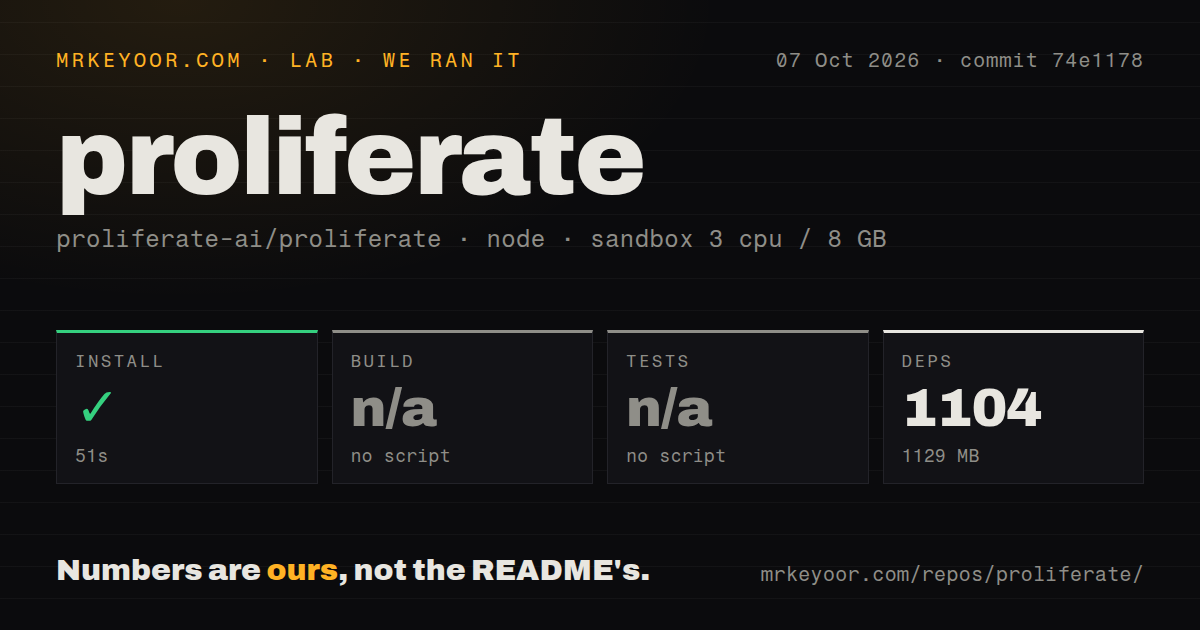
Our Proliferate install pulled 1,108 packages and used 1,128 MB, while the root offered no generic build or test target for our harness to run. Try it when parallel agents are already creating branch, worktree, credential, and review-state confusion. A single-agent workflow does not justify operating its full local or self-hosted stack.

We ran it

Lab card: what happened when we ran proliferateScreenshot of proliferate (proliferate.com/docs)
Install✓ · 50s1108 packages · 1128 MB
Buildn/ano build script
Testsn/ano test script
Repo8133 files~1,380,405 lines of source · 61.8 MB · 28 CI workflows · tests dir

Answers from our run

Does proliferate build from source?

Dependencies installed in 50 seconds (1108 packages), and the project has no separate build step. We cloned commit 8f2dcd3 into a clean Debian container with 3 CPUs and no project-specific setup.

Does proliferate have tests you can run?

Not through a standard command: the project exposes no test script or target that our harness could run.

Who should not use proliferate?

Solo developers who run one agent at a time and already manage its worktree comfortably: Proliferate's main value appears when tasks overlap.

What are the alternatives to proliferate?

Vibe Kanban, Warp, Zed. Our Proliferate install pulled 1,108 packages and used 1,128 MB, while the root offered no generic build or test target for our harness to run.

Setup2/51,128 MB install; full stack spans Rust, Node, Python, and Docker
Docs5/5Detailed source, profile, deployment, secret, and update guidance
Community3/5428 stars with same-day releases and detailed active issues
Maturity3/5Usable control plane, but self-hosting is beta with active defects

Discussed on

  1. hnShow HN: Proliferate- open-source, self-hostable Codex for any coding agent46 points

Who it’s for

Developers supervising several coding agents on separate tasks in one repository.
Teams that want a worktree and branch created for every agent task instead of managing them by hand.
Claude Code and Codex users who want shared MCP, skills, browser tools, and review state across native harnesses.
Organizations prepared to self-host a web control plane with Postgres, Caddy, identity, secrets, and optional cloud workspaces.

Who it’s NOT for

Solo developers who run one agent at a time and already manage its worktree comfortably: Proliferate's main value appears when tasks overlap.
Users wanting a packaged Windows or Linux desktop app today: the README advertises a macOS download, while other paths require web or source deployment.
Anyone seeking a one-container self-host: the production stack includes Caddy, Postgres, an API and web image, generated secrets, and optional LiteLLM, Redis, OAuth, GitHub App, and E2B pieces.
Teams that require a single root build and test command for CI: our harness found neither target, so both steps were skipped.
Linux ARM64 self-hosters needing managed Claude or Codex installation immediately: open issue 2141 reports missing catalog pins for that platform.

Setup reality

Our sandbox install succeeded in 50 seconds, adding 1,108 pnpm packages and using 1,128 MB. The root package exposed no generic build script, so build was skipped. It also exposed no generic test target, so tests were skipped.

The desktop source path needs stable Rust, Node.js 22+, and pnpm. Full-stack local development adds Python 3.12+, uv, Docker, Postgres-backed named profiles, generated configuration, and agent credentials. The packaged download is currently presented for macOS.

Production self-hosting runs Caddy, Postgres 16, the FastAPI control plane, and compiled web client through Docker Compose. Operators must supply a domain, DNS, TLS reachability, admin identities, backups, updates, and any optional OAuth, GitHub App, model-gateway, or E2B credentials they enable.

Every task gets a branch, worktree, terminal, and conversation

Proliferate addresses a problem that appears after a developer runs more than 1 coding agent. Concurrent agents collide in one working directory, share credentials in unclear ways, and leave the human matching conversations to branches and reviews. Proliferate makes the task the unit of isolation. Each task receives a Git worktree, its own branch, terminal, conversation, and review state, so Claude Code can change one area while Codex works elsewhere.

Native harnesses matter here. Proliferate does not reduce every agent to a generic chat adapter; the README lists Claude Code, Codex, OpenCode, Cursor, and Grok as supported agent kinds. MCP integrations, skills, Computer Use, Browser Use, and custom tools can be configured once and shared. Subagents allow a running agent to delegate bounded work, while recurring or event-driven workflows handle jobs such as nightly review and dependency updates.

Parallel work helps only when the merge queue stays understandable

A worktree prevents file collisions, but it does not settle architecture disagreements or make 5 simultaneous patches easy to review. Someone still chooses task boundaries, watches agent output, compares overlapping changes, resolves merge conflicts, and verifies behavior. Proliferate gives that person a common view and durable state. It cannot decide whether parallelism is improving delivery or simply producing a larger queue of plausible code.

For one agent and one branch, the added layer may be needless. Claude Code, Codex, and OpenCode already preserve their own conversations and can work in a manually created worktree. Proliferate becomes more persuasive when several tasks overlap, credentials must be scoped, or a team wants repeatable workflows and review gates. The adoption question is not whether parallel agents look impressive; it is whether branch ownership and verification are currently painful.

What happened when we ran it

Our sandbox installed 1,108 pnpm packages in 50 seconds and consumed 1,128 MB on disk. We measured commit 8f2dcd3 in an unprivileged Debian container with 3 CPUs and 8 GB of RAM. The 61.8 MB checkout contained 8,133 files, roughly 1,380,405 source lines, 28 CI workflows, monorepo workspaces, and a tests directory. It did not have a root Dockerfile.

The root package exposed no generic build script or target to our harness, so the build step was skipped. It also exposed no generic test script or target, so tests were skipped. That does not mean Proliferate has no builds or tests. The repository has scoped commands for its web client, SDK, runtime, mobile app, and release suites, while the Makefile drives the full development stack. It means there is no single root command whose result we can report.

Full control-plane self-hosting needs more than Docker Compose

The production guide puts Caddy in front of a FastAPI server and compiled Vite web app, with Postgres 16 as the bundled database. The installer checks Docker, Compose, disk, ports, and release assets, then writes generated secrets and boots the stack. A public domain must point to the host so Caddy can obtain TLS. This is a real self-hosted control plane, not a thin client redirected to Proliferate Cloud.

Operating it still means owning data and identity. Admin email settings can reinstate access on sign-in, invitations can be domain-gated, and GitHub OAuth is separate from the GitHub App used for repository access. Optional cloud workspaces add E2B and Redis; a central model gateway adds LiteLLM, another database, provider keys, and budget settings. The security policy calls both Proliferate Cloud and self-hosted control planes beta and tells self-hosters to track the latest release.

Anonymous telemetry is enabled by default in the example production environment unless the operator sets the disable flag. The same file contains JWT, cloud, database, OAuth, webhook, agent-provider, and GitHub App secrets. Generated values help the first boot, but backups, secret rotation, restore tests, image pinning, and release updates remain operator duties. Air-gapped support is documented, yet every enabled agent and integration still needs a deliberate source for binaries, models, and credentials.

Credential readiness can disagree with session launch

Open issue 2164 reports an agent shown as ready because one check sees a credential in the host environment, followed by session creation failing with LoginRequired because the workspace-scoped path does not see it. Issue 2107 describes the model picker remaining in a probing state after server restart even though logs show a successful probe. Both reports concern the layer Proliferate exists to simplify: translating several native agent harnesses into one dependable workspace.

Linux ARM64 has another current boundary. Issue 2141 says the agent catalog declared 6 platforms but generated download pins for only 3, leaving Claude and Codex installation unavailable on ARM64 self-hosts. The report gives a server-v0.4.20 reproduction, while the latest release is already server-v0.4.28. Confirm the issue against the exact release you plan to deploy rather than assuming either that it persists or that a newer tag fixed it.

Workflow recovery is still being designed around real failures

An agent workflow can complete useful nodes and still fail later on an unsupported model. Issue 1898 reports a model ID accepted when a workflow definition was saved, then rejected only when that node launched, making the whole run terminal. A related issue says Fail and redo inherits the failing model configuration without offering an override. Those reports make approval and retry semantics worth testing before automating nightly or alert-triggered work.

GitHub showed 428 stars and 82 combined issues and pull requests. The repository and server-v0.4.28 release were both updated on August 27, 2026. That pace supports active maintenance but also means self-hosters must pin releases and read changes before updating. Proliferate is a strong idea with a serious implementation: adopt it when coordinating agents is already a real systems problem, and prove recovery, credentials, and merge discipline before turning on unattended workflows.

Alternatives

ProjectWhat it isPick it when
Vibe KanbanA task board for coordinating coding agents across isolated workspaces.pick this instead when a lighter kanban-shaped agent manager fits better than a full IDE and control plane.
Warp gh↗A terminal-centered development environment with built-in and external coding agents.pick this instead when the terminal is the main workspace and cloud self-hosting is less important.
Zed gh↗A fast collaborative code editor with integrated agent features.pick this instead when editing code is primary and parallel-agent operations are secondary.

What people are saying

  1. [github-trending] proliferate-ai/proliferate

Sources

  1. Proliferate repository and README
  2. Proliferate self-hosting guide
  3. Proliferate development profile guide
  4. Proliferate security policy
  5. Credential readiness scope report
  6. Linux ARM64 agent catalog report
  7. Workflow model validation report
  8. Proliferate server v0.4.28 release

More dev tools reviews

workmux · v2rayNG · SecLists · hashcat · eslint · fastfetch · the whole board →