Separate worktrees keep concurrent agents from editing one checkout
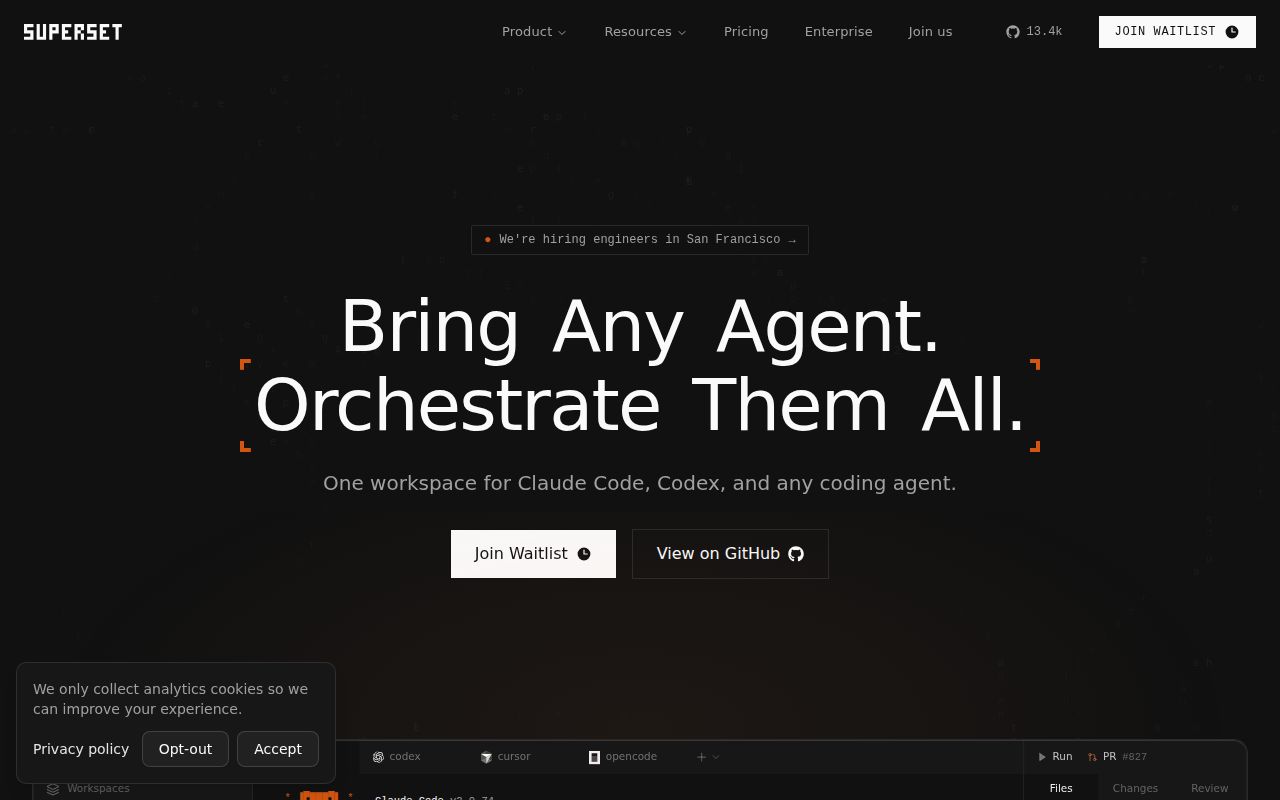
Superset gives each coding-agent task a Git worktree, branch, terminal, and environment. The desktop app shows which agents are working, finished, or waiting for input. A built-in diff viewer lets the developer inspect and edit changes before committing. That arrangement addresses the most immediate failure mode in parallel agent work: two processes changing the same files and leaving one mixed working tree.
The README says the interface can run more than 100 agents, but our sandbox did not measure concurrency or agent output quality. The useful claim is architectural: worktrees isolate file changes, while one application keeps terminals and review state visible. CPU, memory, provider quotas, and human review time still set practical limits. Running 100 sessions is possible according to the project, not a sensible default for every repository.
The product includes a terminal, diff viewer, browser, and scheduler
A workspace can hold terminal tabs and splits, a prompt editor with file mentions, an in-app browser for detected development ports, and a handoff to an external editor. Superset can also schedule agent sessions for recurring jobs. Remote hosts extend the same workspace model beyond the local machine, and Slack or Linear integrations can create workspaces from incoming work.
Those features move Superset closer to an agent operations console than a terminal wrapper. They also increase the amount of code and state a team adopts. Our checkout had 7,012 files, about 570,260 lines of source, and occupied 120.9 MB before dependencies. The monorepo contains desktop, mobile, service, SDK, and marketing surfaces, so contributors should identify the package they own before treating a root command as a small desktop build.
What happened when we ran it
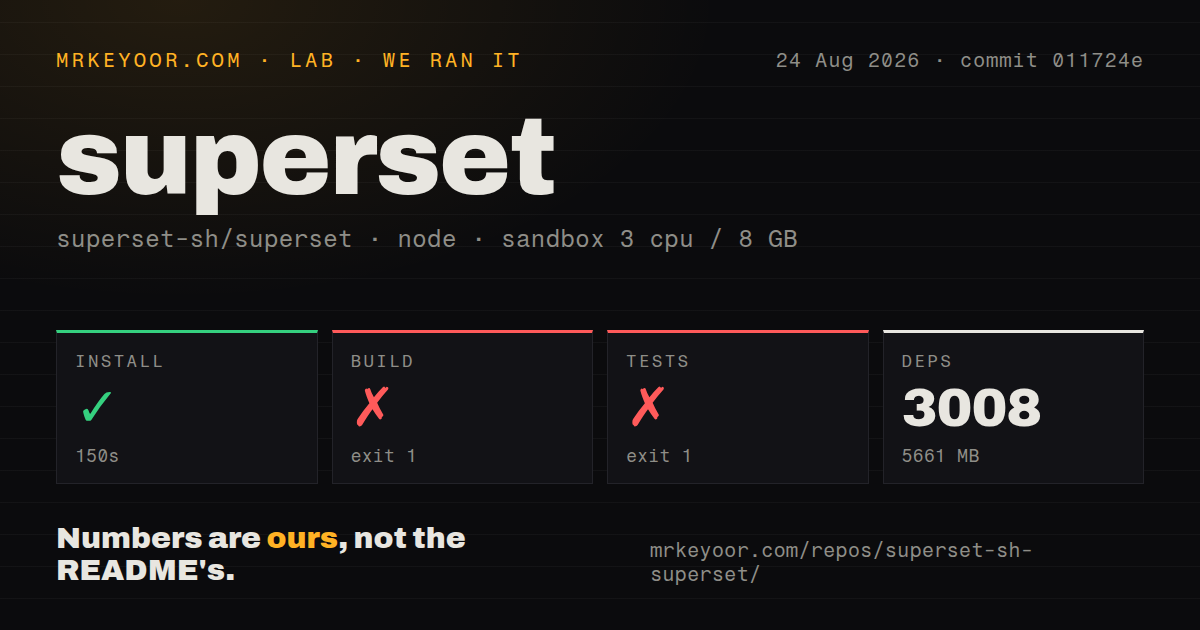
Our clean Debian sandbox installed 3,008 Bun packages in 150 seconds. Dependencies used 5,661 MB on disk. The repository had 14 CI workflow files, a Compose file, and monorepo workspaces, but our scan found no root Dockerfile or tests directory. These structure signals do not say whether a release works; they describe the checkout we tested at commit 011724e.
The build failed with exit code 1 after 244 seconds. The final log says Electron rebuild invoked node-gyp for the desktop app's native-keymap module and that the native rebuild failed. Turbo reported 0 successful tasks out of 1. The log does not say which compiler, header, or platform condition produced that result, so the finding stops at the native module failure.
The test command failed after 49 seconds. Several packages reported completed test totals, including 81 tests in pty-daemon, 101 in workspace-fs, 67 in port-scanner, and 796 in shared. The decisive tail came from agent-setup: 5 tests failed among 249 across 11 files. The available log does not name those five cases. Messages from a trustd probe also describe missing, timed-out, and signaled checks that failed open as healthy.
macOS is primary, Linux is experimental, and Windows is absent
For ordinary users, the project directs macOS owners to signed Apple Silicon or Intel disk images. Linux gets an x64 AppImage marked experimental. No Windows build is available. Git is the only stated base requirement for the released app, while GitHub CLI is optional and enables pull-request workflows. Each coding agent still has its own installation, login, subscription, and permissions.
Development is a heavier proposition than downloading the app. The README requires Bun 1.3.14 or later, Docker, jq, and Caddy. A per-worktree setup script assigns application identity and ports, starts local Postgres and Electric services, and seeds a development login. No Neon account is needed for that local route. Caddy supplies local HTTPS, including a trust step that modifies the developer machine's certificate setup.
The CLI, SDK, and MCP server expose the same workspaces
Superset is not confined to its Electron window. A standalone CLI can create workspaces, launch agents, read terminals, and manage scheduled jobs. The TypeScript SDK provides programmatic access from Node, Bun, or Deno. An MCP server lets Claude Code, Codex, Cursor, and other compatible clients manage workspaces through tools rather than shelling out manually.
That API surface is useful for teams building their own dispatch logic. It also creates an authority question: an agent that can create a workspace, run another agent, and read terminal output can act on a wide part of the development environment. Start with a restricted repository and inspect the MCP tools and host permissions before connecting it to production credentials. Our 49-second test step does not establish the security of a remote-host deployment.
Elastic License 2.0 limits hosted resale
The desktop app is described as free, including parallel agents on the user's own machine. The repository source is available under Elastic License 2.0. Users may run, fork, modify, and self-host it for a team. The README states one material restriction plainly: you may not repackage Superset itself as a service sold to other customers.
That is different from an OSI-approved open-source license, and procurement should read LICENSE.md rather than rely on a badge. Internal use and contribution fit the stated terms. A company whose product would expose Superset as a hosted agent workspace needs another choice or a separate agreement.
August releases show fast work and a broad issue queue
GitHub recorded a push on August 26, 2026, 13,383 stars, and 571 open issues and pull requests. Release desktop-v1.24.2 arrived on August 21 with fixes across desktop, relay, host service, mobile, billing, and admin packages. Its notes also mention an internally flagged plugins catalog with MCP installation. The combined open count includes pull requests, so it is evidence of activity and workload, not a bug total.
Superset has a clear audience: macOS developers already spending enough time supervising concurrent coding agents to justify a dedicated console. Worktree isolation, review, and remote control belong together. The 5,661 MB dependency footprint and failed native build make source contribution less inviting, and non-macOS buyers face explicit product gaps. Try the release on one real repository before moving scheduled jobs or remote credentials into it.