A 30-second film is treated as a software build
procedural-film does more than prompt an agent for animation code. Its skill file prescribes a sequence from brief and research through an art bible, storyboard, timeline, placeholder render, per-shot scene work, music, critic passes, and delivery. The default drawn format is 1080 by 1920 at 24 fps, with events aligned to a beat grid. A finished project includes a self-contained HTML player, a master MP4, smaller transcodes, and a shot list. This structure is the reason to use the skill: production decisions become files and checks rather than a long unrecorded chat.
The included butterfly film makes the promise concrete. It has 17 shots, runs 32 seconds at 120 bpm, and alternates hand-inked paper scenes with navy blueprint scenes. The repository includes its planning documents, source, tools, HTML player, and phone export. Three Claude Quest examples push the same engine toward a 60 fps pixel-art film and a playable platformer. The game version uses a 320 by 180 native canvas, four levels, a boss fight, recorded controller tapes, and pre-deployment gates. This is substantial reference material, not an empty skill prompt.
3 modes share a pipeline but not an asset policy
Drawn mode computes its imagery on Canvas, while retro mode uses a constrained pixel engine and synthesized chip audio. Those 2 modes can honestly ship with no media assets. Photo-doodle is different: it places cut-out photographs on paper-like scenes and draws animated marks around them. The skill requires the maker to source usable public-domain or Creative Commons images, record credits while downloading, and check whether share-alike terms follow the film. Its local cutout path adds Python 3.12 and downloads a roughly 180 MB segmentation model.
That distinction prevents a misleading reading of the README's zero-asset pitch. A photo-doodle production has asset discovery, licensing, cutout quality, and attribution work even though the final HTML can embed the processed images. The skill is unusually direct about common failures: similar foreground and background colors can make a cutout fall apart, an end card can resample the same image inconsistently, and a 1080-square timeline silently renders with the wrong vertical assumptions if dimensions are omitted. These are useful production notes earned from a specific engine.
What happened when we ran it
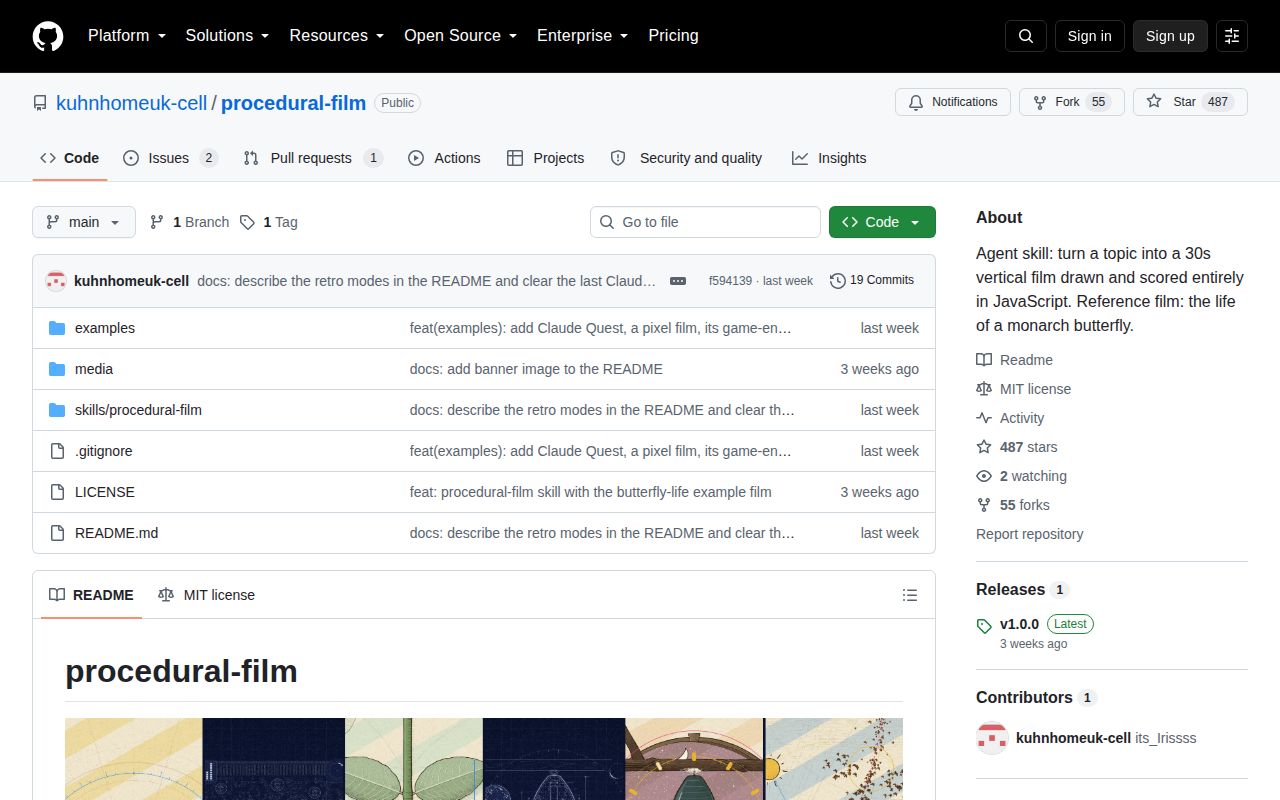
We did not run commit f594139. The lab classified the repository as having no supported ecosystem and found no Dockerfile, so it had no install, build, or test command to execute. GitHub identifies JavaScript as the primary language, and the README documents Node.js 20, but the dependency manifest we found belongs to examples/butterfly-life/tools rather than the repository root. The measurement record therefore contains no dependency count, build time, audit result, or test total. We will not substitute the project's own green-gate claims for an independent run.
The repository itself was active after its first release. Version v1.0.0 shipped on 2026-09-17, and GitHub recorded the latest push on 2026-09-25. It had 487 stars and 3 open issues and pull requests. One pull request adds motion helpers and a motion meter; another issue asks for the original prompt behind the butterfly example. That last question matters because the final artifact alone cannot show how much steering, retrying, and manual judgment the example required. The skill file reveals a great deal of that labor, but not a reproducible usage bill.
6 film checks catch breakage before the final render
The film gate runs 6 checks covering media, determinism, source rules, timeline structure, drawing, and frame cost. The workflow starts with fixtures and a placeholder film, then asks scene agents to render contact sheets and inspect them before full assembly. Audio cues are analyzed against timestamps, final loudness is measured, and critic waves use fresh frames to verify repairs. For the game track, the skill names 13 gates and recorded bot runs that prove each level can be completed. These checks are a genuine strength because generated creative code often fails in the spaces between individually plausible scenes.
Automation cannot decide whether a film is worth watching. The skill acknowledges that by requiring visual critics to judge composition, story fidelity, motion, density, phone readability, and match-cut geometry. It also reveals the cost: the README says one scene agent writes 1,000 or more lines for each shot, followed by critic waves. A 17-shot reference can therefore occupy a large portion of a Claude Code plan. That makes the system appropriate for a showcase piece or reusable art pipeline, and hard to justify for a disposable social clip.
Remotion is the safer general-purpose choice
procedural-film wins when its constraints are the brief: hand-drawn or retro visuals, synthesized sound, beat-locked cuts, agent-owned scene files, and a strict review loop. Remotion is easier to adopt for ordinary code-driven video work because it is a general React framework rather than a Claude Code skill. Motion Canvas suits programmable explanatory animation with a timeline-oriented editor. p5.js is the blanker canvas for someone who wants creative coding without inheriting 10 production stages. The skill's specificity is its product, but it also means you should want the look and the workflow together.