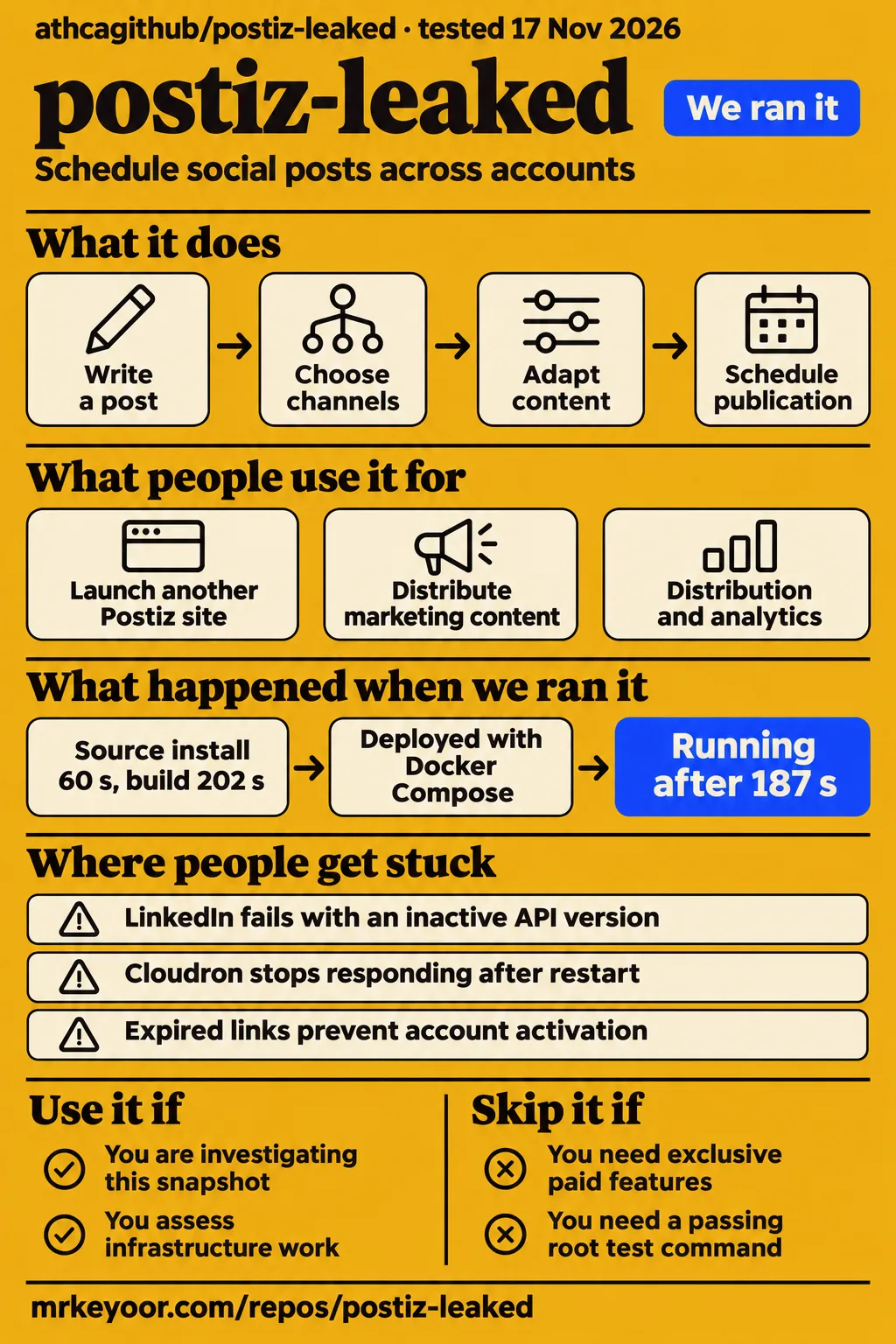
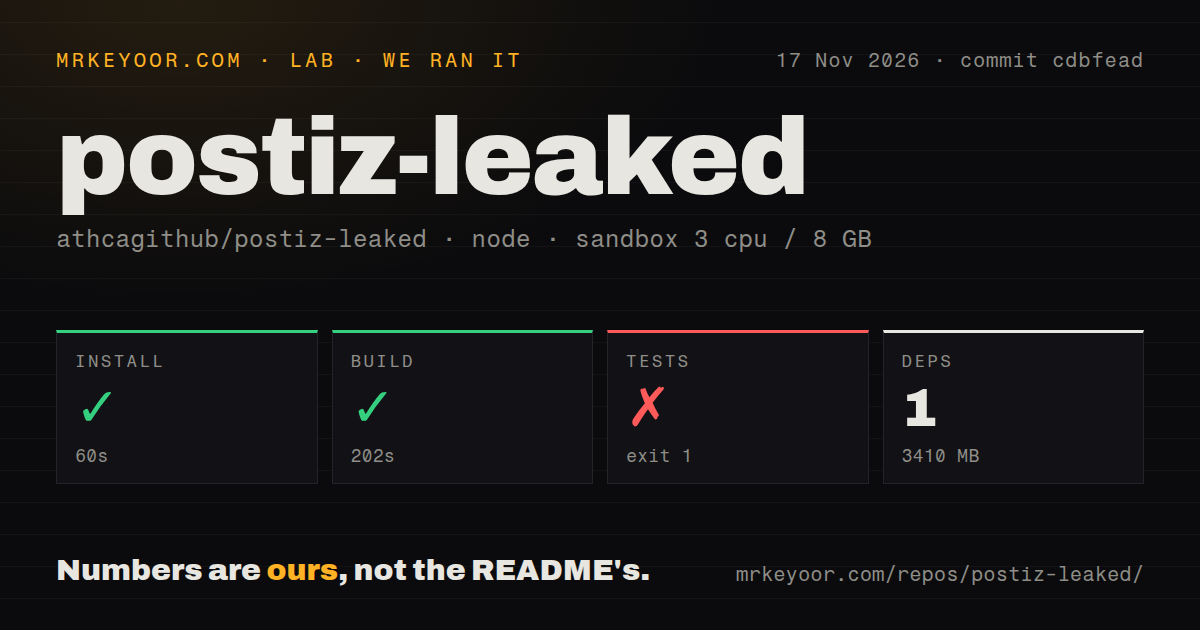
Our sandbox built postiz-leaked in 202 seconds, but the test command stopped while reading Jest's configuration. Use this snapshot if you are investigating its source and comparing it with upstream. Teams choosing a new production publishing service should start with official Postiz or assess its hosted service. The decision is about which source and operating path to take, rather than the publicity surrounding the repository.
The README leaves infrastructure and integrations to you
The postiz-leaked README assigns database, Redis, storage and social-platform setup to the operator. It advertises scheduling, an AI agent and analytics, then lists OAuth applications, platform app reviews, X API access and ongoing maintenance as additional work. Its short launch command therefore sits inside a larger operating commitment. Read the leaked repository README.
Official Postiz describes a workflow in which you write a post, choose channels, adapt it for individual destinations and schedule publication. Its homepage also describes analytics drawn from network insights APIs. Those product descriptions explain why someone would want Postiz. Choosing athcagithub/postiz-leaked adds a separate source-selection question, which this review addresses alongside the recorded installation and deployment outcomes. Read the official Postiz product description.
What people use postiz-leaked for
X users reported a fork launch and sponsorship; Postiz's own article describes agent-driven publishing workflows. The examples below keep the speaker and product attached to each report. For a reader deciding whether to inspect this repository, they distinguish interest in the leaked copy from the broader publishing jobs described by upstream Postiz. Read the supplied X discussion.
| Who | Reported use | Source |
|---|---|---|
| X user attenisalluneed | Claimed to launch postiz.si from the leaked source and make their younger brother CEO | X fork-launch report |
| X user tarasshyn | Reported sponsoring postiz-leaked | X sponsorship report |
| Oliver Henry, in Postiz's article | Used the Larry agent with upstream Postiz for distribution and analytics | Postiz's Larry account |
| Ernesto Lopez, in Postiz's article | Used Eddie to adapt content for 12 apps and distribute it through upstream Postiz | Postiz's Eddie account |
Postiz's article says Larry reached 8 million views by the end of its first week. It describes automatic draft uploads, scheduled posts, cross-posting and analytics feedback. Eddie's described job is distributing content across multiple apps. Together, the two vendor accounts show the intended role of a common publishing service in an agent workflow: accepting content and returning performance information. Read Postiz's customer-workflow article.
What happened when we ran it
Our November 17, 2026 Compose run deployed commit cdbfead18247 in 187 seconds, with every port bound to 127.0.0.1. The record then shows a Docker network error, a model-pull tail, a successful health check and a failed task recipe. Keeping those steps separate makes the failure sequence easier to interpret.
| Hands-on step | Recorded outcome |
|---|---|
| Deploy | OK in 187 seconds. |
| Connect Ollama | Error response from daemon: network hxbfda7e_default not found. |
| Model pull | The retained tail shows a manifest pull, a 4.7 GB layer at 100%, 124 MB/s and digest checks. |
| Health check | OK in 0.2 seconds. |
| Task recipe | FAILED; no runnable adapter yet for recipe generic. |
| Teardown | OK. |
The Ollama connection step returned: Error response from daemon: network hxbfda7e_default not found. That message identifies a Docker network problem in the recorded sequence. The task recipe failed separately because the runner lacked an adapter for recipe generic. These are distinct failures at different steps, and the records name both directly.
The recorded container total was 2,853 MiB at idle. The application container used 1,340 MiB, Temporal's Elasticsearch used 599 MiB and temporal-admin-tools used 536 MiB. The other recorded containers were Temporal at 115 MiB, temporal-postgresql at 98 MiB, temporal-ui at 4 MiB, postiz-postgres at 68 MiB, postiz-redis at 4 MiB and spotlight at 89 MiB.
The later sample totalled 2,854 MiB. Its temporal-postgresql reading rose to 99 MiB; the other listed readings stayed the same. The source labels this sample "after the questions". The task recipe's recorded outcome is still the missing-adapter failure described above, so the useful comparison here is the two retained memory samples and their container breakdown.
Our separate source harness used commit cdbfead on November 17, 2026, with 3 CPUs, 8 GB RAM and recorded image label lab-node:22. The checkout contained 1,035 files, about 147,257 source lines and 19.2 MB of content. The harness recorded one dependency entry, eight CI workflow files and monorepo workspaces; its scan reported no Dockerfile or tests directory.
| Source harness step | Result | Meaning |
|---|---|---|
| pnpm install | Succeeded in 60 seconds; 3,410 MB on disk | The dependency-installation step completed |
| Build | Succeeded in 202 seconds | The recorded build command completed |
| Tests | Failed with exit 1 in 4 seconds | Jest stopped while loading its TypeScript configuration |
The test log names /work/repo/jest.config.ts and TypeScript error TS2307: Cannot find module '@nx/jest' or its corresponding type declarations. This places the observed failure in configuration loading. The immediate development task is to resolve that command's configuration and module resolution using the checkout and its logs, then obtain a test result before relying on it for changes.
Where people get stuck: provider setup continues after startup
The README explicitly assigns OAuth applications, platform reviews, X API costs and changing integrations to self-hosters. Upstream troubleshooting then gives operators a concrete route through publishing failures: inspect the calendar error, reconnect an expired channel and address the destination platform's requirements. That continuing work belongs in the choice between operating Postiz and buying a hosted service. Read the README's operating requirements.
| Report or symptom | Source's response | Recorded status |
|---|---|---|
| LinkedIn returns 426 NONEXISTENT_VERSION | Vrenli72 proposes updating both LinkedIn providers to a supported API version | Open in upstream issue #2005. LinkedIn report |
| Latest deployment has a "tempory" problem | The same reporter offers fuller logs and steps | Reporter describes an unusable UI/backend. Additional report |
| Cloudron application stops responding after restart | Staff published a replacement package and instructed the user to update | IniBudi confirmed normal operation. Cloudron resolution |
| Scheduled post fails | Read the calendar tooltip, reconnect expired channels and address platform requirements or rejection messages | Official troubleshooting route. Publishing guidance |
| Activation link is malformed or expired | Request a new email, copy the complete link and use the signup browser | Official troubleshooting route. Activation guidance |
Cloudron staff attributed their packaging failure to extra Prisma asset downloads and published a replacement package. IniBudi confirmed that updating restored normal operation. The sequence gives Cloudron users a specific support outcome to compare with their own symptoms. The LinkedIn report follows a different path: its reporter identifies an inactive provider version and proposes changing both providers. Read the Cloudron exchange and upstream issue #2005.
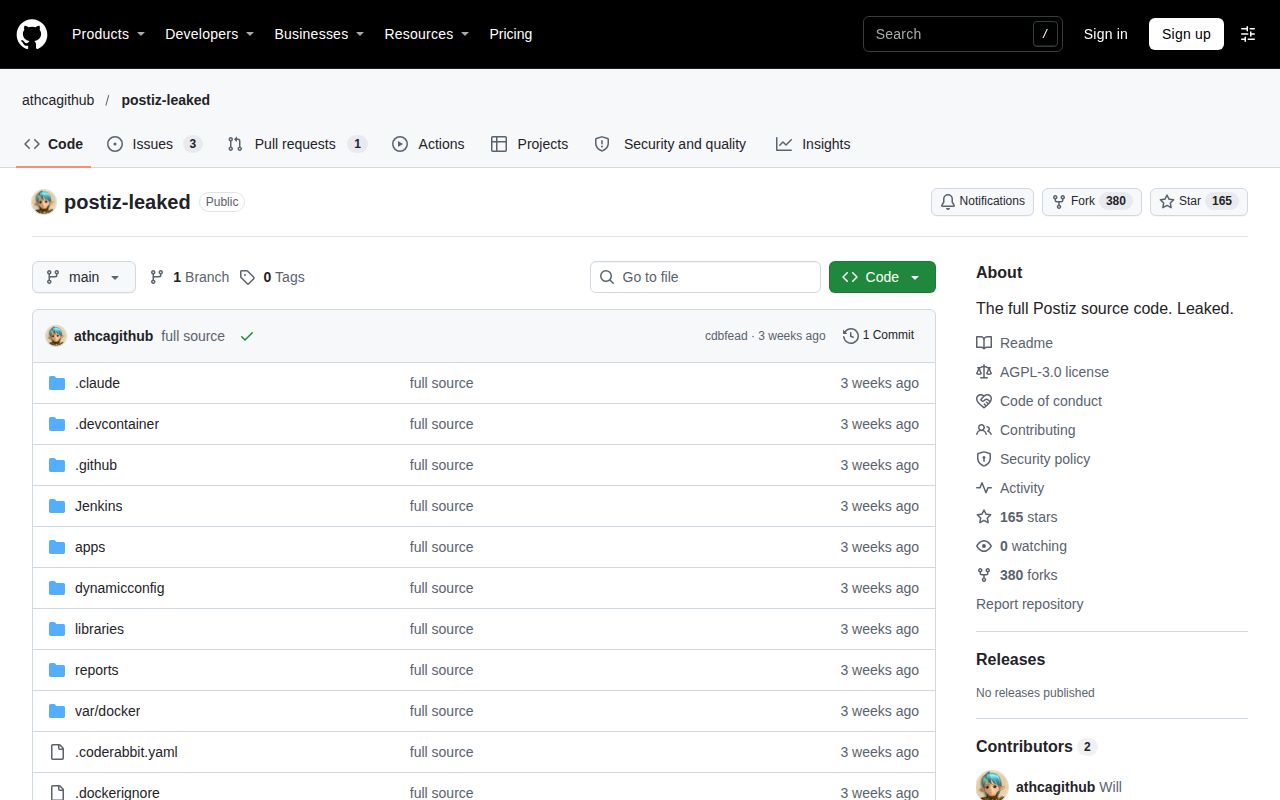
The leaked repository's issue #1 requests Rakazo integration and asks for stars on other repositories. Issue #2 promotes ThreadPilot. Issue #3 promotes Feedbackjar, despite its payment-related title. All three supplied records show open issues with zero comments. Reading the bodies provides a more useful account of this sample than treating their titles as defect reports.
More channels mean more platform rules to own
Official troubleshooting identifies platform-rule violations and content rejections as publishing failure categories. Examples include excessive images, an unsuitable media type, missing settings, duplicate text, blocked links and account restrictions. The calendar tooltip carries the platform's message. An operator's next action therefore depends on the failed destination and its stated reason, rather than a single generic retry procedure. Read Postiz's publishing troubleshooting.
Saffari's documentation-based review describes TikTok Direct Post as publishing automatically, while Upload sends media to TikTok for manual completion within 24 hours. That distinction changes the work a publishing team must schedule. A workflow built around Upload includes a person completing the handoff; one built around Direct Post depends on the account and integration supporting that route. Read Saffari's TikTok-mode comparison.
Security history makes source provenance a deployment requirement
An external analysis reports two upstream vulnerabilities fixed in v2.25.3. It describes an unconfined file read and a signing oracle, and recommends credential rotation for affected instances reachable by untrusted registrants. This history makes the relationship between a candidate checkout and upstream fixes consequential when selecting source for a service that holds publishing credentials. Read the attributed upstream security analysis.
The README states AGPL-3.0 and points to the licence. Source selection therefore includes both the technical patch history and the terms attached to operating or modifying the software. For a team comparing repositories, the practical next step is to examine the actual licence and identify the candidate revision's relationship to upstream before committing accounts and credentials to a deployment. Read the README's licence statement.
postiz-leaked vs official Postiz, Buffer and Hootsuite
The leaked README recommends Postiz Cloud for readers who want someone else to handle its listed operating work. Official Postiz is the source repository identified by the supplied community context. Those two options address the immediate source-and-operations decision; the broader alternatives below address differences in publishing workload. Saffari's comparison supplies the Buffer and Hootsuite shortlist. Read the README's hosted option.
| Candidate | Choose it when | Evidence |
|---|---|---|
| Official gitroomhq/postiz-app | You are selecting a source repository for a new Postiz deployment | Community context identifies already-public official source. Official-source context |
| Postiz Cloud | You want the hosted route suggested by the README | The README directs readers there to handle its listed operating work. Hosted recommendation |
| Buffer | You have a small publishing queue | Saffari shortlists it for an occasional poster. Buffer comparison |
| Hootsuite | Conversations and monitoring matter alongside publishing | Saffari keeps it in contention for that workload. Hootsuite comparison |
| ContentStudio | Agency and engagement tools are the priority | Konecny recommends it for those priorities. ContentStudio comparison |
| Later or Flick | Your operation centres on Instagram | The reviews discuss visual planning and Instagram-focused work. Later comparison, Flick comparison |
| SocialBee or Predis.ai | Reusable categories or content creation are the main job | The reviews distinguish those tasks from distribution. SocialBee comparison, Predis.ai comparison |
Saffari also says Buffer lists API access. An API's presence alone therefore gives a poor comparison between the products. His stronger reason to investigate Postiz combines deployment control, publishing automation and agent access. For this candidate, first decide whether you need to operate Postiz source; then choose the repository and publishing workflow that match that responsibility. Read Saffari's comparison reasoning.
What the other reviews get wrong
The README's fired-CMO account conflicts with community context describing termination of a three-month paid ads consulting contract. The same context says official Postiz was already public without feature gating. Attribute these accounts to their sources rather than adopting the README's employment framing or its implication that the copy newly unlocked paid features. Read the README account and community correction.
The xCloud guide advertises v2.23.0, while the later security analysis reports fixes in v2.25.3 and places v2.23.0 in an affected range. Its analytics wording also promises impressions, engagement rate and reach for every connected account. Official Postiz instead says coverage depends on each platform's public insights API. These distinctions affect both version selection and expectations for reporting. Read the hosting guide, security analysis and official analytics description.
ToolsGavel says exact annual rates are unpublished, while the supplied official homepage lists monthly-equivalent annual prices. Billing units matter: a monthly equivalent billed annually differs from a monthly subscription. MCP guidance also needs route-specific wording. Official documentation describes a shared OAuth endpoint, alongside API-key routes for some clients and the CLI. Read ToolsGavel's billing account, official pricing and official MCP connection methods.
Questions people ask
Postiz was already public without feature gating according to the supplied community context, which identifies gitroomhq/postiz-app as the official repository. That is the central answer for readers arriving because of the leak narrative. The remaining questions below cover the event, provider reports and operating choices raised in the supplied discussion and review records. Read the official-source context.
How does postiz-leaked differ from the official Postiz repository?
athcagithub/postiz-leaked is a separate repository whose README presents the code as a release following its author's firing. Community context instead points to already-public official source. A Grok reply describes the copy as a one-commit dump. For a developer investigating this candidate, the useful next step is a source and patch-history comparison with gitroomhq/postiz-app. Read the repository discussion.
What happened between Postiz and the person who published the leaked repository?
The README says its author was fired as CMO; community context describes termination of a three-month paid ads consulting contract. The X records reproduce the announcement and response. Keeping those speakers attached to their accounts explains the disagreement without making the employment story the reason to choose software for a publishing service. Read the README and community context.
Was the Postiz firing and source-code leak creative marketing?
Jake Castillo called it creative marketing on X, while Ziwen presented a stunt as one possible explanation. These are reactions to the event. The source-selection decision still turns on the repository, licence, patch history and operating requirements described elsewhere on this page, rather than whether a commentator found the announcement effective marketing. Read the attributed X reactions.
Can Postiz add a Rakazo integration?
Issue #1 requests Rakazo integration and includes promotional links to other repositories. Its supplied record is open with zero comments. Readers considering that integration can use the request to identify the proposed destination and discussion thread; its recorded status is a request, rather than an implementation or a maintainer commitment. Read the Rakazo integration request.
Can the LinkedIn providers be updated to a supported API version?
Vrenli72 proposes that change in upstream issue #2005 after reporting 426 NONEXISTENT_VERSION responses. The report identifies hardcoded 202501 provider headers and suggests 202608 as an example at the time. The issue's proposed action is to update both LinkedIn providers to a currently supported version, so its example belongs to the dated report. Read the LinkedIn provider proposal.
Is the latest-version “tempory” issue known, and is a fix planned?
The supplied reporter describes a latest-version deployment whose UI/backend becomes unusable and offers fuller logs and steps. The issue records that symptom alongside the LinkedIn complaint. An operator following up should bring the actual deployment error and reproduction details to the discussion so the problem can be distinguished from the separately described provider-version failure. Read the additional deployment report.
Why will my Cloudron Postiz installation not start after a restart?
Cloudron staff resolved IniBudi's reported case with a replacement package after attributing the failure to Prisma asset downloads. The user confirmed normal operation after updating. For that packaging path, the thread gives a concrete action and recorded result; compare the package and symptoms before applying the same response to another installation. Read the Cloudron fix and confirmation.
Is Postiz worth paying for?
The leaked README recommends hosted Postiz to readers who want its listed infrastructure and integration work handled for them. Konecny's buying advice favours Postiz for people publishing consistently across accounts and points smaller setups toward Buffer. The practical comparison is the subscription against the workload and operating responsibility your team already has. Read the hosted recommendation and Konecny's buying advice.
How much RAM does a Postiz server need?
Our recorded Compose container set used 2,853 MiB at idle and 2,854 MiB in the later sample. The xCloud guide separately lists 2 GB for single-user light use and 8 GB for a small team. Keep those figures attached to their configurations: the first is our observed stack, while the others are the hosting guide's sizing recommendations. the sizing guide.
Does Postiz require HTTPS?
The xCloud guide says production Postiz requires HTTPS because it uses secure cookies, with TLS terminated at a reverse proxy. Our Compose record instead describes ports bound to 127.0.0.1. The deployment paths therefore involve different network arrangements, and a public installation needs its domain, reverse proxy and platform callback setup considered together. Read the HTTPS guidance.
Can Claude or ChatGPT publish social posts through Postiz?
Official Postiz MCP documentation describes scheduling and publishing through Claude and ChatGPT using OAuth sign-in. It supplies a shared connection link and asks users to keep a human in the loop. The documented sequence starts by listing connected channels, then asking the agent to schedule or publish through the chosen connection route. Read the official MCP instructions.
What happened during Postiz's October 2026 security incident?
ToolsGavel reports that Postiz shut down service during an investigation and later restored it, attributing its account to founder posts. That report concerns hosted-service availability. The separate application-security analysis discusses upstream file-read and signing-oracle vulnerabilities fixed in v2.25.3. Keeping those reports distinct preserves what each source actually describes. Read ToolsGavel's incident account and the application-security analysis.
What we have not tested yet
The missing task adapter leaves this snapshot without a recorded end-to-end publishing result. Scheduled delivery, duplicate handling, token renewal, media processing, campaign load, analytics accuracy and an AI client's actual publishing permissions remain outside the completed checks. Startup and build completion answer their respective setup questions. The model-pull tail supplies neither a model identity nor answer-quality results; the pack contains no screenshots or known-answer question results.
The exact upstream ancestor, code differences, security-patch inclusion and maintenance commitment of cdbfead remain unaudited. The supplied upstream documentation, issue reports and customer workflows therefore retain their named origins rather than establishing snapshot compatibility. The image label lab-node:22 is configuration metadata, and the dependency entry is bookkeeping rather than a complete package inventory. The source scan and Compose run are separate records; the memory samples are observations of one container set rather than a general server minimum.
The fork launch is a self-report, and vendor customer stories do not isolate the scheduler's contribution to views or revenue. Our comparison is a sourced shortlist rather than a side-by-side product trial. The supplied video excerpts and unrelated Bilibili results add no substantive Postiz task evidence; no Reddit discussion or autocomplete questions were supplied. Interface localisation, public TLS configuration, OAuth callbacks and AGPL obligations also fall outside the completed checks.
The underlying consulting contract, coordinated marketing plans, a diagnosis or fix commitment for the "tempory" report, and an implemented LinkedIn repair are absent from the supplied records. ToolsGavel's incident account lacks an official postmortem; the evidence connects neither that incident nor the reported vulnerabilities to the source-code publicity. The hosting guide's advertised version also leaves its current deployment version unresolved. The next useful result is scheduled delivery through your actual channels on a revision with an identifiable patch history.