PostCSS is a programmable CSS pipeline, not a feature bundle
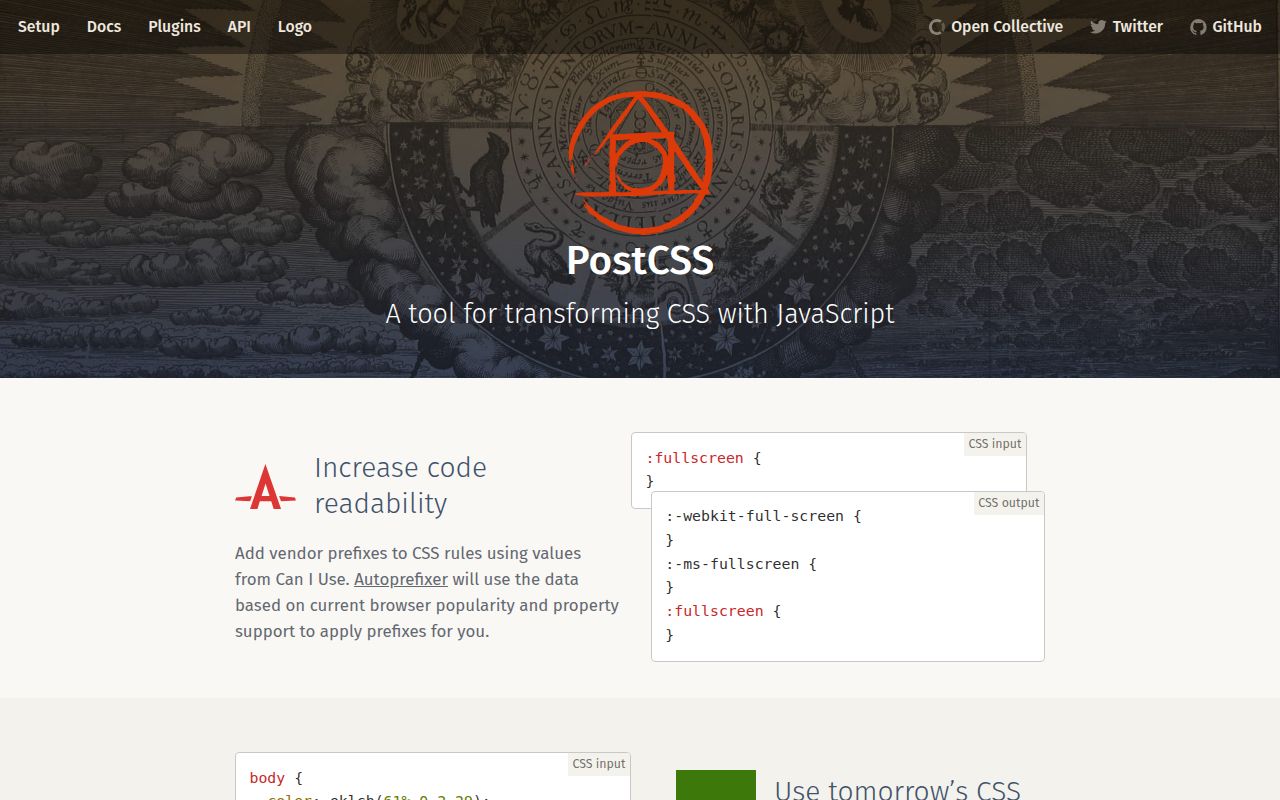
PostCSS takes a stylesheet, turns it into a syntax tree, lets plugins visit or change its nodes, and serializes the result. That sounds abstract until you name the work: Autoprefixer inserts browser prefixes, preset-env translates newer CSS, Stylelint inspects rules, and cssnano minifies output. The core supplies the shared machinery. Your chosen plugins decide what happens to the file.
The README lists more than 200 plugins, but installing PostCSS does not switch those features on. You also need a runner for your bundler or task tool, or you call the JavaScript API yourself. This separation is the reason to choose it. A team can add one transformation without replacing its whole CSS build, and a tool author can operate on a known tree instead of maintaining a parser.
Plugin order is part of the output contract
An ordered plugin array looks harmless in a configuration file, yet it is executable build logic. A plugin may add a node that the next plugin renames, remove a declaration another plugin expects, or emit a warning that your runner ignores. PostCSS documents a plugin API and runner guidelines, but it cannot make an arbitrary collection of third-party transformations commute. You own the resulting chain.
Open issue #2047 gives that warning a visible shape. The reporter combined Autoprefixer with a renaming plugin and found different output when the second plugin became asynchronous. Reversing the order changed the result. The report remains open, so a competent team should pin plugins and keep fixture tests for generated CSS. Passing each plugin's own suite does not prove that your exact sequence produces the same file after an upgrade.
What happened when we ran it
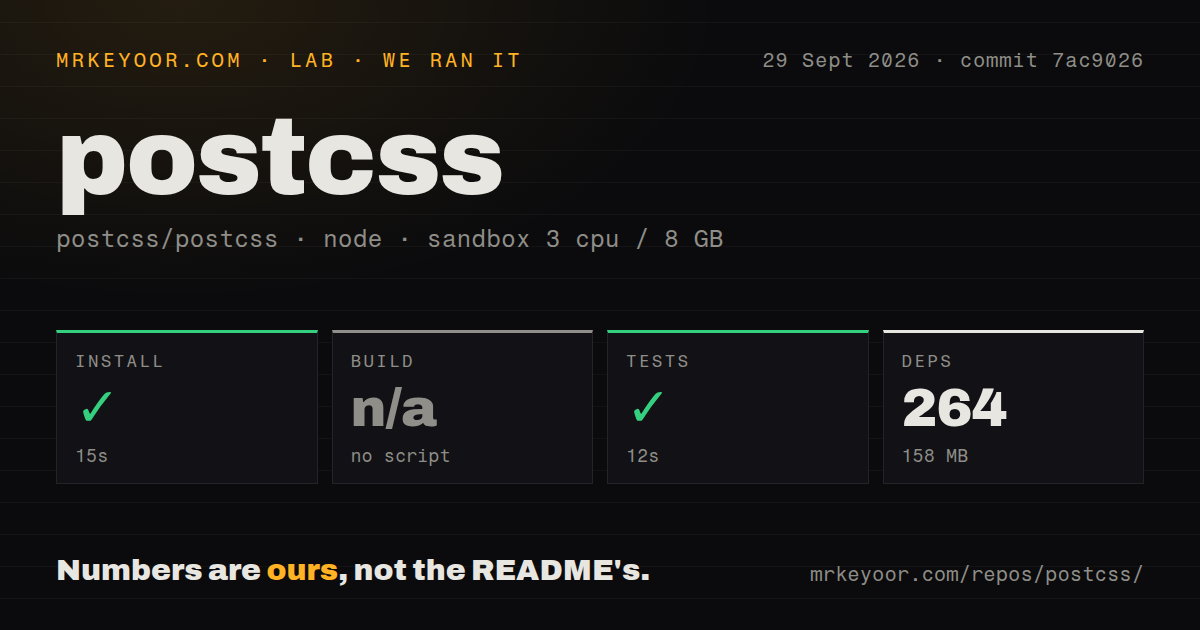
Our sandbox installed commit 7ac9026 in 15 seconds with pnpm. The install brought in 264 packages and occupied 158 MB. The checkout itself contained 115 files, roughly 17,703 lines of source, and used 0.7 MB. Those figures describe the repository and development environment we ran, not the size of PostCSS in a shipped browser bundle.
There was no build script or build target, so we skipped that step rather than inventing one. The supplied test command passed in 12 seconds in an unprivileged Node 22 container with 3 CPUs and 8 GB of RAM. The repository also had a tests directory and 2 CI workflow files. It had no Dockerfile, which is reasonable for a Node library rather than a service.
That run says the checked-out core was straightforward to install and its own tests were green. It says nothing about the correctness of a production plugin stack because our measurement did not run your configuration, source maps, or stylesheet fixtures. The useful acceptance test is a small set of real input files and reviewed expected output, run whenever PostCSS or any plugin changes.
Sass syntax support stops at parsing
PostCSS can accept other syntaxes through alternate parsers and stringifiers. The README names packages for SCSS, Sass, Less, HTML style blocks, Markdown code blocks, and CSS inside JavaScript. This is useful for linters and codemods that need to inspect several file types through a related API. It does not mean every syntax package implements the language behind that syntax.
The clearest trap is in the README itself: postcss-scss and postcss-sass let tools work with those syntaxes, but they do not compile SCSS or Sass into CSS. If you need variables, modules, functions, and the rest of Sass evaluation, use Dart Sass. Treating a parser as a compiler can leave valid-looking source in an output file that a browser cannot interpret.
Integration is easy until the browser is the runtime
Webpack, Gulp, Parcel, command-line scripts, and direct JavaScript calls all have documented routes. The direct API accepts plugins plus options such as from, to, parser, stringifier, and source-map settings. Current package metadata supports both import and require entry points, and Node support reaches back through several older release lines. For a normal server-side build, the basic wiring is modest.
Direct browser use has a sharper edge. Open issue #1858 asks for native browser ESM loading without a bundler or Node-module stubs. The issue was still open after activity in June 2026. A browser-based editor can bundle PostCSS, as the README suggests, but a team requiring plain import maps should prove its chosen path before committing to the library.
September activity supports a mature-core decision
GitHub showed 28,977 stars and 26 open issues and pull requests, a combined count rather than 26 confirmed bugs. The latest release was 8.5.28 on September 3, 2026, with a type-regression fix. The repository was pushed again on September 29. Recent open work included a report about repeated byte-order marks and pull requests around comment preservation and tokenization, which shows maintainers still working on parser details.
PostCSS earns its place when the plugin boundary is the feature you need. Our 12-second green test run makes the core easy to trust at commit 7ac9026, but the decision cannot stop there. Inventory the plugins, lock their order, and test the CSS they emit. If that sounds like unwanted ownership, Lightning CSS or a bundler-managed pipeline is the cleaner choice.