Short answer: use the inventory to find vendor evidence
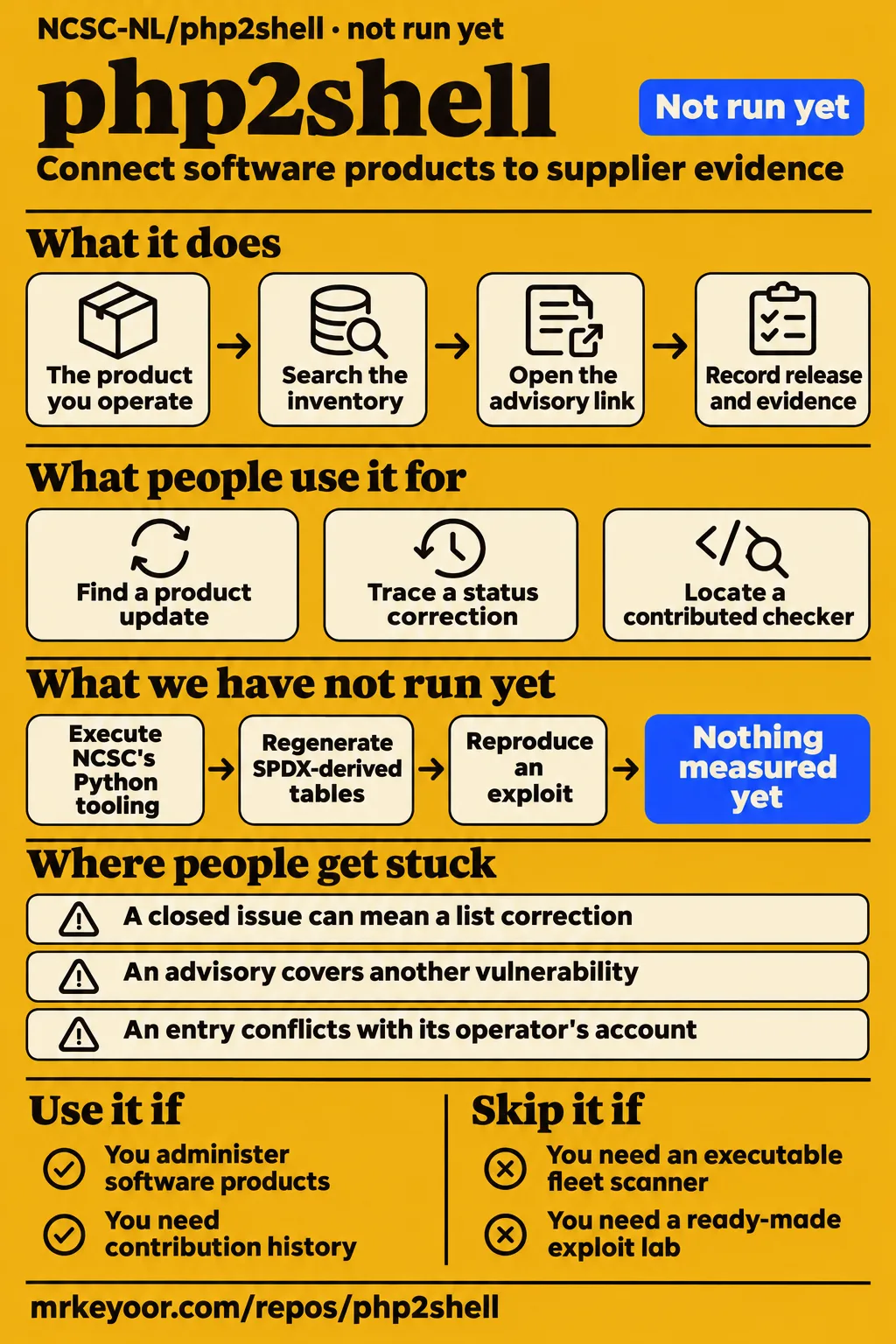
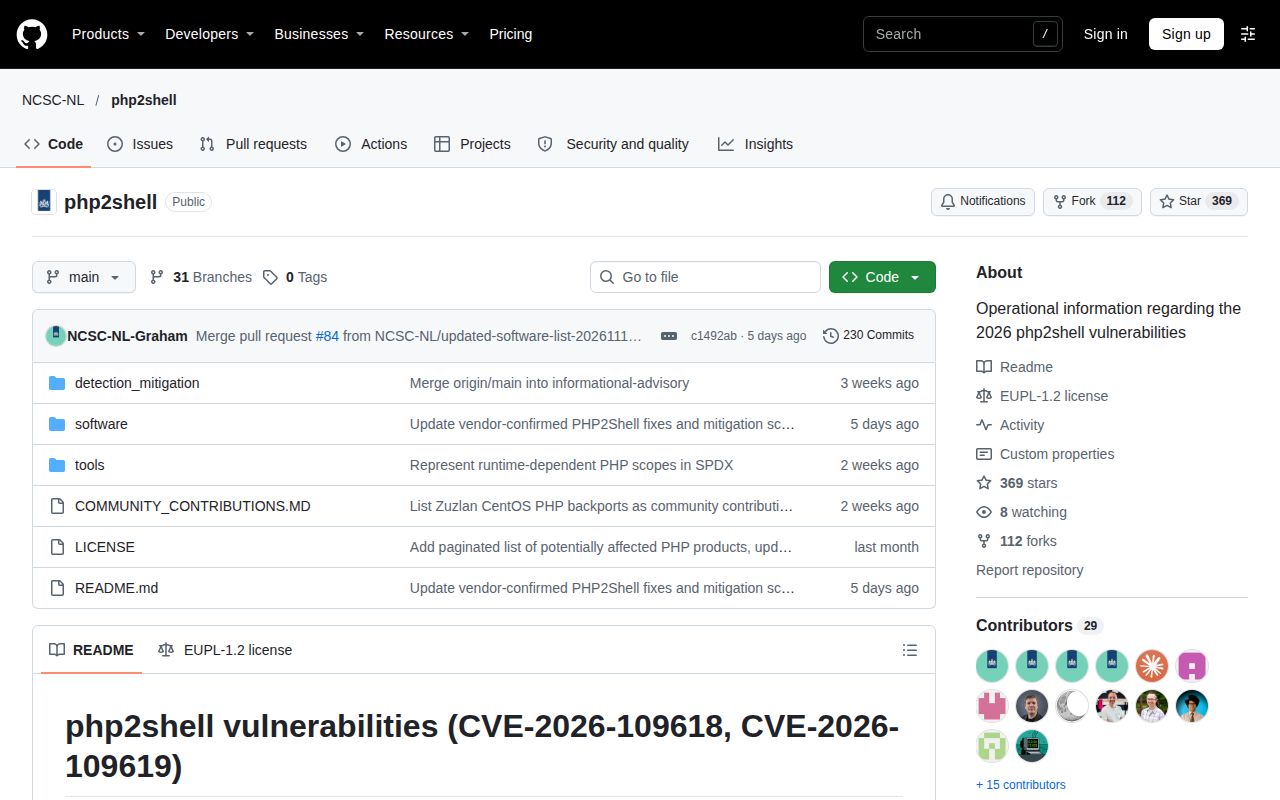
NCSC-NL/php2shell contains operational information for CVE-2026-109618 and CVE-2026-109619. Use it to find product-specific evidence for software you administer, especially appliances and management interfaces that bundle PHP. Its README combines recommended actions, a software inventory and links to contributed resources. An administrator can use those materials to connect a product name to a supplier notice, while a contributor can inspect how a reported status entered the shared reference.
The useful starting point is the NCSC-NL English README, followed by the software list. Keep the owner-qualified repository name in an incident ticket: other projects also use php2shell, including assessment tools and exploit demonstrations. NCSC's documented purpose is operational information. Readers who need an executable fleet scanner or an exploit lab should choose a project whose documented job matches that requirement; the comparison below identifies two assessment-tool alternatives.
What people use php2shell for
The software inventory and sampled issues support three practical uses: finding a reported product update, tracing a packaging-specific correction and locating a contributed checker. Each contribution supplies a different kind of evidence. A product-update submission points toward a supplier release, while a tool submission points toward a separate project. Reading the contribution beside the current inventory or catalog helps an administrator understand what was reported and what the maintained reference now says.
| Contributor's task | What happened | Why a reader should care |
|---|---|---|
| Report a fixed Checkmk Appliance release in issue #11. | NCSC-NL-Sebastiaan said the information had been added. | The submission names Appliance version 1.7.25 and links update information. |
| Submit a HestiaCP update in issue #22. | NCSC-NL-Dennis replied that it was implemented. | The submission identifies hestia-php version 8.5.12. |
| Propose a checker in issue #65. | The contributor proposed php2shell-check; the supplied community catalog lists it. | Readers can follow the proposal and read the catalog's description of the separate tool. |
Start by searching the software inventory for the supplier and exact product you operate, then open the entry's advisory link. Record the applicable product release and the supporting evidence beside your asset record. The README says PHP also appears in appliances, network devices and management interfaces where administrators may be unable to update PHP directly. Those products need supplier-specific release information as well as knowledge of PHP's upstream fixed versions.
What happened when we ran it
Our run at commit c1492ab on November 16, 2026 ended with NOT RUN: no supported ecosystem for the Python classification and no Dockerfile. The harness recorded 3 seconds for the entire attempt, which ended without executing the repository. That is total harness duration, not application runtime or a performance benchmark. Its recorded allocation was 3 CPUs and 8 GB RAM, with image n/a; the separate hands-on route stopped at its Compose prerequisite.
| Question | Answer | Verdict | Why |
|---|---|---|---|
| Which checkout and configuration did the harness record? | c1492ab on November 16, 2026; 3 CPUs, 8 GB RAM; image n/a. | Recorded configuration. | These values identify the attempt and its allocation. |
| Did the harness execute the repository? | NOT RUN; total harness duration was 3 seconds. | Execution stopped. | The harness reported no supported ecosystem for language Python and no Dockerfile. |
| Did the Compose safety prerequisite pass? | No accepted Compose filename existed. | Failed. | The safety record names compose.yaml, compose.yml, docker-compose.yaml and docker-compose.yml. |
| What did the administrative run summary say? | Deployed with its own Docker Compose, every port bound to 127.0.0.1. | Conflicting record. | That description conflicts with the failed Compose prerequisite and harness outcome. |
| What did teardown report? | teardown: ok | Cleanup recorded. | The teardown record reports cleanup separately from the execution outcome. |
The hands-on safety record reports: "hands-on step safety: FAILED; unsafe repo: none of compose.yaml, compose.yml, docker-compose.yaml, docker-compose.yml exists (rule: a compose file is required)". The missing file is the concrete failed prerequisite. This explains the consequence of the attempted route: it stopped at an admission requirement instead of reaching an application result. The documented inventory remains the starting point for the reference workflow described in the README.
The administrative run summary says deployment occurred on November 16, 2026 with every port bound to 127.0.0.1. The teardown record says "teardown: ok". Both records remain visible here, but the reported outcome is the explicit stopped harness result and failed safety prerequisite. The deployment summary conflicts with those records rather than supplying a successful execution result.
Where people get stuck: a closed issue can mean a list correction
Issue #12 reports affected KACE appliances and says "No fix released yet," while the maintainer replies that the information will be added. The closed KACE contribution records an inventory-maintenance response, not an announcement of a product fix. Read the issue's product statement and maintainer response separately: one describes the submitted status, while the other describes the action requested or taken in the repository.
A contributor claiming to work at Securepoint says their team installed the update before the list existed and asks for removal. In issue #58, NCSC-NL-Sebastiaan replies that a user introduced Securepoint through PR #10 and says the product will be marked fixed, using the message as evidence. The exchange exposes both the entry's origin and the maintainer's stated basis for changing its status, giving readers a contribution trail to follow.
| Problem you encounter | Evidence in the tracker | Sensible next step |
|---|---|---|
| A product entry conflicts with its operator's account. | Issue #58 records the Securepoint correction request and maintainer response. | Follow the entry's evidence trail and applicable supplier notice. |
| A relevant-sounding advisory covers another vulnerability. | In issue #29, DDTFCH closed a Fortinet suggestion as unrelated to PHP2Shell. | Match the advisory to the CVEs before using it in a ticket. |
| You need contributed filtering resources. | Issue #57 proposes two CrowdSec WAF rules and telemetry. | Read the community catalog's description of each resource and its purpose. |
These submissions show acceptance, correction and rejection as distinct outcomes. Checkmk's received an acknowledgment that information was added; Securepoint's prompted a stated correction; Fortinet's was closed as unrelated. For contributors, the practical lesson is specific: name the product, attach relevant evidence and describe the requested status change. For administrators, the same detail helps explain why a closed contribution appears in the history of an inventory entry.
The inventory tracks 972 products across six statuses
The README's November 12, 2026 inventory statistics count 972 products: 213 fixed, 212 vulnerable, 92 under investigation, 240 runtime-dependent, 214 not affected and 1 unassessed or unknown. These categories make the inventory more useful than a list of product names. A reader can distinguish a reported fix from an installation-dependent status or an investigation, then use the linked evidence to decide what information belongs in the local asset record.
Assigning a service owner to each matching product is a practical way to use those categories. A runtime-dependent entry calls for information about the installation; a fixed-product entry calls for matching the applicable update to the deployed release. This is an administrative recommendation based on the inventory's structure. The shared reference supplies product evidence, while the local record connects that evidence to the product release and configuration the organization actually operates.
The README dates operational information to October 28, 2026 and the software-list status update to November 12, 2026. Preserve the date attached to the information you use. A ticket based on a product entry should retain that entry's evidence and update context rather than borrowing the introduction's timestamp. This gives the next administrator a clear record to revisit when a supplier issues another update or the product's inventory status changes.
Software-list corrections start in the SPDX sources
NCSC asks contributors to edit software-list entries in software/spdx/, because the Markdown list pages are generated from those source files. That instruction gives a documented starting point for a correction: locate the source entry, prepare the change and include the evidence behind it. The README also offers a fallback for contributors who find SPDX editing difficult, saying maintainers will attempt to backport edits from the Markdown files.
A useful correction explains the product and the specific change, as the sampled issues illustrate. Checkmk's submission names version 1.7.25 and supplies update links; HestiaCP's names hestia-php 8.5.12; Securepoint's requests a status correction with an attributed account of patching. These are examples of contribution content rather than a required template. They show how a precise release or status statement gives maintainers something concrete to incorporate into the shared inventory.
Community listings identify separate tools and actions
The community catalog separates runtime discovery, remediation, replacement packages, operational guidance, filtering controls and telemetry. Its description of SirjanSingh's Python checker includes an optional harden --apply action that writes PHP configuration. Read that current catalog description alongside the issue #65 proposal when deciding which operation to inspect. The proposal identifies the submitted project; the catalog explains the actions summarized in the maintained reference.
The community contributions catalog describes CrowdSec filtering as an interim mitigation that does not repair the PHP runtime. It also places externally maintained replacement packages in a category separate from platform-vendor updates. Those distinctions answer a practical question before an operator follows a contribution: what does the proposed action change, and who supplies it? A filtering rule, a package source and a runtime-discovery tool perform different jobs.
php2shell vs local checkers and exposure scanners
NCSC-NL organizes operational information and product evidence; the two alternative projects describe assessment tools. Choose according to the immediate task. Finding a supplier advisory starts with the reference, while running an assessment calls for inspecting a separately maintained program and its documented requirements. The table compares the supplied descriptions of those jobs, keeping the product-reference workflow distinct from local discovery, remediation and application-exposure checks.
| Project | Documented job | Pick it when |
|---|---|---|
| NCSC-NL/php2shell | Operational information, detection material and software inventory. | You need product-specific source links and contribution history. |
| kometsoft/php2shell-check | Discovery, verdict and remediation script. | Your task calls for a separate Bash assessment script. |
| ArshiaMahdizadeh/php2shell | Command-line checks for potential PHP application exposure. | You own the systems or have explicit permission to assess them. |
kometsoft describes php2shell-check as a discovery, verdict and remediation script. Its supplied extract identifies one Bash file and names coreutils and a package manager as dependencies. ArshiaMahdizadeh describes php2shell as a command-line tool for checking PHP applications for potential exposure. That extract specifies repository cloning and dependency installation, a command-line interface and an authorization requirement. These documented requirements provide a concrete next step for readers choosing an assessment project to inspect.
Similarly named exploit projects answer a different question
Sol0-dev's PHP2Shell describes a multi-target proof of concept, while NCSC-NL's README describes operational information and a product inventory. The Sol0-dev project extract belongs to the exploit-demonstration category. This distinction matters when reading search results: execution instructions for a proof of concept address a different task from finding a supplier notice. An administrator using the inventory can keep the investigation focused on the affected product and its documented update.
The supplied discussions also concern exploitation and patching. In r/AskNetsec, lucasluitjes asks whether php2shell is practical only against extremely low-traffic targets. In r/pwnhub, feje describes creating a separate reproduction project after patching their servers. Those attributed accounts explain the questions surrounding the vulnerability. The NCSC reference's recommended operator actions remain identifying PHP runtimes, applying fixed releases or vendor backports, and checking bundled products separately.
FAQ
NCSC's README lists PHP 8.5.12, 8.4.27, 8.3.36 and 8.2.35 as fixed releases. That addresses the patch-release question recorded in the supplied issues. The FAQ also keeps two questions asked in the supplied discussions: one about low-traffic targets and another about streaming sites. The answers distinguish the README's concrete operator guidance from the different decisions those questioners are trying to make.
Has a patch been released?
Yes: NCSC's README says PHP published fixed releases on October 21, 2026. Issue #2, "Patch has been released", records a maintainer updating the README. For products that bundle PHP, the README directs administrators to check third-party images, appliances and embedded runtimes separately and apply vendor updates as they become available. Follow the product entry's supplier evidence when matching an update to an installed appliance or distribution package.
Is php2shell only practical against extremely low-traffic targets?
NCSC's README says all PHP installations serving web requests are at risk and identifies mod_php as the highest-risk configuration in its summary of PHP's position. The r/AskNetsec question asks about extremely low-traffic targets. For operators, the README recommends identifying PHP applications and runtime versions, prioritizing internet-facing systems and web-serving SAPIs, and applying fixed releases or vendor-provided backports. Its recommended response is to assess and update the affected installation.
When will it be safe to use streaming sites?
NCSC's inventory records software-product statuses, while the r/Piracy question asks about visiting individual streaming sites. The README addresses operators: identify PHP applications and runtimes, apply updates, and monitor vendor advisories and logs. An administrator can use the inventory to trace a product's update evidence. A visitor asking about a particular website needs a website-specific answer, which is separate from the product-status workflow reviewed here.
What we have not tested yet
The sandbox stopped before installation, build or tests; the supplied logs contain no application timings, passing-test totals or actual runtime and operating-system versions. We did not execute NCSC's Python tooling, regenerate its SPDX-derived tables or reproduce an exploit. The 3-second total describes the harness attempt alone. The runner's "unsafe repo" label reflects its Compose admission rule, not a security audit, and the teardown acknowledgment does not demonstrate a successful deployment.
The product entries have not been independently checked here against every supplier notice or an actual estate. Issue #58 supplies a contributor's employment and patching account plus a maintainer's stated next action, rather than an inspection of Securepoint's systems. The alternatives comparison uses upstream descriptions rather than comparative execution results. NCSC's catalog says its community tools have not been verified or tested by NCSC and are not endorsed. This review supplies no independent assessment of those tools, packages or filtering rules.
The supplied evidence establishes neither a safe traffic threshold nor a date when an individual streaming site is safe to visit. It also supplies no measured adoption, search demand or representative support-response times. The latest-release field is null and does not prove that no release exists. GitHub metadata records a November 12, 2026 last push; the checkout identified by our harness remains commit c1492ab. These records support a dated reference review rather than a runtime-reliability rating.